
Reviewed · CRUISES & BOAT TOURS
Tokyo Spectacular View Day-Cruise in 90 Minutes
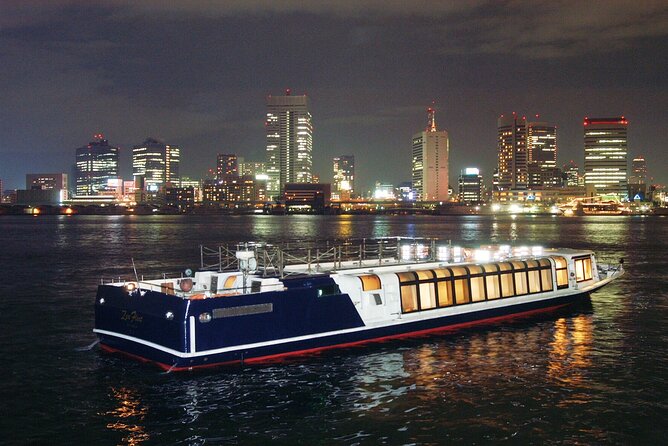
Tokyo looks different from the water. This 90-minute Tokyo Bay cruise gives you a calm way to see famous sights without pushing through crowds or hunting for a clear photo spot. I like the open-air upper deck for skyline pictures, and I like having a warm, air-conditioned cabin below when the evening air turns cool. The main drawback is price: at $65.89 per person, this is not a cheap way to spend an hour and a half.
You board at Tennoz Yamatsu Pier and return to the same place. The route passes Rainbow Bridge, Tokyo Tower, Kachidoki Bridge, Tsukiji, Toyosu, Eitai Bridge, and Odaiba Seaside Park. I would choose the evening sailing for city lights, but remember that an open deck can be chilly, and one visitor wished for blankets and clearer sound from the guide.
In This Review
- Five things to know before you book
- Why seeing Tokyo from the water works
- Leaving Tennoz Yamatsu Pier
- Rainbow Bridge from below
- Tokyo Tower across the bay
- Kachidoki Bridge and Tokyo’s working waterfront
- Eitai Bridge, Tsukiji, and Toyosu
- Odaiba Seaside Park and the cruise’s historical note
- Daylight or night sailing?
- Comfort, crew, drinks, and snacks
- Is $65.89 a fair price?
- Who should book this cruise?
- Practical details before booking
- Should you book it?
- FAQ
- How long is the Tokyo Spectacular View Day-Cruise?
- Where does the cruise begin?
- Where does the cruise finish?
- What sights can I see from the boat?
- Can I sit outside?
- Is there an indoor area?
- Are drinks and snacks included?
- Is there a restroom on the boat?
- Is the cruise suitable for children?
- What happens if bad weather cancels the cruise?
Five things to know before you book
- You pass beneath Rainbow Bridge: The boat gives you a low, unusual view of one of Tokyo’s best-known bridges.
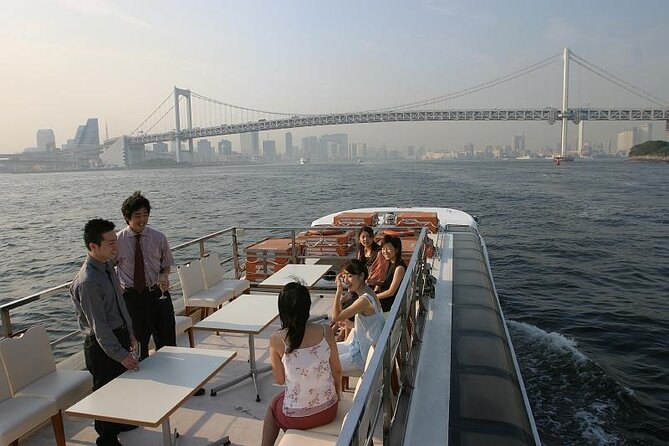
- The open-air deck is the photo spot: You can head upstairs for skyline pictures, then return below for warmth and a table.
- The evening departure has the strongest mood: Tokyo Tower and the waterfront lights give the cruise its most memorable views.
- The boat is limited to 57 people: That is small enough to feel more relaxed than a large sightseeing vessel, though the exact crowd depends on the departure.
- The route mixes modern Tokyo with old river landmarks: Odaiba’s former cannon batteries, Tsukiji, Toyosu, and historic bridges give the ride more substance than a simple skyline loop.
- Alcohol and snacks cost extra: They are available for purchase onboard, but neither is included in the $65.89 fare.
Why seeing Tokyo from the water works
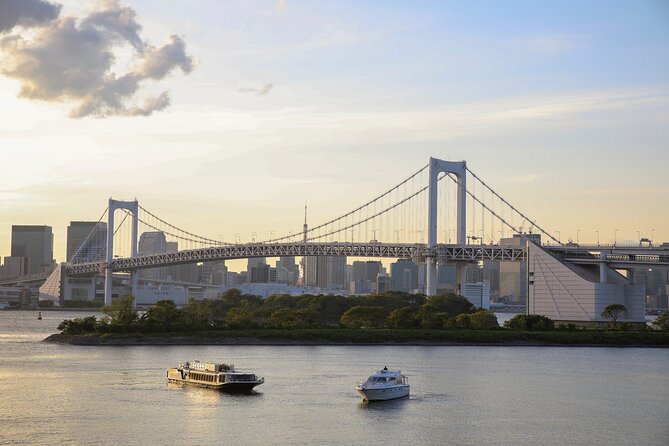
Tokyo can be tiring at street level. You change trains, cross wide roads, squeeze into busy shopping streets, and spend much of the day looking up between buildings. A boat gives you a pause. For 90 minutes, the city moves past you while you sit down and watch.
That change of viewpoint is the real reason to book this cruise. Tokyo Tower appears across the water rather than from a crowded observation platform. Rainbow Bridge becomes something you pass under, not just something you photograph from Odaiba. The waterfront districts also make more sense when you see their bridges, docks, islands, and broad stretches of open water together.
I especially like this format for a first or last night in Tokyo. It does not replace a full sightseeing day, but it gives you a clean visual introduction to the bay. At the end of a long trip, the gentle ride and comfortable seating below can feel like a welcome break.
The boat has an upper deck for unobstructed views and an air-conditioned lower level with tables. That combination matters. You do not have to choose between good photographs and comfort for the whole trip. Go upstairs when the boat approaches a bridge or skyline view, then sit below when you want to listen to the commentary, eat, or warm up.
More Boat Tours in Tokyo
- Mt Fuji & Hakone Cruise, Drum Show Bullet Train 1 Day from Tokyo
★ 4.0 · 7,413 reviews - Tokyo Mt Fuji 5th St & Hakone Cruise Bus Tour w/Bullet Train
★ 4.4 · 5,024 reviews - Tokyo: Meiji Shrine, Asakusa, Skytree Bus Tour and Cruise
★ 4.7 · 1,986 reviews
Leaving Tennoz Yamatsu Pier
The cruise begins at Tennoz Yamatsu Pier, at 1-chōme-39-21 Higashishinagawa in Shinagawa City. The activity ends at the same pier, so you do not need to arrange a second meeting point after the ride.
The mobile ticket makes entry simple, and booking confirmation is provided at the time of booking. The pier is near public transportation, but the supplied information does not give a precise station-to-pier walking time. I would allow extra time to find the boarding point, especially if you are arriving after dark.
The boat carries a maximum of 57 people. That is not a private cruise, but it is also not a huge sightseeing ship. The smaller limit should help keep the ride from feeling chaotic. Still, if having the best upper-deck position matters to you, arrive ready to board rather than cutting the timing close.
A restroom is available onboard. Chairs for children are also available, making the cruise practical for families, although the upper deck may be less comfortable for young children if the weather is cool.
Rainbow Bridge from below
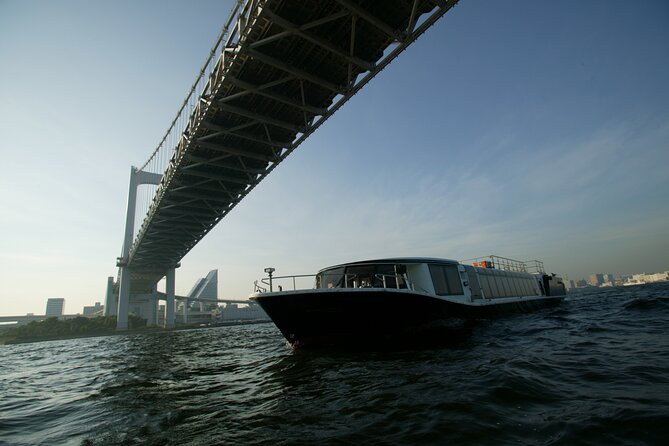
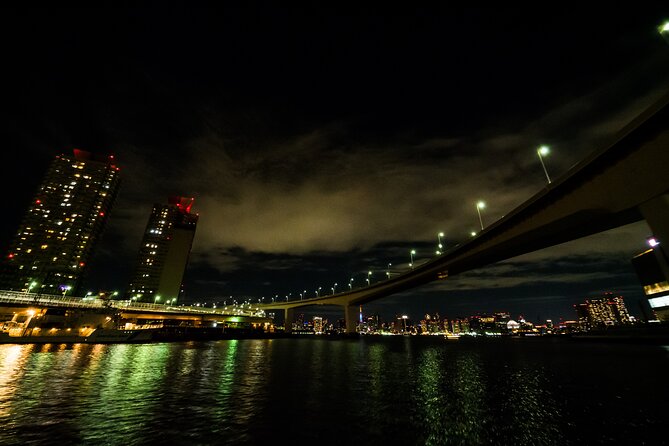
Rainbow Bridge is one of the major highlights. It connects Shibaura and Odaiba and rises about 50 meters above sea level. From the boat, you pass beneath it and see the structure from a low angle that is hard to get from land.
This is a good moment to be on the open deck. Look up as the boat approaches, then turn back toward the span after passing underneath. The bridge’s scale is easier to appreciate from the water, where you can see the full height between the roadway and the bay.
The bridge also gives the cruise a clear sense of place. You are not just looking at Tokyo’s buildings from a distance. You are moving through the infrastructure that links the city’s waterfront districts.
For photographs, keep your phone or camera ready before the boat reaches the bridge. The best angle passes quickly, and glass reflections or cabin lights can interfere with pictures from below. If you are taking a night sailing, bring an extra layer. The upper deck is where you get the cleanest view, but it can be colder than the protected cabin.
Tokyo Tower across the bay
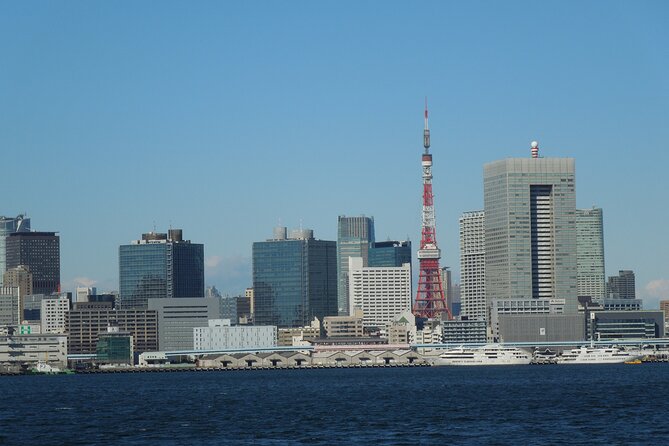
Tokyo Tower is described from the water as a landmark rather than simply another tall building. It was Japan’s largest television tower from 1958 until 2011, and it remains one of the city’s most recognizable sights.
The water-level view changes its character. You are not looking up from the streets around the tower. Instead, you see it set among the city lights, with the bay creating distance between you and the urban core.
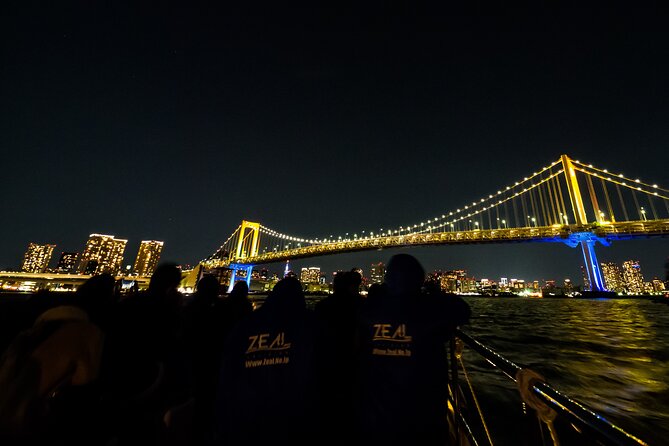
Night departures are especially appealing here. Tokyo Tower is lit after dark, and its colors give the skyline a focal point. One of the strongest reasons to choose this cruise at night is that several attractions become part of one moving view: the tower, bridge lights, waterfront buildings, and their reflections.
The guide provides information about the architecture and history of the sights. Previous passengers praised the crew’s friendly manner and strong English, but one person found that the guide could speak louder or use a microphone. If you are seated below or near other passengers, you may not hear every word clearly.
That is a useful expectation to set. This is a sightseeing cruise with commentary, not a formal lecture. Listen for the broad story of the landmarks, then let the views do most of the work.
A completely different kind of day out in Tokyo:
- Mt Fuji and Hakone 1-Day Bus Tour Return by Bullet Train
★ 5.0 · 26,383 reviews - 1-Day Tokyo Bus Tour
★ 5.0 · 14,250 reviews - Tokyo: TOKYO SKYTREE® Admission ticket
★ 4.5 · 11,192 reviews - Tokyo: teamLab Planets TOKYO Digital Art Museum Entry Ticket
★ 4.6 · 9,779 reviews
Kachidoki Bridge and Tokyo’s working waterfront
The boat passes beneath Kachidoki Bridge, one of the few bascule bridges in Japan. A bascule bridge lifts to let ships pass, and the bridge’s design reflects the days when large vessels used the Sumida River more heavily.
That detail gives the ride a little more depth. Tokyo’s waterfront is not only a postcard of towers and lights. It has long been shaped by shipping, trade, bridges, and market activity.
You may find this section less immediately dramatic than Rainbow Bridge, especially if you are expecting nonstop skyline views. Its value is different. It helps explain why the waterways mattered to Tokyo and why the city’s bridges were built in such distinctive forms.
The route also passes Tsukiji. The district was once Japan’s largest central market, though its wholesale functions later moved to Toyosu because of the aging market buildings. From the boat, you will not get the full food-market experience, but you will see the area from a useful distance.
Do not book this cruise expecting to visit Tsukiji. The boat passes by rather than stopping. Think of it as a geographic introduction that can help you understand the relationship between the old market district and the newer waterfront facilities.
Eitai Bridge, Tsukiji, and Toyosu
Eitai Bridge was built in 1926. Earlier bridge construction in the area used iron for the first time on a road bridge in Japan, but a wooden floor left it vulnerable to fire. The bridge you see today belongs to a later stage in Tokyo’s changing river infrastructure.
These details are brief, but they give the commentary a practical purpose. You learn why bridges were rebuilt and how fire, shipping, and city growth affected their design.
The boat then passes the Toyosu market area, which now serves as the central wholesale market after the move from Tsukiji. Toyosu’s newer building has an unusual shape, and the water offers a broad view of the complex.
This part of the ride may appeal most to visitors interested in how Tokyo functions. You see less of the famous postcard skyline and more of the city’s food distribution and waterfront planning. It is a reminder that the bay is still part of daily urban life, not just a backdrop for sightseeing.
If your main goal is Tokyo Tower and Rainbow Bridge, these sections may feel like connective scenery. If you enjoy cities as working places, they add useful context.
Odaiba Seaside Park and the cruise’s historical note
The route passes through Odaiba Seaside Park. The name comes from daiba, a place where a cannon is placed. At the end of the Edo period, the Tokugawa shogunate built coastal cannon batteries in response to the perceived threat from foreign ships.
Today, Odaiba is known for its modern waterfront setting, but the origin of the name points to a much older defensive role. Seeing the area from the water makes that shift easier to picture. What was once a military position is now part of Tokyo’s leisure and entertainment zone.
The boat does not turn this into a walking tour, so the historical information is necessarily short. Still, the stop rounds out the trip nicely. You get bridges, a broadcasting landmark, former and current markets, and a man-made island with a military past.
This is one reason I would choose the cruise over a simple harbor ride with no commentary. The sights have connections, and the guide helps join them together.
Daylight or night sailing?
The experience offers afternoon and night options. Your choice should depend on what you want from the ride.
An afternoon departure gives you clearer views of bridge structures, buildings, and the waterfront itself. It is the safer choice if you care most about seeing architectural details or taking ordinary daylight photographs.
A night sailing brings more atmosphere. Tokyo Tower is lit, the city lights reflect on the water, and the skyline feels less like a collection of buildings and more like one wide urban scene. The strongest praise for this cruise centers on the evening views, the colors, and the sense of seeing Tokyo from a fresh angle.
Night also brings two small drawbacks. The open deck can be cold, and photos may be harder to capture without blur. Bring a warm layer and do not assume you will spend the entire 90 minutes upstairs.
The latest sailing can sometimes be quiet. One Wednesday evening had only about 10 people onboard, creating an almost private feel. That will not be guaranteed, but it shows that some departures may be notably calm, especially outside the busiest periods.
Comfort, crew, drinks, and snacks
The lower deck has tables and seating, with air conditioning and a restroom. That makes the boat more than a quick ride for standing passengers. You can settle in, keep your belongings nearby, and take a break from Tokyo’s busy streets.
The crew is repeatedly praised for being kind, welcoming, and helpful. The guide also provides information about the buildings and bridges along the route. English commentary is available, though sound quality may vary by seat and crowd.
Alcoholic drinks and light snacks can be bought onboard. They are not part of the ticket price, so plan on paying extra if you want refreshments. I would treat these as optional additions, not a reason to book the cruise. The main product is the view and the commentary.
The facilities have also been described as clean, and the boat runs on time according to the information supplied. Those are modest details, but they matter on a short evening activity. A late departure that returns when promised can fit neatly around dinner or other plans.
Is $65.89 a fair price?
At $65.89 per person, this cruise sits in the paid sightseeing experience category, not the casual ferry ride category. You are paying for the reserved activity, the boarding fee, the boat, the crew, the commentary, and access to both the upper and lower levels.
The value depends on how much you care about seeing Tokyo from the water. If you only want transportation across the bay, the price will feel high. If you want a timed sightseeing experience with a photo deck, a sheltered cabin, a restroom, and a guide, the cost is easier to defend.
A 90-minute duration is also a good fit for a packed Tokyo schedule. You get a substantial change of pace without giving up half a day. I would place it after a day in Shinagawa, Odaiba, or central Tokyo, though the exact route from your plans depends on where you are staying.
The activity has a 4.9 out of 5 rating from 25 ratings, with 100 percent recommending it. The strongest praise goes to the scenery, friendly crew, punctual operation, clean facilities, and relaxed evening mood. The main criticisms are the ticket price, the lack of blankets on the upper deck, and commentary that could be louder.
Who should book this cruise?
You are a good match if you want:
- A gentle way to see several Tokyo landmarks in one outing
- Night views without joining a crowded observation deck
- A short activity that fits into a busy itinerary
- Open-air photography with a warm cabin available
- A family-friendly boat with children’s chairs
- A quieter end to a long Japan trip
You may want to skip it if your budget is tight or if you need close-up visits to each landmark. The cruise passes Tokyo Tower, Tsukiji, Toyosu, and Odaiba, but it does not replace walking through those districts.
I would also think twice if you dislike boats, cold air, or sightseeing commentary that may be hard to hear from some seats. Weather matters here, and poor conditions can lead to a cancellation or a choice between another date and a full refund.
Practical details before booking
The cruise is about 1 hour and 30 minutes and returns to Tennoz Yamatsu Pier. A mobile ticket is accepted, and confirmation arrives at booking.
Free cancellation is available until 24 hours before the start time. Cancellations or changes made inside that period are not refunded or accepted. The cruise requires good weather and a minimum number of passengers, so a cancellation by the operator may result in another date, another experience, or a full refund.
The maximum group size is 57 people. Most people can take part, and the pier is near public transportation. Alcohol and snacks are available for onboard purchase but are not included.
Should you book it?
Book this cruise if you want Tokyo’s bridges and lights to be the main event. The views are the reason to go, especially on a night sailing, and the open deck gives you a much better photo position than a fully enclosed boat.
The $65.89 price is fair only if you value the complete package: a 90-minute route, friendly crew, city commentary, seating below, and a different view of Tokyo than you get on land. Bring a warm layer, board with your camera ready, and choose this as a scenic break rather than a substitute for exploring the neighborhoods themselves.
FAQ
How long is the Tokyo Spectacular View Day-Cruise?
The cruise lasts approximately 1 hour and 30 minutes.
Where does the cruise begin?
It begins at Tennoz Yamatsu Pier, 1-chōme-39-21 Higashishinagawa, Shinagawa City, Tokyo 140-0002, Japan.
Where does the cruise finish?
The cruise returns to Tennoz Yamatsu Pier, the same place where it begins.
What sights can I see from the boat?
The route passes Rainbow Bridge, Tokyo Tower, Kachidoki Bridge, Tsukiji, Eitai Bridge, Toyosu, and Odaiba Seaside Park.
Can I sit outside?
Yes. The boat has an open-air upper deck for scenic photographs and views.
Is there an indoor area?
Yes. The downstairs level is air-conditioned and has tables and chairs.
Are drinks and snacks included?
No. Alcoholic drinks and snacks are available for purchase onboard but are not included in the ticket price.
Is there a restroom on the boat?
Yes. A restroom is available onboard.
Is the cruise suitable for children?
Most travelers can participate, and chairs for children are available onboard.
What happens if bad weather cancels the cruise?
If poor weather causes a cancellation, you will be offered a different date or a full refund.
Just added around Tokyo
- Tokyo Shibuya Walking tour With A Guide★ 4.4 · 22 reviews
- Tokyo’s Authentic and Finest Taiko Drumming Workshop★ 5.0 · 22 reviews
- Tokyo: Visit Sumo Morning Practice with English Guide★ 4.5 · 22 reviews
- Private Tokyo Local Food and Drink Tour with a Bar Hopping Master★ 5.0 · 22 reviews
- Nikko Toshogu, Kegon waterfall, Lake Chuzenji One Day Pvt. Tour★ 5.0 · 22 reviews
- Private Departure Transfer : Central Tokyo City to Haneda Airport★ 4.5 · 22 reviews
- Mt. Fuji and Hakone Private Tour with English Speaking Driver★ 5.0 · 22 reviews
- Private Tour with a Local Guide – Learn about daily life in Japan★ 5.0 · 22 reviews
Cruises & Boat Tours, compared.
Mt Fuji & Hakone Cruise, Drum Show Bullet Train 1 Day from Tokyo
Read our review →
Tokyo Mt Fuji 5th St & Hakone Cruise Bus Tour w/Bullet Train
Read our review →
Mt. Fuji 5th Station & Hakone Cruise 1-Day Bus Tour
Read our review →
Meiji Shrine, Asakusa, Skytree Bus Tour and Cruise
Read our review →
Mt Fuji & Hakone Cruise, Drum Show Bus 1 Day from Tokyo
Read our review →
Dotonbori District River Cruise with Drink Discount
Read our review →
Sumida River: Japanese Traditional Yakatabune Dinner Cruise
Read our review →
Hakone Fuji Day Tour w/ Cruise, Cable Car, Volcano
Read our review →Browse the lists this tour appears in