
Reviewed · CYCLING TOURS
Tokyo downtown bicycle tour Tokyo Backstreets Bike Tour
Tokyo rewards slow looking. This four-hour bike ride trades crowded avenues for quiet neighborhood streets, small shrines, traditional shops, gardens, and everyday scenes around Asakusa and Sumida. I like the personal scale, with no more than six people, and I like that guide Takeshi can adjust the route to match your interests. The main consideration is that this is not a greatest-hits tour focused on Tokyo Tower or Shibuya. It is a relaxed ride through eastern Tokyo, with some famous sights mixed into local areas.
I also like the practical extras: a folding bike, helmet, water, and a traditional sweet from Yamamotoya. The route covers roughly 15 kilometers in about four hours, so you see much more than you could on foot without spending the day underground on trains. Summer heat, rain, and the meeting point deserve attention, though. The tour depends on good weather, and the small office inside a shared workspace can take a moment to find.
In This Review
- Key things to know before you book
- Why cycling works so well in eastern Tokyo
- Starting near Higashimukōjima
- Yamamotoya and the first taste of sakuramochi
- Honryuin Matsuchiyama Shoden and its unusual symbols
- Imado Shrine and beckoning cats
- Traditional crafts in the Taito district
- Sensoji, with the bicycle parked outside
- Kyu Yasuda Garden and the calm between districts
- Ryogoku Kokugikan and Tokyo’s sumo district
- Oyokogawa Water Park and the Skytree view
- Kyojima Minami Park and everyday neighborhood Tokyo
- The guide makes the difference
- Families, older riders, and physical effort
- Is $65.41 a fair price?
- Practical details that affect your decision
- Who should book the Tokyo Backstreets Bike Tour?
- Should you book it?
- FAQ
- How long is the Tokyo Backstreets Bike Tour?
- How much does the tour cost?
- How many people can join the tour?
- Where does the tour start?
- Where does the tour finish?
- Are bicycles and helmets provided?
- What rider heights suit the included bicycles?
- Can I request a tandem bicycle?
- Is water included?
- What happens if bad weather cancels the tour?
Key things to know before you book
- A small six-person group: The limited group size makes it easier to ask questions, take photo stops, and request small changes to the route.
- A real taste of old Tokyo: You visit local shopping streets, neighborhood temples, a traditional sweet shop, and quieter residential areas rather than only famous landmarks.
- A 15-kilometer half-day ride: The route gives you broad coverage of Asakusa, Ryogoku, Sumida, and the area beneath Tokyo Skytree.
- Compact folding bicycles: Bikes have 14 to 20-inch wheels and suit people from 140 to 180 centimeters tall. Tell the operator in advance if you are taller.
- Family-friendly options: Children can ride their own bikes, and a tandem bike may be available if you request it at least three days ahead.
- A flexible guide: Takeshi is praised for a friendly manner, useful explanations, photos, and adapting the outing to individual interests.
Why cycling works so well in eastern Tokyo
Eastern Tokyo is a good place to ride because the experience changes from block to block. One minute you are near a major temple or railway line. A few turns later, you are passing small homes, neighborhood stores, and streets where daily life matters more than sightseeing.
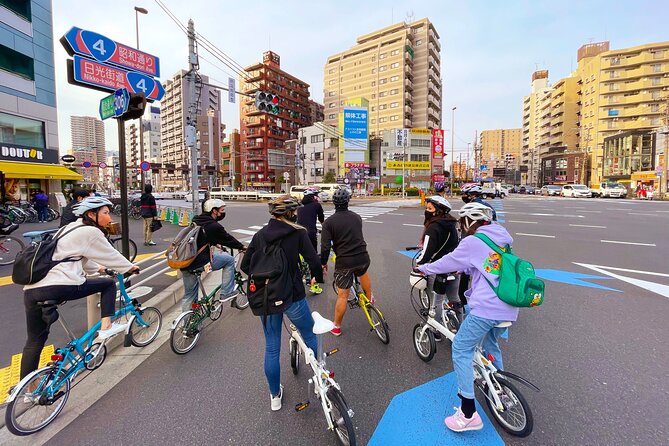
A walking tour would cover some of this ground, but not all of it in half a day. The bike lets you connect Asakusa with Ryogoku, the Sumida area, and Tokyo Skytree without repeatedly returning to a station. You still stop often, so this is sightseeing by bicycle, not a race.
The route is described as easy to follow, and the ride generally uses streets with light traffic. That does not mean you can switch off completely. You are still cycling in Tokyo, so you should be comfortable steering, stopping, and following a guide through changing streets.
The bikes are folding models with small wheels. Those are practical for city riding and storage, though taller riders may find the standard size less natural. If you are over 180 centimeters, contact the operator before booking rather than hoping the regular bike will fit.
More Bike Tours in Tokyo
- Tokyo Guided Small-Group Biking Tour
★ 5.0 · 1,250 reviews - Tokyo Great Cycling Tour
★ 5.0 · 811 reviews - Tokyo Top Highlights 3h Guided E-bike Tour
★ 5.0 · 714 reviews
Starting near Higashimukōjima
The tour begins at Tokyo Backstreets Bike Tour in Sumida City, at 2-chōme 24-14 Higashimukōjima, inside the shared office called Synapse. This is not a grand storefront on a major tourist street, so allow time to identify the office and arrive without rushing.
The starting area places you on the eastern side of Tokyo, close to the neighborhoods that give this tour its character. The activity also ends back at the same meeting point, which makes the outing easy to fit into a day of sightseeing if you plan your return trip carefully.
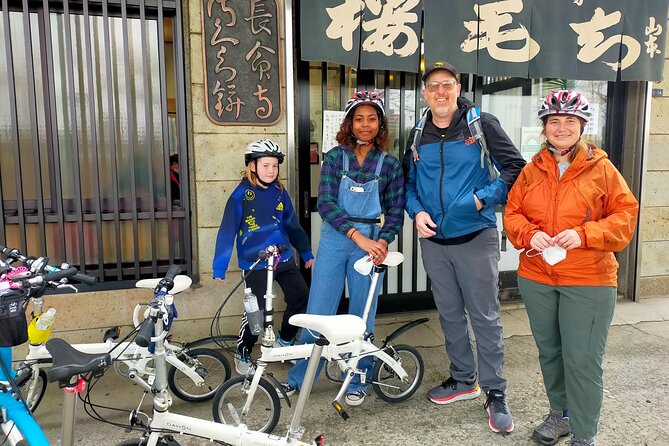
Before setting off, you receive a bicycle and helmet. Helmets are provided but are not mandatory. I would still wear one, especially if you are not used to cycling in city traffic. Water and a snack are also included, with the snack coming from a traditional sweet shop on the route.
Yamamotoya and the first taste of sakuramochi
The first stop is Yamamotoya, associated with Chōmeiji Sakuramochi. The specialty is sakuramochi, a traditional Japanese sweet made with red bean paste and wrapped in a salt-pickled cherry leaf.
This is a fine opening stop because it gives you a small cultural detail before the temples and landmarks begin. The salty cherry leaf balances the sweet bean filling, and the shop is said to have originated this style of sakuramochi.
You only spend about 10 minutes here, so do not expect a full confectionery lesson. Still, the snack makes the tour feel connected to the neighborhood rather than assembled from a standard sightseeing checklist.
Honryuin Matsuchiyama Shoden and its unusual symbols
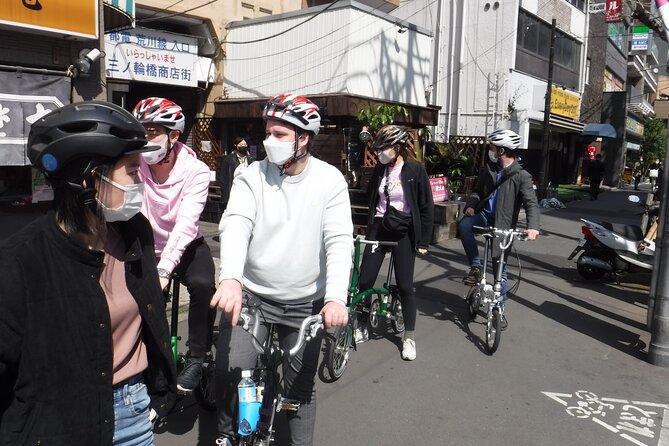
At Honryuin Matsuchiyama Shoden, you pause for about 20 minutes. This temple is part of the Sensoji religious complex and is associated with a foundation date of 595.
The temple’s distinctive symbols are the Japanese radish, or daikon, and a pouch. The daikon represents a mind trapped in ignorance and releasing poison, while the pouch suggests wishes for practical well-being. These details give you something specific to look for instead of simply walking through another temple gate.
This stop also shows the value of a guide. Without an explanation, a collection of radish images might seem puzzling. With context, the decoration becomes a quick lesson in how Japanese religious sites use ordinary objects to express spiritual ideas.
A completely different kind of day out in Tokyo:
- Mt Fuji and Hakone 1-Day Bus Tour Return by Bullet Train
★ 5.0 · 26,383 reviews - 1-Day Tokyo Bus Tour
★ 5.0 · 14,250 reviews - Tokyo: TOKYO SKYTREE® Admission ticket
★ 4.5 · 11,192 reviews - Tokyo: teamLab Planets TOKYO Digital Art Museum Entry Ticket
★ 4.6 · 9,779 reviews
Imado Shrine and beckoning cats
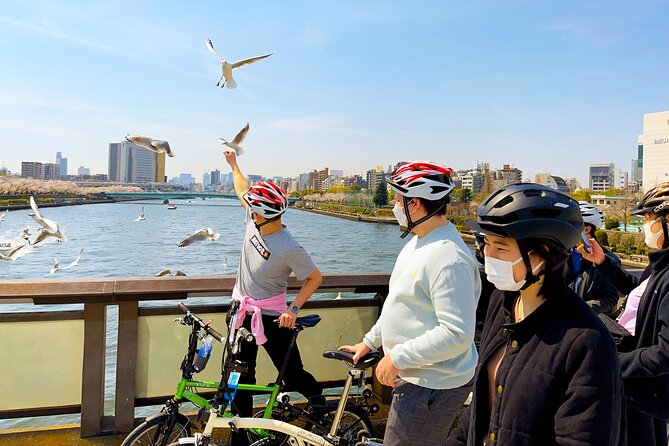
Imado Shrine is another 15-minute stop, founded in 1063 and now known as a place associated with romance, marriage, and good fortune. It is especially linked with beckoning cats, the familiar paw-raised figures seen in shops and homes across Japan.
The shrine is a pleasant counterpoint to the larger Sensoji complex. You get a smaller sacred setting and a chance to hear how local beliefs continue to shape a place today. If you are interested in Japanese symbols, this stop offers more to notice than its short visit suggests.
The route description calls Imado a power spot. Treat that as a cultural idea rather than a promise. The real value is seeing how a shrine becomes meaningful through stories, hopes, and repeated local use.
Traditional crafts in the Taito district
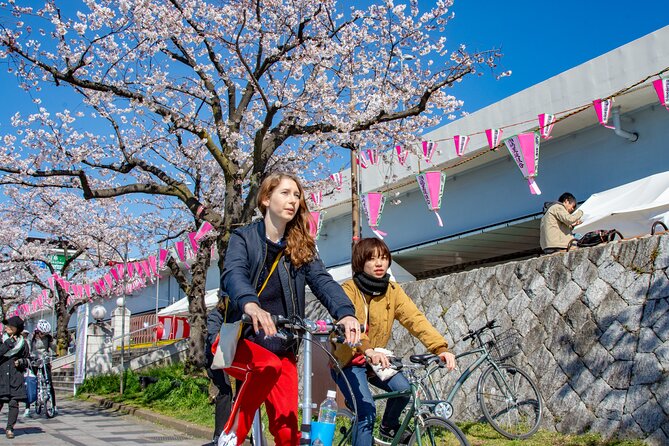
The Edo Taito Traditional Crafts Center takes about 20 minutes. It displays Japanese handicrafts and gives you a look at the patience and skill behind traditional making.
This stop helps balance the religious sites. You are not only looking at old buildings. You are also seeing how craft traditions remain part of the cultural identity of Tokyo’s older districts.
The museum visit is brief, so it works best as an introduction rather than a long workshop. If you want to spend serious time examining each craft, you may wish the schedule allowed longer. On the other hand, the short stop keeps the ride moving and leaves room for the neighborhoods themselves.
Sensoji, with the bicycle parked outside
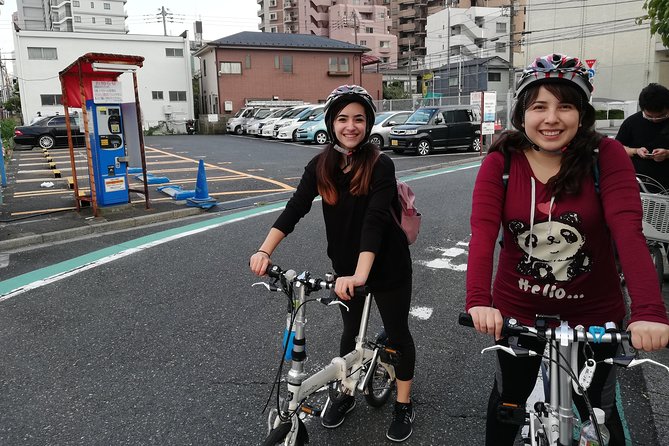
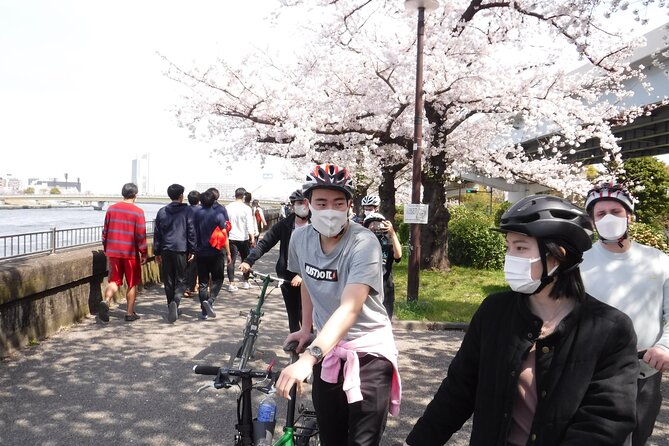
At Sensoji, you cycle in front of the Kaminarimon gate, one of Asakusa’s most recognizable sights. You then leave the bikes and walk inside the temple grounds for about 20 minutes.
This is the tour’s clearest famous landmark. The advantage of arriving by bicycle is that Sensoji appears as part of a larger local route rather than as your entire Asakusa visit. You have already seen smaller religious sites and a traditional sweet shop, so the big gate and temple complex gain some useful context.
Twenty minutes is enough for a focused look, but not enough for every lane and shop around Sensoji. If Sensoji is your main priority, tell Takeshi when you book or at the start. The itinerary can be adjusted, but the tour still needs to return within its half-day schedule.
Kyu Yasuda Garden and the calm between districts
Kyu Yasuda Garden offers about 20 minutes of walking through a Japanese garden built in the 17th century. After the movement of the streets and the crowds around Sensoji, this is a welcome pause.
A garden stop also changes the rhythm of the day. You put the bicycle aside, slow down, and look at the arrangement of water, paths, and plantings. The visit is short, but it gives you a quieter view of Tokyo’s past.
Do not book this tour expecting long, unhurried time at every stop. The strength is variety: sweets, temples, shrines, crafts, a garden, sumo, waterways, a tower, and a shopping district. The tradeoff is that each individual sight receives only a slice of the afternoon.
Ryogoku Kokugikan and Tokyo’s sumo district
The bicycle passes the Ryogoku Kokugikan, Tokyo’s major sumo stadium. You have about five minutes for photographs, depending on the timing of the ride.
This is a quick exterior stop, not a sumo match or stadium tour. It works well as a photo opportunity and as a reminder that Tokyo’s neighborhoods often have a clear cultural identity. Ryogoku is tied closely to sumo, and seeing the stadium helps place that tradition on the city map.
If you want an in-depth introduction to sumo, this tour will not provide it. You get a glimpse from the street and the guide’s explanation, then continue by bike.
Oyokogawa Water Park and the Skytree view
The 30-minute ride through Oyokogawa Water Park is one of the most appealing parts of the route. You cycle toward Tokyo Skytree through a greener corridor and away from the main roads.
This section gives you a feel for the scale of the city. Tokyo is huge, but waterways and parks create breaks between dense districts. On a bicycle, those transitions are easy to appreciate because you move through them at street level.
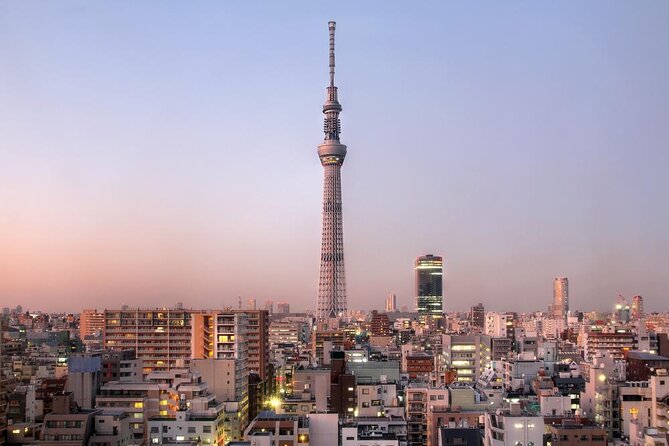
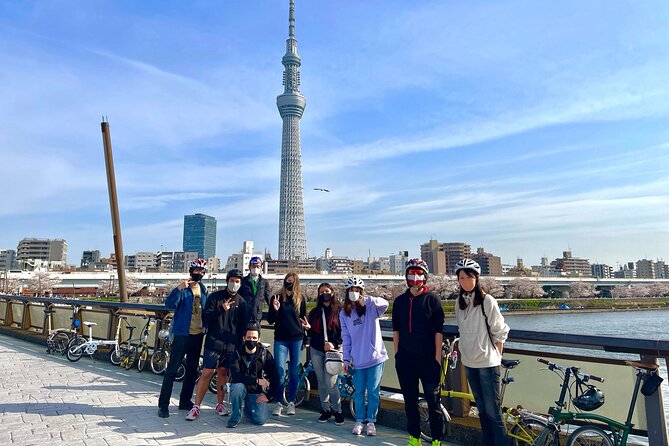
The ride then reaches Tokyo Skytree, where you cycle beneath the tower and stop for about 10 minutes. You are not buying admission to the observation decks. The point here is the ground-level view and the chance to frame the tower from a less typical angle.
Kyojima Minami Park and everyday neighborhood Tokyo
Kyojima Minami Park leads into one of the tour’s most local sections. The area includes old-fashioned shopping malls where you can see ordinary Japanese neighborhood life.
This may be the part you remember best if you have already visited Tokyo’s major sights. The shops and streets are not presented as grand attractions, and that is exactly their value. You get a sense of where people buy things, walk, and go about their day.
The route spends about 30 minutes here, which gives you enough time to look around rather than simply cycle past. Keep your expectations realistic. This is not a polished shopping arcade built for sightseeing. It is a glimpse of a lived-in district.
The guide makes the difference
The guide is a major reason to choose this tour. Takeshi is repeatedly praised for his friendly approach, clear explanations, flexibility, and willingness to take photographs. One review identifies him as Akiyama Takeshi, so you may see either Takeshi or Takashi used in references to the guide.
His role is more than leading the way. He explains the meaning of temple symbols, adds background to the neighborhoods, and responds to what interests you. You may be able to spend more time in one area, visit a craft shop, or adjust the balance between famous sights and backstreets.
That flexibility has limits. The tour remains a group activity unless you happen to book it privately, and one participant expected a private outing but found another person had joined. The maximum group size is six, which still keeps the experience personal without guaranteeing that you will be alone with the guide.
The tour also includes photo help. Takeshi has taken pictures for participants during the ride, a useful touch when you want images of the whole group rather than another solo portrait in front of a temple.
Families, older riders, and physical effort
The route has worked for families with children, including a nine-year-old on a tandem bike and older children riding their own bikes. A family also completed much of the ride before rain forced an early finish.
The ride is described as easy, and older participants have found the streets fairly quiet. Still, four hours in the saddle and roughly 15 kilometers require basic cycling comfort. You should be able to ride steadily, stop when asked, and manage a city bicycle.
The pace is generally relaxed, with stops for temples, gardens, photographs, and snacks. It is a better match for someone who enjoys gentle exercise than for someone seeking a strenuous training ride.
Because helmets are supplied but optional, you can choose your own comfort level. I recommend wearing one, particularly for children and anyone unfamiliar with Japanese road etiquette.
Is $65.41 a fair price?
At $65.41 per person, the tour sits in a reasonable range for a four-hour guided experience in Tokyo. You are paying for the bicycle, helmet, guide, water, snack, route planning, and the ability to cover a large part of eastern Tokyo without navigating it alone.
The value is strongest if you want interpretation and local orientation. You could visit Sensoji, Skytree, and Ryogoku independently, but connecting them with smaller shrines, a garden, crafts, and neighborhood streets takes planning. The guide saves you that work and gives meaning to places that might otherwise pass by.
The price is less compelling if you only want major attractions or prefer to stop for long periods at one museum or temple. Admission tickets are free at the listed stops, but this is not a ticket bundle. The main purchase is access to a guided route and a local perspective.
Group discounts are available, which may improve the value for families or larger booking parties. The tour itself has a maximum of six participants, so even a discounted group should not feel like a large bus outing.
Practical details that affect your decision
The tour lasts approximately four hours and returns to the meeting point. It is near public transportation, though the shared-office location can be a little confusing at first. Read the address carefully and allow extra time.
The standard folding bikes suit riders between 140 and 180 centimeters tall. Notify the operator in advance if you are taller. If you want a tandem bike, request it at least three days before the booked date.
The activity requires good weather. If rain or other poor conditions cancel it, you can choose another date or receive a full refund. You can also cancel for a full refund up to 24 hours before the start time. Cancellations or changes inside that window are not refunded or accepted.
The tour also requires a minimum number of participants. If that minimum is not reached, you will be offered another date or experience, or a full refund.
Who should book the Tokyo Backstreets Bike Tour?
I would choose this ride early in a Tokyo stay if I wanted a quick sense of how the city fits together. It can help you beat jet lag, get exercise, and learn which eastern districts deserve a longer return visit.
It suits couples, families with cycling children, older riders who prefer a gentle pace, and repeat visitors who have already checked off the standard attractions. It is also a good choice if you enjoy taking photos and asking questions as you go.
I would think twice if you dislike bicycles, need a fully private tour, or want long visits at Sensoji, Skytree, or the crafts museum. The route is broad rather than exhaustive, and weather can change the plan.
Should you book it?
Book this tour if you want to see Tokyo at street level and are happy to trade a few famous sights for local streets, small religious sites, traditional sweets, and ordinary shopping districts. The small group, flexible itinerary, comfortable bikes, and friendly guidance from Takeshi give the ride real value.
Skip it if your Tokyo plan is already packed with major attractions or if four hours of cycling sounds tiring. For most reasonably comfortable riders, though, this is a smart half-day way to cover eastern Tokyo and leave with a better feel for the city beyond its postcard views.
FAQ
How long is the Tokyo Backstreets Bike Tour?
The tour lasts approximately four hours.
How much does the tour cost?
The listed price is $65.41 per person.
How many people can join the tour?
The maximum group size is six travelers.
Where does the tour start?
It starts at Tokyo Backstreets Bike Tour Japan, inside the shared office called Synapse at 2-chōme 24-14 Higashimukōjima, Sumida City, Tokyo 131-0032.
Where does the tour finish?
The activity ends back at the original meeting point.
Are bicycles and helmets provided?
Yes. Folding bicycles and helmets are provided. Wearing a helmet is not mandatory.
What rider heights suit the included bicycles?
The folding bikes have 14 to 20-inch wheels and suit people between 140 and 180 centimeters tall. You should inform the operator in advance if you are over 180 centimeters.
Can I request a tandem bicycle?
Yes. You must request a tandem bike at least three days before the booked date.
Is water included?
Yes. Water and a snack from a traditional sweet shop are included.
What happens if bad weather cancels the tour?
You will be offered a different date or a full refund if poor weather causes the cancellation.
Just added around Tokyo
- Tokyo 6hr Instagram Highlights Private Tour with Licensed Guide★ 5.0 · 38 reviews
- Tokyo Small Group Tour with Guide★ 4.5 · 38 reviews
- Tokyo Sumo Experience with Live Show & Audience Challenge★ 5.0 · 38 reviews
- Japanese Food Cooking Class in Asakusa, Tokyo★ 5.0 · 39 reviews
- Very popular in Harajuku♡Animal petting zoo★ 4.6 · 39 reviews
- Ramen Making from Scratch with Tokyo Mom(Vegan Option Available)★ 5.0 · 39 reviews
- Tokyo JDM Night: 600hp C63s AMG Edition 1 (Private)★ 4.9 · 39 reviews
- Tokyo: Kimono Rental inside Shinjuku Gyoen National Garden★ 4.9 · 39 reviews
Cycling Tours, compared.
3h Tokyo E-Bike Tour: Hidden Gems, and Local Life with guide
Read our review →
Arashiyama Bamboo Forest & Hidden Gems Bike Tour (Early Bird)
Read our review →
Hiroshima in a Nutshell: Morning Bike Adventure
Read our review →Browse the lists this tour appears in