Reviewed · TOKYO TOURS
Tokyo Metropolis
Tokyo rewards a camera with a curious eye. This 2.5-hour walk turns Shiodome, Ginza, and Yurakucho into a practical photography classroom, with an expert local photographer showing you how to frame towers, reflections, people, and unexpected city details. I especially like the small maximum of six people and the chance to photograph places many visitors simply pass through. The main consideration is that this is a walking workshop, not a general sightseeing tour, so you should come ready to learn and walk about 1.3 miles.
I also like the route’s useful finish at the Tokyo International Forum, one of Tokyo’s best modern buildings for dramatic interior photographs. Guides such as Stephane and Lukasz have been praised for patient instruction, camera-setting advice, and finding good angles without getting in the way of pedestrians. The non-refundable booking policy is worth noting, and poor weather can cancel the outing.
In This Review
- Key points at a glance
- Tokyo photography with a purpose
- Meeting the guide at Shinbashi’s steam locomotive
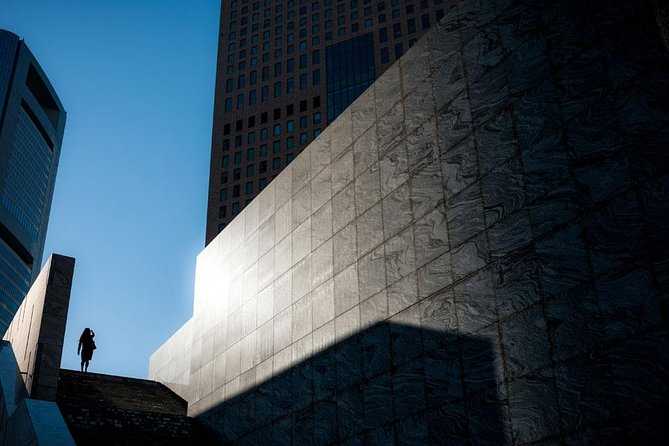
- One hour among Shiodome’s towers
- Ginza’s back lanes and working city
- The Tokyo International Forum’s dramatic interior
- What the teaching is really worth
- Is $158.52 good value for two?
- Who should book this walk?
- Practical preparation for the 2.5-hour route
- Should you book this Tokyo photography workshop?
- FAQ
- How long does the photography workshop last?
- How far does the group walk?
- Where does the experience begin?
- Where does the experience end?
- What time does the workshop start?
- Which Tokyo areas does the route visit?
- Is the tour suitable for beginners?
- How many people can join?
- Is transportation included?
- What happens if bad weather cancels the tour?
Key points at a glance
- Start beside a real steam locomotive: Meet at the SL Square outside Shinbashi Station, an easy-to-identify starting point for the morning walk.
- Study skyscrapers in Shiodome: Spend about an hour working on framing, lines, reflections, and the relationship between buildings and people.
- Find quieter corners of Ginza: The route moves beyond the polished main streets into narrow back lanes and working city scenes.
- Finish inside the Tokyo International Forum: Use its sweeping interior forms for bold, abstract architectural photographs.
- Get personal help with your camera: The group is limited to six, making it easier to ask about composition, timing, and settings.
- Pay by group, not per person: The price is $158.52 for up to two people, which makes the value strongest for a pair.
Tokyo photography with a purpose
Tokyo is easy to photograph badly. Point a camera at a tall building, press the button, and you may get a picture that says very little. This workshop gives you a reason to slow down and ask better questions: Where should the frame begin? What line leads the eye? Can a person, train, sign, or patch of shadow give the building a sense of scale?
That approach makes this experience more useful than a simple walk to attractive places. You are not only collecting views. You are learning how to notice structure, repetition, reflections, negative space, and the small human moments that give a city photograph a story.
The emphasis suits a wide range of ability. If you are new to photography, you can ask basic questions about settings and composition without having to figure everything out alone. If you already use a serious camera, the value is more about fresh ideas, unusual viewpoints, and an experienced eye that can point out possibilities you might miss.
Past participants have singled out guides including Stephane and Lukasz for patient, practical teaching. One guide, Exel, was praised for explaining ideas clearly to two very amateur photographers. That matters because technical advice is only useful when it matches your level.
A few more Tokyo experiences worth weighing up
- Mt Fuji and Hakone 1-Day Bus Tour Return by Bullet Train
★ 5.0 · 26,383 reviews - 1-Day Tokyo Bus Tour
★ 5.0 · 14,250 reviews - Tokyo: TOKYO SKYTREE® Admission ticket
★ 4.5 · 11,192 reviews
Meeting the guide at Shinbashi’s steam locomotive
The experience begins at the steam locomotive in SL Square, outside the west entrance of Shinbashi Station. The meeting point has a memorable landmark, which is helpful in a city where large stations can feel like underground towns.
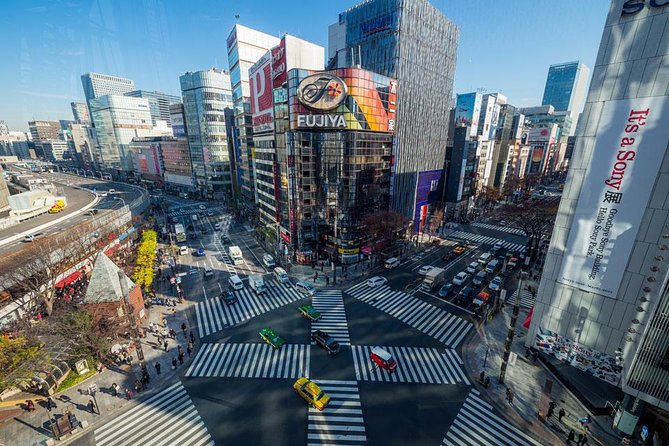
The start time is 10:00 am. From there, the group heads toward Shiodome, a modern business district close to Shinbashi. The walk is not designed around famous temple gates or traditional neighborhoods. Instead, it focuses on Tokyo’s steel, glass, concrete, and moving city life.
This route choice is deliberate. Shiodome gives you large forms and strong vertical lines, while nearby Ginza adds older urban patterns, narrow passages, shopfronts, and people at work. The contrast keeps the workshop from becoming a parade of similar towers.
You should bring the camera you actually plan to use during the rest of your trip. The instruction can cover settings and functions, but carrying unfamiliar equipment may distract you from the visual exercises. The supplied details do not require a particular camera, and the workshop is intended for beginners as well as experienced photographers.
One hour among Shiodome’s towers
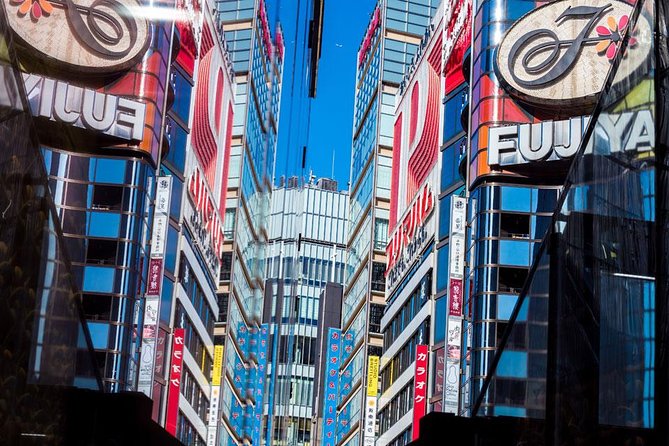
The first stop, Shiodome Siosite, receives about an hour. This is the longest section of the route, and it makes sense: modern towers offer countless variations on the same basic challenge.
Here you work on composition, especially how to frame a scene. A local photographer can help you decide which edges to include, how much sky to leave, and how to use the buildings around you instead of treating each tower as an isolated object.
The instruction also covers visual storytelling. The goal is not simply to record architecture, but to use the surrounding environment and people to show how the city functions. A salaryman crossing the frame, a worker entering a building, or a reflection in glass can change the feeling of an otherwise static image.
The morning light is another useful part of the plan. The route specifically begins by photographing Shiodome’s towers in morning light, when changing brightness can reveal reflections and surface detail. The exact conditions will depend on the day, so you should expect guidance rather than guaranteed effects.
This stop is likely to be most useful if you tend to take conventional postcard photographs. Tall buildings can look flat and repetitive when photographed from eye level. The guide can help you look for patterns, converging lines, reflections, and unusual relationships between foreground and background.
There is a possible drawback. If your idea of Tokyo photography centers on shrines, gardens, or old wooden streets, Shiodome may feel too corporate. This is a workshop about modern city design, not a broad survey of Tokyo’s visual identity.
Ginza’s back lanes and working city
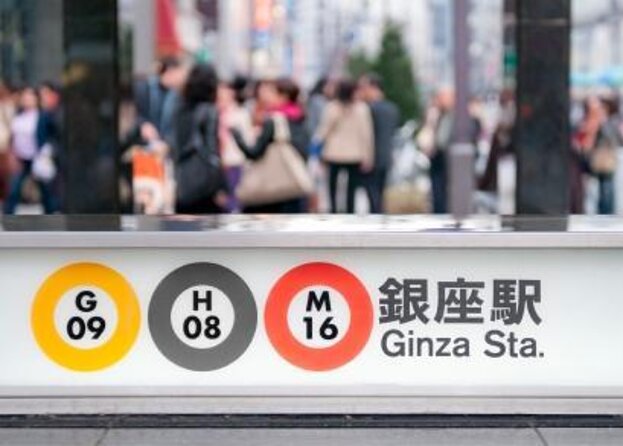
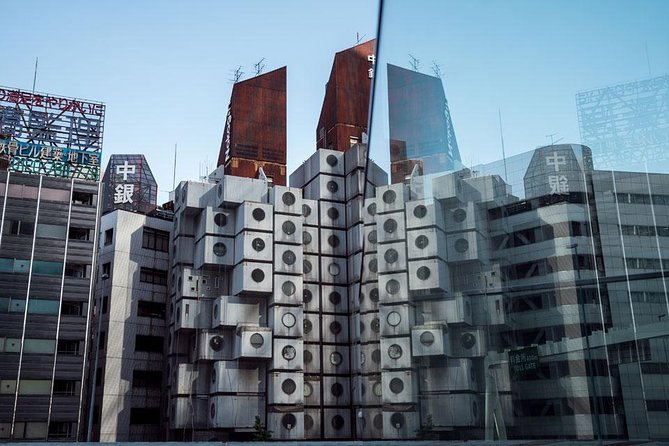
The route then moves into Ginza for about 45 minutes. Ginza is famous for its polished shopping streets, but the workshop focuses on tiny back alleys and less obvious pockets of the district.
That change of scale is important. Large buildings teach you about geometry. Narrow lanes teach you to watch for small details, layered signs, shop entrances, textures, and the way people move through tight spaces. The route can place you near cooks, wait staff, and office workers going about their daily routines.
You are encouraged to photograph the city without treating people as decorations. The supplied description emphasizes using the environment and people to craft a story, so the guide’s advice can help you make a scene feel connected rather than random.
Ginza is also a good place to practice finding order in visual clutter. Tokyo can offer a great deal to fit into one frame, and that can lead to messy pictures. The guide may suggest reducing the number of competing elements, waiting for a person to enter the right spot, or using a line in the street to connect separate parts of the image.
Several participants appreciated advice about lines, patterns, and reflections. Those themes suit Ginza particularly well, since glass, polished surfaces, narrow passages, and repeating architectural forms can create strong graphic pictures.
The 45-minute time limit keeps the walk moving, but it also means you should not expect a long period at every alley. This is a guided exercise through several kinds of city space, not an open-ended photo outing where you can linger at one doorway for an hour.
A completely different kind of day out in Tokyo:
- Tokyo: teamLab Planets TOKYO Digital Art Museum Entry Ticket
★ 4.6 · 9,779 reviews - Mt Fuji & Hakone Cruise, Drum Show Bullet Train 1 Day from Tokyo
★ 4.0 · 7,413 reviews - Tokyo: Sumo Show Experience with Chicken Hot Pot and a Photo
★ 4.8 · 6,678 reviews - Tokyo: Shinjuku Food Tour (13 Dishes at 4 Local Eateries)
★ 5.0 · 6,603 reviews
The Tokyo International Forum’s dramatic interior
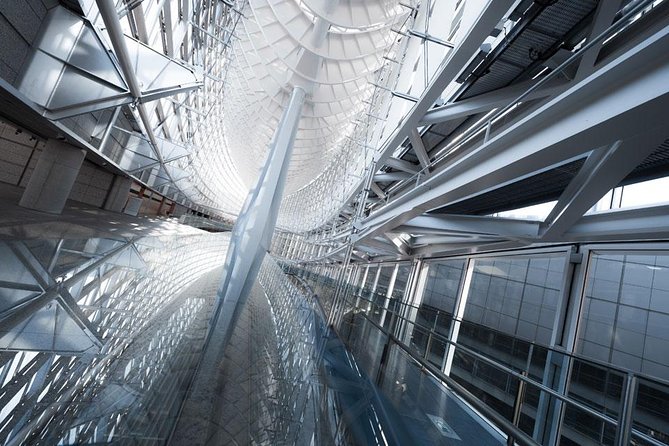
The final stop is the Tokyo International Forum in Yurakucho, where the group spends about 45 minutes. This building is a highlight for anyone interested in architecture. Its immense interior provides sweeping curves, structural lines, open space, and strong changes in scale.
It is an especially good place to apply the lessons from earlier in the morning. You can work with symmetry, repetition, negative space, perspective, and the challenge of making a large interior feel understandable in one frame.
The building also gives you a change from outdoor street photography. After towers and back lanes, the International Forum offers a more controlled setting, though people and movement can still help establish scale. The stop is described as containing numerous photographic challenges, so you should expect to try several compositions rather than simply take one wide picture and leave.
The ending is practical as well as visual. The tour finishes near Yurakucho, and you can easily catch a train to your next destination from there. That makes it simple to continue sightseeing without retracing your steps to Shinbashi.
The listed endpoint is near Anthony Caro’s Barcelona Ballad at 3 Chome-5 Marunouchi. Since the activity is a walking route, check the meeting and ending details carefully before setting out, particularly if you are navigating Tokyo Station or Shinbashi for the first time.
What the teaching is really worth
The professional photography instructor is the main reason to choose this activity. You are paying for a trained eye beside you, not admission to a building or transportation between sights.
The instruction appears to be hands-on. Guides have helped with composition, timing, camera settings, and the use of different functions. They have also checked photographs during the walk and discussed how to capture a mood or story. That kind of immediate correction can save you from repeating the same weak habit for the rest of your trip.
The small group matters here. A limit of six people allows more room for individual questions than a large walking tour. The activity is also private to your own booking according to the supplied details, though the description separately gives a maximum group size of six, so confirm the exact arrangement when booking if you are traveling alone or with a larger party.
This format works especially well for two people with different skill levels. A beginner can ask how to use camera controls, while a more experienced photographer can focus on stronger composition and visual choices.
Guide style may vary. Names associated with the experience include Stephane, Lukasz, and Exel, and the comments about them differ in emphasis: Stephane was praised for artistic vision and detailed answers, Lukasz for finding unusual angles and offering constructive advice, and Exel for patient explanations. You should expect a capable local instructor, but not necessarily a particular guide unless that is confirmed.
Is $158.52 good value for two?
The price is $158.52 per group of up to two people. For a pair, that works out to $79.26 each. For one person, the same group price is less attractive, unless personalized instruction is your main reason for booking.
There are no admission charges for the three listed stops, and the professional photography instructor is included. Bus fare is not included, although the route is walked and the tour ends near rail connections. The real cost covers the guide’s time, technical help, route planning, and access to viewpoints you might not identify on your own.
I think the price is fair for two people who will actively use the instruction. It is less compelling if you only want a guided walk through Ginza and Shiodome, since the route covers public areas and does not include a meal or a major attraction ticket.
The experience is often booked about 16 days ahead. That suggests you should plan it early if it is important to your schedule, especially since the group is small. The cancellation terms are strict: bookings are non-refundable and cannot be changed for any reason. If poor weather cancels the activity, you are offered another date or a full refund.
Because weather affects outdoor photography, consider placing this activity early in your Tokyo stay only if you can accept some scheduling risk. Placing it later gives you more time to watch the forecast, but popular dates may be gone.
Who should book this walk?
I would recommend it to anyone who wants to improve photographs during a Tokyo visit rather than simply collect snapshots. It is particularly well suited to:
- Beginners who want clear help with camera settings and composition.
- Enthusiastic amateurs looking for new ways to photograph architecture.
- Couples or friends who can share the group price.
- People interested in modern Tokyo, geometric forms, and street scenes.
- Photographers who prefer a short focused activity over a full-day excursion.
It may not suit you if you dislike walking, want a history-heavy tour, or mainly hope to photograph traditional Tokyo. The route is about Shiodome, Ginza, Yurakucho, architecture, alleys, and daily city movement.
You should also be comfortable photographing in public places. The guide can help you work respectfully around pedestrians, and one praised feature of Lukasz’s approach was finding interesting spots without obstructing other people.
Practical preparation for the 2.5-hour route
Wear comfortable shoes. The listed walking distance is about 1.3 miles, but the workshop involves stopping, repositioning, looking up, and possibly repeating a shot, so the time on your feet matters more than the distance alone.
Bring your camera, charged batteries, and enough storage. The supplied details do not list equipment requirements, but a workshop about camera settings is more useful when you have a camera with adjustable controls. A phone may still be useful for photography, but the experience is presented as a camera-skills workshop.
Arrive ready for an outdoor activity. The route moves between business districts, alleys, and the International Forum, and it requires good weather. The start is at 10:00 am, with no meal included, so plan breakfast beforehand.
The tour is near public transportation, starts at Shinbashi Station, and ends near Yurakucho. That makes it easy to connect with the rest of your day. The route is compact enough to pair with nearby sightseeing, but do not schedule something requiring you to rush away before the full 2.5 hours are finished.
Should you book this Tokyo photography workshop?
Book it if you want practical instruction, modern architecture, and a small group. The strongest features are the personal feedback, the unusual route through Shiodome and Ginza, and the final session inside the Tokyo International Forum. The activity has earned a 5 rating from 51 reviews, with 100 percent recommending it, and the praise centers on teaching quality, patience, useful camera advice, and fresh angles on Tokyo.
I would be more cautious if you are a solo visitor focused strictly on price, since the $158.52 group rate is better for two. I would also skip it if your priority is traditional scenery or a relaxed sightseeing stroll.
For a pair of photographers, though, this is a smart way to spend a morning. You leave with more than pictures of towers. You gain a method for seeing Tokyo, from the largest glass wall to the smallest alley reflection.
FAQ
How long does the photography workshop last?
The workshop lasts approximately 2.5 hours.
How far does the group walk?
The average walking distance is about 1.3 miles, or 2 kilometers.
Where does the experience begin?
It begins at SL Square, outside the west entrance of Shinbashi Station, beside the steam locomotive.
Where does the experience end?
It ends near Anthony Caro’s Barcelona Ballad in the Marunouchi area, close to the Tokyo International Forum and rail connections.
What time does the workshop start?
The scheduled start time is 10:00 am.
Which Tokyo areas does the route visit?
The route includes Shiodome, Ginza, and Yurakucho. The photography focus includes Shimbashi and Ginza as well.
Is the tour suitable for beginners?
Yes. The workshop is designed for beginners and more advanced photography enthusiasts, with advice on composition, timing, and camera settings.
How many people can join?
The small-group experience is limited to six participants, and it is described as private to your own group.
Is transportation included?
No. Bus fare is not included. The route itself is walked, and the tour ends near public transportation.
What happens if bad weather cancels the tour?
If poor weather causes cancellation, you are offered a different date or a full refund. Normal cancellations and amendments are non-refundable.
Just added around Tokyo
- Tokyo 6hr Instagram Highlights Private Tour with Licensed Guide★ 5.0 · 38 reviews
- Tokyo Small Group Tour with Guide★ 4.5 · 38 reviews
- Tokyo Sumo Experience with Live Show & Audience Challenge★ 5.0 · 38 reviews
- Very popular in Harajuku♡Animal petting zoo★ 4.6 · 39 reviews
- Japanese Food Cooking Class in Asakusa, Tokyo★ 5.0 · 39 reviews
- Ramen Making from Scratch with Tokyo Mom(Vegan Option Available)★ 5.0 · 39 reviews
- Tokyo: Kimono Rental inside Shinjuku Gyoen National Garden★ 4.9 · 39 reviews
- Tokyo JDM Night: 600hp C63s AMG Edition 1 (Private)★ 4.9 · 39 reviews
Tokyo Tours, compared.
Mt Fuji and Hakone 1-Day Bus Tour Return by Bullet Train
Read our review →
teamLab Planets TOKYO Digital Art Museum Entry Ticket
Read our review →
Mt Fuji & Hakone Cruise, Drum Show Bullet Train 1 Day from Tokyo
Read our review →
Shinjuku Food Tour (13 Dishes at 4 Local Eateries)
Read our review →
Tokyo Mt Fuji 5th St & Hakone Cruise Bus Tour w/Bullet Train
Read our review →