Reviewed · TOKYO TOURS
TokyoSumoShow, ChickenHotPot, and Mochi-Pounding by Pro Wrestlers
Sumo gets personal here. SUMOLAND Tokyo Ryogoku turns Japan’s national sport into a lively, family-friendly show with former professional wrestlers, hands-on activities, and a meal served beside the ring. I especially like the close-up performances and the way the program explains basic sumo terms and techniques in accessible English. The main catch is that this is theater, not a tournament or morning practice, and the meal earns mixed marks.
The experience costs $106.12 per person and lasts about 90 minutes to two hours. I like that the schedule keeps you involved with food, demonstrations, mochi pounding, audience challenges, and photo time. The assigned seating is practical but gives you no choice of table, and participation in the most popular activities may be limited or decided by lottery.
In This Review
- Key points to know before booking
- Why SUMOLAND works for a first sumo experience
- Arriving at the Ryogoku sumo district
- Chanko hot pot comes before the main action
- The ring entrance gives the show its first jolt
- Mochi pounding is the most approachable activity
- Sumo demonstrations explain the sport through movement
- The sumo bout challenge puts you in the ring
- Photo time makes the memory feel personal
- Seating, children, and practical comfort
- Is $106.12 a fair price?
- Who should book SUMOLAND?
- Cancellation and booking details
- FAQ
- Where is SUMOLAND Tokyo Ryogoku located?
- How long does the sumo experience last?
- Is the chicken chanko hot pot included?
- Can I request a vegetarian or vegan meal?
- Are children allowed to participate?
- Can I choose my seat?
- Should you book this sumo show?
Key points to know before booking
- Former top-division wrestlers perform live bouts, demonstrations, and comic audience challenges.
- Chicken chanko hot pot is served during the program, with vegetarian and vegan meals available if requested at least two days ahead.
- Mochi pounding is hands-on, and children are welcome to try it.
- The event is designed for English-speaking visitors, with Japanese sumo terms translated and practiced aloud.
- Seat locations are assigned by the venue, with standard and box seating handled differently for children.
- Ryogoku Station is only a short walk away, putting you near Asakusa, Akihabara, Nihonbashi, and Tokyo Skytree.
Why SUMOLAND works for a first sumo experience
Sumo can be hard to follow if you have never watched it. The rules are simple at first glance, but the rituals, winning techniques, rankings, stable system, and formal language take time to understand. SUMOLAND gives you a friendly starting point without asking you to commit to a full tournament day.
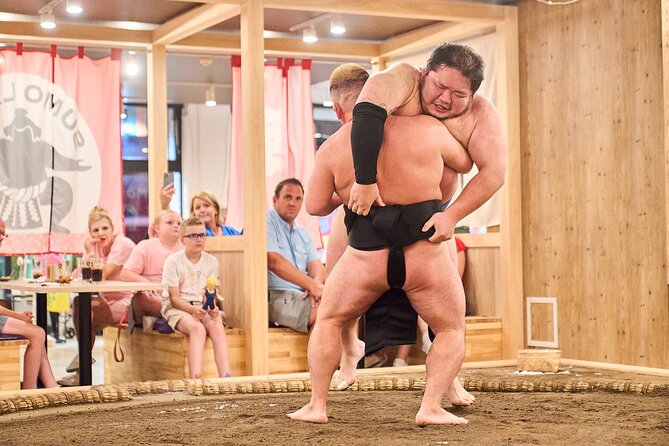
The program is supervised by the 63rd Yokozuna and features former professional sumo wrestlers. That matters. You are not watching actors pretend to wrestle. The men in the ring have real training and experience, and the short bouts show the force, balance, timing, and control that make sumo more than two large bodies pushing forward.
At the same time, you should set your expectations correctly. This is an entertainment program for adults and children. It is not a morning practice session at a stable, and it is not an official Grand Sumo Tournament. If you want the strict ceremony and quiet concentration of professional competition, buy a tournament ticket instead. If you want a clear, cheerful introduction with plenty of audience contact, this format makes far more sense.
The show’s biggest strength is its personality. The wrestlers explain techniques, play to the room, and invite people into the action. Several parts are funny, but the humor works best because the physical skills are genuine.
A few more Tokyo experiences worth weighing up
- Mt Fuji and Hakone 1-Day Bus Tour Return by Bullet Train
★ 5.0 · 26,383 reviews - 1-Day Tokyo Bus Tour
★ 5.0 · 14,250 reviews - Tokyo: TOKYO SKYTREE® Admission ticket
★ 4.5 · 11,192 reviews
Arriving at the Ryogoku sumo district
SUMOLAND Tokyo Ryogoku is at 1F Takashima Ryogoku Mansion, 4-32-19 Ryogoku, Sumida City, Tokyo 130-0026. The venue is on the first floor, a short walk from Ryogoku Station. Look for the large sumo wrestler sign and flags.
Ryogoku is the right setting for this kind of outing. The area around the station is associated with sumo and gives you a chance to pair the show with other Tokyo sights. Asakusa, Akihabara, Nihonbashi, and Tokyo Skytree are all nearby by city transport. You might also arrive early and explore the local park and garden area before your assigned start time.
Arrive a few minutes early. The program begins on time, and you will enjoy it more if you are seated before the first entrance. Since the venue assigns seats, arriving early does not guarantee a better table, but it gives you time to find the entrance, settle in, and understand the room.
The mobile ticket keeps the arrival process simple. Confirmation is sent within 48 hours of booking, subject to availability, so do not treat the reservation as final until you receive that confirmation.
Chanko hot pot comes before the main action
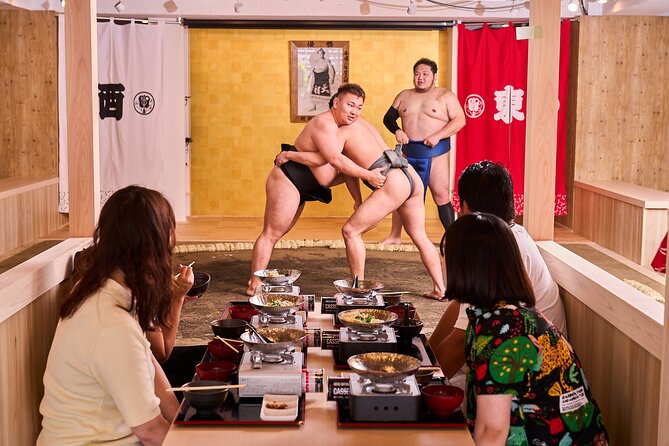
The meal is chicken chanko hot pot, the hearty dish linked with sumo stables. Here, it is specially prepared by sumo wrestlers and supervised by the Isegahama stable. The broth is an important part of the dish, and some diners found it especially good. It is filling without being a heavy restaurant feast, which suits a show where you are also watching demonstrations and joining activities.
The food is best understood as part of the experience rather than the reason to book it. Some people found the hot pot delicious and innovative. Others described the meal as merely fine or just okay. The mochi dessert receives more consistent praise, and the mochi-making section adds fun to the sweet finish.
The format also helps the program flow. You begin with something to eat while the next part is prepared, so you are not left watching staff reset the room. That small detail makes the 90-minute-to-two-hour schedule feel relaxed instead of crammed.
Alcoholic drinks and bottled water are not included. Vegetarian and vegan meals can be arranged if you request them at least two days in advance. Gluten-free and halal meals are not available, though you may bring your own food. If dietary needs matter to your booking, make the request early rather than hoping to solve it at the door.
The ring entrance gives the show its first jolt
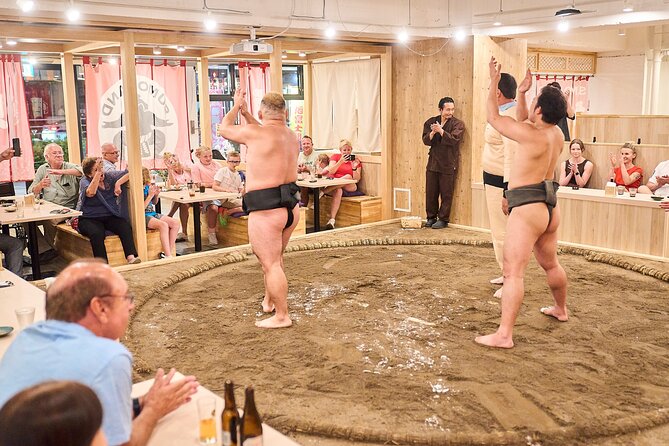
The ring entrance ceremony brings former top-division wrestlers into view with the weight and ceremony you expect from sumo. This is where the room changes from meal venue to performance space.
The wrestlers are close to the audience, so you can see their size, footwork, expressions, and ritual movements without the distance of a large arena. That closeness is one of the strongest reasons to choose this experience. You are not simply watching a screen or a staged explanation from across a room.
A short video or visual presentation may appear between sections. One useful improvement would be more spoken explanation during those transitions, especially about tournament rules and sumo history. You receive a good introduction, but someone hoping for a detailed lesson may want more context.
Still, the show gives you enough information to recognize what happens next. You learn basic Japanese terms, hear the English meaning, and may practice saying them aloud. That language element makes the program more memorable and helps you pay attention during the later demonstrations.
A completely different kind of day out in Tokyo:
- Tokyo: teamLab Planets TOKYO Digital Art Museum Entry Ticket
★ 4.6 · 9,779 reviews - Mt Fuji & Hakone Cruise, Drum Show Bullet Train 1 Day from Tokyo
★ 4.0 · 7,413 reviews - Tokyo: Sumo Show Experience with Chicken Hot Pot and a Photo
★ 4.8 · 6,678 reviews - Tokyo: Shinjuku Food Tour (13 Dishes at 4 Local Eateries)
★ 5.0 · 6,603 reviews
Mochi pounding is the most approachable activity
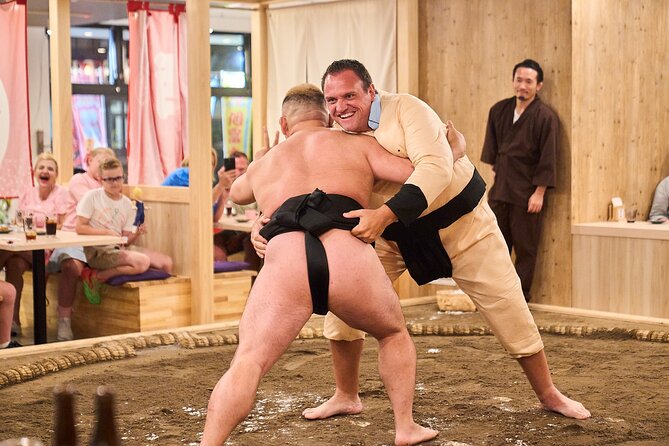
Mochi pounding is a traditional Japanese rice-making activity, and SUMOLAND turns it into a safe group challenge with the wrestlers. Children are welcome, making this one of the easiest parts for younger visitors to enjoy.
The appeal is simple: you do not need to know anything about sumo to take part. You watch the technique, get a chance to swing the mallet, and later taste the finished mochi. The activity also creates good photographs, particularly for families.
Participation may be limited to one person per group if many people want to try. The venue may also use a lottery. That rule applies to the mochi activity and the sumo challenge, so do not promise every child a turn before you arrive.
Even if you do not get selected, watching other people attempt it remains entertaining. The wrestlers make the demonstrations lively, and the audience becomes part of the show rather than a silent crowd.
Sumo demonstrations explain the sport through movement
The wrestlers demonstrate sumo techniques and strategies in a way that is easier to understand than a written explanation. You see how balance, leverage, timing, and foot placement matter. The point is not simply to show a big push. It is to help you notice the skill behind the sport.
This section works especially well for families with older children and teenagers. It gives them something concrete to watch, and it shows why sumo takes serious physical effort. A family with an 11-year-old and teenagers found the program helped them appreciate how difficult sumo really is.
The tone remains light. Wrestlers have room to show personality, and the audience is encouraged to laugh and respond. You get an introduction to sumo culture without the formality that can make a museum talk or sports lecture lose a child’s attention.
The sumo bout challenge puts you in the ring
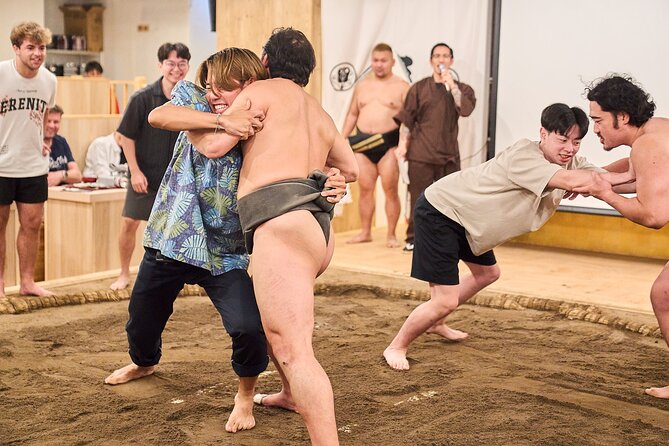
The most memorable part for many people is the chance to face a real sumo wrestler. Children are welcome to participate, and the wrestlers keep the mood playful while showing just how hard it is to move someone with proper sumo technique.
This is not a serious contest in the tournament sense. It is a controlled demonstration and audience activity. You should expect physical comedy, cheering, and a sharp reminder that professional sumo wrestlers are powerful athletes.
If several people want to try, participation can be limited to one person per group or assigned by lottery. That is worth considering when booking for a family. You may want to choose the person most eager to participate rather than assume everyone will get a turn.
Even if you remain at your table, the challenge is fun to watch. The show is arranged so that other people’s attempts become part of the entertainment. It is a smart way to keep the whole room involved without forcing anyone into the ring.
Photo time makes the memory feel personal
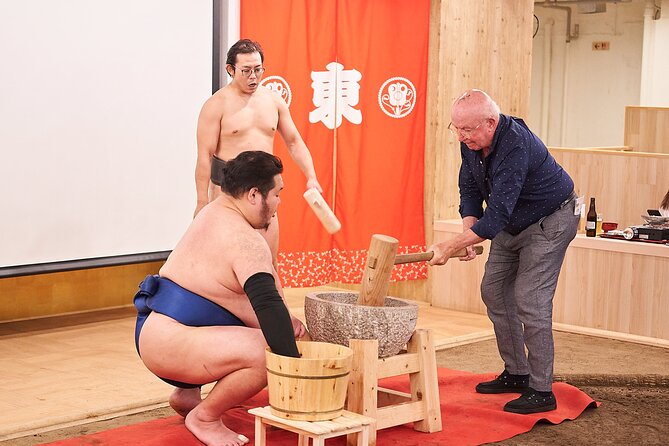
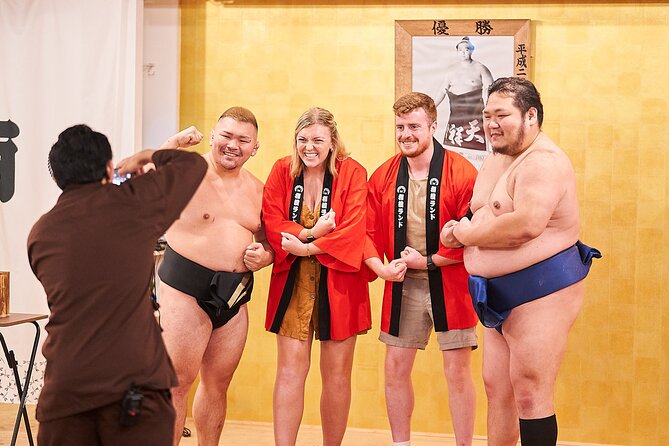
Photo time with the wrestlers is another major strength. The athletes come close to the audience, and the staff works to keep people involved and help with pictures. You get a more personal souvenir than a quick photograph from the back row of a stadium.
This is particularly useful for families and first-time visitors who want a clear memory of their Tokyo outing. The wrestlers are approachable, and their personalities carry through the photo session. The experience feels welcoming rather than stiff.
Souvenirs are included, although the exact item can change by season. Alcohol and bottled water remain separate purchases, so budget a little extra if you want drinks beyond the included meal.
Seating, children, and practical comfort
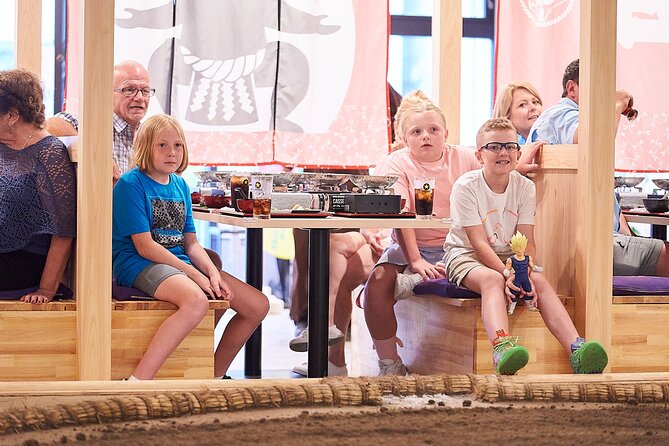
Seat locations are assigned by the venue and cannot be selected. That may disappoint people who want a guaranteed ringside position, but the room is arranged so the show remains visible from the standard seating areas.
Pay close attention to the child seating rule. Standard seats are not considered safe for holding a child on your lap, so reserve a ticket for every person using that section. Box seats can accommodate up to six people and allow a child to sit on an adult’s lap.
The information provided does not give an exact group size, so I would not assume an intimate class or a huge theater crowd. The program is built around shared audience participation, and the assigned seating helps the venue organize that smoothly.
Most people can take part, but the ring activities are optional. You can enjoy the meal, demonstrations, bouts, and photo session without volunteering.
Is $106.12 a fair price?
At $106.12 per person, SUMOLAND is not a cheap meal with a short performance attached. You are paying for a full program, a chicken chanko hot pot, former professional wrestlers, translated instruction, interactive demonstrations, mochi pounding, a possible ring challenge, photos, and a souvenir.
The value is strongest if you want several things in one booking. A sumo tournament offers a more serious sports experience, but it also requires more time, planning, and patience. SUMOLAND gives you direct contact with wrestlers and a clear introduction in less than two hours.
The value is weaker if your main goal is fine dining or formal cultural study. The food is serviceable to good, depending on your taste, but the show is the real attraction. Likewise, the explanations are useful but not exhaustive. You will leave with a better grasp of basic sumo, not a complete education in the sport.
For a family, the price can make sense because children and adults have several ways to participate. For a solo visitor focused on serious sumo, an official tournament may be a better use of money if one fits your schedule.
Who should book SUMOLAND?
I would recommend this most strongly to:
- Families with children or teenagers
- First-time visitors to Japan
- People who want an English-friendly introduction to sumo
- Anyone who enjoys interactive shows and photo opportunities
- Visitors with only a short window for a sumo-related activity
- Couples or friends looking for an unusual Tokyo evening or daytime outing
I would be more cautious if you want a quiet, formal, highly traditional experience. The program openly aims to entertain. The laughter, audience challenges, and showmanship are part of the design, not distractions from it.
Vegetarians and vegans can join with advance notice. People requiring gluten-free or halal food should plan to bring their own meal, since those options are not available. Families should also check the seating arrangement and reserve the exact number of people for standard seats.
Cancellation and booking details
Free cancellation is available if you cancel at least 24 hours before the experience start time. Cancellations within 24 hours are not refunded, and changes inside that window are not accepted. Cut-off times use Tokyo local time.
The ticket is mobile, and confirmation arrives within 48 hours, subject to availability. Since seats are assigned, you should not book expecting to choose a particular table.
FAQ
Where is SUMOLAND Tokyo Ryogoku located?
It is at 1F Takashima Ryogoku Mansion, 4-32-19 Ryogoku, Sumida City, Tokyo 130-0026. The venue is on the first floor, a short walk from Ryogoku Station.
How long does the sumo experience last?
The experience lasts approximately 1 hour 30 minutes to 2 hours.
Is the chicken chanko hot pot included?
Yes. The entrance fee, chicken chanko hot pot meal, and a souvenir are included. Alcoholic beverages and bottled water are not included.
Can I request a vegetarian or vegan meal?
Yes. Vegetarian and vegan meals are available if requested at least two days in advance.
Are children allowed to participate?
Yes. Children are welcome to try the mochi pounding and sumo challenge. If many people want to participate, the venue may limit participation to one person per group or use a lottery.
Can I choose my seat?
No. The venue assigns seat locations, and guests cannot select them. Box seats can hold up to six people and allow a child to sit on an adult’s lap, while standard seats require a reservation for each person.
Should you book this sumo show?
Book it if you want sumo up close, clear explanations, a filling Japanese meal, and plenty of chances to laugh and take pictures. The former wrestlers bring real ability to a program that is easy for children and English-speaking visitors to follow.
Skip it if you want an official tournament, a serious training visit, or a meal that deserves the price on its own. For most first-time Tokyo visitors, though, SUMOLAND offers a practical and memorable introduction to sumo, especially when your family wants to do more than sit and watch.
Just added around Tokyo
- Tokyo Small Group Tour with Guide★ 4.5 · 38 reviews
- Tokyo 6hr Instagram Highlights Private Tour with Licensed Guide★ 5.0 · 38 reviews
- Tokyo Sumo Experience with Live Show & Audience Challenge★ 5.0 · 38 reviews
- Very popular in Harajuku♡Animal petting zoo★ 4.6 · 39 reviews
- Japanese Food Cooking Class in Asakusa, Tokyo★ 5.0 · 39 reviews
- Ramen Making from Scratch with Tokyo Mom(Vegan Option Available)★ 5.0 · 39 reviews
- Tokyo: Kimono Rental inside Shinjuku Gyoen National Garden★ 4.9 · 39 reviews
- Tokyo JDM Night: 600hp C63s AMG Edition 1 (Private)★ 4.9 · 39 reviews
Tokyo Tours, compared.

Mt Fuji and Hakone 1-Day Bus Tour Return by Bullet Train
Read our review →
teamLab Planets TOKYO Digital Art Museum Entry Ticket
Read our review →
Mt Fuji & Hakone Cruise, Drum Show Bullet Train 1 Day from Tokyo
Read our review →
Shinjuku Food Tour (13 Dishes at 4 Local Eateries)
Read our review →
Tokyo Mt Fuji 5th St & Hakone Cruise Bus Tour w/Bullet Train
Read our review →