
Reviewed · FOOD & DRINK
Shinjuku Golden Gai Food Tour
Tokyo gets louder after dark. This three-hour walk through Omoide Yokocho, Kabukicho, and Golden Gai gives you a useful way into Shinjuku’s maze of tiny bars and eateries. I like the mix of food and local context, and I especially like that two drinks are included rather than leaving every little bill to you. The main concern is price: at $217 per person, you are paying for access, guidance, and atmosphere, not a luxury dinner.
The small group, capped at 10 people, is another strong point. Guides such as Sandra, Ray, Wesley, Alex, and Yoshi have earned praise for making the evening social and explaining etiquette, history, and neighborhood life. Still, restaurant seating and food quality can vary, so this suits curious first-time visitors more than serious dining specialists seeking the best sushi in Tokyo.
In This Review
- Key points at a glance
- Starting at 5 p.m. near Shinjuku Station
- Omoide Yokocho and Tokyo after 1950
- Kabukicho, nightlife, and the first dishes
- Hanazono Shrine and a quieter pause
- Golden Gai, where the tour gets personal
- What the $217 price really buys
- Food quality, seating, and changing venues
- Who should choose this Shinjuku night walk?
- Timing, cancellation, and simple planning tips
- Should you book the Golden Gai food tour?
- FAQ
- How long does the Shinjuku Golden Gai Food Tour last?
- What time does the tour begin?
- Where does the tour start?
- Where does the tour end?
- What food is included?
- How many drinks are included?
- Is the tour suitable for vegetarians?
- How large is the group?
- What is the cancellation policy?
Key points at a glance
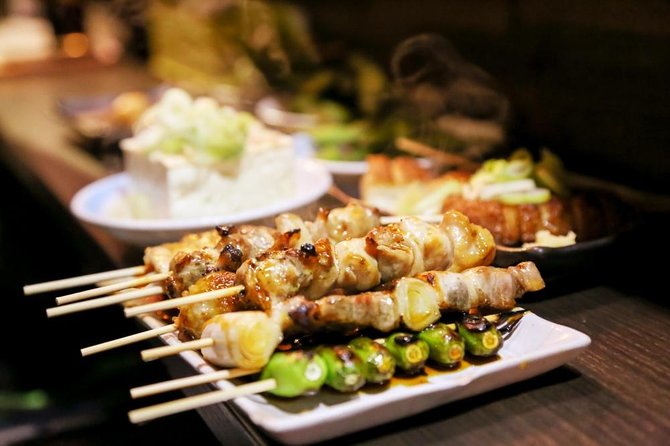
- Four food stops usually cover Japanese favorites such as yakitori, ramen, and sushi.
- Two drinks are included, with the final one enjoyed in or near Golden Gai.
- The route links three famous Shinjuku areas, including Omoide Yokocho, Kabukicho, and Golden Gai.
- Groups are limited to 10 people, which helps the guide manage narrow lanes and small venues.
- Guides add cultural background, from Japanese dining manners to the story of Shinjuku’s nightlife.
- Karaoke may be available afterward, but it is an additional option rather than the core tour.
Starting at 5 p.m. near Shinjuku Station
The tour begins at Tajimaya Coffee, at 1-2-6 Nishishinjuku, Shinjuku City. The meeting time is 5 p.m., a useful hour for catching the district as offices empty and evening life begins.
Give yourself extra time to find the meeting point. Shinjuku Station is famously confusing, and one guide waited for a delayed group that had trouble reaching the start. Your mobile ticket is convenient, but it does not replace a careful look at the address and map before you set out.
The opening five minutes are mainly a greeting and introduction. This is where your guide sets the tone for the evening. The strongest guides have been praised for bringing people together quickly, explaining the plan clearly, and making the group feel relaxed before entering the tighter streets.
Because the tour uses public streets and small restaurants, it helps to arrive ready to walk and stand. The stated fitness level is moderate. Comfortable shoes are a smart choice, especially if you want to continue exploring after the formal tour ends.
More Food Tours in Tokyo
- Tokyo: Shinjuku Food Tour (13 Dishes at 4 Local Eateries)
★ 5.0 · 6,603 reviews - Tokyo Tsukiji Fish Market Food and Culture Walking Tour
★ 5.0 · 3,184 reviews - Tokyo: Shinjuku Food Tour (15 Dishes and 4 Eateries)
★ 4.9 · 2,033 reviews
Omoide Yokocho and Tokyo after 1950
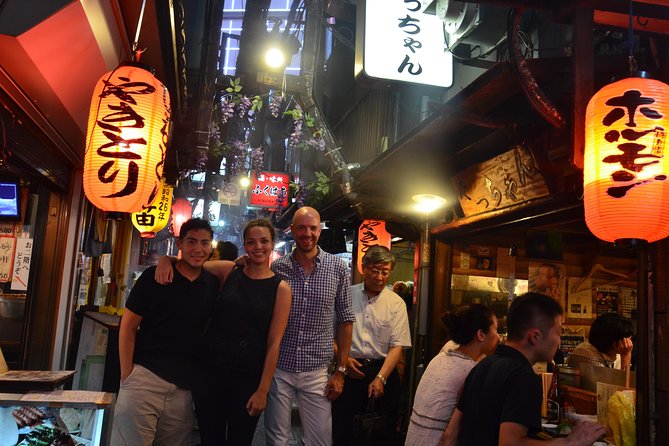
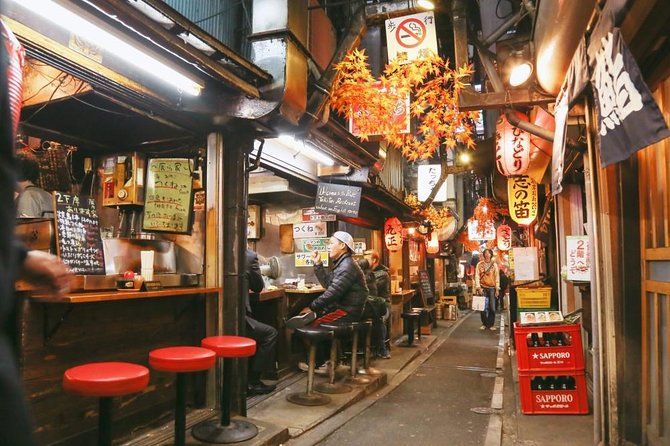
The first major stop is Omoide Yokocho, whose name means Memory Lane. Its narrow passageways and compact eateries offer a sharp contrast to the wide roads and giant signs around Shinjuku Station.
The area is linked with postwar Tokyo, and the tour points out bars that have remained largely unchanged since 1950. That detail gives the walk more weight than a simple restaurant crawl. You are not only stopping for food. You are seeing how a small entertainment quarter survived beside one of the world’s biggest railway hubs.
This is a quick stop on the published route, listed at about five minutes, but the value comes from the guide’s explanation and the chance to see the setting before sitting down to eat. Space is tight. Restaurants here are not designed for large tour groups, so expect close quarters and a fast-moving visit.
Omoide Yokocho is particularly useful at the beginning of your Tokyo stay. A guide can explain how to approach tiny eateries, how ordering works, and how Japanese dining manners differ from those at home. Ray was praised for explaining etiquette in a fun, practical way, while other guides have added food and neighborhood details that made the area easier to understand.
Kabukicho, nightlife, and the first dishes
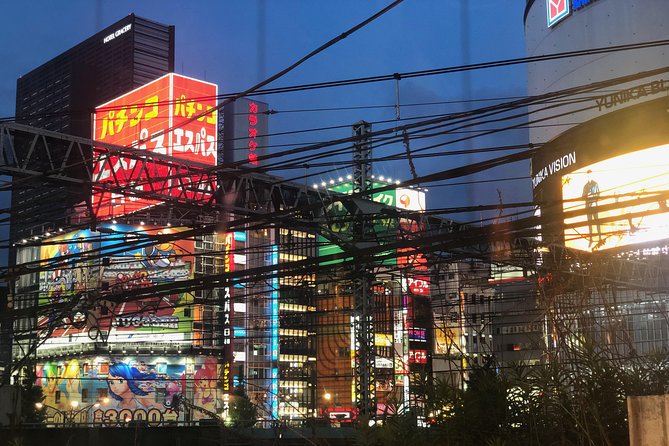
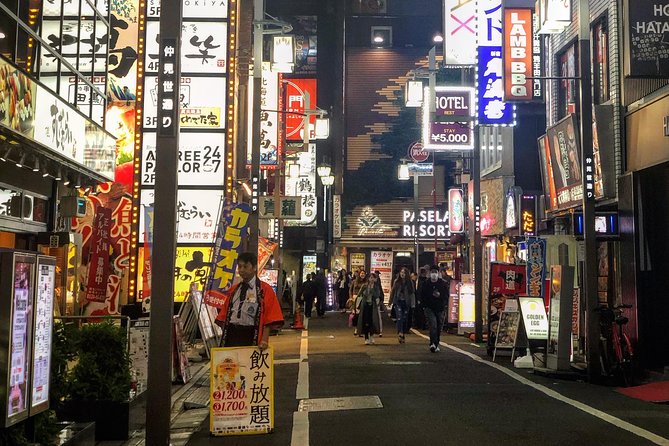
The route continues into Kabukicho, known for its nightlife and entertainment businesses. The tour describes it as Asia’s largest and safest red-light district, though the atmosphere is still busy, flashy, and more adult-oriented than many other parts of Tokyo.
You will walk through streets filled with signs, narrow entrances, bars, restaurants, and late-night businesses. The guide’s role matters here. Without help, it is easy to see Kabukicho as a wall of neon and miss the social rules and local background behind it.
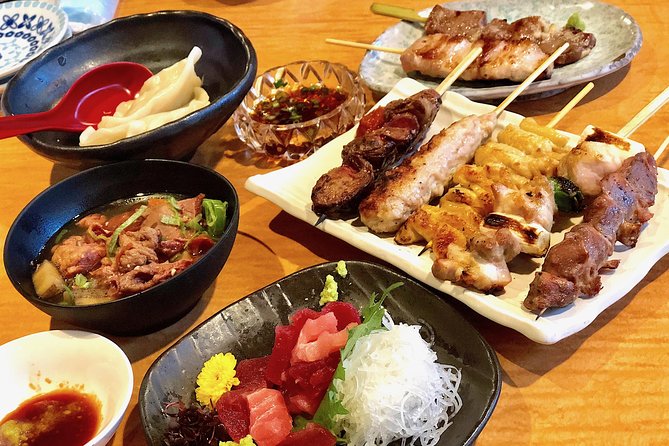
The food portion is spread across four stops. Depending on restaurant schedules, holidays, weather, or other conditions, the exact venues can change. The advertised examples include yakitori, ramen, and sushi, and the evening is intended to give you a broad sample rather than one long meal at a single restaurant.
Yakitori is usually a natural fit for this part of Shinjuku. These grilled skewers are easy to share and let you try several small bites. The quality can be uneven, however. One unhappy participant found the chicken dry and under-seasoned, while others described the food as delicious and praised the range of dishes.
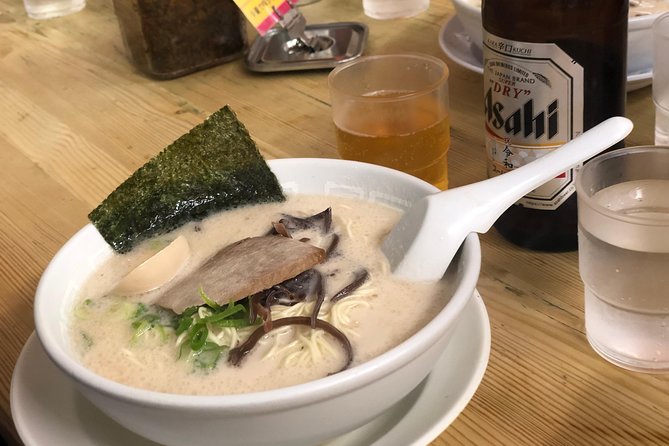
Ramen is often the safest bet for a satisfying meal. Several people singled it out as a highlight, with one calling it the best ramen of the trip. The tour may not always provide a long technical explanation of the broth or regional style, so ask your guide what you are eating. That simple question can turn a good bowl into a more useful food lesson.
Sushi may also appear in the rotation. Some groups loved the sashimi stop, while another found the sushi disappointing. That contrast is important. This is a neighborhood tasting tour with changing restaurant choices, not a reservation at a top-end sushi counter.
Hanazono Shrine and a quieter pause
Hanazono Shrine appears along the route between the entertainment streets. Its presence adds a welcome change of pace.
After the noise and bright signs of Kabukicho, a shrine stop lets you see another side of Shinjuku. The tour information does not promise a long visit or a formal ceremony, so think of it as a short cultural pause rather than a full shrine tour.
This is one place where your guide can add real value. Japanese religious customs can be confusing to first-time visitors, particularly because Shinto and Buddhist practices often appear side by side in daily life. Ask questions if the guide brings up local customs. The better guides use the stop to explain everyday culture instead of giving only a quick photo opportunity.
A completely different kind of day out in Tokyo:
- Mt Fuji and Hakone 1-Day Bus Tour Return by Bullet Train
★ 5.0 · 26,383 reviews - 1-Day Tokyo Bus Tour
★ 5.0 · 14,250 reviews - Tokyo: TOKYO SKYTREE® Admission ticket
★ 4.5 · 11,192 reviews - Tokyo: teamLab Planets TOKYO Digital Art Museum Entry Ticket
★ 4.6 · 9,779 reviews
Golden Gai, where the tour gets personal
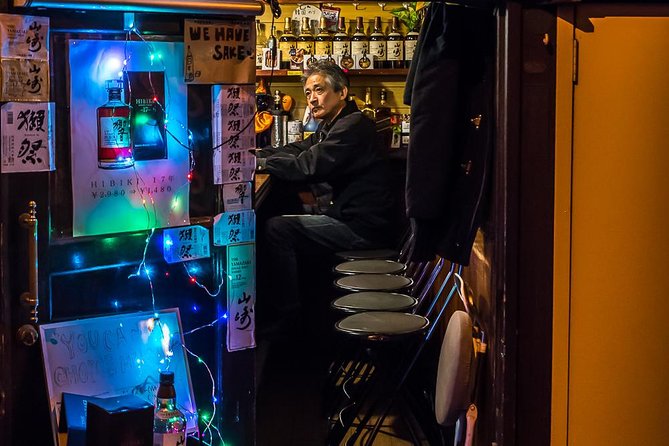
The final neighborhood is Shinjuku Golden Gai, a compact nightlife quarter with more than 200 small pubs, stalls, and karaoke bars. Its venues are packed closely together, often up narrow lanes and stairways, creating an experience that feels very different from a standard Tokyo night out.
Golden Gai is not a place I would want to approach with a large group or a rigid plan. Tiny bars may have only a handful of seats, and some are aimed at regular customers. A guide gives you confidence and helps you understand the setting without wasting your evening wandering past doors that are hard to interpret.
The tour ends at Araku Bar in the Golden Gai area. One included drink is enjoyed here, and the atmosphere may become the most social part of the evening. Several guides, including Sandra and Osmar, were praised for making the final bar stop fun and bringing the group together. Karaoke has also been a highlight for some groups, but the after-party is an optional add-on, not something to assume is included in the $217 price.
You can continue exploring Golden Gai after the tour. That is a real advantage. The guide gives you an introduction, then you can decide if you want another drink, more food, or a return visit on your own.
What the $217 price really buys
At $217 per person, this is an expensive food walk by Tokyo standards. The included package covers a local English-speaking guide, four food stops, and two drinks. It does not cover hotel pickup, transportation, or food and drink outside the specified tastings.
I would not book this expecting $217 worth of restaurant food alone. You could spend less by choosing your own ramen shop, yakitori counter, and bar. The price makes more sense if you value a small group, a guide who can explain the area, and a smoother first encounter with places that can feel intimidating.
The value also depends heavily on your guide. Sandra has been praised for arranging suitable food for a gluten-free vegetarian participant. Ray received strong praise for food explanations and etiquette. Wesley, Alex, Yoshi, Giulia, Tommy, and Osmar were also singled out for warmth, humor, cultural background, or group management.
That range of guide styles means the evening can feel personal and lively. It also means you should keep your expectations flexible. A guide can improve the experience, but cannot guarantee that every restaurant will be your favorite.
Food quality, seating, and changing venues
The tour’s biggest practical weakness is inconsistency. The exact restaurants can change because of restaurant schedules, public holidays, weather, and other unforeseen issues. Substitutions are made when needed, but the replacement may not match your original hopes.
Seating also deserves attention. One group encountered venues that could not fit them, followed by a final location with standing room only. In narrow Golden Gai bars, this is not surprising, but it is frustrating at this price.
The tour works best when you see it as a progressive tasting walk. You will try several foods in smaller portions, move through different parts of Shinjuku, and finish with a drink. It is less suitable if you want a carefully planned multi-course dinner with guaranteed seats and high-end ingredients.
Do not eat a large meal beforehand. The route can include a lot of food, and several people found the portions generous enough to make the three hours feel substantial. If you have dietary restrictions, state them when booking and remind the guide at the start. Pescetarian and vegetarian diets are supported, and the experience has accommodated gluten-free vegetarian needs in at least one case, but restaurant substitutions may still be necessary.
Who should choose this Shinjuku night walk?
I would recommend it most strongly to first-time visitors who want help entering Shinjuku’s nightlife without spending an hour guessing which door to open. It is also a good fit for solo visitors and couples who enjoy meeting a small group over food and drinks.
The tour suits you if you want:
- A guided introduction to Golden Gai and Kabukicho
- Several Japanese dishes in one evening
- Food explanations mixed with local stories
- A small group rather than a large bus tour
- A social final stop with the option of karaoke
- A planned evening soon after arriving in Tokyo
I would think twice if your main goal is elite sushi, rare regional cuisine, or detailed culinary instruction at every stop. One person felt the food did not justify the price, and that criticism is fair for diners who measure value mainly by ingredient quality.
The adults-only rule also matters. All participants must be at least 20 years old. The tour is near public transportation, but hotel pickup and drop-off are not provided, and you will need to reach the meeting point yourself.
Timing, cancellation, and simple planning tips
The experience lasts about three hours and starts at 5 p.m. That timing lets you see the transition from evening dining into nightlife. It also leaves you plenty of time to continue around Shinjuku afterward.
The maximum group size is 10 people. That is small enough to hear the guide in noisy streets, though the narrow venues can still make conversation difficult. One guide, Sandra, made a point of checking that everyone could hear, a useful habit in crowded areas.
Free cancellation is available up to 24 hours before the local start time for a full refund. Changes made inside that window are not accepted, and late cancellations are not refunded. The tour needs good weather and a minimum number of participants. If the operator cancels for either reason, you are offered another date or experience, or a full refund.
Should you book the Golden Gai food tour?
Book it if you want a guided first look at Shinjuku’s back streets, you enjoy trying several foods in one night, and you are willing to pay for local guidance and convenience. The strongest part is the combination of neighborhood context, small-group conversation, and access to places you might not confidently choose on your own.
Skip it if $217 feels too high for a casual dinner, or if you want guaranteed seating and consistently outstanding food. For the best chance of a good fit, take it early in your Tokyo stay, arrive early at Tajimaya Coffee, come hungry, and tell the guide about dietary needs before the first stop.
For curious eaters, the experience can be one of the most memorable introductions to Shinjuku. Just treat it as a guided night out with food, not as a premium tasting menu.
FAQ
How long does the Shinjuku Golden Gai Food Tour last?
The tour lasts approximately three hours.
What time does the tour begin?
The tour starts at 5 p.m.
Where does the tour start?
The meeting point is Tajimaya Coffee at 1-2-6 Nishishinjuku, Shinjuku City, Tokyo 160-0023.
Where does the tour end?
The tour ends at Araku Bar in the Golden Gai area of Kabukicho.
What food is included?
The tour includes four food stops. Possible dishes include yakitori, ramen, sushi, and other local or seasonal foods.
How many drinks are included?
Two drinks are included in the tour.
Is the tour suitable for vegetarians?
The experience is listed as pescetarian and vegetarian friendly. Dietary needs should be provided when booking.
How large is the group?
The tour has a maximum of 10 participants.
What is the cancellation policy?
You can cancel up to 24 hours before the start time for a full refund. Cancellations or changes made less than 24 hours before the start are not accepted for a refund.
Just added around Tokyo
- Tokyo 6hr Instagram Highlights Private Tour with Licensed Guide★ 5.0 · 38 reviews
- Tokyo Small Group Tour with Guide★ 4.5 · 38 reviews
- Tokyo Sumo Experience with Live Show & Audience Challenge★ 5.0 · 38 reviews
- Japanese Food Cooking Class in Asakusa, Tokyo★ 5.0 · 39 reviews
- Very popular in Harajuku♡Animal petting zoo★ 4.6 · 39 reviews
- Ramen Making from Scratch with Tokyo Mom(Vegan Option Available)★ 5.0 · 39 reviews
- Tokyo JDM Night: 600hp C63s AMG Edition 1 (Private)★ 4.9 · 39 reviews
- Tokyo: Kimono Rental inside Shinjuku Gyoen National Garden★ 4.9 · 39 reviews
Food & Drink, compared.
Shinjuku Food Tour (13 Dishes at 4 Local Eateries)
Read our review →
Tokyo Tsukiji Fish Market Food and Culture Walking Tour
Read our review →
Shinsekai Food Tour with 13-15 Dishes at 5 Eateries
Read our review →
Osaka Food Tour: 13 Dishes at 5 Local Eateries
Read our review →
Shinjuku Food Tour (15 Dishes and 4 Eateries)
Read our review →
Best of Shinjuku: Izakaya Food Tour (4 Stops, 14+ Tastings)
Read our review →
Kyoto Night Foodie Tour in Gion (9+ dishes + 6 Sake tastings)
Read our review →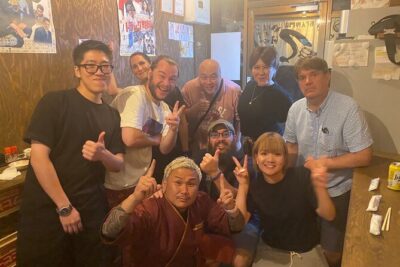
Hungry Osaka Street Food Tour:15 Tastings & 3 Drinks with a Local
Read our review →Browse the lists this tour appears in