
Reviewed · JAPANESE CALLIGRAPHY CLASSES
Tokyo: Calligraphy Workshop & Original T-Shirt Creation
Ink, brush, and a little quiet await. In Shinjuku, this two-hour class turns Japanese calligraphy into a hands-on souvenir, not just a demonstration. I like the traditional ink-making ritual and the patient English guidance, especially for first-timers. The main catch is simple: the T-shirt costs extra, and calligraphy is harder than it looks.
You begin in traditional workwear, learn basic brush control, and turn your name into kanji with help from a professional teacher. I also like that children can join and that you take home artwork even if you skip the shirt. Your finished lettering may look charmingly wonky, which is part of the fun, but perfectionists should prepare to practice.
In This Review
- Key points to know before you book
- Why this Shinjuku workshop feels different
- Meeting the guide near Okubo Station
- Changing into workwear and preparing the ink
- Learning brush control before the final piece
- Choosing kanji for your name
- Paper artwork or an original T-shirt
- Is two hours enough?
- What the $30 price includes
- Who should book this calligraphy class?
- Should you book it?
- FAQ
- How long does the Tokyo calligraphy workshop last?
- Where is the meeting point?
- How do I identify the guide?
- Is the workshop taught in English?
- What is included in the price?
- Is the T-shirt included?
- Can children join the activity?
- Can I cancel my booking?
Key points to know before you book
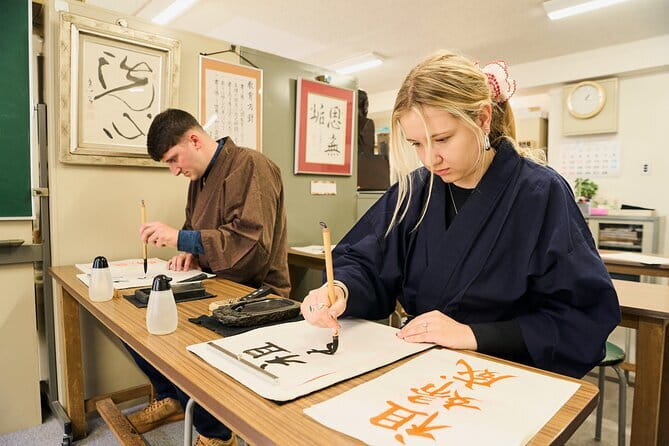
- Make ink the traditional way: Grind a solid inkstick with water before you write, creating a calm and surprisingly absorbing start.
- Turn your name into kanji: The instructor helps you choose characters and explains their meanings, giving your souvenir a personal connection.
- Learn from a real calligrapher: The class includes brush order, stroke technique, character placement, and feedback from a professional teacher.
- Choose your final souvenir: Take home paper artwork, or place your kanji directly on an original T-shirt for an added cost.
- Small English-led group: With no more than 10 participants and an English guide, you get help without the feel of a large tour.
- Meet near Okubo Station: Find the guide at the FamilyMart Okubo Station South Exit Store, holding a Local Guide Stars sign.
Why this Shinjuku workshop feels different
Tokyo offers plenty of quick cultural activities, but this one asks you to slow down. You are not simply watching a calligrapher produce a beautiful character while you take photos. You handle the tools, prepare the ink, make mistakes, and try again.
That change matters. Japanese calligraphy, or shodo, depends on brush pressure, stroke order, spacing, and rhythm. Even a simple character can look unbalanced if your brush starts too heavily or lifts at the wrong point. The class gives you a short, friendly introduction to those rules without expecting you to become an expert in two hours.
The experience also has a useful personal touch. Your name is transformed into kanji, with characters chosen for their sound and meaning. Guides and teachers have helped participants select characters connected to ideas such as strength, peace, beauty, or other qualities. You are not just copying random symbols. You get a small lesson in how Japanese names and meanings can work.
At 4.9 out of 5 from 105 ratings, the experience has a very strong record. The most consistent praise goes to the calm atmosphere, kind instruction, and English translation. Guides named Hiromi, Nono, Aki, Naoto, Erico, Frankie, and others have been singled out for patient help, though the specific guide and instructor can vary by date.
More Calligraphy Classes in Tokyo
- Tokyo: Calligraphy on Kanji Fan & Scroll with Drink
★ 5.0 · 210 reviews - Let’s experience calligraphy in YANAKA, Taito-ku, TOKYO !!
★ 5.0 · 127 reviews - Experience all of Japanese culture and Japanese food experience classes “origami, udon, Japanese food, green tea, calligraphy” in 4 hours
★ 5.0 · 105 reviews
Meeting the guide near Okubo Station
Your meeting point is the FamilyMart Okubo Station South Exit Store at 1-23-21 Hyakunincho, Shinjuku-ku. A guide holds a Local Guide Stars sign, which should make the rendezvous easier to spot near the busy station area.
Build in a little time to locate the correct station exit and shop. The address is specific, but Shinjuku can be confusing when you are moving between nearby railway stations and crowded streets. Have the map link available before you leave your hotel, and do not assume that every Shinjuku station entrance puts you in the same place.
The location is practical for a short cultural stop in western Shinjuku. You can pair the workshop with other activities in the district, but do not schedule it so tightly that you arrive flustered. The class begins with preparation, and a rushed arrival works against the quiet mood that makes the activity appealing.
The guide then takes you to the workshop space in Shinjuku. The activity lasts two hours, and the group is limited to 10 people. That size is important because brush work requires individual correction. In a larger group, you might spend more time watching than writing. Here, the instructor can look at your grip, stroke direction, and character spacing.
Changing into workwear and preparing the ink
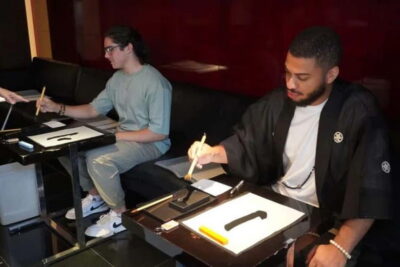
One of the first steps is changing into traditional Japanese workwear. It is a small detail, but it helps mark a break from ordinary sightseeing. You have come in from Tokyo traffic and station noise, then shift into a setting built around careful hand movements.
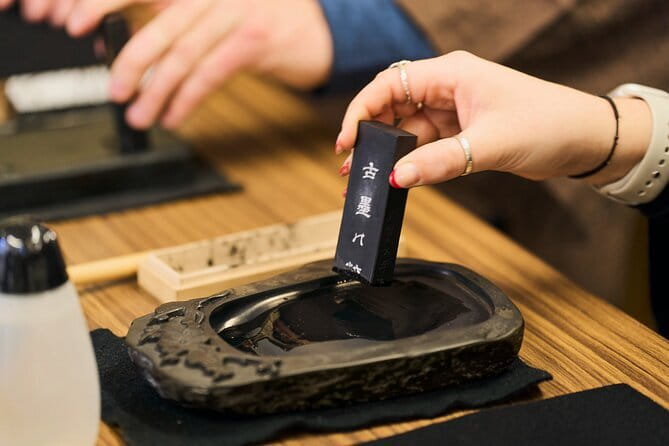
The most distinctive part of the opening is grinding the solid inkstick. You add water and work the stick against an inkstone until you create usable ink. This is not a decorative performance. It is part of the traditional process and gives you time to settle your attention before the brush reaches the paper.
I think this step gives the class its strongest sense of place. You could learn brush strokes with ready-made bottled ink, but grinding the ink makes the activity feel connected to an older practice. It is also a natural form of mindfulness. The movement is repetitive, quiet, and easy to understand, even if you know nothing about calligraphy.
Do not expect this portion to be a long lecture on Japanese art. The focus is practical. You learn what you are doing, why the ink is prepared this way, and how it affects the writing process.
Learning brush control before the final piece
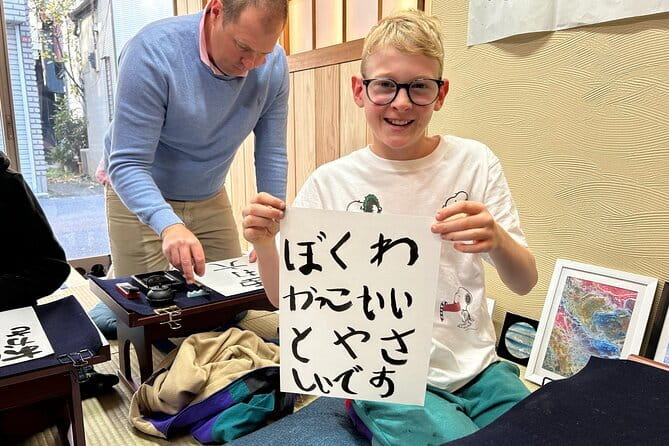
After the ink is ready, you practice basic brush techniques. The instructor shows you how to hold the brush and work through the beginning, middle, and end of a stroke. Stroke order is not just a classroom rule. It affects the shape and balance of the finished character.
This is where the class becomes more demanding than a casual craft session. The brush does not behave like a pencil. Pressure changes the line, and the ink can spread if you move too slowly or use too much liquid. You may produce several imperfect attempts before one character begins to look intentional.
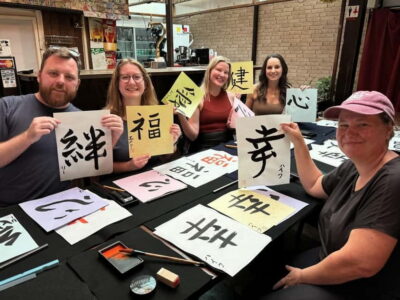
That challenge is useful. Beginners receive feedback instead of being left to guess why a stroke looks wrong. Participants have received help with technique, brush order, and the way characters sit beside one another. One particularly helpful feature is learning how to position multiple characters next to each other, since a name must look like a balanced group rather than a collection of separate marks.
Your teacher may be a different sensei depending on the session. Names associated with the workshop include Sousen, Nori, Horino, Mona, and Ai. The teaching style described across the experience is patient and encouraging, with plenty of time for individual assistance when the group is small.
English support comes through a guide who translates the instructor and adds cultural explanation. Guides such as Mayuko, Hiromi, Nono, and Naoto have been praised for clear communication. That matters because the subtle advice can be easy to miss when you are concentrating on the brush.
A completely different kind of day out in Tokyo:
- Mt Fuji and Hakone 1-Day Bus Tour Return by Bullet Train
★ 5.0 · 26,383 reviews - 1-Day Tokyo Bus Tour
★ 5.0 · 14,250 reviews - Tokyo: TOKYO SKYTREE® Admission ticket
★ 4.5 · 11,192 reviews - Tokyo: teamLab Planets TOKYO Digital Art Museum Entry Ticket
★ 4.6 · 9,779 reviews
Choosing kanji for your name
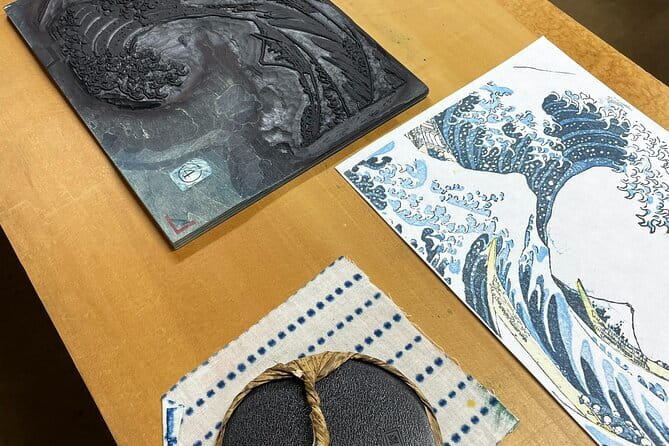
The name activity is the heart of the workshop. You work with the teacher and guide to transform your name into kanji. Japanese characters carry meaning, so this is more than finding a sound-alike spelling.
You may have some freedom in choosing characters that fit the qualities or ideas you want connected with your name. The teacher can explain the character meanings and show you how to write them. This gives you a useful glimpse into the relationship between language, identity, and visual art.
The lesson can also touch on the development of Japanese writing and the different writing systems used in Japan. Several participants found the explanation of character evolution especially interesting. You will not leave with a full language course, but you should understand more about why kanji looks and functions differently from the Roman alphabet.
Bring an open mind to the final design. The goal is not to create a flawless museum piece. You are learning a traditional art with a steep learning curve, and your personal handwriting will show. That is precisely why the paper artwork makes a good souvenir.
Paper artwork or an original T-shirt

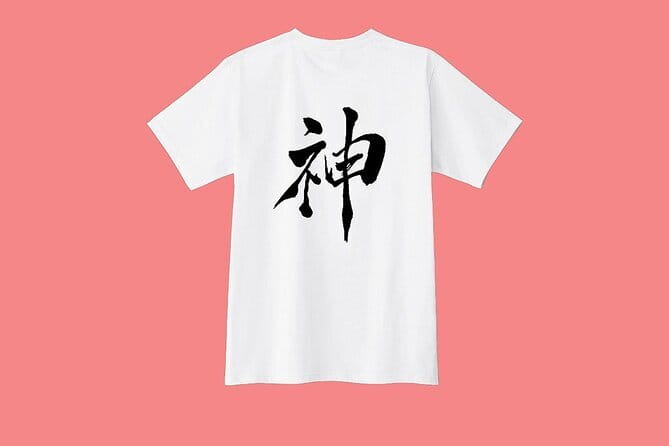
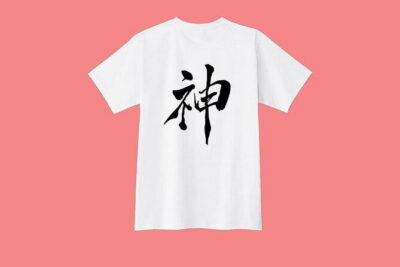
Your calligraphy can be made into an original T-shirt, but the shirt is not included in the $30 price. The activity description lists the T-shirt as optional, and one participant found the added cost high. Check the current price before booking if the shirt is the main reason you are interested.
The shirt option gives the workshop a more casual, wearable result. You write your kanji directly on the shirt and create a design that feels personal rather than mass-produced. It can be a fun choice for couples, families, and friends who want matching or related pieces.
There is a practical tradeoff. A T-shirt may be more useful than a sheet of paper, but it adds expense and can create extra concern about getting the design right. If you feel nervous about making a permanent mistake, start with the practice work and ask the teacher for advice before moving to the shirt.
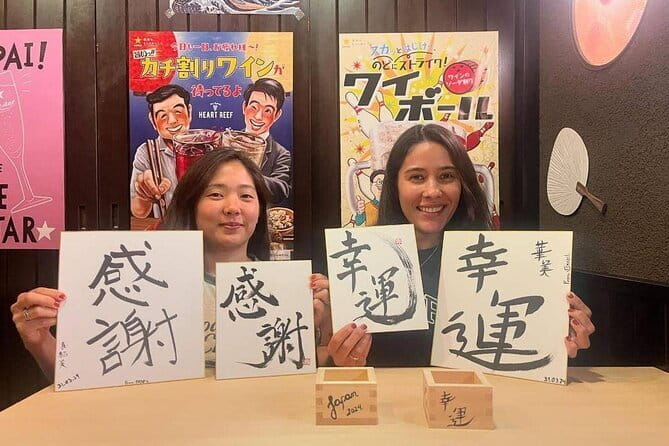
Skipping the shirt does not make the class incomplete. You still create original calligraphy to take home, and the teacher may prepare a neat version of your name on paper. Some participants preferred the paper artwork, while others were excited to receive their custom shirts. A paper scroll option is not listed, so do not count on having that alternative.
Is two hours enough?
Two hours is a good length for this activity. It gives you time to change, prepare ink, hear an introduction, practice, choose your kanji, and produce a final piece without taking an entire day from your Tokyo plans.
The class is structured around doing rather than sitting through a long history talk. That keeps it suitable for children, though younger children may need more help with brush control and patience. The setting has been described as calm enough for a toddler, but the exact experience will depend on the child and the group.
Solo participants can also fit in well. At times, the group may be very small, even down to one student. That can mean excellent personal attention, although you may feel a little more pressure when every attempt is your own. Couples and families may find the shared activity easier than another sightseeing stop where everyone wanders in different directions.
The workshop is best for people who enjoy making something with their hands. If you want a polished souvenir with no risk of smudges, this may not be your ideal activity. If you like the story behind an object and do not mind visible evidence of being a beginner, it offers good value.
What the $30 price includes
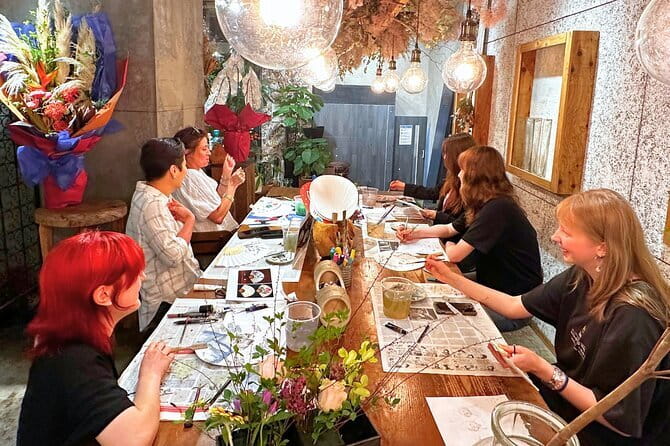
At $30 per person, the base price includes the English guide, calligraphy supplies during the class, instruction, and your own artwork to take home. That is a fair price for a two-hour small-group cultural activity in Tokyo, especially since the lesson uses professional tools and includes direct practice.
The value comes less from the amount of material and more from the access to a trained teacher. You receive an explanation of the craft, hands-on correction, help selecting kanji, and a finished souvenir. A standard museum visit might give you context, but it will not give you the physical memory of grinding ink and producing your own character.
The extra T-shirt is the main budget question. Since it is not included, decide in advance if you want the wearable version or simply the included paper artwork. If you are traveling with children, remember that each person who wants a shirt will need the additional purchase.
The booking terms also make planning easier. You can cancel up to 24 hours ahead for a full refund, and the reserve-now, pay-later option lets you hold a place without paying immediately. Availability and start times vary, so check the date that fits your Shinjuku plans.
Who should book this calligraphy class?
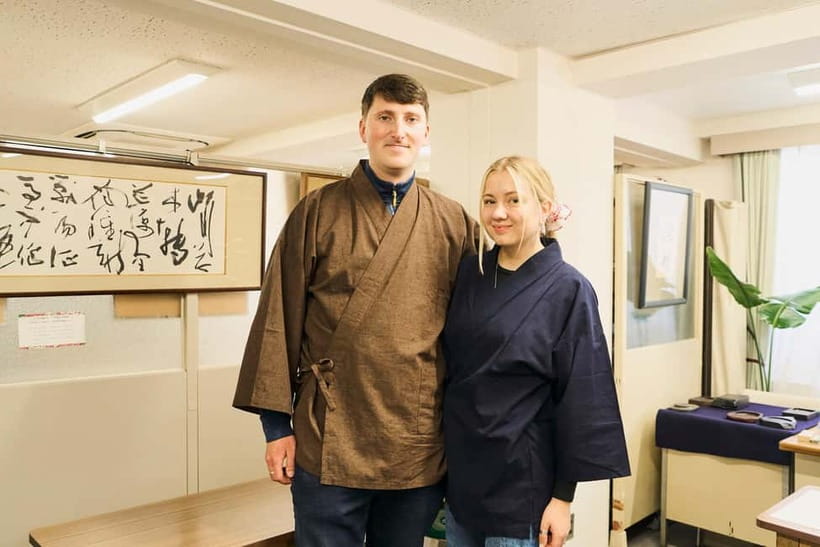
I would choose this workshop if you want a cultural activity that feels personal, quiet, and useful as a souvenir. It suits first-time visitors who want more than a photo opportunity, art lovers curious about brush work, and families looking for an activity that children can attempt.
It is also a good choice during a packed Tokyo trip. Two hours gives you a change of pace from stations, shopping, and major sights. The calm rhythm of ink preparation and brush practice can feel like a reset.
You should think twice if you dislike guided instruction, have no interest in making a souvenir, or expect to produce professional calligraphy immediately. The class is friendly, but the technique takes time. Your final shirt or paper may be funny-looking, as one participant honestly put it.
The English element is a real strength. The guide translates the sensei and helps explain cultural details, so you do not need Japanese language ability. The quality of the experience may vary slightly with the assigned teacher and guide, but the repeated praise for patience and clear explanations makes the format reassuring for beginners.
Should you book it?
Yes, if you want a hands-on introduction to Japanese culture and are comfortable with an imperfect result. The inkstick preparation, name-to-kanji lesson, small group, and professional instruction give this experience more substance than a quick souvenir-making stop.
Book it especially if you have two free hours in Shinjuku and want something calmer than the usual city program. Skip the optional T-shirt if the extra cost bothers you, since the included artwork still gives you a meaningful keepsake. For most people, the workshop is worth the $30, with the strongest value coming from the patient teaching and the chance to create something tied to your own name.
FAQ
How long does the Tokyo calligraphy workshop last?
The workshop lasts two hours, including changing into workwear, preparing ink, practicing brush techniques, choosing kanji, and creating your final artwork.
Where is the meeting point?
Meet at the FamilyMart Okubo Station South Exit Store, 1-23-21 Hyakunincho, Shinjuku-ku, Tokyo, Japan.
How do I identify the guide?
The guide will be holding a sign that says Local Guide Stars.
Is the workshop taught in English?
Yes. The activity includes a live English-speaking guide who translates and supports the calligraphy lesson.
What is included in the price?
The $30 price includes the English guide, calligraphy supplies used during the class, and your own artwork to take home.
Is the T-shirt included?
No. The original T-shirt is optional and costs extra.
Can children join the activity?
Yes. The workshop is designed to be enjoyable for children, although children may need help with the brush work and kanji writing.
Can I cancel my booking?
You can cancel up to 24 hours in advance for a full refund. You can also reserve now and pay later, subject to the available booking terms.
Just added around Tokyo
- Tokyo 6hr Instagram Highlights Private Tour with Licensed Guide★ 5.0 · 38 reviews
- Tokyo Small Group Tour with Guide★ 4.5 · 38 reviews
- Tokyo Sumo Experience with Live Show & Audience Challenge★ 5.0 · 38 reviews
- Japanese Food Cooking Class in Asakusa, Tokyo★ 5.0 · 39 reviews
- Very popular in Harajuku♡Animal petting zoo★ 4.6 · 39 reviews
- Ramen Making from Scratch with Tokyo Mom(Vegan Option Available)★ 5.0 · 39 reviews
- Tokyo: Kimono Rental inside Shinjuku Gyoen National Garden★ 4.9 · 39 reviews
- Tokyo JDM Night: 600hp C63s AMG Edition 1 (Private)★ 4.9 · 39 reviews
Japanese Calligraphy Classes, compared.
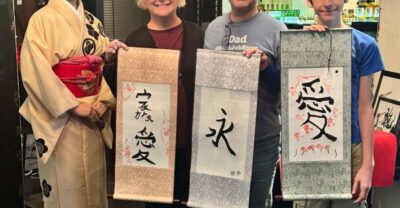
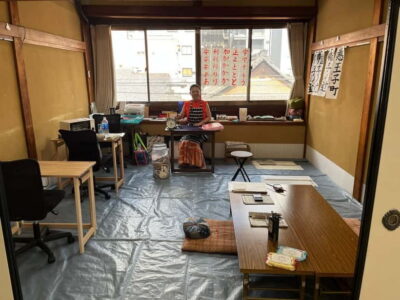
Calligraphy class at Buddhist temple in city center
Read our review →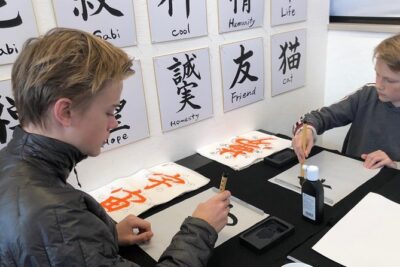
Let’s experience calligraphy in YANAKA, Taito-ku, TOKYO !!
Read our review →
Calligraphy Workshop & Original T-Shirt Creation
Read our review →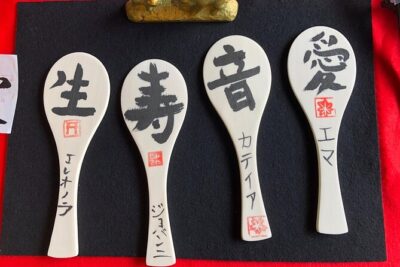
An Amazing set of Cultural experience: Kimono, Tea Ceremony and Calligraphy
Read our review →Browse the lists this tour appears in