
Reviewed · TEMPLE & SHRINE TOURS
Kyoto: Calligraphy class at Buddhist temple in city center
Quiet hands, bold characters, lasting memories. This 70-minute Kyoto calligraphy class brings you into Seigan-ji Temple, a historic Buddhist temple in the center of the city, where a skilled Japanese teacher guides you through brush, ink, and kanji. I especially like the small groups, limited to six, and the chance to leave with your own finished artwork rather than a factory-made souvenir.
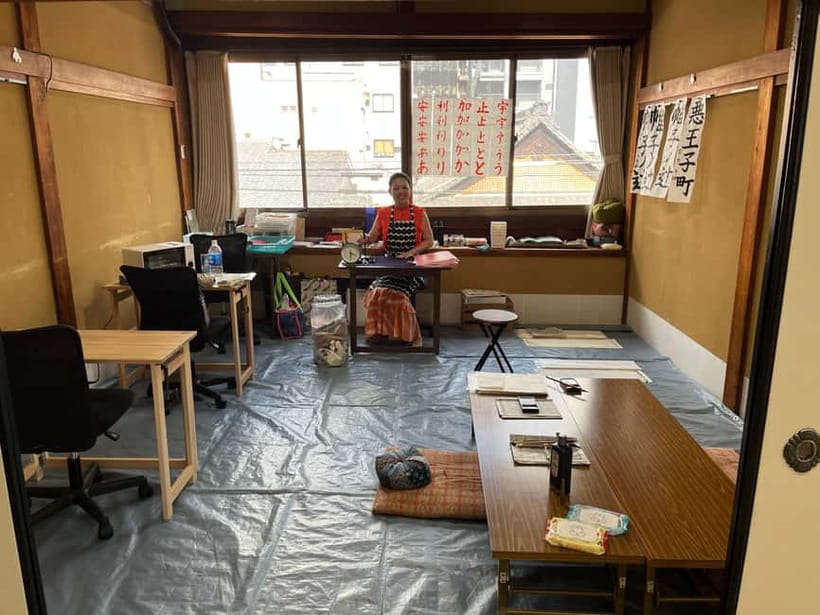
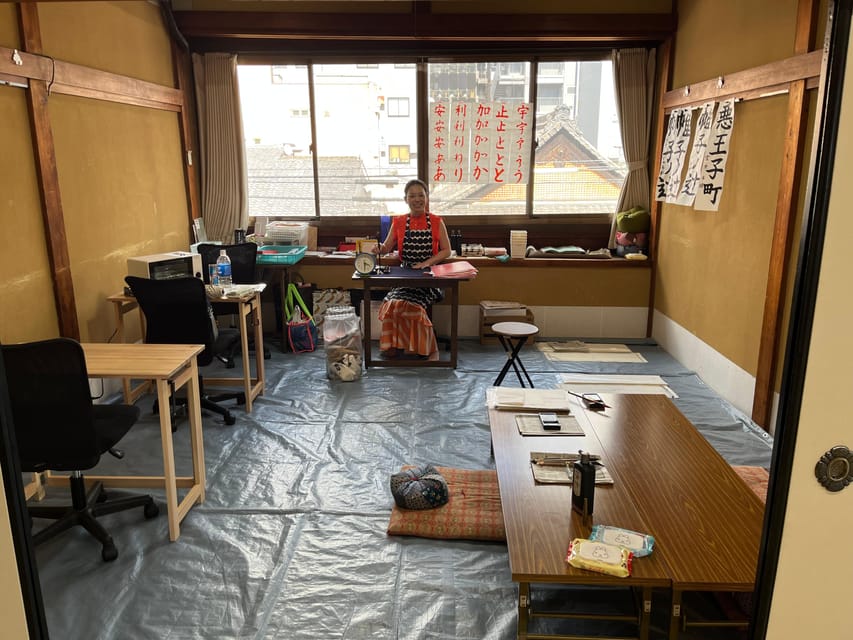
I also like the cultural setting: you work in a washitsu with tatami flooring, near a Great Buddha, while learning an art that forms part of Japanese school education. The main consideration is physical comfort. Most seating is on the floor with a zabuton cushion, and desks are limited, so this may be tiring if your knees or legs are troublesome.
In This Review
- Key points to know before booking
- Why this Kyoto calligraphy class feels different
- Finding Seigan-ji Temple in Shinkyogoku
- A traditional room, tatami, and floor seating
- The 70-minute lesson, from introduction to finished board
- The teacher, translator, and pace of instruction
- Choosing a kanji and making a personal souvenir
- Is $55 a fair price for 70 minutes?
- Who will enjoy this most?
- Should you book this Kyoto calligraphy class?
- FAQ
- Where does the calligraphy class meet?
- Should I go up the stairs into Seigan-ji Temple to find the class?
- How long does the class last?
- What languages are available?
- What materials are included?
- Can I choose my own word or kanji?
- What do I take home?
- Is the class suitable for everyone?
Key points to know before booking
- Write your own chosen kanji: Come with a few word ideas, or select from the examples provided.
- Learn inside Seigan-ji Temple: The class takes place in a traditional Japanese room on tatami flooring.
- Small groups mean personal help: With no more than six participants, the teacher and translator can offer individual guidance.
- Practice before the final piece: You learn brush control and basic strokes before writing on a shikishi, a decorative square board.
- Take home two keepsakes: Your completed calligraphy work comes with a character key-chain made by the teacher.
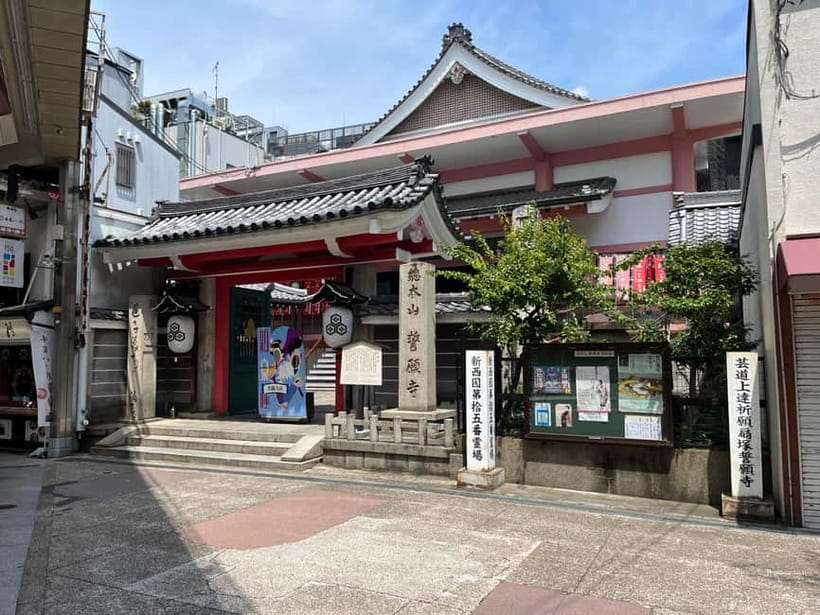
- Meet under the red lantern: Wait in front of Seigan-ji Temple in the covered Shinkyogoku shopping street, not up the temple stairs.
Why this Kyoto calligraphy class feels different
Kyoto offers no shortage of temples, gardens, tea ceremonies, and craft workshops. What makes this class appealing is its simple format. You do not just watch a demonstration and applaud politely. You pick a character, hold the brush yourself, make mistakes, practice again, and produce something personal to carry home.
Calligraphy, or shodo, is more than decorative writing. The teacher explains the structure of the kanji, the order and shape of its strokes, and the way small changes affect the finished character. Even in a short session, you get a useful glimpse of why Japanese writing is treated as an art as well as a language skill.
I would not book this expecting to become a calligrapher in 70 minutes. You will learn the basics and make a respectable final piece with help. The value is in the process: the quiet concentration, the feel of the brush, and the pleasure of seeing a strange-looking character gradually become your own.
More Calligraphy Classes in Kyoto
- Kyoto: Japanese Calligraphy Class
★ 4.8 · 89 reviews - Kyoto: Japanese Calligraphy Workshop
★ 4.7 · 84 reviews - Kyoto: Local Home Visit and Japanese Calligraphy Class
★ 5.0 · 66 reviews
Finding Seigan-ji Temple in Shinkyogoku
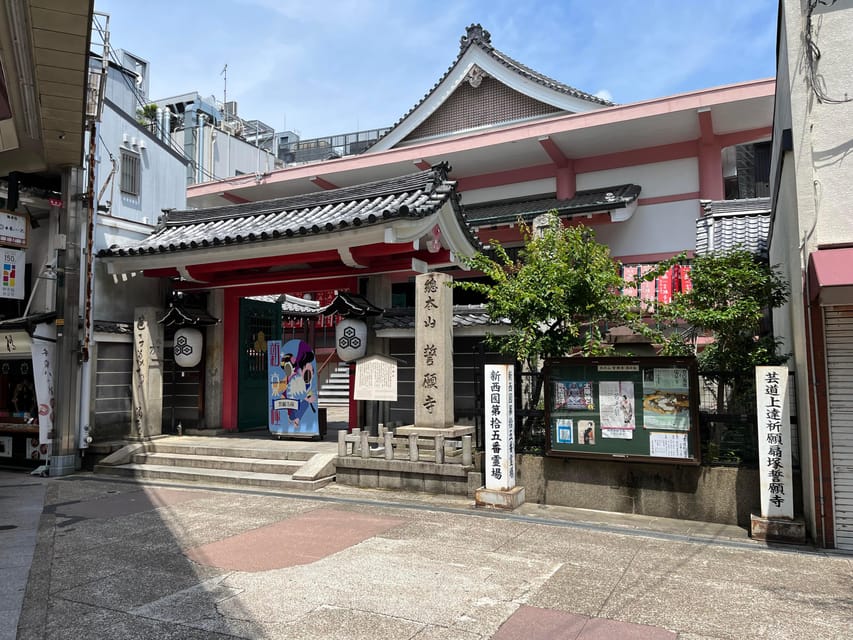
The meeting point is easy to miss if you are looking for a large tour desk or a prominent workshop sign. Go to the front of Seigan-ji Temple in the covered Shinkyogoku shopping street and look for a person holding a red lantern on a stick beneath the roof.
This detail matters. You should not climb the stairs into the temple looking for the class, and you should not interrupt the monks or temple staff to ask where the workshop is. Simply wait outside for the person with the lantern. If you are unsure, use the contact information on your booking confirmation.
Once you meet the guide, you enter the temple setting for the class. The location puts a traditional cultural activity right in the middle of central Kyoto, close to major shopping and sightseeing areas. It is a handy choice if you want to add a calm, focused activity to a day that might otherwise involve plenty of walking.
A traditional room, tatami, and floor seating
The workshop takes place in a washitsu, a Japanese-style room with tatami flooring. This is not just a decorative backdrop. Sitting in the room, using traditional materials, and working quietly on the floor gives the class a stronger sense of place than a standard activity room would.
Most participants sit on a zabuton, a Japanese floor cushion. A few desks are available, but they are limited. If you cannot sit comfortably on the floor for much of an hour, contact the provider before booking or treat the seating arrangement as a serious consideration.
The room is generally quiet because everyone is concentrating, but it is not presented as a silent meditation session. You can expect instruction, translation, questions, and the gentle activity of people practicing their strokes. That makes it suitable for someone who wants a peaceful cultural class without needing complete silence.
The temple setting also gives the hour a sense of occasion. You are not simply learning how to make attractive marks on paper. You are working inside a Buddhist temple with a Great Buddha at the center of the experience, in a room style closely tied to Japanese daily life and traditional arts.
The 70-minute lesson, from introduction to finished board
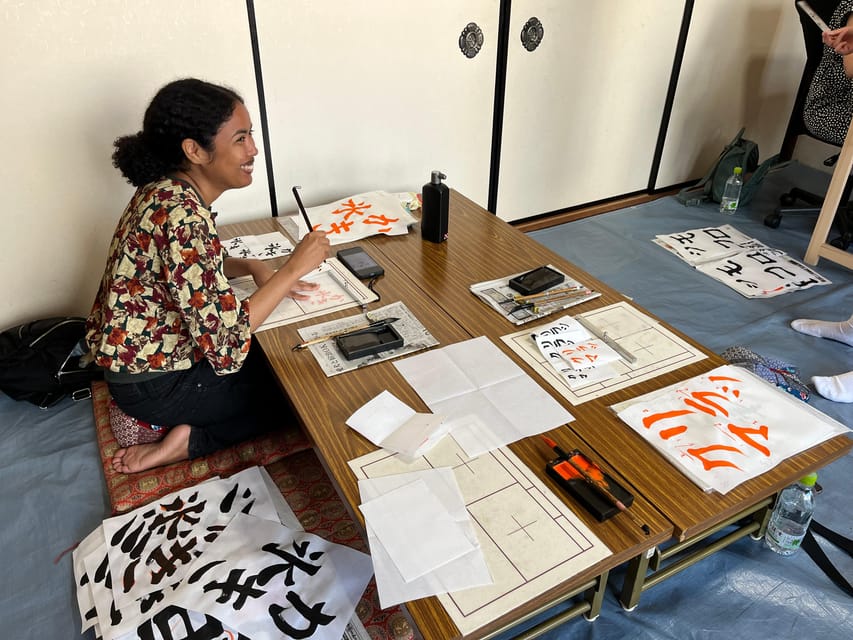
The class follows a clear progression, which is helpful if you have never held a calligraphy brush.
First comes an introduction to the Japanese teacher and the translator. The teacher has more than a decade of calligraphy experience, and the instruction is supported in English, Spanish, Japanese, or Dutch depending on the session. Some classes are led by a Japanese-speaking teacher with a translator explaining each step.
Next, you choose the word or kanji you want to write. You can select from examples, but I strongly suggest arriving with several ideas. A favorite quality such as courage, peace, love, strength, or happiness may be easy to discuss, but the exact examples available in the class can vary. Having a short list gives you a better starting point.
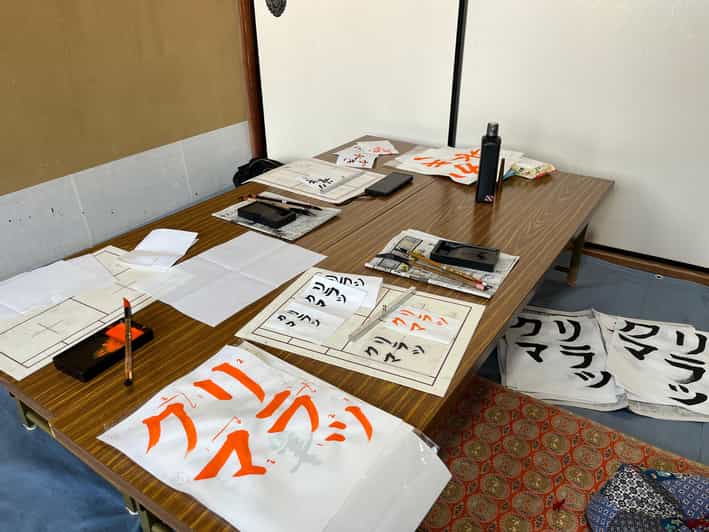
The teacher then introduces the tools. These include washi paper, a brush, ink, bunchi, and shitakami. You learn what each item does and how to handle it. This is a useful part of the lesson because the brush is not used like a felt-tip pen. Pressure, speed, angle, and the amount of ink all affect the line.
You start with basic strokes. This is where the class earns its keep. The teacher demonstrates, then you practice lines that form the building blocks of your chosen character. The instruction is gradual, and the translator helps make the demonstrations clear for people who do not speak Japanese.
After that, you practice the full word or kanji. The teacher and assistants move around the room, offering tips and encouragement. Because the group is capped at six, you are not left trying to copy a demonstration from the far side of a crowded room. The individual attention is especially useful for beginners and left-handed participants.
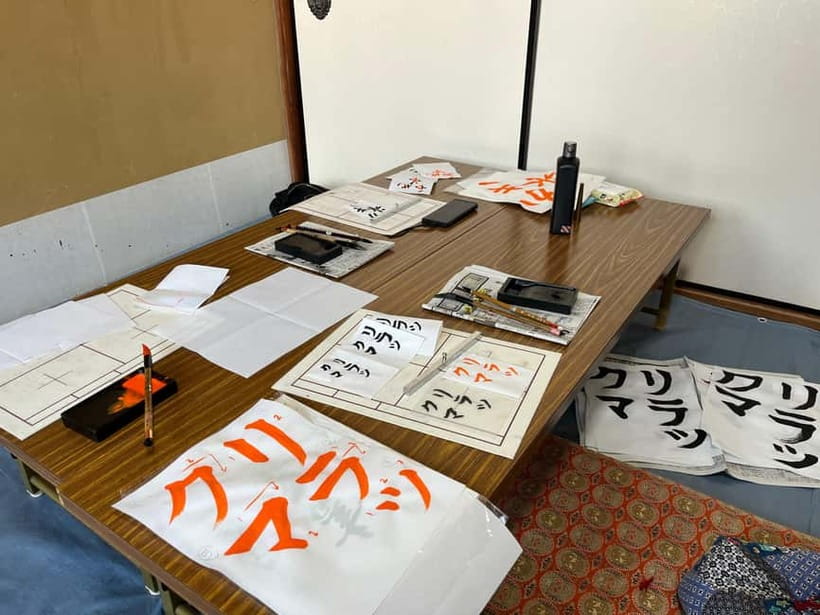
Finally, you create the finished piece. Your chosen character is written on a shikishi, a special square cardboard board often used for calligraphy and decorative writing. This is the moment to slow down, breathe, and use what you have learned.
One practical warning is worth repeating: more practice is not always better. You need enough repetition to understand the strokes, but too much can tire your arm. A tired arm often produces a weaker final piece. The teacher’s advice is sensible: practice seriously, but stop before you wear yourself out.
More Temple & Shrine Tours in Kyoto
- Kyoto: Fushimi Inari, Kinkakuji, Bamboo Grove 1 Day Bus Tour
★ 4.8 · 4,316 reviews - Kyoto: Tea Ceremony in a Traditional Tea House in Kiyomizu
★ 4.9 · 3,519 reviews - Kyoto: Tea Ceremony Ju-An at Jotokuji Temple
★ 4.9 · 3,207 reviews - Fushimi Inari Hidden Hiking Tour (Private Option Available)
★ 5.0 · 1,750 reviews
The teacher, translator, and pace of instruction
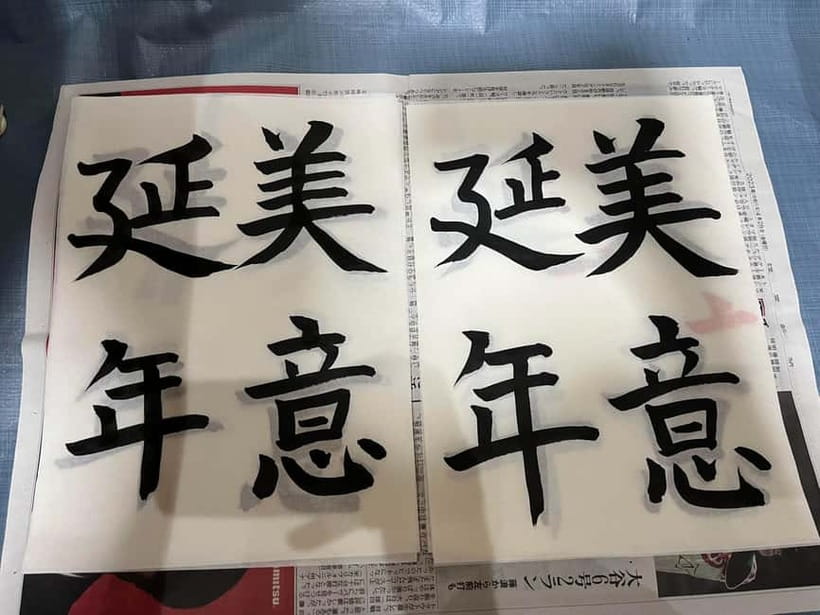
The Japanese instructor is the heart of the class. The teaching is described as patient, encouraging, and systematic, with demonstrations that make the process look much easier than it feels in your own hand. That is part of the fun. Calligraphy has a graceful appearance, but controlling the brush takes care.
The translator adds more than word-for-word explanation. In sessions led by guides such as Jose, and in some classes with Jose and Saskia, the support includes practical tips, encouragement, cultural explanation, and help with photographs. The translation allows the teacher to focus on demonstrating the art while the guide helps you understand what to do.
This arrangement works best for people who appreciate hands-on instruction rather than a long lecture. You receive an explanation, then quickly start practicing. The short format keeps the class moving, although anyone hoping for an advanced study of kanji history or brush theory may find the time limited.
The atmosphere is warm and informal. You are encouraged to try, make mistakes, and improve. That matters because beginners often worry that one crooked stroke has ruined everything. Here, a flawed practice sheet is simply part of learning. Your final board is made after you have had time to understand the character.
Choosing a kanji and making a personal souvenir
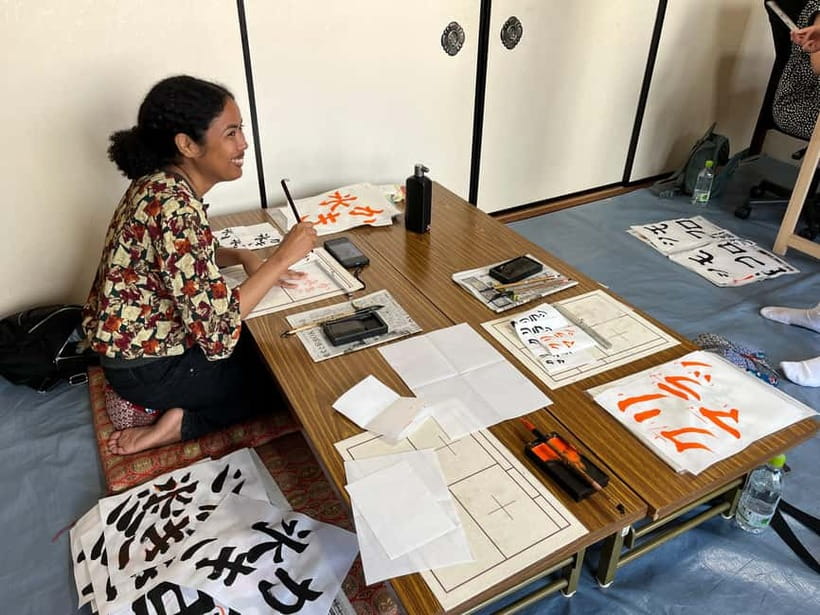
The strongest reason to prepare before arriving is that the final work is meant to mean something to you. A random character chosen in a hurry can still look good, but a word connected to your family, a personal goal, or your time in Japan gives the souvenir more weight.
You can write a single kanji or another selected word, depending on the options explained during the class. If you are unsure, the examples provided can help. Ask the teacher or translator about the meaning before you commit your final choice.
The finished shikishi is more satisfying than a standard souvenir because you made it yourself. It will not have the perfect uniformity of a professional piece, and that is precisely the point. You can see the evidence of your practice in the final work.
You also receive a key-chain featuring your chosen character, made by the teacher. It is a small extra, but it gives you another way to remember the class. The provider may also help take photographs during the activity, which is useful when your hands are covered in ink and you want pictures of the process.
Materials are included, including the washi, brush, ink, bunchi, and shitakami. Food and drinks are not included. You can buy a drink from vending machines outside the temple, so plan ahead if you need water before or after the class.
Is $55 a fair price for 70 minutes?
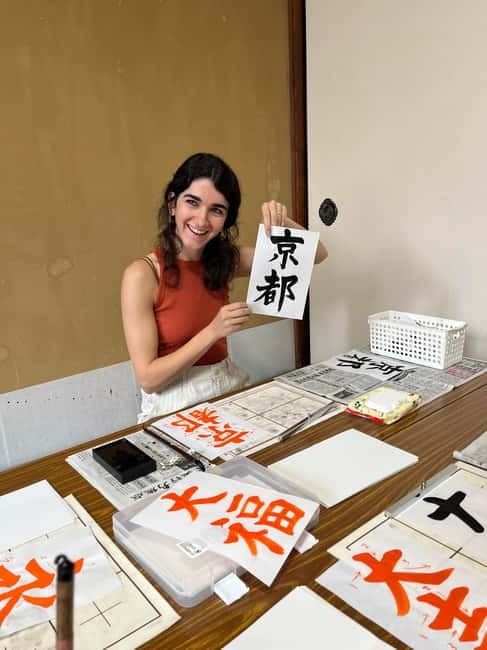
At $55 per person, this is not the cheapest short activity in Kyoto. You are paying more than the cost of buying a brush and trying a few characters at home. But the price includes instruction from an experienced teacher, translation, all materials, a temple setting, a finished shikishi, and the character key-chain.
The small group size improves the value. Six participants is still a group, but it is small enough for personal correction and attention. Some sessions may have fewer people, which can make the class feel closer to a private lesson.
I also think the souvenir changes the calculation. A mass-produced fan or magnet costs less, but it tells you little about the place. Your calligraphy board records a specific choice, a specific hour, and your first attempt at a traditional Japanese art.
The class is particularly good value if you want a cultural activity that fits between sightseeing plans. At 70 minutes, it does not consume half a day, and its central Kyoto location makes it practical to pair with shopping or nearby sightseeing. The price is harder to justify if you are only looking for a quick photo opportunity or if you have no interest in making the artwork yourself.
Who will enjoy this most?
I would recommend the class to couples, solo visitors, families with older children, and anyone who wants a break from temple viewing that still feels connected to Japanese culture. It is also a good choice for people who like thoughtful souvenirs and hands-on activities.
You do not need artistic ability. In fact, complete beginners may get the most from the step-by-step structure. The practice sheets and demonstrations make the task manageable, even though the final character can be harder than it looks.
Families should note the age restrictions. The activity is not suitable for children under five, with the provider also listing younger age categories and babies as unsuitable. Older children who can sit quietly, handle the tools carefully, and follow instructions may enjoy it, but the class is not designed as a free-form children’s activity.
Left-handed participants can take part, though the brush technique may feel more difficult. One participant found it helpful to try with the right hand as well. If you are left-handed, tell the teacher and ask for guidance rather than assuming you must copy the standard position.
The class is listed as wheelchair accessible, but the floor-based seating deserves attention. Wheelchair access and comfortable participation are not always the same thing in a tatami room, so ask about your specific needs in advance. The provider lists the experience as unsuitable for visually impaired people.
Smoking, vaping, alcohol, and drugs are not allowed, and you must wear footwear. Bare feet are not permitted.
Should you book this Kyoto calligraphy class?
Book it if you want to make something personal, learn from a real instructor, and spend an hour in a traditional temple room. The strongest features are the small group, patient teaching, English and multilingual translation, and the finished board you take home.
I would skip it if floor seating is likely to cause pain, if you need a fully silent setting, or if you want an advanced calligraphy course. I would also avoid arriving without any idea for your word. Bring two or three possible kanji choices, wear comfortable clothing, and leave enough room in your luggage for the shikishi.
For most visitors, this is a memorable and fairly priced way to meet Japanese culture with your hands, not just your camera. The final work may not be museum quality, but it will be yours, and that makes it a much better souvenir.
FAQ
Where does the calligraphy class meet?
Meet in front of Seigan-ji Temple in the covered Shinkyogoku shopping street. Look for a person holding a red lantern on a stick under the roof.
Should I go up the stairs into Seigan-ji Temple to find the class?
No. Wait at the front of the temple for the person with the red lantern. Do not ask the monks or other temple workers if you are in the right place.
How long does the class last?
The experience lasts about 70 minutes.
What languages are available?
The activity is available in English, Spanish, Japanese, and Dutch.
What materials are included?
The class includes washi, a brush, ink, bunchi, and shitakami, along with explanations, practice, kanji examples, and materials for making your souvenir.
Can I choose my own word or kanji?
Yes. You can select a word or kanji of your choice. Examples are also available, but it is better to arrive with a few ideas.
What do I take home?
You take home your finished calligraphy on a shikishi, a special square cardboard board. You also receive a key-chain with your chosen character made by the teacher.
Is the class suitable for everyone?
The activity is listed as wheelchair accessible, but most seating is on the floor with a zabuton and desks are limited. It is not suitable for children under five, babies, or visually impaired people. Food and drinks are not served, though drinks can be bought from vending machines outside the temple.
Just added around Kyoto
- Kyoto: Private Customizable Day Trip by Car★ 5.0 · 38 reviews
- Kyoto: Gion Night Walking Tour with Geisha Insight★ 5.0 · 39 reviews
- Kyoto: Full Day Bike Tour★ 4.9 · 39 reviews
- Private Japanese Calligraphy in Kyoto – Learn Shodō with a Master★ 5.0 · 39 reviews
- Experience a tea ceremony in an authentic tearoom, in Kyoto!★ 4.5 · 41 reviews
- Kyoto: Gion Evening Walk with Hidden Gems, Geisha & Sake★ 5.0 · 41 reviews
- Kyoto Private Photo Shoot & Tour by SnapKyoto★ 5.0 · 41 reviews
- The Way of Tea: Kyoto Crafts, Hidden Temples & Wabi-Sabi Walk★ 5.0 · 41 reviews
Temple & Shrine Tours, compared.

Fushimi Inari, Kinkakuji, Bamboo Grove 1 Day Bus Tour
Read our review →
Tea Ceremony in a Traditional Tea House in Kiyomizu
Read our review →

Meiji Shrine, Asakusa, Skytree Bus Tour and Cruise
Read our review →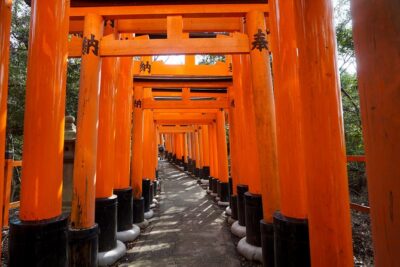
Fushimi Inari Hidden Hiking Tour (Private Option Available)
Read our review →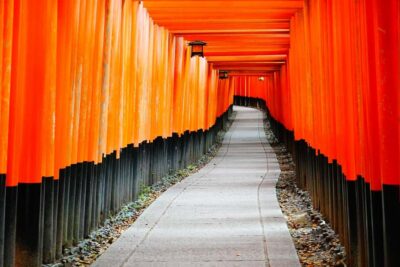
Osaka/Kyoto:Kinkakuji,Arashiyama,FushimiInariShrine,NaraPark
Read our review →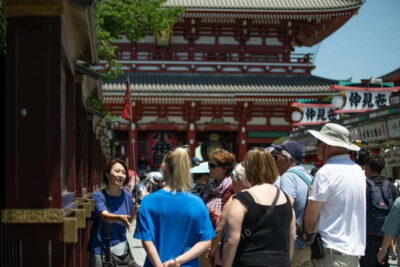
Asakusa Walking Tour with Sensoji Temple Visit
Read our review →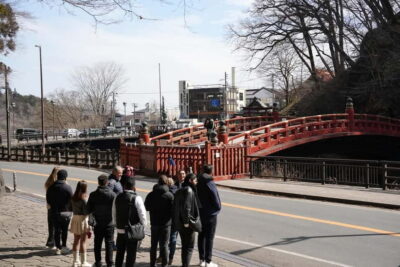
Nikko: Kegon Falls, Lake Chuzenji & Toshogu Temple
Read our review →Browse the lists this tour appears in