
Reviewed · JAPANESE CALLIGRAPHY CLASSES
Calligraphy Culture SHODO Experience in Tokyo
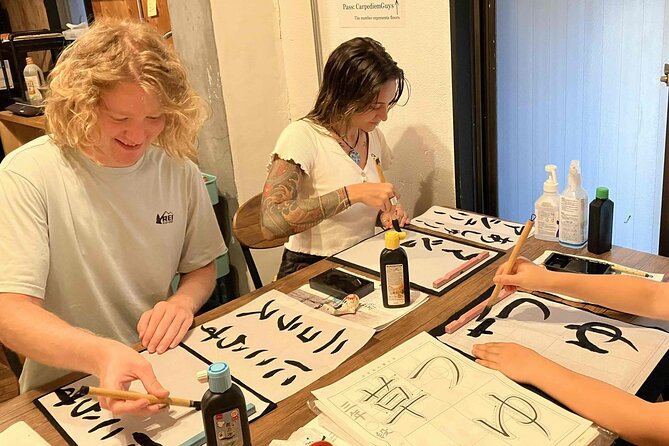
Brushes make quiet souvenirs. This 90-minute shodo class gives you a hands-on way to meet Japanese culture, starting with posture, brush control, and basic lines before you write a name or favorite word in Japanese. I like the small maximum of five people, which gives the teacher room to help each person, and I like that your finished work goes home on an autograph board rather than disappearing into a phone gallery.
I also like the location, just a five-minute walk from Iriya Station and close to Asakusa and Ueno. The main consideration is the setting: classes take place in a small hostel or boarding-house-style space, and one participant found that household activity sometimes interrupted the lesson. If you want a polished studio, this may feel informal. If you prefer a personal local class, that same informality can be part of its charm.
In This Review
- Key points to know before you book
- What happens during the 90-minute shodo lesson
- Choosing between kanji, hiragana, and katakana
- Teachers Sachie and Zuisen make the class approachable
- The informal classroom near Iriya Station
- Why the $33.03 price can be good value
- What makes the final souvenir worthwhile
- Who will enjoy this Tokyo activity most
- Timing, tickets, and cancellation advice
- Should you book the Tokyo shodo experience?
- FAQ
- How long does the calligraphy experience last?
- How much does the activity cost?
- Where does the activity start?
- Where does the activity end?
- How far is the meeting point from Iriya Station?
- Is the activity close to Asakusa and Ueno?
- What can I write during the class?
- Are calligraphy supplies included?
- How many people can join the class?
- Can I cancel for a full refund?
Key points to know before you book
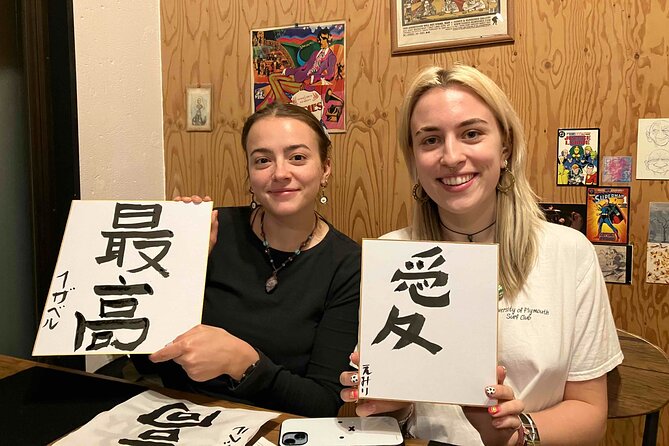
- Write your own Japanese name: You can work on your name in Japanese or choose a favorite word in kanji, hiragana, or katakana.
- Small groups matter: The class accepts no more than five people, and some sessions may feel almost private.
- Patient teachers: Sachie and Zuisen are praised for clear English, patience, and friendly instruction.
- A useful Tokyo location: Iriya Station is a five-minute walk away, with Asakusa and Ueno nearby for a fuller half-day outing.
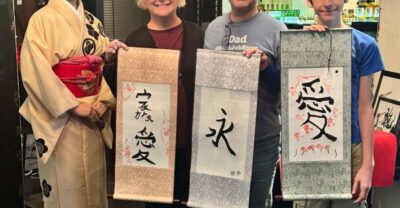
- Your artwork is included: Brushes, ink, paper, and other calligraphy supplies are provided, and you take home a finished piece on a board.
- A low-cost cultural activity: At $33.03 per person, the class costs less than many major Tokyo attractions while giving you a physical souvenir.
What happens during the 90-minute shodo lesson
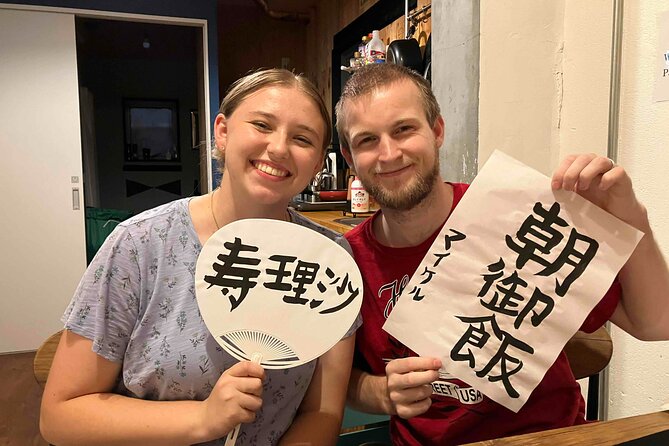
This is not a watch-and-leave demonstration. You sit down with a brush and learn by doing, making it a good choice if you want more than a quick photo opportunity.
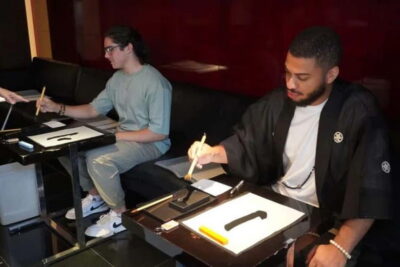
The lesson begins with the basics of Japanese calligraphy, known as shodo. You learn how to hold the brush, how to sit or stand with the right posture, and how pressure changes the line. These details matter because a brush does not behave like a ballpoint pen. The movement of your wrist, the angle of the brush, and the speed of each stroke all affect the result.
You then practice simple lines and shapes. This stage may sound modest, but it gives you a feel for the tools before you attempt a full character. It also helps take the pressure off. Your first few marks do not need to look perfect. The point is to understand how the ink and brush respond.
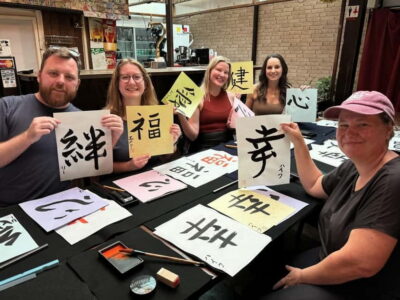
The class can then move into Japanese writing systems. The experience introduces hiragana, katakana, and kanji, giving you a useful glimpse into why Japanese writing has several forms. You may choose a Japanese version of your own name, or select a word that means something to you.
One participant worked on the Japanese writing for knitting, which involves complicated characters. That is a useful reminder to choose your word with care. A short, simple character may be easier to complete neatly, while a more involved word gives you a bigger challenge and a story to tell when you get home.
At the end, you write your selected name or word on a nicer piece of cardboard or an autograph board. Supplies are included, so you do not need to buy brushes, ink, or paper before class. The finished piece becomes a lightweight souvenir that fits easily into luggage.
More Calligraphy Classes in Tokyo
- Tokyo: Calligraphy on Kanji Fan & Scroll with Drink
★ 5.0 · 210 reviews - Let’s experience calligraphy in YANAKA, Taito-ku, TOKYO !!
★ 5.0 · 127 reviews - Experience all of Japanese culture and Japanese food experience classes “origami, udon, Japanese food, green tea, calligraphy” in 4 hours
★ 5.0 · 105 reviews
Choosing between kanji, hiragana, and katakana
The choice of writing system is one of the most interesting parts of this experience. Japanese uses three scripts, and each creates a different look on the page.
Katakana is often used for foreign names and borrowed words. If you want to write your name in Japanese, katakana may be the natural choice. One participant was delighted when Google Translate recognized the finished katakana name, though the point of the class is the act of writing rather than testing translation software.
Hiragana has softer, more rounded forms and is used for many native Japanese words and grammatical elements. It can be a pleasant option if you want a word with a flowing appearance.
Kanji carries meaning through characters. You might choose a favorite concept, name, or word, but ask the instructor for help before settling on one. A word that looks simple in English may require several complex characters in Japanese. The teachers can guide you toward a suitable choice for your time and skill level.
I appreciate that the class does not force every person into the same final result. You can work toward a name, a favorite word, or a more ambitious kanji design. That personal choice makes the finished board feel connected to your trip.
Teachers Sachie and Zuisen make the class approachable
The teacher can make or break a hands-on cultural class. Here, Sachie receives especially warm praise for being kind, patient, and encouraging. She is described as an engaging teacher who wants to share her art, not simply run through a fixed demonstration.
That patience is important for beginners. You do not need prior calligraphy skills, and you may arrive unsure how to hold the brush or how much ink to use. A patient instructor lets you correct small problems without making the class feel like a test.
Zuisen is also praised for strong English and clear instruction. That helps when you are asking about the meaning of a character, the difference between writing systems, or the best way to approach your chosen word.
The experience is designed for foreign visitors, so the teaching is aimed at people who may know little about Japanese writing. Most people can participate, and the small class size gives the teacher more time to look at your strokes.
The occasional one-person session could be especially appealing. One person described receiving a personal lesson after being the only student. That is not something you should assume will happen, but a maximum of five people keeps the class from feeling like a large workshop.
The informal classroom near Iriya Station
The Tokyo Iriya Shodo Club is at 2-29-2 Iriya, Taito City, on the second floor. The activity starts and ends at this same meeting point.
The address places you in Taito, a convenient part of eastern Tokyo. The class is a five-minute walk from Iriya Station and close to Asakusa and Ueno, so you can attach it to a day of sightseeing in the area. Save extra time if you want to explore nearby Taito before or after the lesson.
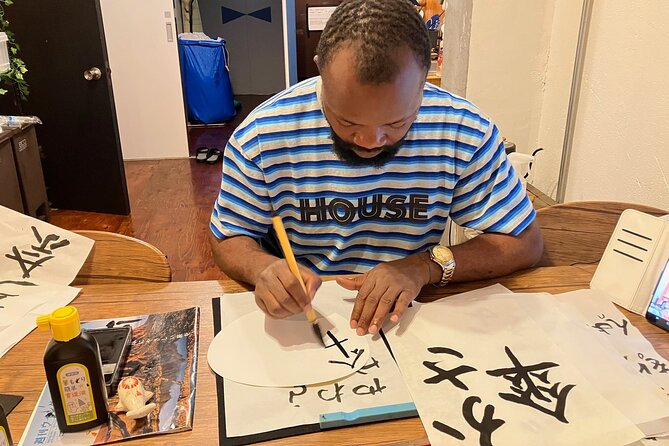
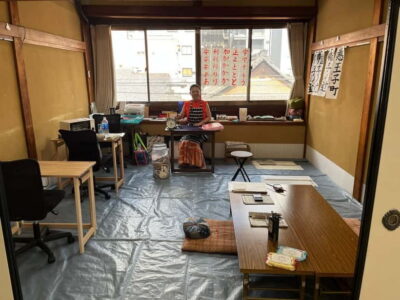
The room itself is not presented as a formal art school. Several sessions took place in a cozy hostel or boarding-house-style classroom, with one class using a kitchen area. This creates a more personal, everyday setting, and one participant said it felt like an old Japanese school.
There is a tradeoff. In one session, people sharing the building were preparing food and washing clothes during the class. That caused interruptions and reduced the calm atmosphere. If you care most about a quiet, carefully designed studio, contact the operator before booking if you need to understand the exact room setup.
For me, the informal location is acceptable at this price, especially if you see the activity as a local cultural meeting rather than a luxury art lesson. Still, you should know what you are paying for: personal instruction in a simple setting, not a grand traditional hall.
A completely different kind of day out in Tokyo:
- Mt Fuji and Hakone 1-Day Bus Tour Return by Bullet Train
★ 5.0 · 26,383 reviews - 1-Day Tokyo Bus Tour
★ 5.0 · 14,250 reviews - Tokyo: TOKYO SKYTREE® Admission ticket
★ 4.5 · 11,192 reviews - Tokyo: teamLab Planets TOKYO Digital Art Museum Entry Ticket
★ 4.6 · 9,779 reviews
Why the $33.03 price can be good value
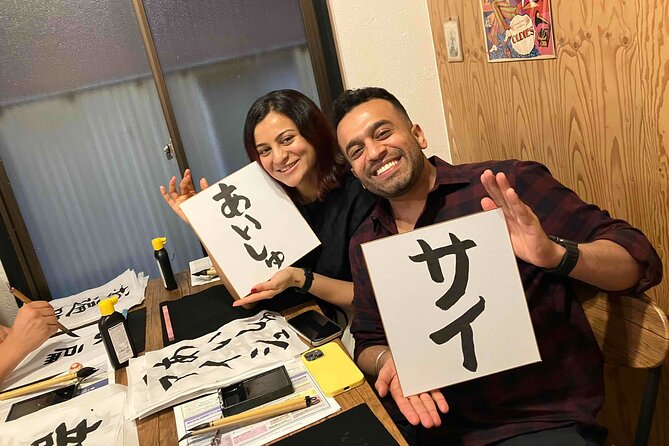
At $33.03 per person, this is a fairly modest way to add a cultural activity to a Tokyo trip. The price includes calligraphy supplies, instruction, and a finished board to take home.
The value comes from participation. You are not only looking at an object or listening to a short explanation. You learn basic brush handling, practice lines, make several attempts, and create a personal piece. That gives the class more substance than a quick souvenir-making stop.
The small group also helps justify the cost. With no more than five people, the teacher can watch individual technique and help with your chosen characters. If you are the only person booked, the session may feel like private tuition without the usual private-class price.
There are limits. The class lasts about an hour and a half, so you should not expect professional-level calligraphy training. You will learn the fundamentals and produce a keepsake, but developing real skill requires continued practice. One enthusiastic participant joked about becoming an artist but also recognized that more training would be needed.
The price is best for you if you want a short, affordable activity with a clear result. It is less suitable if you want a serious multi-session course or a formal art-school setting.
What makes the final souvenir worthwhile
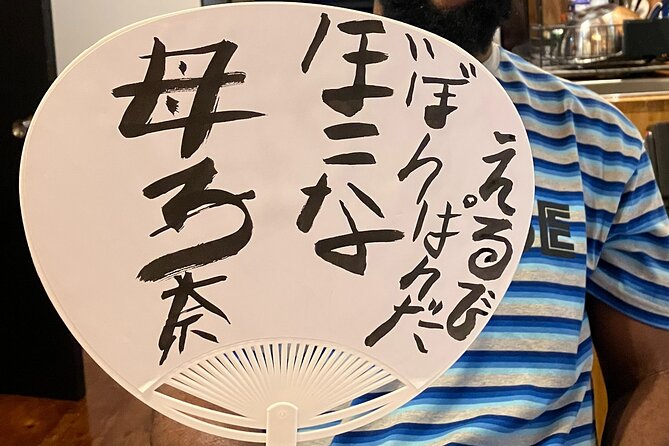
Tokyo offers plenty of ready-made souvenirs. A piece you write yourself feels different.
Your finished board records the shape of your hand at one particular moment in Japan. The lines may not be perfect, but that is part of its value. You will remember the brush, the ink, the concentration, and the teacher’s corrections each time you see it.
The board is also light and practical. You do not have to carry a ceramic object or fragile sculpture through the rest of your trip. If you choose a meaningful word, the souvenir can have more personal value than a standard Tokyo purchase.
Think about your word before arriving, but do not become fixed on one choice. The characters may be more complex than expected, and the teacher may suggest a different writing system or a simpler alternative. Having two or three ideas ready gives you flexibility.
Names work well because they connect directly to you. A favorite word can be more visually striking, especially if you like the appearance of kanji. If you choose a complicated word, accept that the process may take more practice time.
Who will enjoy this Tokyo activity most
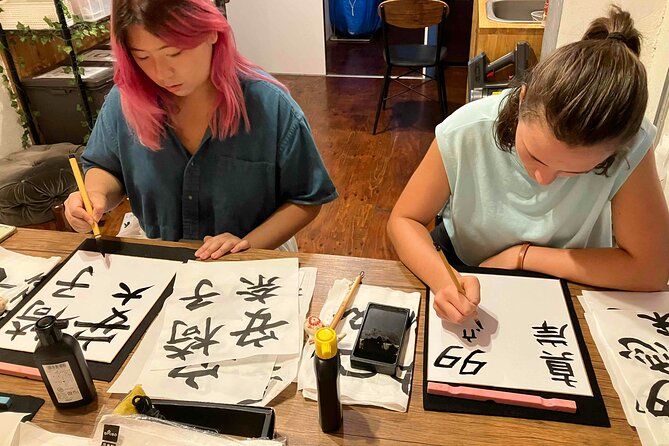
I would recommend this class to first-time visitors who want a direct cultural activity without giving up half a day. The 90-minute duration fits neatly between other plans, and the location works well with time in Asakusa or Ueno.
It also suits families. A session with Sachie was described as engaging for an entire family, and the chance to make a take-home piece gives children a clear goal. Younger children may need help with posture and brush control, but the activity is participatory rather than lecture-based.
Couples and solo visitors can also get a lot from it. A solo booking may create a particularly personal lesson if the class is otherwise empty. Couples can choose related words or compare different writing styles, though the provided information does not promise a private booking.
This is a good fit for anyone interested in Japanese language, lettering, crafts, or small-group cultural activities. It may be less appealing if you dislike sitting still, making repeated practice marks, or working in a shared hostel-style space.
Timing, tickets, and cancellation advice
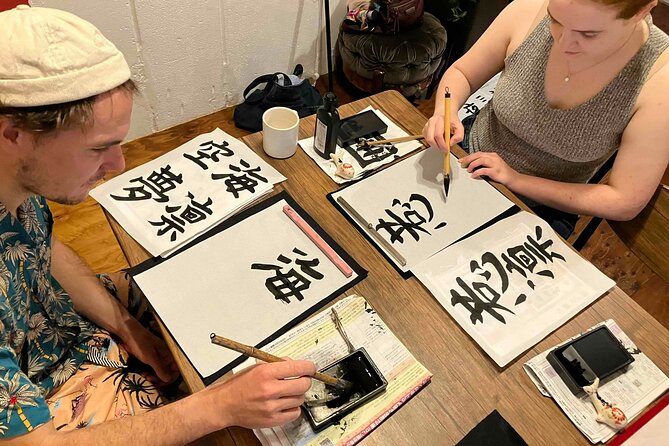
You receive confirmation when you book, and the activity uses a mobile ticket. The class is near public transportation, with Iriya Station about five minutes away on foot.
The average booking point is 27 days before the activity. That figure suggests you may want to reserve ahead, particularly if you have a fixed Tokyo schedule or want a smaller class. The group limit is five people, so last-minute availability may be limited.
The experience begins and ends at Tokyo Iriya Shodo Club. Plan enough time to find the second-floor meeting point, since some classes take place inside a hostel or shared accommodation building. Asking inside may help if the entrance does not look like a dedicated school.
Free cancellation is available if you cancel at least 24 hours before the local start time. Cancellation or changes made inside that 24-hour period are not accepted for a refund. That policy is reasonable, but Tokyo plans can change quickly, so do not leave the decision until the last day.
Should you book the Tokyo shodo experience?
Book it if you want a friendly, small-group introduction to Japanese calligraphy and a personal souvenir for about $33.03. Sachie and Zuisen appear to be the strongest part of the experience, and the five-person limit gives beginners a fair chance to receive help.
The class is especially worthwhile when paired with sightseeing in Taito, Asakusa, or Ueno. Keep your expectations practical: you are learning the basics in an informal shared setting, not attending a silent master-class studio.
I would book this for families, solo visitors, couples, and anyone curious about writing their own name in Japanese. I would skip it only if a household-style room and possible interruptions would spoil the experience for you. For most people seeking an affordable, personal cultural activity, the take-home board makes this a sensible addition to a Tokyo itinerary.
FAQ
How long does the calligraphy experience last?
The experience lasts approximately 1 hour and 30 minutes.
How much does the activity cost?
The listed price is $33.03 per person.
Where does the activity start?
It starts at Tokyo Iriya Shodo Club, at 2-29-2 Iriya, Taito City, Tokyo, Japan, on the second floor.
Where does the activity end?
The activity ends back at the same meeting point, Tokyo Iriya Shodo Club.
How far is the meeting point from Iriya Station?
The club is approximately a five-minute walk from Iriya Station.
Is the activity close to Asakusa and Ueno?
Yes. The club is located near both Asakusa and Ueno.
What can I write during the class?
You can write your name in Japanese or choose a favorite word in kanji. The class also introduces hiragana and katakana.
Are calligraphy supplies included?
Yes. Calligraphy supplies are included in the activity price.
How many people can join the class?
The maximum group size is five people.
Can I cancel for a full refund?
Yes, if you cancel at least 24 hours before the experience start time. Cancellations or changes made less than 24 hours in advance are not refunded.
Just added around Tokyo
- Tokyo 6hr Instagram Highlights Private Tour with Licensed Guide★ 5.0 · 38 reviews
- Tokyo Small Group Tour with Guide★ 4.5 · 38 reviews
- Tokyo Sumo Experience with Live Show & Audience Challenge★ 5.0 · 38 reviews
- Very popular in Harajuku♡Animal petting zoo★ 4.6 · 39 reviews
- Japanese Food Cooking Class in Asakusa, Tokyo★ 5.0 · 39 reviews
- Ramen Making from Scratch with Tokyo Mom(Vegan Option Available)★ 5.0 · 39 reviews
- Tokyo: Kimono Rental inside Shinjuku Gyoen National Garden★ 4.9 · 39 reviews
- Tokyo JDM Night: 600hp C63s AMG Edition 1 (Private)★ 4.9 · 39 reviews
Japanese Calligraphy Classes, compared.
Calligraphy class at Buddhist temple in city center
Read our review →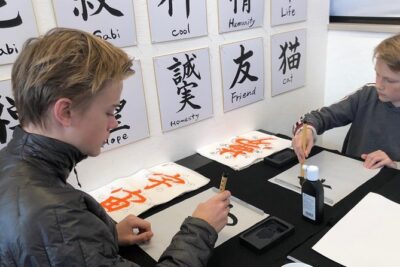
Let’s experience calligraphy in YANAKA, Taito-ku, TOKYO !!
Read our review →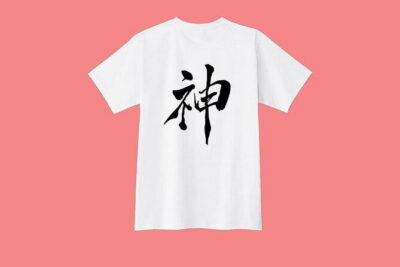
Calligraphy Workshop & Original T-Shirt Creation
Read our review →
Calligraphy Workshop & Original T-Shirt Creation
Read our review →Browse the lists this tour appears in