Reviewed · MORNING
Private Tokyo Early Morning Tour with English-Speaking Guide
Tokyo rewards early risers. This five-hour private tour links Shibuya, Harajuku, Akihabara, Ueno, and Asakusa before the day reaches full speed. I like the smart route, which covers seven major sights without leaving you to decode Tokyo’s train system alone, and I like the personal attention of an English-speaking guide. The main drawback is the pace: you will walk a lot, use public transportation, and pay an extra ¥900 per person for transit.
The early start is the real strength. Meiji Jingu is calmer in the morning, Senso-ji is easier to appreciate before the surrounding streets fill up, and Shibuya Crossing still gives you its famous photo moment. Guide Yukou received special praise for making the experience friendly and practical, including help with how to navigate each place. At $97.22 per person, this is not a bargain basement outing, but it can be fair value if you want a private orientation to Tokyo in one efficient morning.
In This Review
- Key points to know before booking
- Why the early morning timing matters in Tokyo
- Shibuya Crossing: Tokyo’s famous opening scene
- Meiji Jingu: quiet forest beside Harajuku
- Takeshita Street: a quick look at Harajuku style
- Kanda Shrine and Akihabara: tradition meets pop culture
- Ameyoko: food, shopping, and postwar Tokyo
- Senso-ji: the grand finish in Asakusa
- What the private format adds
- Is $97.22 per person a fair price?
- Walking, weather, and practical preparation
- Who should book this Tokyo morning tour?
- Should you book it?
- FAQ
- How long does the Private Tokyo Early Morning Tour last?
- Where does the tour start?
- Where does the tour end?
- Which places are visited?
- Is the tour private?
- Is the guide English-speaking?
- Is public transportation included in the price?
- Are temple and shrine admission fees included?
- Are food and drinks included?
- What happens if I arrive late?
Key points to know before booking
- Seven Tokyo stops in about five hours: You see Shibuya Crossing, Meiji Jingu, Takeshita Street, Kanda Shrine, Akihabara, Ameyoko, and Senso-ji.
- The early start avoids the worst crowds: Morning timing is especially useful in July, when heat and busy streets can make sightseeing harder.
- A private guide keeps the route moving: Only your group participates, so you can receive direct help with navigation and questions.
- The tour finishes in Asakusa: You can eat nearby, continue sightseeing, visit Tokyo Skytree, or ask the guide for directions.
- Public transport costs extra: Plan on ¥900 per person in addition to the tour price.
- This is an active walking tour: You need moderate fitness and must arrive on time, since late arrivals cannot join or receive a refund.
Why the early morning timing matters in Tokyo
Tokyo’s best-known places can feel very different at 8 or 9 in the morning than they do later in the day. The streets are not empty, but the softer pace gives you room to notice details, take photos, and listen to your guide without competing with a wall of noise.
The timing also helps with comfort. One person specifically praised starting early in July, before both the crowds and the heat built up. That advice is worth taking seriously. Tokyo summers can make a long walk feel much longer, so an early five-hour route is more pleasant than trying to cover the same ground in the afternoon.
You begin at the Hachiko Statue near Shibuya Station. This is a clear, memorable meeting point, but Shibuya Station and the surrounding streets can be confusing. Give yourself extra time. The tour has a strict late-arrival rule, and a private activity cannot simply wait for one missing person without disrupting the route.
The tour lasts about five hours and uses trains or other public transportation between areas. The ¥900 transport charge is not included. That extra cost is modest compared with the convenience of having someone guide you through the connections, but it should be part of your budget.
A few more Tokyo experiences worth weighing up
- Tokyo: Sumo Morning Practice Viewing Tour
★ 4.8 · 570 reviews - Tokyo: Sumo Morning Training Visit
★ 4.4 · 370 reviews - Tokyo: Sumo Morning Practice Tour at Sumida City
★ 4.8 · 308 reviews
Shibuya Crossing: Tokyo’s famous opening scene
The first stop is Shibuya Crossing, with about 20 minutes to take in the scene and get photos. When the signals change, people move across the intersection from several directions at once. It is one of Tokyo’s simplest sights to understand and one of the easiest to photograph.
The short stop works well because Shibuya Crossing is an observation moment rather than a place that needs a long visit. You can watch one or two signal changes, take pictures, and hear why this intersection has become such a familiar image of modern Tokyo.
The benefit of arriving early is space. You may still see plenty of people, but you are less likely to deal with the full crush found later in the day. Your guide can also help position you and keep the stop focused, rather than letting the first part of the tour swallow the schedule.
Meiji Jingu: quiet forest beside Harajuku
You spend about an hour at Meiji Jingu Shrine, dedicated to Emperor Meiji and Empress Shoken. The shrine sits in a forested area in the middle of Tokyo, making it a sharp change from Shibuya’s giant screens and traffic.
This is one of the most valuable stops on the route because it gives you a sense of Tokyo beyond shopping, electronics, and famous crossings. You can walk through the shrine grounds, observe the Shinto setting, and enjoy a calmer hour before the tour returns to city streets.
Admission to the temples and shrines is included, so you do not need to handle separate entry payments during the morning. The tour information lists the shrine admission as free, but the included admission promise still means the guide is handling the planned shrine and temple access as part of the experience.
An hour is enough to make this more than a quick photo stop. Wear comfortable shoes, though. The tour is built around walking, and the grounds add to the day’s total distance.
Takeshita Street: a quick look at Harajuku style
Takeshita Street gets about 20 minutes. This narrow, famous shopping street is linked with youth fashion, unusual boutiques, colorful sweets, and the playful side of Harajuku.
Twenty minutes gives you a taste rather than a shopping session. If you want to browse every shop or stop for food, you will need to return on your own. That is not a flaw in the tour’s design, since the goal is to show you several parts of Tokyo in one morning, but shoppers should keep expectations realistic.
The stop pairs nicely with Meiji Jingu. Within a short distance, you move from a quiet shrine setting to a street associated with youth culture and novelty shopping. That contrast helps you understand why Harajuku is such a useful Tokyo neighborhood to visit.
A completely different kind of day out in Tokyo:
- Mt Fuji and Hakone 1-Day Bus Tour Return by Bullet Train
★ 5.0 · 26,383 reviews - 1-Day Tokyo Bus Tour
★ 5.0 · 14,250 reviews - Tokyo: TOKYO SKYTREE® Admission ticket
★ 4.5 · 11,192 reviews - Tokyo: teamLab Planets TOKYO Digital Art Museum Entry Ticket
★ 4.6 · 9,779 reviews
Kanda Shrine and Akihabara: tradition meets pop culture
The 20-minute visit to Kanda Shrine gives you another look at Shinto worship. Kanda Shrine, also called Kanda Myojin, is associated with prosperity and protection. It is also popular with businesspeople and anime fans, which makes it a particularly good bridge to the next stop.
You then spend about 30 minutes in Akihabara, Tokyo’s electric town. The area is known for electronics, gaming, anime, collectibles, otaku goods, and maid cafés. You may find the area more interesting if you already have a clear interest in one of those subjects, but even a short visit shows how sharply Tokyo shifts from old religious sites to modern fan culture.
Do not expect a full shopping expedition here. Thirty minutes is enough to look around and get your bearings, not enough to compare every gadget shop or hunt down a particular collectible. The guide’s help is useful because Akihabara can feel scattered, with shops covering different interests across several blocks.
For me, this pairing is one of the tour’s strongest ideas. Kanda Shrine and Akihabara are close enough to connect in a single morning, yet they represent very different sides of Tokyo. You get cultural context instead of a string of similar photo stops.
Ameyoko: food, shopping, and postwar Tokyo
Ameyoko Shopping Street in Ueno receives about 20 minutes. The street began as a postwar black market and now sells seafood, snacks, clothing, souvenirs, and other everyday goods.
This is a good place to see a more commercial, local-feeling side of Tokyo. It is less polished than a major department store district, and the mix of food stalls and small shops gives the stop a direct, street-level character.
Again, time is limited. You can look, take photos, and note places to revisit, but food and drinks are not included. If you are hoping for a proper snack break, ask your guide how to fit one in without losing time at the later stops.
Ameyoko also works as a useful transition before Asakusa. It prepares you for a traditional shopping street near Senso-ji, while offering a different mood and history.
Senso-ji: the grand finish in Asakusa
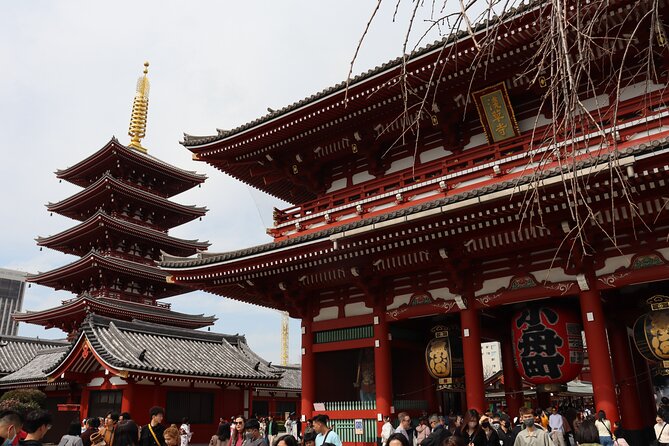
The final major stop is Senso-ji Temple, Tokyo’s oldest and most famous Buddhist temple. You spend about an hour here, which gives this landmark the time it deserves.
Senso-ji is known for Kaminarimon Gate, the large entrance gate, and Nakamise Street, lined with traditional shops. The temple is a strong finish because it brings together architecture, worship, shopping, and one of Tokyo’s most recognizable views.
The early schedule helps here, too. Asakusa becomes very busy, especially around the temple approach. An early visit gives you a better chance to see the gate and street without feeling pushed along by large crowds.
This is also where the tour ends, at Tokyo Cruise Asakusa Pier. The ending is practical. You can eat at a recommended restaurant, continue exploring Asakusa, ask for directions, or make your way toward Tokyo Skytree, which is nearby and suggested as a possible next stop.
Finishing in Asakusa rather than returning to Shibuya makes sense if you plan to spend the rest of the day in eastern Tokyo. It is less convenient if your hotel or next booking is back on the west side, so check your plans before reserving.
What the private format adds
A private tour means only your group participates. That gives you more direct access to the guide and avoids the social compromises of a large group. You can ask questions as they come up, and the guide can help you understand practical details such as shrine behavior, public transportation, and the best way to move between stops.
The English-speaking guide is central to the tour’s value. The experience includes a passionate local guide, and Yukou was singled out for his friendly approach and effort to show people how to do things at each site. That kind of help matters in Tokyo, where a first visit can involve unfamiliar train stations, signs, customs, and payment systems.
Professional photos are also included. The information does not specify how many photos you receive or how they are delivered, so I would treat this as a pleasant extra rather than the main reason to book. Still, having someone take pictures can be useful at Shibuya Crossing and the larger shrine and temple grounds.
Is $97.22 per person a fair price?
The listed cost is $97.22 per person, with group discounts available. You also pay ¥900 per person for public transportation, and food and drinks are separate.
The price makes the most sense for couples, families, or small private groups who value time and guidance. You are paying for a custom-feeling experience, an English-speaking local guide, shrine and temple admission, professional photos, and a route that covers several districts without requiring you to plan every train connection.
It is less compelling if you already know Tokyo’s transport system, prefer slow independent sightseeing, or mainly want time to shop. The schedule is efficient, but efficiency means short visits at Shibuya, Takeshita Street, Kanda Shrine, Akihabara, and Ameyoko.
The perfect group for this tour is visiting Tokyo for the first time and wanting a strong orientation. You see major landmarks, get a sense of how different neighborhoods connect, and finish with the rest of the day still available.
Walking, weather, and practical preparation
This is not a ride-around-and-look-out-the-window experience. The tour is designed as a walking experience supported by public transportation, with plenty of time on foot. Moderate physical fitness is recommended.
Wear supportive shoes and dress for the weather. An early start reduces heat exposure, but you are still outside for much of the morning. Bring water, since food and drinks are not included.
Keep your schedule open after the tour if possible. Senso-ji and Asakusa deserve more time than the one-hour visit if you want to shop, eat, or explore nearby streets. The guide can point you toward a restaurant or help with directions after the official route ends.
Free cancellation is available if you cancel at least 24 hours before the start time. Changes or cancellations inside that window are not accepted, and late arrival means you cannot join or receive a refund.
Who should book this Tokyo morning tour?
I would recommend it to first-time visitors who want to see a lot without spending their first morning studying maps. It also suits families and small groups who prefer the attention of a private guide and want help managing a busy city.
It is a good match for photographers, too. Shibuya Crossing, Meiji Jingu, Takeshita Street, Kanda Shrine, Akihabara, Ameyoko, and Senso-ji offer very different settings, and the early timing improves your chances of getting clear pictures.
I would think twice if you want deep shopping time, a relaxed meal, or long visits at every stop. The route covers a lot of ground, and its strength is variety rather than lingering.
Should you book it?
Book this tour if you want a fast, well-organized introduction to Tokyo with a private English-speaking guide. The early timing, strong landmark mix, included shrine and temple admission, and finish in Asakusa give you a useful first look at the city.
Skip it if you already know Tokyo well or dislike structured schedules. For everyone else, $97.22 plus ¥900 transport is a reasonable price for saving planning time and getting personal help from a guide such as Yukou. Arrive early, wear good shoes, and treat the tour as a city orientation, not a full day at each attraction.
FAQ
How long does the Private Tokyo Early Morning Tour last?
The tour lasts approximately five hours.
Where does the tour start?
It starts at the Hachiko Statue at 2 Chome-1 Dogenzaka, Shibuya, Tokyo 150-0043, Japan.
Where does the tour end?
The tour ends at Tokyo Cruise Asakusa Pier at 1-chome-1-1 Hanakawado, Taito City, Tokyo 111-0033, Japan.
Which places are visited?
The route includes Shibuya Crossing, Meiji Jingu Shrine, Takeshita Street, Kanda Shrine, Akihabara, Ameyoko Shopping Street, and Senso-ji Temple.
Is the tour private?
Yes. Only your group participates in the activity.
Is the guide English-speaking?
Yes. The tour includes a local English-speaking guide.
Is public transportation included in the price?
No. Public transportation costs ¥900 per person and is paid separately.
Are temple and shrine admission fees included?
Yes. Admission fees for all temples and shrines visited during the tour are included.
Are food and drinks included?
No. Food and drinks are not included.
What happens if I arrive late?
If you are late for the meeting time, you cannot join the tour and will not receive a refund.
Just added around Tokyo
- Tokyo Shibuya Walking tour With A Guide★ 4.4 · 22 reviews
- Tokyo’s Authentic and Finest Taiko Drumming Workshop★ 5.0 · 22 reviews
- Private Tokyo Local Food and Drink Tour with a Bar Hopping Master★ 5.0 · 22 reviews
- Tokyo: Visit Sumo Morning Practice with English Guide★ 4.5 · 22 reviews
- Nikko Toshogu, Kegon waterfall, Lake Chuzenji One Day Pvt. Tour★ 5.0 · 22 reviews
- Private Departure Transfer : Central Tokyo City to Haneda Airport★ 4.5 · 22 reviews
- Mt. Fuji and Hakone Private Tour with English Speaking Driver★ 5.0 · 22 reviews
- Private Tour with a Local Guide – Learn about daily life in Japan★ 5.0 · 22 reviews
Morning, compared.
Kyoto Early Morning Tour with English-Speaking Guide
Read our review →Early Morning Tour with English-Speaking Guide
Read our review →
World Heritage Shirakawa-go Morning Guided Tour
Read our review →
Nara Early Morning Tour (Kyoto or Osaka Departure Available)
Read our review →
Hiroshima in a Nutshell: Morning Bike Adventure
Read our review →