
Reviewed · ARASHIYAMA & BAMBOO GROVE TOURS
Kyoto: Arashiyama Bamboo Forest, Monkeys, Matcha & Temple Tour
Arashiyama packs a lot into four hours. This walking tour brings together Tenryu-ji Temple and its Zen gardens, the famous bamboo grove, a quiet shrine, matcha, a river bridge, and wild Japanese macaques. I like the smart mix of culture and nature, and I like that the guide-led route removes much of the guesswork from a busy Kyoto district. The main caution is the uphill hike to Monkey Park, which can be hard if your health or stamina is limited.
The tour costs $53.06 per person and runs about four to four and a half hours. That is a fair price if you want the temple entry, matcha drink, monkey park admission, and an English-speaking guide bundled together. Guides such as Tim, Sofia, Nay, Amy, Gabriele, and Shin have earned especially warm praise for clear explanations and good group management, though one poor experience points to a possible late start and uneven guiding.
In This Review
- Key reasons to consider this Arashiyama walk
- Why this four-hour route works
- Tenryu-ji Temple and its reflective Zen gardens
- The bamboo grove, with practical expectations
- Nonomiya Shrine and a quieter side of Arashiyama
- Matcha, including a welcome pause
- Togetsukyo Bridge and the open river view
- The uphill climb to Monkey Park Iwatayama
- Guides can make or break the day
- Price, timing, and what you receive
- Who should book this walk?
- Should you book it?
- FAQ
- Where does the tour begin?
- Where does the tour end?
- How long does the tour last?
- Is the tour conducted in English?
- How many people can join the tour?
- Is Tenryu-ji Temple admission included?
- Is Monkey Park admission included?
- Is matcha included?
- Is transportation included?
- Can I cancel for a full refund?
Key reasons to consider this Arashiyama walk
- Tenryu-ji comes first, giving you a calm start among one of Kyoto’s finest Zen gardens.
- The bamboo grove and Nonomiya Shrine fit naturally together, with both reached on foot in the Arashiyama area.
- Monkey Park Iwatayama adds real exercise, including an uphill climb and wide views over Kyoto.
- A Uji matcha drink is included, offering a pleasant pause before or after the more active part of the route.
- A maximum of 15 people keeps the group manageable, though the exact group size can vary.
- The tour has a 4.9 rating from 759 reviews and 99 percent recommendation, a strong signal that the guides usually make the experience work.
Why this four-hour route works
Arashiyama can feel scattered when you first arrive. The district sits on Kyoto’s western edge, with temples, wooded paths, the bamboo grove, the Katsura River, and Monkey Park spread across a walkable but busy area.
This route gives your visit a clear shape. You begin at Tully’s Coffee beside Randen Arashiyama Station, then move through the temple and bamboo area before crossing toward the bridge and monkey park. You return to the original meeting point at the end.
I like that the day is not built around one photo stop. The bamboo grove is famous, but it is only part of the experience. Tenryu-ji gives you art, design, and Zen tradition. Nonomiya Shrine adds a smaller and more intimate religious site. Togetsukyo Bridge provides open river views, while Monkey Park changes the mood again with wildlife and a climb.
The route lasts four to four and a half hours, so you need to plan for a half-day rather than a quick outing. Several people have praised the pace, especially when guides allow time for photos, questions, toilets, and short breaks. That matters in Arashiyama, where rushing from one landmark to the next can make the whole visit feel like a checklist.
More Temple & Shrine Tours in Kyoto
- Kyoto: Fushimi Inari, Kinkakuji, Bamboo Grove 1 Day Bus Tour
★ 4.8 · 4,316 reviews - Kyoto: Tea Ceremony in a Traditional Tea House in Kiyomizu
★ 4.9 · 3,519 reviews - Kyoto: Tea Ceremony Ju-An at Jotokuji Temple
★ 4.9 · 3,207 reviews
Tenryu-ji Temple and its reflective Zen gardens
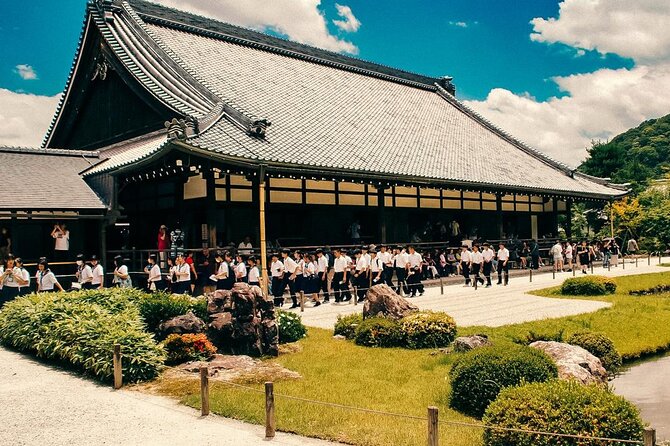
Tenryu-ji is the cultural anchor of the tour. It is a UNESCO World Heritage Site and one of Kyoto’s major Zen temples. The visit is scheduled for about 30 minutes, with admission included in the tour price.
The garden is the real reason to pay attention here. Its design uses water, trees, stones, and borrowed views of the surrounding hills to create a calm setting. The central pond and its reflections are particularly striking, and seasonal color changes give the garden a different mood across the year.
Your guide can help explain details you might otherwise pass without noticing. The point is not simply to photograph a pond or a temple roof. The garden reflects a way of arranging space so that movement slows and the eye has room to rest.
Thirty minutes is enough for an introduction, but it is not a long temple visit. If you want to study every garden feature or spend time inside the temple buildings, you may want to return on your own after the tour. The included admission still adds good value, since you do not have to arrange a separate visit before joining the group.
This is also a useful first stop because it sets a quieter tone. Afterward, the bamboo grove feels less like an isolated social-media landmark and more like another expression of Arashiyama’s connection between nature and spiritual life.
The bamboo grove, with practical expectations
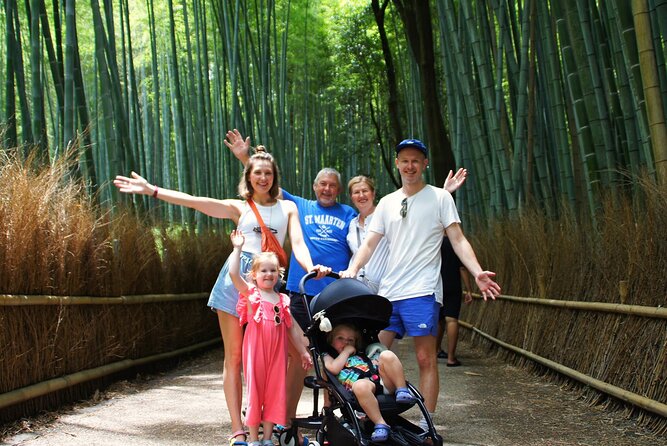
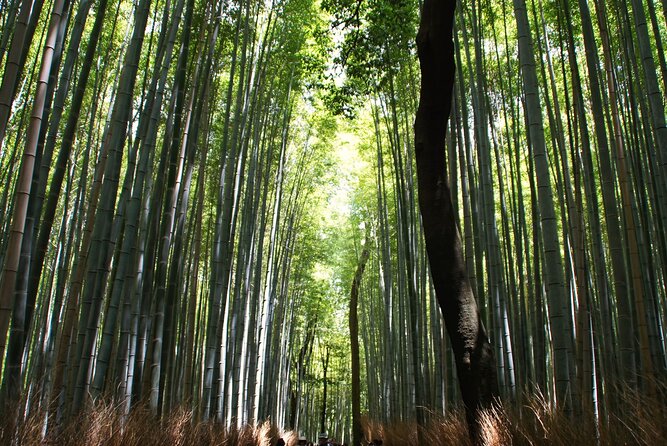
The Arashiyama Bamboo Forest is the image most people associate with this part of Kyoto. Tall bamboo rises on both sides of the path, creating a narrow green corridor where the stalks sway overhead.
The scheduled visit lasts about 30 minutes, and there is no separate admission charge. That makes the stop easy to fit into the route, but you should keep your expectations sensible. The grove is a public path, not a private garden, and its fame means the experience can vary with the number of people around you.
I like having a guide here because the stop can otherwise become a quick walk, a few photographs, and a hurried exit. A good guide can explain the cultural importance of bamboo, point out nearby details, and help the group keep moving without losing the atmosphere.
The path itself is not the demanding part of the tour. The more serious physical challenge comes later at Monkey Park. Still, you will spend much of the experience on foot, so comfortable shoes are essential. One guide, Nay, was praised for keeping the pace comfortable across different age groups, while other guides made a point of allowing everyone time for pictures.
Nonomiya Shrine and a quieter side of Arashiyama
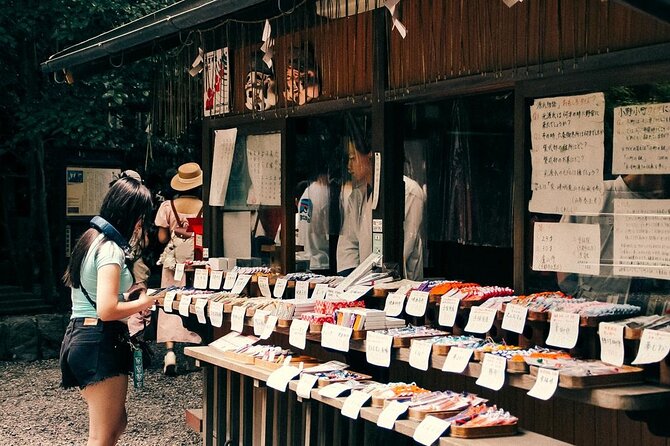
Nonomiya Shrine receives about 15 minutes on the route. It is small compared with Tenryu-ji, but that is part of its appeal.
The shrine was linked with ancient purification rituals and sits among mossy woods. Its setting feels more private and subdued than the bamboo path nearby. This is a useful stop for understanding how Shinto traditions connect sacred places with trees, moss, and natural surroundings.
Fifteen minutes will not allow for a long visit, but it gives you enough time to look around and hear the basic story from your guide. I would pay attention to the contrast here. Tenryu-ji presents a carefully shaped Zen garden, while Nonomiya feels more enclosed and woodland-based.
This short stop also breaks up the more heavily photographed parts of Arashiyama. If you enjoy smaller religious sites more than major monuments, you may find Nonomiya one of the most atmospheric moments of the walk.
More Arashiyama and bamboo grove walks:
- Osaka/Kyoto:Kinkakuji,Arashiyama,FushimiInariShrine,NaraPark
★ 4.1 · 1,596 reviews - Kyoto/Osaka: Nara, Fushimi Inari Taisha, Arashiyama Bus Tour
★ 4.7 · 1,275 reviews - Kyoto Arashiyama Walking Tour: Bamboo, Monkeys, Gardens & Secrets
★ 5.0 · 1,216 reviews - Arashiyama Bamboo, Temple, Monkeys, or Secret Sake Brewery
★ 4.8 · 886 reviews
Matcha, including a welcome pause
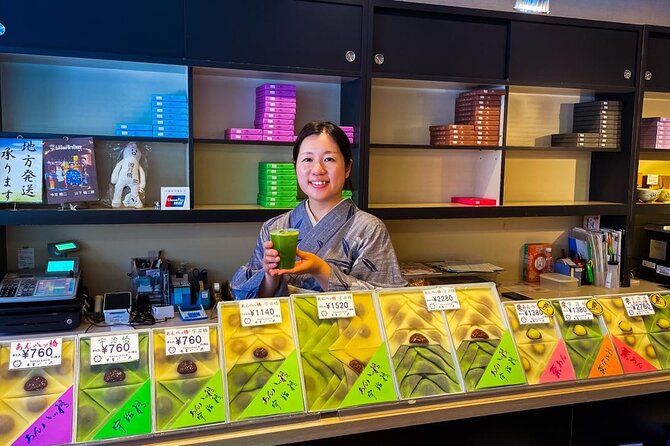
The tour includes one Uji matcha drink. The precise length of the tea stop is not stated, but it functions as a break within the walking route.
That small inclusion has real value. A half-day walk through Arashiyama can become tiring, and matcha gives you a chance to pause before the bridge and monkey park portion. Some participants also praised a matcha ice cream stop, but the advertised inclusion is a Uji matcha drink, so you should not assume an ice cream is guaranteed.
Uji is a well-known tea-producing area near Kyoto, and matcha has a powdered texture and focused flavor that differs from ordinary brewed green tea. A proper cup can be slightly bitter, especially if you are used to sweet drinks. That is part of the point: you get a brief taste of a local food tradition rather than just another bottled refreshment.
The tea stop also helps the experience feel less like a fast march between landmarks. Guides including Tim and Gabriele were praised for adding food and local suggestions along the way, which can be useful if you plan to stay in Arashiyama after the tour ends.
Togetsukyo Bridge and the open river view
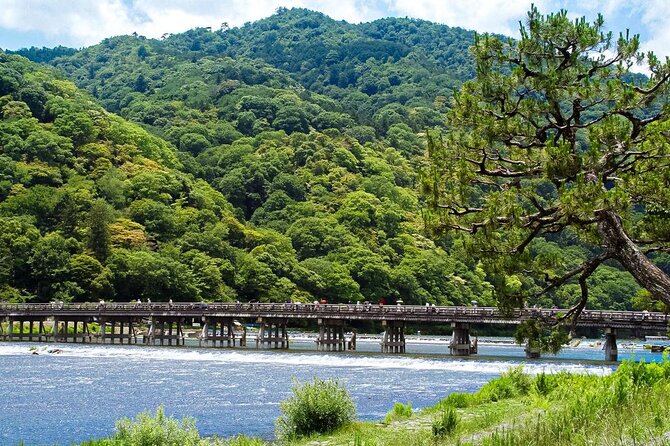
Togetsukyo Bridge is one of Arashiyama’s best-known symbols. The name means Moon Crossing Bridge, and the bridge gives you a very different view from the enclosed bamboo paths.
The scheduled stop is only about 10 minutes. That is enough to cross, take photographs, and look along the river toward the surrounding hills. It is not enough for a long riverside break, so consider the bridge a scenic pause rather than a full sightseeing session.
I like this part of the route because it opens up the day. The bamboo grove narrows your view and focuses your attention overhead. At the bridge, you can look outward across the river and see how the district fits together.
The bridge is also a useful orientation point. The tour ends back at the starting location, while the bridge area puts you near more restaurants, shops, and riverside activities if you choose to continue exploring after the group walk.
The uphill climb to Monkey Park Iwatayama
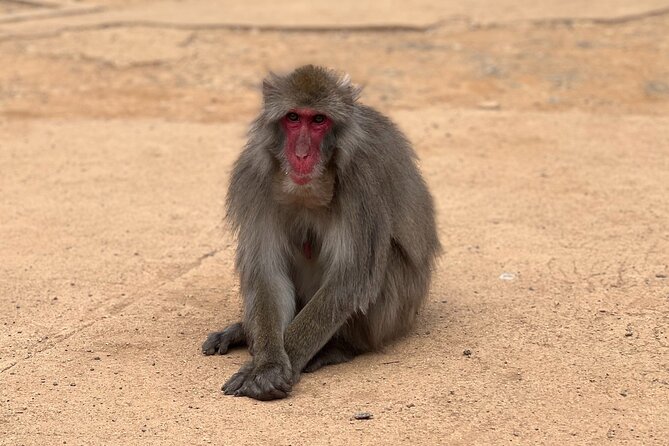
Monkey Park is the most active part of the tour. The visit lasts about one hour and includes the entrance fee.
You reach the park by a short but uphill hike. The climb is important to understand before booking. Several people praised the macaques and the views, but others noted that the ascent can be difficult, especially in poor weather or for anyone not in good health.
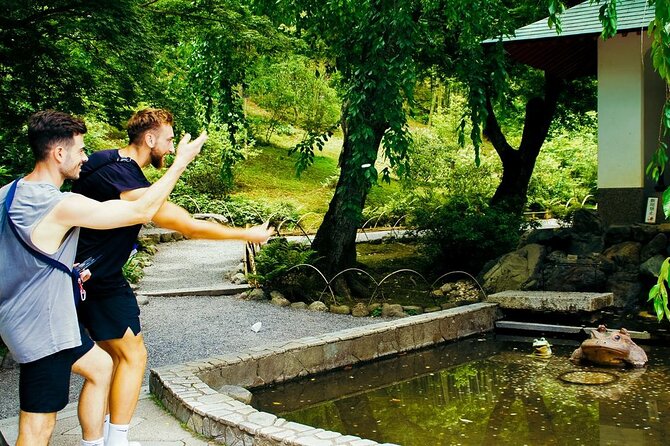
At the top, you can see wild Japanese macaques moving and interacting nearby. The animals are not presented as a staged performance. They are free to move around the park, and the experience is based on watching their natural behavior.
The park has a feeding area, and the macaques generally do not approach you unless you go there, according to the practical guidance included in the experience feedback. You still need to follow the park’s rules and keep a sensible distance. The appeal is watching the troop, including young monkeys, rather than trying to touch or attract them.
The Kyoto view is an added reward. From the mountaintop, the city spreads below with mountains in the distance. This wide view helps explain Kyoto’s setting better than another street-level photograph would.
The one-hour allocation gives you time to recover from the climb and watch the animals. If the weather is wet, the path may feel slippery or harder to manage. Anyone with mobility concerns should think carefully about this stop. One couple skipped the uphill section because of recent hospital stays while their friends continued, which shows that the tour can still offer plenty even if you cannot complete every part, but there is no stated alternative activity or transport to the top.
Guides can make or break the day
The tour’s strongest feature is often the guide. The best comments praise guides who explain the history of each stop, answer questions, keep the pace steady, and make the walk enjoyable without losing control of the group.
Tim was praised for being entertaining and well informed about the area. Sofia was described as attentive. Nay earned credit for detailed explanations and a comfortable pace. Gabriele Cammisuli was especially praised for making time for photographs and questions, while Amy and Daniel were recognized for keeping a large group on track.
Shin, with Maggie training alongside him, handled a large group well. Pedro supported Shen with explanations about the places visited. These details suggest that guide quality can vary by departure, but the company has several guides who know how to bring personality and structure to the route.
There is one important counterpoint. A poor experience involved a late start caused by delayed arrivals and a guide whose explanations felt limited and scripted. That appears to be the exception rather than the usual pattern, given the high overall score, but it is worth remembering that a group tour depends partly on the guide assigned that day and on everyone arriving on time.
The stated group limit is 15 people. That is not private touring, but it is small enough for a guide to keep track of the group and respond to questions. Arrive at Tully’s Coffee at Randen Arashiyama Station on time, since delays can affect the schedule for everyone.
Price, timing, and what you receive
At $53.06 per person, the tour offers solid value for a guided half-day in Kyoto. The price includes an English-speaking guide, Tenryu-ji admission, one Uji matcha drink, and Monkey Park admission.
The included admissions matter. You are not paying only for a walk through free public areas. Tenryu-ji and Monkey Park both have entry costs, and the tour handles those as part of the booking.
The value is strongest if you want a structured introduction to Arashiyama. You get several major sights in one route, along with explanations and basic group support. The value is weaker if you prefer lingering at one temple, taking long café breaks, or setting your own pace.
Tips are not included and are optional. The tour accepts mobile tickets, confirmation arrives when you book, and the meeting area is near public transportation. Free cancellation is available up to 24 hours before the start time. Cancellations or changes made less than 24 hours ahead are not accepted for a refund.
Who should book this walk?
I would choose this tour if you have one half-day for Arashiyama and want more than the bamboo grove. It suits first-time Kyoto visitors who appreciate clear routing, cultural context, and a guide who can connect the temple, shrine, tea, river, and wildlife stops.
It also works well for active families and couples who enjoy variety. Children may find the monkeys more memorable than the temple, while adults can appreciate the gardens and shrine. The hike means you should not treat this as an easy stroll.
You may prefer to visit independently if you want a slow temple morning or if you already know Arashiyama well. Independent visitors can spend longer at Tenryu-ji, return to the bamboo grove at a quieter time, or skip Monkey Park entirely.
The strongest reason to book is the combination. Few short outings give you a UNESCO temple, bamboo forest, Shinto shrine, matcha, historic bridge, and macaques in one organized route. The strongest reason to hesitate is the climb and the fixed pace.
Should you book it?
For most reasonably active visitors, yes. The 4.9 rating from 759 reviews and 99 percent recommendation fit the tour’s strengths: strong guides, good variety, useful pacing, and included entry fees.
Book it if you want an efficient introduction to Arashiyama and do not mind walking uphill. Skip it if the Monkey Park climb would be unsafe or if you prefer long, quiet visits over a scheduled route. Wear comfortable shoes, arrive on time, and treat the bamboo grove as one part of a larger Kyoto experience rather than the whole show.
FAQ
Where does the tour begin?
It begins at Tully’s Coffee Randen Arashiyama Station Shop, located at 20-2 Sagatenryuji Tsukurimichicho, Ukyo Ward, Kyoto, 616-8384, Japan.
Where does the tour end?
The tour ends back at the original meeting point.
How long does the tour last?
The tour lasts approximately four to four and a half hours.
Is the tour conducted in English?
Yes. An English-speaking professional guide is included.
How many people can join the tour?
The maximum group size is 15 people.
Is Tenryu-ji Temple admission included?
Yes. Entry to Tenryu-ji Temple is included in the tour price.
Is Monkey Park admission included?
Yes. The entrance fee to Monkey Park Iwatayama is included.
Is matcha included?
Yes. One Uji matcha drink is included.
Is transportation included?
The tour begins near public transportation, but the provided tour details do not state that transportation is included.
Can I cancel for a full refund?
Yes, if you cancel at least 24 hours before the experience start time. Cancellations made less than 24 hours before the start time are not refunded.
Just added around Kyoto
- Kyoto: Gion Night Walking Tour with Geisha Insight★ 5.0 · 39 reviews
- Kyoto: Private Customizable Day Trip by Car★ 5.0 · 38 reviews
- Kyoto: Full Day Bike Tour★ 4.9 · 39 reviews
- Private Japanese Calligraphy in Kyoto – Learn Shodō with a Master★ 5.0 · 39 reviews
- Experience a tea ceremony in an authentic tearoom, in Kyoto!★ 4.5 · 41 reviews
- Kyoto: Gion Evening Walk with Hidden Gems, Geisha & Sake★ 5.0 · 41 reviews
- Kyoto Private Photo Shoot & Tour by SnapKyoto★ 5.0 · 41 reviews
- The Way of Tea: Kyoto Crafts, Hidden Temples & Wabi-Sabi Walk★ 5.0 · 41 reviews
Arashiyama & Bamboo Grove Tours, compared.
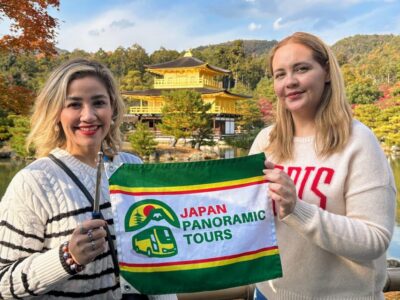
Fushimi Inari, Kinkakuji, Bamboo Grove 1 Day Bus Tour
Read our review →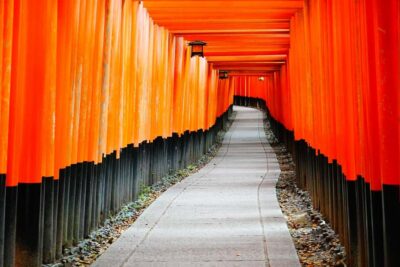
Osaka/Kyoto:Kinkakuji,Arashiyama,FushimiInariShrine,NaraPark
Read our review →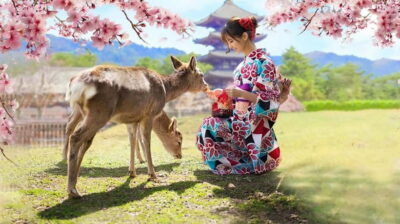
Kyoto/Osaka: Nara, Fushimi Inari Taisha, Arashiyama Bus Tour
Read our review →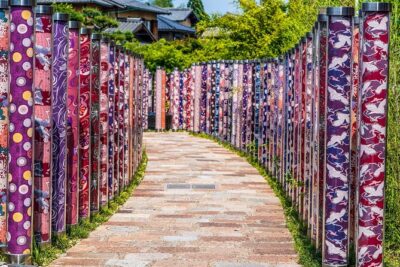
Kyoto Arashiyama Walking Tour: Bamboo, Monkeys, Gardens & Secrets
Read our review →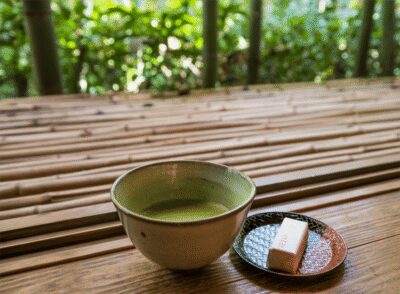
Arashiyama Bamboo, Temple, Monkeys, or Secret Sake Brewery
Read our review →
Osaka/Kyoto: Arashiyama, Nara & Fushimi Inari Shrine w/Lunch
Read our review →
Nijo, Kinkaku-ji, Arashiyama, Kiyomizu & Fushimi Inari
Read our review →
Kyoto Ghost Tour: Dark Tales, Urban Legends, Bamboo Forest Night
Read our review →Browse the lists this tour appears in