
Reviewed · FULL-DAY
Osaka’s Best and Brightest: Private Full-Day Tour by Vehicle
Osaka rewards a little local help. This private day tour packs major sights, food districts, temples, and neighborhood streets into about seven and a half hours, with an English-speaking guide driving you between stops. I like the hotel pickup within central Osaka and the freedom to adjust the day around your interests. I also like that the guides, including Thomas, Kevin, Hugo, Ferdinand, and Lito, are praised for local lunch ideas, clear explanations, family-friendly help, and good photo-taking skills.
The main thing to consider is the price: $600 per group of up to six is a serious outlay for one day. It can be good value for a full group, especially if you have limited time or want to avoid Osaka’s trains, but a couple traveling alone may find public transport cheaper. The day also involves walking, even though the vehicle handles the longer transfers.
In This Review
- Key points to know before booking
- Why a private car works well in Osaka
- Osaka Castle: start with the city’s great symbol
- Shitennoji: a quieter temple break
- Shinsekai: Osaka with the volume turned up
- Abeno Harukas and Tennoji: lunch with a high view
- Kuromon Market: a quick look at Osaka’s food culture
- Dotonbori: finish under the famous neon
- Guides who shape the experience
- Price, group size, and practical value
- Who will enjoy this Osaka day most
- Should you book Osaka’s Best and Brightest?
- FAQ
- How long does the tour last?
- How many people can join the private tour?
- Is hotel pickup available?
- What attractions are included in the route?
- Is lunch included in the price?
- Are admission fees included?
- Can the itinerary be changed?
- Is a child seat available?
Key points to know before booking
- Six major Osaka stops in one day: The route covers Osaka Castle, Shitennoji, Shinsekai, Abeno Harukas, Kuromon Market, and Dotonbori.
- A private vehicle changes the pace: You avoid repeated train transfers and can spend more of your day sightseeing, though traffic can still affect timing.
- The itinerary can bend: The listed route is a model course, and the guide may adjust stops, walking, and timing around your interests and energy level.
- Local lunch is a recurring highlight: Food is not included, but guides such as Kevin, Hugo, Thomas, and Levy have taken groups to local places they personally like.
- Expect a mix of history and modern Osaka: You move from castle grounds and one of Japan’s oldest Buddhist temples to shopping arcades, food stalls, skyscraper views, and neon signs.
- Best for short stays and groups: A group of four to six gets the strongest value, while families and visitors who dislike complicated transit gain the most convenience.
Why a private car works well in Osaka
Osaka has a fine rail system, but a sightseeing day by train can become a small logistical project. You need to find the right station exit, walk through large station buildings, manage transfers, and keep everyone together. A private vehicle removes much of that work.
The guide is also the driver, so you have one person handling navigation and interpretation. That matters at places where the story is not obvious from the buildings alone. The English-speaking guides are described as friendly, easy to understand, and able to explain Japanese culture alongside the history of each place.
You can also ask for more or less walking. One group appreciated that Ferdinand changed the plan after Osaka Castle when tired legs became an issue. That flexibility is useful, but do not mistake a vehicle tour for a no-walking tour. You still explore castle grounds, temple grounds, markets, shopping streets, and Dotonbori on foot.
The vehicle is private to your group, with space for up to six people. For a family or group of friends, that gives you control over conversation, stops, and the day’s general rhythm. For two people, the same private service costs more per person, so the value depends on how much you prize time and ease.
A few more Osaka experiences worth weighing up
- Osaka: Minoh, Katsuoji Temple, & Minoh Falls Full-day Tour
★ 4.9 · 172 reviews - Full Day Tour of Kyoto with Private Transportation
★ 5.0 · 130 reviews - Full Day Hiroshima and Miyajima Tour by Bullet Train from Osaka
★ 4.5 · 117 reviews
Osaka Castle: start with the city’s great symbol
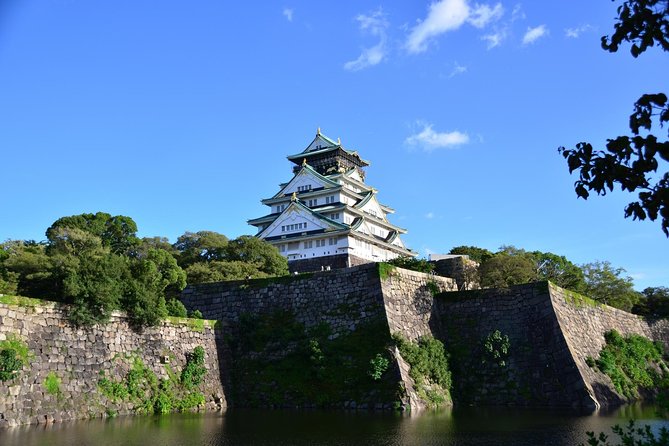
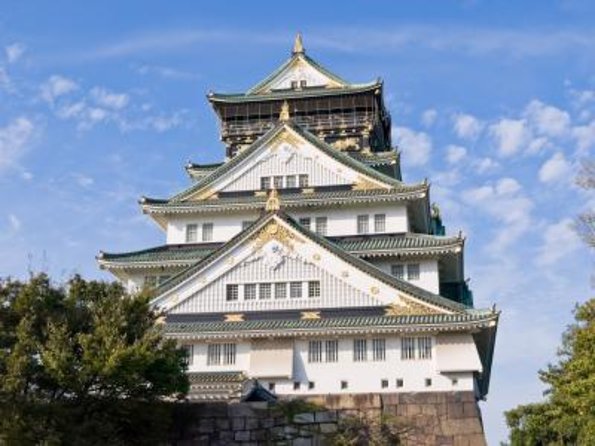
Osaka Castle is the natural opening stop. You get about an hour around the grounds, with admission listed as included. The castle is Osaka’s most recognizable landmark and an important place for understanding the city’s role in Japanese history.
The useful part of having a guide here is the explanation while you walk. You are not simply looking at stone walls and a striking tower. Your guide can connect the site to the people and events that shaped Osaka, then answer questions as they come up.
The visit focuses on the grounds rather than promising a long interior museum visit. That is worth noting if entering the castle tower is your main goal. The schedule is fairly tight, and the tour description gives free admission for this stop, so ask your guide at the beginning how much time will be spent inside if that matters to you.
The grounds are also a good place for photographs. Lito was praised for taking excellent pictures, while other guides helped families manage photos and children during the day. If you want a particular castle photo, mention it early rather than hoping the schedule produces it by chance.
Shitennoji: a quieter temple break
The next stop is Shitennoji, with about 45 minutes to stroll around the grounds. It is described as one of Japan’s oldest Buddhist temples, and it provides a useful change of mood after the scale and crowds of Osaka Castle.
I like this stop because it gives the day some breathing room. The temple is not treated as a long lecture. The plan is to share enough background to make the buildings and grounds meaningful, then let you walk and look around.
Several tours of Osaka can become a procession of famous signs and shopping streets. Shitennoji helps prevent that. It gives you a quieter religious setting in the middle of the city and shows a side of Osaka that is easy to miss when you focus only on food and entertainment.
You will still need to walk across the temple grounds. The route can be adjusted to suit your energy, but this stop is most rewarding if you are willing to slow down for a little while.
Shinsekai: Osaka with the volume turned up
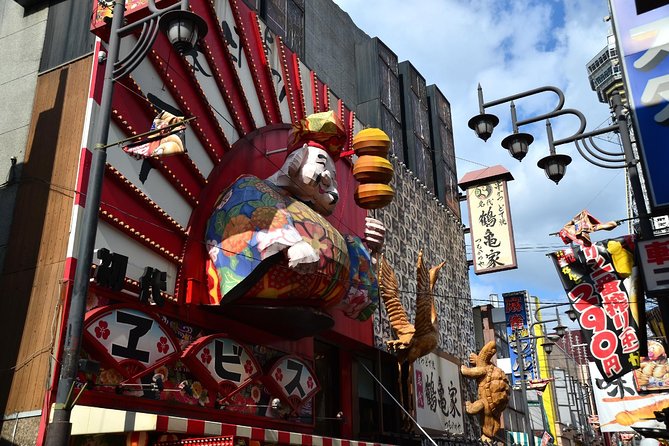
Shinsekai gets around 30 minutes, making it one of the shorter stops. The area is known for games, food, fashion, and a strong sense of old-school Osaka character. It is not polished in the way some central shopping districts are, and that is part of its appeal.
Your guide can help you read the neighborhood rather than simply passing through it. Look for the odd details, colorful storefronts, local eating spots, and the general mix of nostalgia and everyday life. The tour description calls it fun for all ages, though individual tastes will vary. Some people will enjoy its eccentric energy, while others may prefer the temple or castle stops.
Thirty minutes is enough for an introduction, but not enough for a slow meal or serious shopping. If Shinsekai catches your interest, ask whether you can trade time from another stop. The itinerary is flexible, but traffic and the other scheduled visits limit how much the guide can add.
A completely different kind of day out in Osaka:
- Osaka Go Karting Tour with Funny Costume
★ 5.0 · 2,658 reviews - Osaka Castle: Museum and Tower Entry Ticket
★ 4.5 · 2,380 reviews - Osaka: Shinsekai Food Tour with 13-15 Dishes at 5 Eateries
★ 4.8 · 2,204 reviews - Osaka Food Tour: 13 Dishes at 5 Local Eateries
★ 5.0 · 2,149 reviews
Abeno Harukas and Tennoji: lunch with a high view
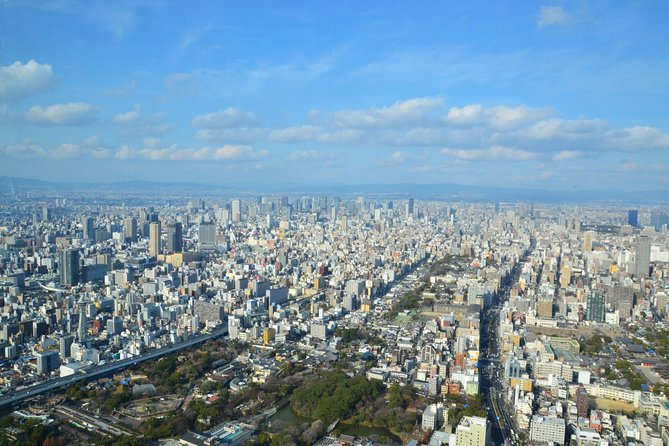
Abeno Harukas receives the longest scheduled block, about one hour and 40 minutes. This includes lunch in the Tennoji area and a trip up Harukas, the 300-meter building described as Japan’s tallest non-tower building.
Lunch is not included, which is normal for a private tour with a flexible food choice. The advantage is that you can tell the guide what you like and how much time you want to spend eating. Kevin, Hugo, Thomas, and Levy were all praised for taking groups to local places, including restaurants in neighborhoods they know well.
That personal recommendation can be more useful than a standard restaurant stop. You may get a chance to try local food without spending your limited Osaka time comparing menus or wandering around hungry. Still, be clear about your preferences. One disappointing experience involved a request for udon that led to mall food courts instead of the kind of local restaurant the group expected.
The Harukas portion adds a modern city view to a day otherwise filled with historic and street-level stops. Since the admission fees are included, you do not need to budget separately for the attraction itself, though your meal and drinks remain extra.
The schedule gives you enough time for both lunch and the building, but not an unlimited shopping session. Abeno Harukas is also described as a good place to shop, so tell your guide if retail time matters more to you than a longer stop elsewhere.
Kuromon Market: a quick look at Osaka’s food culture
Kuromon Market gets about 25 minutes. That is a short visit, but it can be a lively feast for the eyes, with fish, meat, fruit, and plenty of people competing for your attention.
The market is ideal for seeing Osaka’s food culture in one compact stretch. You might find something to sample, but you should not assume this is a full market meal. With only 25 minutes, treat it as a quick introduction unless you arrange a different pace with your guide.
This stop works especially well for people who enjoy seeing what a city eats, not just what it photographs. Ask about unfamiliar ingredients, local habits, and what might be worth returning for later. Since food and drinks are not included, carry a little spending money if you want to buy something.
The market can also feel crowded, so keep your group close and be ready to move at the guide’s pace. The vehicle makes the transfers easy, but once you are on foot, the market requires attention.
Dotonbori: finish under the famous neon
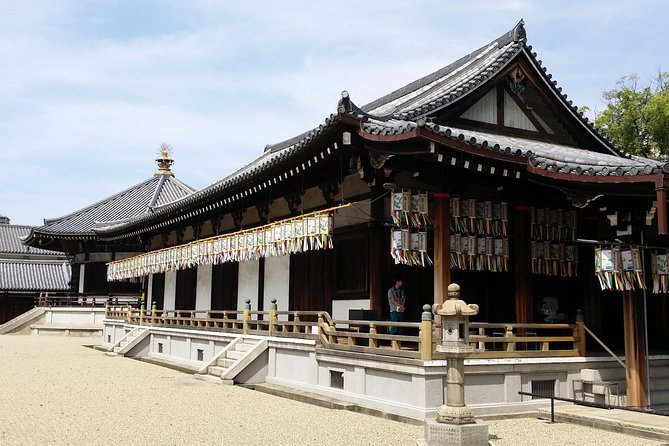
The final scheduled stop is Dotonbori, with about an hour. This is Osaka’s most famous entertainment and food district, known internationally for its Running Man sign and its bright canal-side streets.
The best part of this stop is the flexibility. Your guide can show you more than the standard photo point, including back streets, the kitchenware district, and other places based on your interests. That is where the private format earns its keep. You can ask for food suggestions, shopping, photographs, or a closer look at a particular part of the neighborhood.
An hour goes quickly in Dotonbori. It is enough to see the main sights and get your bearings, but not enough to explore every side street or settle in for a long meal. If you want dinner there, ask whether the tour timing can be adjusted. The itinerary is a model rather than a fixed promise, but traffic and earlier stops may make changes difficult.
Ending in Dotonbori gives the day a lively finish. After the calm of Shitennoji and the historical focus of Osaka Castle, the neon, food, and crowds show you the city’s playful side.
Guides who shape the experience
The guide can make or break this tour because you spend the whole day with the same person. The strongest feedback centers on guides who are warm, flexible, and able to mix facts with conversation.
Thomas is praised for his friendly manner, excellent English, and attention to how people are coping with the walking. Kevin receives repeated praise for local food choices, cultural comparisons, family assistance, photos, and his ability to add less familiar places alongside the main sights.
Hugo is described as especially strong on Osaka’s history, Japanese culture, and comparisons between Japanese and Western life. Ferdinand adapted the schedule for tired legs, and Lito was praised for making the day interactive and fun. Levy was also credited with adjusting the itinerary and finding a good local lunch.
These details tell you what to request when booking. Share your food preferences, walking limits, must-see places, children’s needs, and interest in history before the day begins. The tour is designed to flex, but the guide needs useful information to make good choices.
One low-rated experience shows the risk of assuming personalization will happen without a conversation. The group wanted a fun family day and a specific udon stop, while the guide leaned more heavily into history and followed the planned route. The lesson is simple: explain the kind of day you want.
Price, group size, and practical value
The price is $600 per group of up to six. If six people share the cost, that works out to $100 per person. A group of four pays $150 each, while two people pay $300 each.
That price includes the private vehicle, driving and vehicle-related fees, an English-speaking guide, and admission fees. It does not include lunch, other food, drinks, or a child seat. A child seat costs 1,000 yen per booking and must be requested in advance when required.
For a full group, the math can be reasonable. You are paying for a private driver-guide, a planned route, local interpretation, and the ability to change the pace. The strongest value comes when you have only one day in Osaka and want to see both major attractions and local neighborhoods without piecing together transport.
For a couple with several days in the city, the calculation is less convincing. Osaka’s public transport is extensive, and independent sightseeing will cost much less. You are mainly paying for time saved, translation, local suggestions, and reduced mental effort.
Pickup is offered within central Osaka, described as within or along the JR Loop Line. Pickup outside that area costs extra. Confirm your hotel location and any added fee before booking.
The tour requires moderate physical fitness, though the amount of walking can be adjusted. Confirmation arrives at booking, and free cancellation is available up to 24 hours before the start time. Changes or cancellations inside that window are not accepted for a refund.
Who will enjoy this Osaka day most
I would choose this tour if you have one packed day in Osaka, are traveling with a family, or have a group large enough to share the $600 cost. It is also a strong choice if train transfers are tiring, confusing, or simply not how you want to spend your holiday.
The tour suits people who want a broad introduction rather than a specialist visit to one site. In one day, you see historic buildings, a temple, a distinctive neighborhood, a skyscraper, a market, and Osaka’s best-known entertainment district.
You should think twice if you want a slow schedule, long meals, or hours of shopping. Six stops in seven and a half hours is efficient, not leisurely. Traffic may force changes, and the short blocks at Shinsekai and Kuromon Market leave limited time for lingering.
You should also communicate clearly. Ask for the type of lunch you want, explain whether your group prefers history or local life, and name any places you would like added. The private format gives you room to shape the day, but it does not remove the need to speak up.
Should you book Osaka’s Best and Brightest?
Book it if you want an easy, wide-ranging introduction to Osaka and can fill most of the vehicle. The combination of Osaka Castle, Shitennoji, Shinsekai, Harukas, Kuromon Market, and Dotonbori gives you a strong first look at the city, while guides such as Kevin, Hugo, Thomas, Ferdinand, Lito, and Levy add local food advice and personal context.
Skip it if you are a couple on a tight budget, already comfortable using trains, or hoping for a slow food-focused day. For everyone else, especially families and short-stay groups, the private vehicle and flexible schedule can make $600 worthwhile. Set your expectations, tell the guide what matters to you, and you are more likely to get the relaxed, personal Osaka day this experience is built to provide.
FAQ
How long does the tour last?
The tour lasts approximately 7 hours and 30 minutes.
How many people can join the private tour?
The private vehicle accommodates one group of up to six people.
Is hotel pickup available?
Pickup is offered within central Osaka, described as within or along the JR Loop Line. Pickup outside that area may require an additional fee.
What attractions are included in the route?
The model route includes Osaka Castle, Shitennoji, Shinsekai, Abeno Harukas, Kuromon Market, and Dotonbori.
Is lunch included in the price?
No. Food and drinks are not included. The guide can help choose a lunch place, and several guides have taken groups to local restaurants.
Are admission fees included?
Yes. The tour includes all admission fees listed for the experience.
Can the itinerary be changed?
Yes. The listed route is a model course, and changes may be possible based on your interests, walking needs, traffic, and available time.
Is a child seat available?
Yes. Children under six years old or shorter than 140 centimeters must use a car seat under Japanese law. The seat costs 1,000 yen per booking and should be requested in advance.
Just added around Osaka
- Osaka Food Tour with 10 Classic Japanese Tastings & Drinks★ 5.0 · 38 reviews
- Osaka: Highlights & Hidden Gems Private Walking Tour★ 4.7 · 38 reviews
- Kyoto private tour (Shore excursion available from Osaka or Kobe port)★ 5.0 · 39 reviews
- Osaka Private Day Trip – Enjoy Your First-Time Visit to Osaka!★ 5.0 · 39 reviews
- Kyoto & Nara & Uji: Full Day Sightseeing Tour from Osaka or Kyoto★ 4.5 · 39 reviews
- Authentic SUSHI Course Cooking Class★ 5.0 · 39 reviews
- Osaka: Mind & Spirit Balance Temple Reiki Healing★ 5.0 · 41 reviews
- Osaka: Gluten-Free Ramen and Gyoza Cooking Class★ 5.0 · 42 reviews
Full-Day, compared.
Mount Fuji Full-Day Private Tour from Tokyo (Customizable)
Read our review →
Hiroshima / Miyajima Full-day Private Tour with Government Licensed Guide
Read our review →

5 Top Highlights of Kyoto Full Day Bike Tour (E-bike option)
Read our review →
Full Day Biking Tour Exploring the Best of Kyoto
Read our review →
Mt. Fuji, Hakone Full-Day Private Tour with English Driver Guide
Read our review →Browse the lists this tour appears in