
Reviewed · WALKING TOURS
The Old Quarter of Tokyo – Yanaka Walking Tour
Tokyo has a quieter side. In Yanaka, you walk past wooden homes, small temples, neighborhood lanes, and old shops that feel far removed from Ginza or Omotesando. This three-hour walking tour offers a useful introduction to that calmer corner of the city, with an English-speaking local guide explaining the customs, stories, and daily life you might miss on your own.
I especially like the small-group size, capped at 10 people, and the way the route mixes religious sites with ordinary residential streets. I also like the finish at Yanaka Ginza, where you can browse local shops and buy food after the walk. The main drawback is that you spend much of the three hours outdoors, so hot, humid, or rainy weather can make the experience less comfortable.
In This Review
- Key points at a glance
- Why Yanaka feels different from central Tokyo
- Starting at Nippori Station
- Tennoji Temple and the Yanaka Buddha
- Yanaka Cemetery and local customs
- Ueno-Sakuragi Atari and old wooden houses
- Enju-ji Temple and the god of strong legs
- Nezu Shrine and its red torii gates
- Hebimichi and the ordinary side of Tokyo
- Yanaka Ginza, the tour’s practical finish
- What the guides add
- How much value do you get for $40?
- Who should book this walk?
- My verdict on the Yanaka experience
- FAQ
- How long is the Yanaka walking tour?
- Where does the tour begin?
- Where does the tour finish?
- How many people can join the tour?
- Is food included in the tour price?
- What happens if bad weather cancels the tour?
Key points at a glance
- A rare look at old Tokyo: See wooden houses, narrow lanes, temples, shrines, and a cemetery in one compact neighborhood.
- Small group, personal help: The tour allows a maximum of 10 people, giving you a better chance to ask questions and get photos taken.
- Strong local storytelling: Guides such as Aya, Junko, Mei, Rei, Mami, Kiyo, and Polina have been praised for clear English, cultural explanations, and friendly service.
- A useful religion lesson: You learn how Buddhist temples and Shinto shrines differ, including basic etiquette at religious sites.
- Ends at Yanaka Ginza: The final shopping street is a practical place to sample sweets, street food, and local products at your own expense.
- Good value at $40: For three hours with a local guide and a small group, the price is fair, though food and personal purchases cost extra.
Why Yanaka feels different from central Tokyo
Tokyo is enormous, modern, and fast moving. Yanaka offers a different rhythm. The neighborhood contains older wooden buildings, quiet lanes, temples, shrines, and a cemetery, creating a more residential setting than the city’s major shopping districts.
Some parts of Yanaka survived the World War II bombings, which helps explain the older architecture and the neighborhood’s traditional feel. You are not walking through a preserved open-air museum. People still live here, shop here, worship here, and use the side streets as part of daily life.
That difference gives the tour its value. You do not simply collect famous sights. You get context for how old Tokyo developed and how Buddhist and Shinto customs remain part of ordinary Japanese life.
The route is also useful if you have already seen Shibuya, Shinjuku, Asakusa, or the Imperial Palace and want a change of pace. Yanaka will not deliver giant neon signs or grand city views. Its appeal is smaller and more personal: a temple garden, a local food stall, a wooden house, or a quiet lane where you can see Tokyo functioning at neighborhood level.
More Walking Tours in Tokyo
- Tokyo Tsukiji Fish Market Food and Culture Walking Tour
★ 5.0 · 3,184 reviews - Tokyo: Imperial Palace and Shogun Historical Walking Tour
★ 5.0 · 2,251 reviews - Tokyo: Shinjuku Local Bar and Izakaya Guided Walking Tour
★ 4.9 · 1,794 reviews
Starting at Nippori Station
The tour begins at Nippori Station at 2 Chome-19 Nishinippori in Arakawa City. The meeting point is near public transportation, which makes it practical to reach from other parts of Tokyo.
Starting at Nippori also puts you close to the older part of Yanaka from the beginning. Instead of wasting time on a long transfer into the district, you can begin walking almost at once.
You should arrive ready to walk for about three hours. The route includes temple grounds, a cemetery, narrow residential streets, a shrine, and a shopping street. Comfortable shoes matter. One person specifically noted the need for sun protection and a hat during a 35-degree day with high humidity.
The pace appears moderate rather than rushed. There is a break at Ueno-Sakuragi Atari, and the stops are short enough to keep the route moving. Still, three hours outside is a long time in Tokyo’s summer heat. Bring water, protect yourself from the sun, and check the weather before setting out.
Tennoji Temple and the Yanaka Buddha
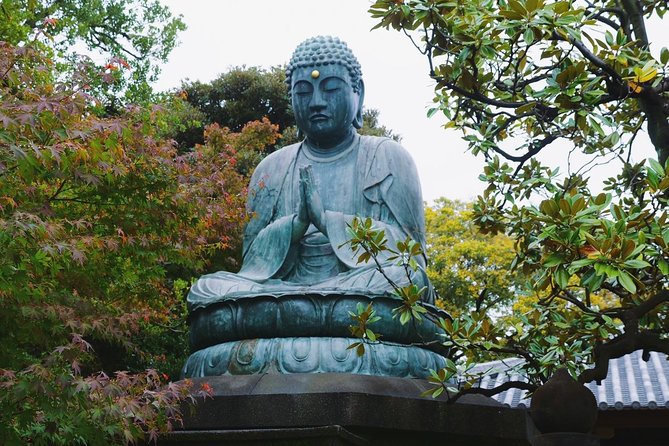
The first major stop is Tennoji Temple, home to the Yanaka Buddha. The statue was created in 1690, giving your guide a useful starting point for discussing Japanese religion and the role of Buddhist temples.
This is not just a quick photo stop. The guide explains the religious setting and the stories connected with the temple. That background helps you understand what you are looking at, particularly if Buddhist architecture and customs are new to you.
The stop lasts about 15 minutes, and admission is free. Since the tour is guided in English, you can ask questions instead of trying to work out the meaning of the site from signs alone.
The short visit is also a strength. You get an introduction without spending too long at one temple before the walk moves into the neighborhood.
Yanaka Cemetery and local customs
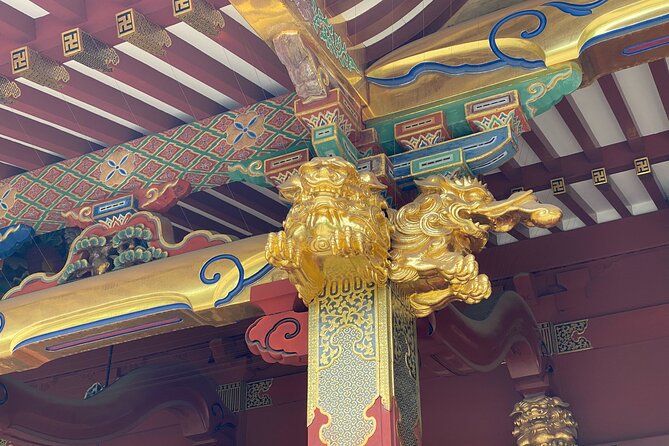
From Tennoji, the group walks through Yanaka Cemetery. Here you learn what a Japanese cemetery is like and about customs followed by local people.
For many visitors, this may be one of the most useful parts of the morning or afternoon. A cemetery can tell you a great deal about family traditions, religion, and the way a neighborhood remembers its past. A guide can explain details that would otherwise seem mysterious or easy to misunderstand.
The cemetery stop takes about 15 minutes and has no admission charge. You should remember that it is an active place of remembrance, not simply a sightseeing site. Follow your guide’s instructions and keep your behavior quiet and respectful.
This part of the walk also changes the mood. Yanaka is not presented as a parade of attractions. The route shows how religious spaces and everyday residential life sit side by side.
A completely different kind of day out in Tokyo:
- Mt Fuji and Hakone 1-Day Bus Tour Return by Bullet Train
★ 5.0 · 26,383 reviews - 1-Day Tokyo Bus Tour
★ 5.0 · 14,250 reviews - Tokyo: TOKYO SKYTREE® Admission ticket
★ 4.5 · 11,192 reviews - Tokyo: teamLab Planets TOKYO Digital Art Museum Entry Ticket
★ 4.6 · 9,779 reviews
Ueno-Sakuragi Atari and old wooden houses
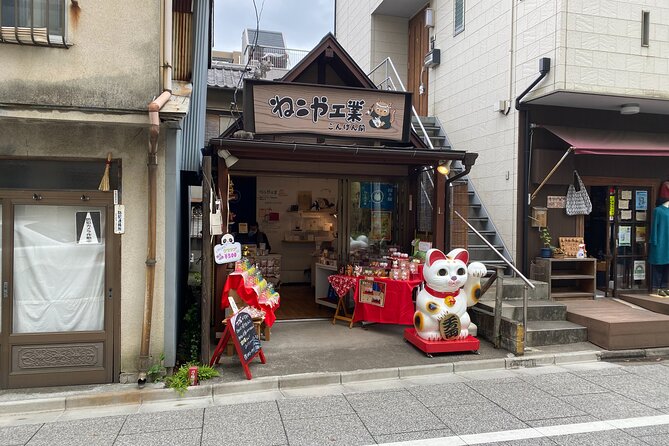
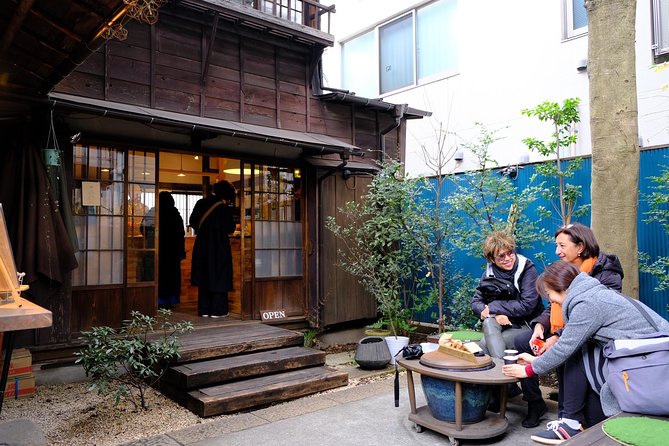
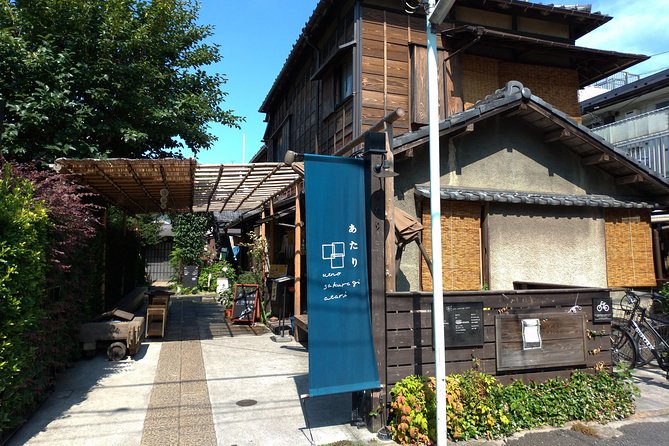
The tour then reaches Ueno-Sakuragi Atari, a group of roughly 80-year-old wooden houses that were renovated into a cafe, bakery, and beer hall. The buildings now serve as a community space for local people.
This is one of the route’s best stops because it connects old architecture with present-day use. You see how older homes can be adapted rather than simply torn down or displayed behind glass.
The stop lasts about 15 minutes. Food, drinks, and purchases are not included, so you can decide for yourself if you want to spend money here or save your appetite for Yanaka Ginza.
The route also points out a 100-year-old cider tree, described as a symbol of Yanaka. It is a small detail, but these are the kinds of neighborhood markers that help a place feel specific. You are not just walking through an anonymous old district. You are learning which buildings, trees, and corners matter to local residents.
Enju-ji Temple and the god of strong legs
Enju-ji Temple offers a more unusual religious detail. Instead of focusing on a typical Buddhist figure, the temple enshrines a god associated with strong legs.
People with foot problems write their wishes on wooden boards at the temple. The stop takes only about five minutes, but it adds variety to the route and shows how religious practice can be direct, practical, and closely tied to everyday concerns.
Admission is listed as not included, so check the arrangements with your guide if any payment is requested. Since the stop is brief, it works best as a quick cultural detail rather than a major temple visit.
I like this part of the tour because it moves beyond the broad explanation that Japan has Buddhist temples and Shinto shrines. You see a specific local belief and how people express personal hopes at a religious site.
Nezu Shrine and its red torii gates
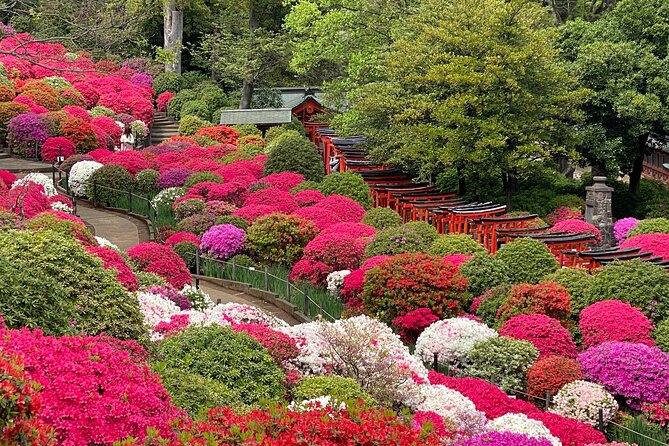
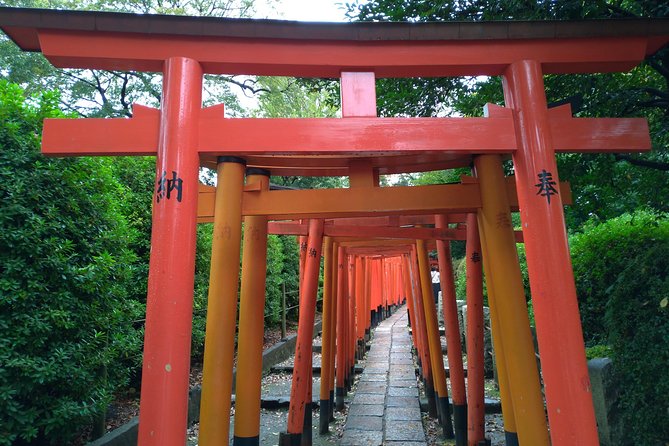
Nezu Shrine is the most visually striking stop on the route. You can see rows of red torii gates, similar in appearance to those at Fushimi Inari Shrine in Kyoto, and take photos at one of Tokyo’s most beautiful Shinto shrines.
The guide also explains shrine etiquette. This matters. A visit to a Japanese shrine is more rewarding when you understand basic behavior, such as how to approach the site and how to show respect. You do not need to memorize a long list of rules, but a short explanation helps you feel less awkward.
The stop lasts around 20 minutes and admission is free. You should have time for photographs, though the exact amount depends on the pace of the group and the conditions on the day.
Nezu Shrine provides a good contrast with Tennoji Temple. Seeing both Buddhist and Shinto sites in the same walk helps you understand that these traditions coexist in Japan rather than occupying completely separate worlds.
Hebimichi and the ordinary side of Tokyo
After the shrine, the route turns onto Hebimichi, a back street in a residential area. Here you see Japanese daily life up close.
This may be the least dramatic stop on paper, but it is central to the experience. Tokyo’s famous districts are designed to attract attention. Hebimichi offers the opposite: a narrow local street where the interest comes from the setting itself.
A guide is particularly useful here. Without explanation, you might simply see houses and a quiet lane. With local context, you can better appreciate the contrast between older neighborhood life and the high-rise city associated with Tokyo.
You should also remember that these are residential streets. Keep voices low, avoid blocking entrances, and ask before photographing people or private homes. The charm of Yanaka depends partly on it remaining a lived-in neighborhood.
Yanaka Ginza, the tour’s practical finish
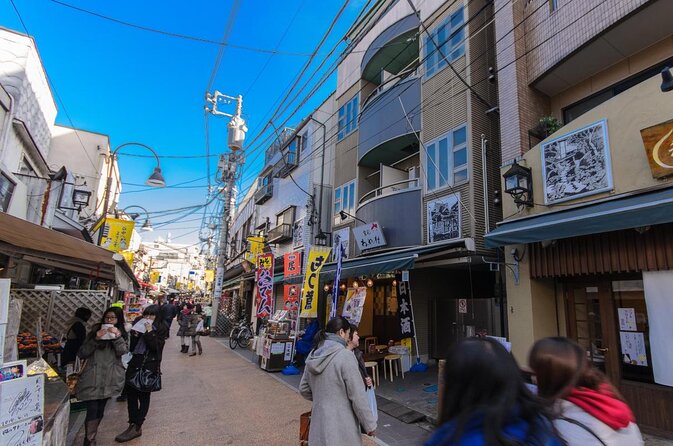
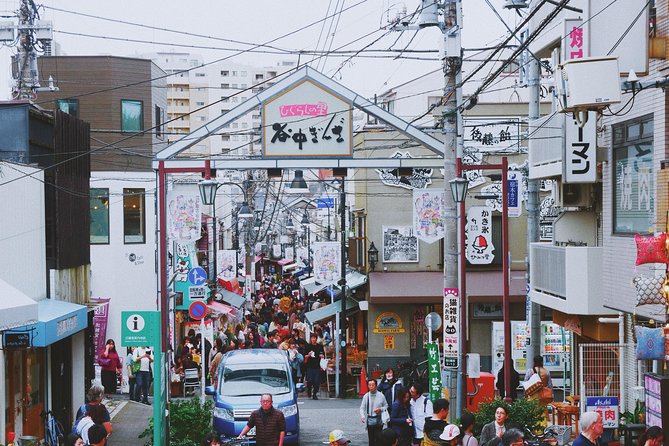
The walk concludes at Yanaka Ginza Shopping Street at 3 Chome-13-1 Yanaka in Taito City. This is a lively finish after the quiet temples and side streets.
Your guide explains which shops are worth a look and points out foods and sweets you can try. Food is not included, so bring some Japanese yen or another accepted payment method for anything you want to buy. Personal expenses are also separate.
Yanaka Ginza is a good place to continue on your own because the formal tour ends here. You can eat, browse, or simply watch local shopping life for a while. The ending is more useful than finishing at a station with nowhere to pause.
The shopping street also reinforces one of the tour’s main ideas. Old Tokyo is not only about temples and preserved houses. It is also about ordinary commerce, neighborhood snacks, small shops, and the daily routines that keep a district alive.
What the guides add
The guides are the main reason to choose this experience instead of walking the same streets independently. The strongest feedback centers on clear English, patience, local knowledge, and a friendly manner.
Aya has been praised for answering questions fully, offering to take photos, bringing laminated images to explain points along the route, and recommending a bakery built into one of the old houses. Junko has been described as especially familiar with the area, including by people who noted that she lives in the neighborhood.
Mei has been praised for enthusiasm and for showing the group places to try street food. Rei has been singled out for answering questions and explaining cultural and religious customs. Kiyo has been credited with discussing both the area’s past and its present.
Other guides named in the feedback include Polina, Mami, and Mommi. The consistent pattern is more important than any single guide’s name: you are likely to get a guide who can explain the area in natural English and adjust the discussion to the group’s questions.
The small-group limit of 10 helps. It is large enough to maintain a social feel, but small enough for the guide to notice people, answer questions, and take occasional photos. One group of nine found the size intimate and the pace comfortable.
How much value do you get for $40?
At $40 per person, this is not the cheapest way to walk through Yanaka. You could explore the neighborhood independently for little more than the cost of transportation and anything you eat.
The price becomes easier to justify if you value explanation. You are paying for a three-hour route, an English-speaking local guide, help with religious etiquette, neighborhood stories, photo opportunities, and a more efficient introduction to places you might otherwise pass without understanding.
I see it as good value for a first visit to Yanaka, especially if you have limited time in Tokyo. The route brings together temples, a cemetery, renovated wooden houses, a shrine, a residential lane, and a shopping street. Recreating that sequence alone would be possible, but you would need to research the area and interpret much of it yourself.
Food, drinks, temple charges where applicable, shopping, and gratuities are not included. Tips are optional. Plan to spend extra at Yanaka Ginza if sampling local foods is part of your reason for booking.
Who should book this walk?
I would choose this tour if you want a quieter side of Tokyo, enjoy local history, or want help understanding Japanese religious customs. It also suits people who have already seen the city’s major sights and want a more residential setting.
It is a good fit for couples, solo visitors, and families with older children who can manage three hours of walking. Most people can participate, and service animals are allowed.
I would be more cautious if you dislike walking, struggle in heat and humidity, or want a tour built around major monuments. The route is not a fast checklist of famous Tokyo attractions. Its rewards come from small details and the guide’s explanations.
There is also a weather condition to keep in mind. The experience requires good weather. If poor weather forces cancellation, you can receive a full refund or move to another date. You can cancel for a full refund up to 24 hours before the start time, but late cancellations and changes are not accepted.
My verdict on the Yanaka experience
Book this walk if you want Tokyo to feel less like a giant city and more like a collection of neighborhoods. The route has a sensible mix of temples, shrines, old buildings, quiet lanes, and local shopping.
I especially value the contrast between Tennoji Temple and Nezu Shrine, the stop at the renovated wooden houses, and the final chance to eat at Yanaka Ginza. The guides add the meaning that makes these places worthwhile, with Aya, Junko, Mei, Rei, Kiyo, Polina, and others receiving particularly warm praise for their English and personal attention.
Skip it if you want grand views, long temple visits, or an indoor activity. For most people seeking an authentic and manageable introduction to old Tokyo, though, this is a well-priced three-hour walk that gives you a side of the city you could easily miss.
FAQ
How long is the Yanaka walking tour?
The tour lasts approximately three hours.
Where does the tour begin?
It begins at Nippori Station, at 2 Chome-19 Nishinippori, Arakawa City, Tokyo 116-0013, Japan.
Where does the tour finish?
The tour ends at Yanaka Ginza Shopping Street, at 3-chōme-13-1 Yanaka, Taito City, Tokyo 110-0001, Japan.
How many people can join the tour?
The group has a maximum of 10 participants.
Is food included in the tour price?
No. Food, drinks, and personal expenses are not included. You can buy local foods and sweets at Yanaka Ginza if you wish.
What happens if bad weather cancels the tour?
Because the experience requires good weather, you will be offered another date or a full refund if it is canceled due to poor weather.
Just added around Tokyo
- Tokyo 6hr Instagram Highlights Private Tour with Licensed Guide★ 5.0 · 38 reviews
- Tokyo Small Group Tour with Guide★ 4.5 · 38 reviews
- Tokyo Sumo Experience with Live Show & Audience Challenge★ 5.0 · 38 reviews
- Very popular in Harajuku♡Animal petting zoo★ 4.6 · 39 reviews
- Japanese Food Cooking Class in Asakusa, Tokyo★ 5.0 · 39 reviews
- Ramen Making from Scratch with Tokyo Mom(Vegan Option Available)★ 5.0 · 39 reviews
- Tokyo: Kimono Rental inside Shinjuku Gyoen National Garden★ 4.9 · 39 reviews
- Tokyo JDM Night: 600hp C63s AMG Edition 1 (Private)★ 4.9 · 39 reviews
Walking Tours, compared.
Kyoto Geisha Walking Tour: Gion District & Hidden Gems
Read our review →
Tokyo Tsukiji Fish Market Food and Culture Walking Tour
Read our review →
Gion Magical Night Walking Tour with Geisha Trivia
Read our review →
Imperial Palace and Shogun Historical Walking Tour
Read our review →
Gion Geisha District Walking Tour – Stories of Geisha
Read our review →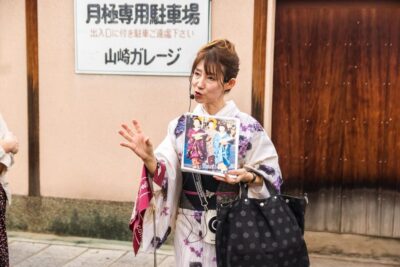

Shinjuku Local Bar and Izakaya Guided Walking Tour
Read our review →
Browse the lists this tour appears in