
Reviewed · WALKING TOURS
Tokyo Shibuya Crossing & Hidden Streets Walking Tour
Shibuya is more than one famous crossing. This two-hour walk pairs the spectacle of Shibuya Crossing with quieter corners, small bars, a striking mural, and the local stories that make the district easier to understand. I especially like the small-group cap of 12 and the practical food and drink advice from guides such as Loc, Rio, Grey, Zach, and Daichi. The main drawback is the meeting point inside Shibuya Mark City, which can be hard to locate, and the route includes several uphill stretches.
At $25 per person, this is a useful first look at Shibuya rather than a deep historical tour. I like that it ends at the Hachiko Statue, close to the station, and that the guide helps you handle Shibuya’s maze of streets without wasting time on wrong turns. You should also plan for humidity, crowds, and a fairly brisk pace, even though guides have adjusted the walk for older participants and taken breaks when needed.
In This Review
- Five things to know before you book
- Why this two-hour Shibuya walk works
- Finding SABON inside Shibuya Mark City
- Myth of Tomorrow and the story behind the mural
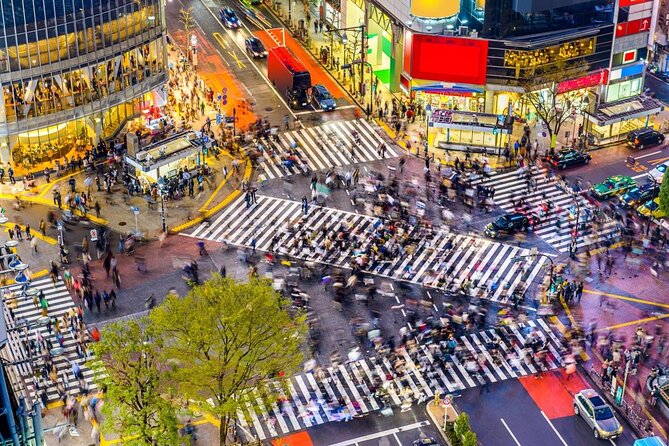
- Shibuya Crossing: spectacle with a practical purpose
- Miyashita Park shows a newer Shibuya
- Nonbee Yokocho delivers the small-scale atmosphere
- Center-gai puts youthful Shibuya on display
- Maruyamacho adds hills, nightlife, and local texture
- Hachiko makes a convenient finish
- The guides make the difference
- Is $25 a fair price?
- Who should take this Shibuya walking tour?
- Should you book it?
- FAQ
- How long does the Shibuya walking tour last?
- Where does the tour start?
- Where does the tour end?
- How many people can join the tour?
- Is the tour available with a mobile ticket?
- What happens if the weather is poor?
Five things to know before you book
- The route goes beyond the crossing: You visit Myth of Tomorrow, Miyashita Park, Nonbee Yokocho, Center-gai, Maruyamacho, and Hachiko.
- The group is limited to 12 people: That gives you a better chance to ask questions than on a large city tour.
- The meeting point takes care: Start at SABON in Shibuya Mark City East Mall, not at the Hachiko Statue.
- The walk has hills: Comfortable shoes and water matter, especially in warm or humid weather.
- The guide adds practical value: Food, bar, and neighborhood tips can help shape the rest of your time in Tokyo.
Why this two-hour Shibuya walk works
Shibuya can feel like several different cities packed into one district. You have the polished station complex, giant video screens, youth fashion, quiet lanes, small drinking spots, modern parks, and neighborhoods with traces of an older Tokyo. The famous crossing gets most of the attention, but it takes only a few minutes to reach places that feel quite different.
That is the strength of this tour. You are not simply taken to the intersection, allowed to take a photo, and sent on your way. The guide connects the major sights with side streets and explains what you are seeing. Several guides, including Loc and Grey, have been praised for making the walk feel relaxed and conversational rather than like a lecture.
A two-hour format is also sensible. You get an introduction without giving up half a day in Tokyo. The tradeoff is that each stop is short. You will see seven places, but this is an overview, not a slow visit with long time at every site.
The group limit of 12 is another plus. In crowded Shibuya, a large party would be difficult to keep together. A small group makes it easier to hear explanations, cross roads together, and ask about restaurants, nightlife, Japanese culture, or the neighborhood’s past.
More Walking Tours in Tokyo
- Tokyo Tsukiji Fish Market Food and Culture Walking Tour
★ 5.0 · 3,184 reviews - Tokyo: Imperial Palace and Shogun Historical Walking Tour
★ 5.0 · 2,251 reviews - Tokyo: Shinjuku Local Bar and Izakaya Guided Walking Tour
★ 4.9 · 1,794 reviews
Finding SABON inside Shibuya Mark City
The tour begins at SABON, located in Shibuya Mark City East Mall on the third floor. The address is 1-chome 12-3 Dogenzaka, Shibuya, Tokyo 150-0043. This is the least user-friendly part of the arrangement.
Shibuya Mark City is a large complex, and the meeting point is a shop rather than an unmistakable outdoor landmark. One person spent about 20 minutes searching and missed the start. I would arrive early, keep the mobile ticket ready, and allow extra time to find the East Mall and third floor.
Do not assume the Hachiko Statue is the starting point. It is the end point. That distinction matters because Hachiko is much easier to identify and is often the landmark first-time visitors use when meeting in Shibuya.
Once you find the guide, the route becomes much easier. Shibuya has layered streets, station exits, pedestrian flows, and sudden changes in elevation. A guide who knows the area can save you from spending your first hour simply trying to work out where you are.
Myth of Tomorrow and the story behind the mural
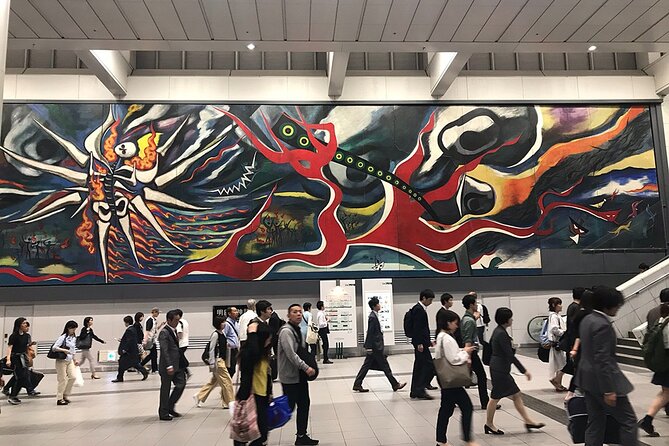
The first stop is Myth of Tomorrow, a large mural by Japanese artist Taro Okamoto inside Shibuya Station. The visit lasts about 10 minutes, and there is no separate admission charge.
This is a serious and powerful way to begin. The mural depicts the destruction caused by the atomic bombings of Hiroshima and Nagasaki. Its location in a busy station creates a sharp contrast between the artwork’s subject and the constant movement around it.
The guide’s explanation is important here. Without context, you might walk past a large, dramatic wall painting and see only color and form. With an introduction to Okamoto and the mural’s subject, the work becomes a point of entry into modern Japanese memory and art.
Ten minutes is enough to understand why the mural matters, but not enough for a long art discussion. If you care deeply about Japanese art, you will want to return later and look at it again at your own pace.
Shibuya Crossing: spectacle with a practical purpose
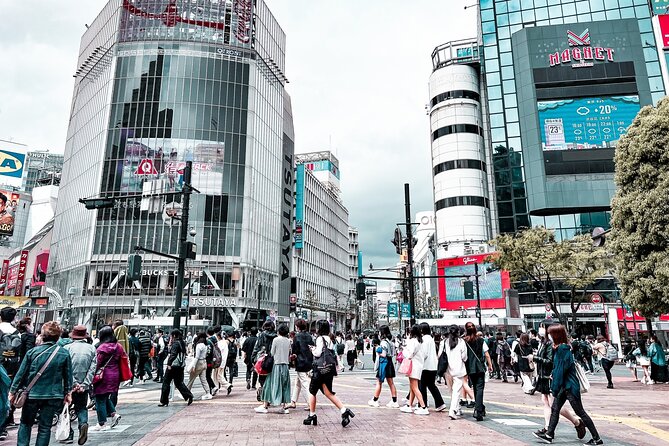
The stop at Shibuya Crossing lasts around 10 minutes. Known locally as the Scramble, it is the moment most people expect from a Shibuya walk, and the tour gives you the chance to cross it rather than only watch from the side.
The crossing is famous because several streams of pedestrians move through the intersection at once, then somehow clear the space without much fuss. It can remind you of Times Square in New York, though the experience here is shaped by Tokyo’s order and courtesy.
Your guide helps place the scene in context and points out useful views. The stop is short, so do not expect a long photography session. You will get the experience of crossing and a chance to take in the scale of the intersection, but the best extended viewing spots are not part of the stated schedule.
This is also where the small group helps. Staying together through a busy crossing is easier with 12 people than with 30 or 40. You can enjoy the spectacle without constantly checking whether you have lost the guide.
A completely different kind of day out in Tokyo:
- Mt Fuji and Hakone 1-Day Bus Tour Return by Bullet Train
★ 5.0 · 26,383 reviews - 1-Day Tokyo Bus Tour
★ 5.0 · 14,250 reviews - Tokyo: TOKYO SKYTREE® Admission ticket
★ 4.5 · 11,192 reviews - Tokyo: teamLab Planets TOKYO Digital Art Museum Entry Ticket
★ 4.6 · 9,779 reviews
Miyashita Park shows a newer Shibuya
Miyashita Park receives about 20 minutes, making it the longest stop on the route. This unusual urban renewal project turns a former simple green space into a multi-level sports and recreation area.
The park helps explain how Shibuya keeps changing. It is not an old temple district or a preserved historic quarter. Instead, it shows Tokyo adapting valuable city space for modern recreation, shopping, and public use.
This stop also gives the walk some breathing room after the crossing. You might find a different rhythm here, with open areas and a change from the station’s dense movement. The guide can explain how the park fits into the wider district and may point out shopping options nearby.
The 20-minute timing is enough for a useful orientation, but not for a full visit to every part of the complex. If Miyashita Park interests you, treat the tour as a preview and return independently.
Nonbee Yokocho delivers the small-scale atmosphere
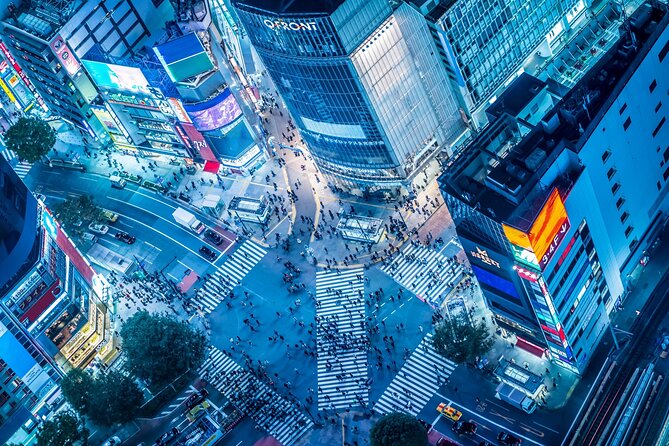
Nonbee Yokocho, or Drunkard’s Alley, gets only five minutes. That sounds brief, but the lane is compact, and the point is to see its character rather than sit down for a meal.
This narrow area near Shibuya Station is known for tiny traditional Japanese bars. Some spaces seat only three or four people. That detail gives you a glimpse of a kind of nightlife that feels very different from the huge chains and high-rise commercial spaces elsewhere in Shibuya.
The guide can explain how these small drinking spots work and why parts of the area may not remain unchanged forever. That warning adds useful perspective. Tokyo is famous for constant renewal, and even the most atmospheric lanes can face pressure from rising land values and redevelopment.
You should not expect a tasting or a bar stop here. Admission is free, and the visit is observational. If you like small drinking alleys, ask your guide for advice about returning later.
Center-gai puts youthful Shibuya on display
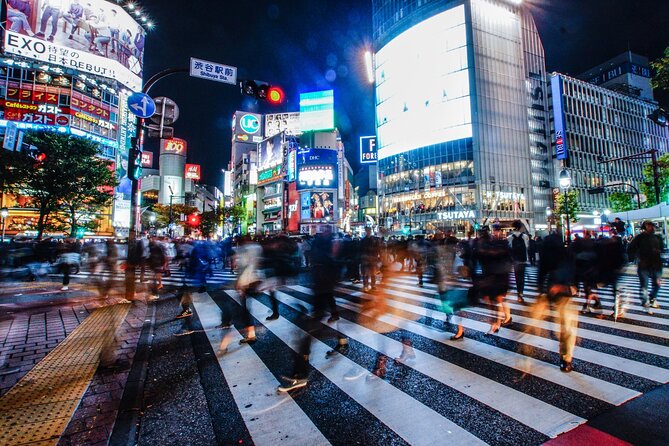
Shibuya Center-gai is a busy shopping street at the heart of the district. The stop lasts about 10 minutes and gives you a look at the fashion, retail, and youth culture associated with Shibuya.
This is the most obvious contrast with Nonbee Yokocho. One area is cramped, old-fashioned, and intimate. The other is broad, commercial, and full of energy. Seeing both in one walk helps you understand why Shibuya is so interesting: it is not one fixed style.
A guide can help you read the street beyond its signs and shops. You may learn where the shopping zones are, which streets lead toward other parts of the district, and where to ask for food recommendations. Guides such as Grey and Zach have been praised for answering questions and adjusting explanations to the interests of the group.
Crowds can make this section slow. Keep your belongings secure and stay close to the group. The route is not designed for shopping time, so save purchases for after the walk.
Maruyamacho adds hills, nightlife, and local texture
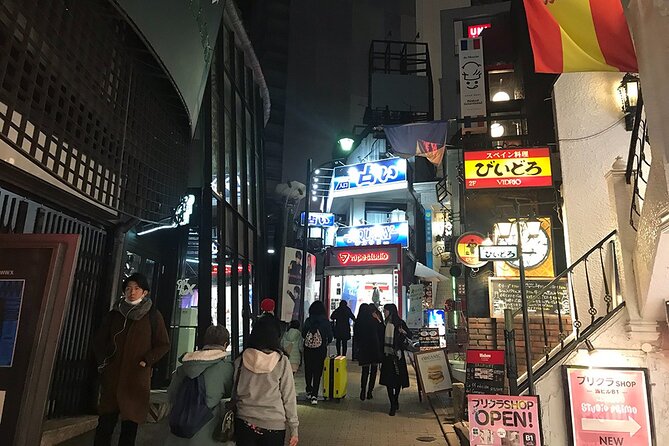
Maruyamacho is another 10-minute stop. The neighborhood was once associated with Tokyo’s red-light district and has since changed into a trendier area with a mix of older and newer elements.
This is one of the more revealing parts of the walk because it shows how neighborhoods change without losing every trace of what came before. The area is also associated with nightlife and love hotels, a subject your guide may explain if you ask.
The route through Maruyamacho includes uphill walking. One person found the amount of climbing notable, and that is worth taking seriously. Shibuya is not flat, and the combination of hills, humidity, and pavement can make the walk feel more demanding than its two-hour length suggests.
Wear shoes with solid support. If you have limited mobility, ask about the route before booking. Most people can participate, and the guide may adjust the pace, but this is still a walking tour through a hilly district rather than a flat station-area stroll.
Hachiko makes a convenient finish
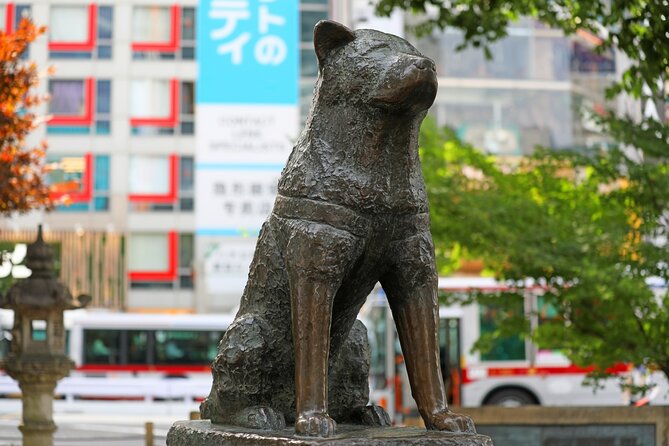
The tour ends at the Hachiko Statue, located at 2 Chome-1 Dogenzaka, near Shibuya Station. The stop lasts about 10 minutes and carries a simple but moving story.
Hachiko was an Akita dog remembered for his loyalty. The bronze statue has become one of Shibuya’s best-known meeting points and a popular place for photographs. Ending here makes practical sense because you are returned to a familiar station landmark after exploring less obvious streets.
It also gives the walk a clear emotional finish. You move from contemporary public art and urban development to the story of a dog whose loyalty became part of Tokyo’s public memory.
Since Hachiko is the endpoint, you can continue into the station, meet friends, or start your next activity without needing to navigate back to the original meeting point.
The guides make the difference
The strongest part of the experience is the guide. Names attached to especially warm feedback include Loc, Rio, Grey, Zach, Daichi, and Dixce. You cannot assume which person will lead your departure, but the range of comments points to a guiding style that is friendly, flexible, and focused on conversation.
Loc is particularly well regarded for his local explanations, humor, and ability to answer questions without giving long speeches. Rio has been praised for making the neighborhood feel personal, while Daichi brought historical and city-planning context to the route. Grey was described as patient and entertaining, and Zach was noted for clear English and adapting the walk to group interests.
That does not mean every departure will feel identical. One person felt the cultural explanation could have gone further and expected a guide who was originally from Japan. The provider’s response also makes clear that a guide may be familiar with the country without being Japanese. If having a Japanese-born guide is essential to you, confirm that before booking.
The food advice is a real benefit. Guides have recommended places to eat and drink, and several people found the tour useful as a way to plan a night out in Shibuya. I would schedule it early in your stay so you can use those suggestions afterward.
Is $25 a fair price?
At $25, the tour offers solid value if you want orientation, context, and local recommendations in a compact format. All fees and taxes are included, so the only expected extra is a tip for the guide if you feel the service deserves one.
You are not paying for attraction admissions because all seven stops are free. The value comes from the route design and the guide’s ability to connect places that you might otherwise visit separately or miss altogether.
It is less suitable if you already know Shibuya well and want lengthy time at each location. Even then, the side streets and historical explanations can reveal parts of the district you skipped on earlier visits. One person found the walk worthwhile even after visiting Tokyo three times.
The rating of 4.8 from 103 ratings and a 96 percent recommendation rate suggests a strong record, but the two serious complaints matter. One guide failed to appear and a refund was issued. Another person could not find the meeting point. These are not normal outcomes, but they show why you should confirm the meeting instructions and arrive early.
Free cancellation is available up to 24 hours before the start time for a full refund. Cancellations or changes inside that window are not refundable. The tour also requires good weather, with another date or a full refund offered if poor weather causes cancellation.
Who should take this Shibuya walking tour?
I would recommend it most to first-time visitors staying in or near Shibuya. It gives you the famous crossing, a station mural, modern urban design, shopping streets, nightlife history, small drinking alleys, and Hachiko in one manageable route.
It also suits solo visitors and couples who want a friendly introduction without joining a huge group. The 12-person limit keeps the experience personal enough for questions and makes city navigation easier.
Families with older children may enjoy it, but the guide cannot remove the crowds or hills. Older adults can participate, and the pace has been adjusted for senior walkers, yet warm weather and the uphill sections remain factors.
I would skip it if you want a food tour with tastings, a nightlife outing, or a slow photography walk. Food and bar suggestions are included, but food, drinks, and nightlife admissions are not.
Should you book it?
Book this tour if you want to understand Shibuya beyond the crossing. For $25, you get a well-planned introduction, a small group, local suggestions, and a route that includes places such as Myth of Tomorrow, Miyashita Park, Nonbee Yokocho, and Maruyamacho.
Arrive early for the Mark City meeting point, wear supportive shoes, and leave room in your evening for a restaurant or bar recommended by the guide. If you want a more profound cultural study or a slower look at each stop, choose a longer specialist tour instead.
For most first visits, this is a practical and enjoyable way to get your bearings fast, with enough local character to make Shibuya feel like a neighborhood rather than just a famous intersection.
FAQ
How long does the Shibuya walking tour last?
The tour lasts approximately two hours.
Where does the tour start?
It starts at SABON in Shibuya Mark City East Mall, third floor, at 1-chome 12-3 Dogenzaka, Shibuya, Tokyo 150-0043.
Where does the tour end?
The tour ends at the Hachiko Statue at 2 Chome-1 Dogenzaka, Shibuya, Tokyo 150-0043.
How many people can join the tour?
The group has a maximum of 12 participants.
Is the tour available with a mobile ticket?
Yes. A mobile ticket is provided for the experience.
What happens if the weather is poor?
If poor weather causes cancellation, you will be offered a different date or a full refund.
Just added around Tokyo
- Tokyo 6hr Instagram Highlights Private Tour with Licensed Guide★ 5.0 · 38 reviews
- Tokyo Small Group Tour with Guide★ 4.5 · 38 reviews
- Tokyo Sumo Experience with Live Show & Audience Challenge★ 5.0 · 38 reviews
- Japanese Food Cooking Class in Asakusa, Tokyo★ 5.0 · 39 reviews
- Very popular in Harajuku♡Animal petting zoo★ 4.6 · 39 reviews
- Ramen Making from Scratch with Tokyo Mom(Vegan Option Available)★ 5.0 · 39 reviews
- Tokyo JDM Night: 600hp C63s AMG Edition 1 (Private)★ 4.9 · 39 reviews
- Tokyo: Kimono Rental inside Shinjuku Gyoen National Garden★ 4.9 · 39 reviews
Walking Tours, compared.
Kyoto Geisha Walking Tour: Gion District & Hidden Gems
Read our review →
Tokyo Tsukiji Fish Market Food and Culture Walking Tour
Read our review →
Gion Magical Night Walking Tour with Geisha Trivia
Read our review →
Imperial Palace and Shogun Historical Walking Tour
Read our review →
Gion Geisha District Walking Tour – Stories of Geisha
Read our review →

Shinjuku Local Bar and Izakaya Guided Walking Tour
Read our review →
Browse the lists this tour appears in