
Reviewed · CASTLE TOURS
Japanesel Archery Experience HIROSHIMA CASTLE SHARAKU
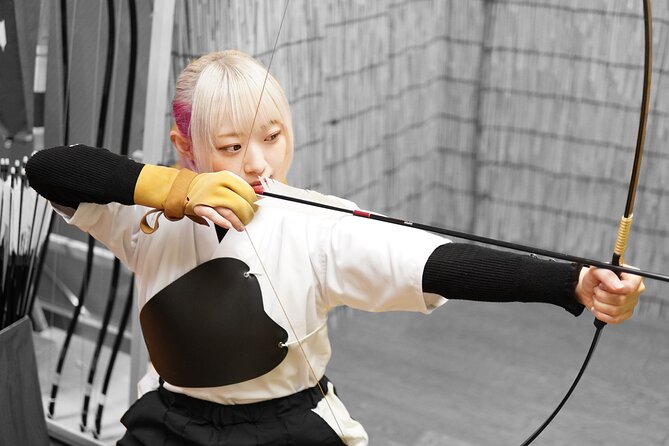
Traditional archery gets serious fast. At Hiroshima Castle Sharaku, you dress in dogi and hakama, learn the formal steps of kyudo, and shoot a Japanese bow under close instruction. I like the small maximum of four people, and I like that complete beginners can actually draw the bow and fire arrows during this one-hour session. The main caution is that some instruction may rely on a translation app, and parking near the castle can be difficult.
This is more than a costume photo stop. Kyudo asks you to slow down, follow a set routine, and pay attention to every movement. I also like that the session usually includes plenty of practice, useful technique tips, and sometimes a friendly competition. If your arm, hand, or shoulder is injured, though, this is not the right activity.
In This Review
- Key points at a glance
- Why kyudo feels different from ordinary archery
- Dressing in dogi and hakama at Hiroshima Castle
- The first lesson: formal steps before the first arrow
- Practice rounds and the feel of the bow
- The friendly contest and the high-score card
- What makes the instructors effective
- Location, timing, and planning your visit
- Is $43.11 a fair price?
- Who should book this kyudo experience?
- Should you book Japanese Archery Experience Hiroshima Castle Sharaku?
- FAQ
- How long does the Japanese archery experience last?
- Where does the experience begin and end?
- Can a complete beginner take part?
- What clothing is provided?
- How many people can join the activity?
- Can I cancel for a full refund?
Key points at a glance
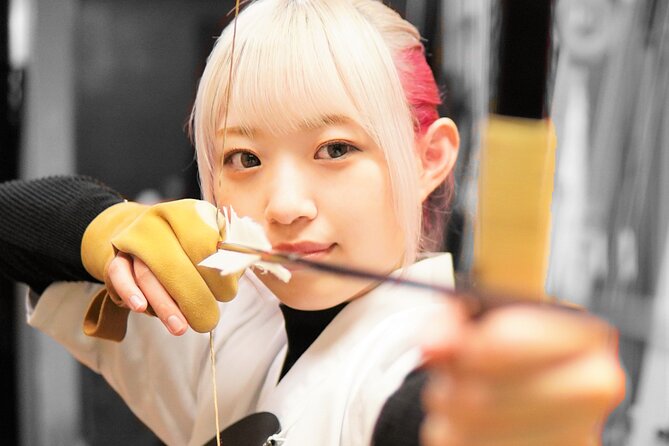
- Traditional kyudo clothing: Put on dogi and hakama before learning the basic shooting form.
- A genuine beginner lesson: You can draw the bow and shoot, even without previous kyudo experience.
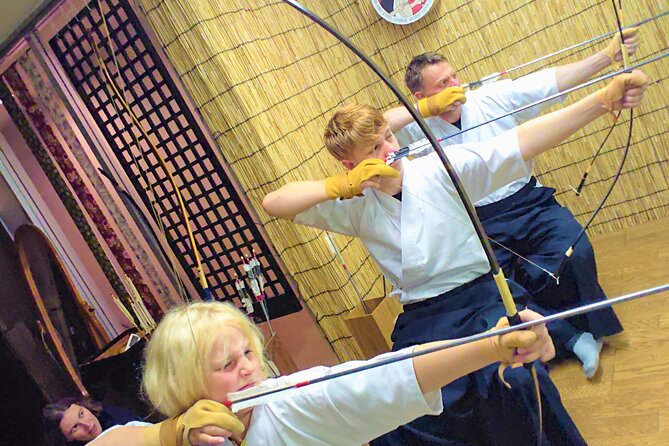
- Small group size: The maximum is four people, allowing close help from the instructors.
- Practice plus competition: Depending on your pace, you may shoot many arrows and take part in a simple scoring game.
- Convenient Hiroshima setting: The range is at the Hiroshima Castle Sannomaru Ruins, near major sights and public transportation.
- Strong overall value: At $43.11 for about an hour, the price is reasonable for instruction, equipment, clothing, and a cultural activity.
Why kyudo feels different from ordinary archery
Kyudo is often translated as the way of the bow. It is a Japanese martial art, but the goal is not simply to hit the center of a target. The way you stand, hold the bow, place the arrow, draw, aim, and release all follow a traditional routine.
That routine changes the feel of the activity. In Western archery, you may focus mainly on stance, aim, and accuracy. In kyudo, the process matters just as much as the result. Each movement shows care for the bow, the arrow, the range, and the people taking part.
You will learn that accuracy does not come from rushing. You must listen, copy the form, and repeat the steps in the correct order. Even a shot that misses can teach you something about balance or release.
The session makes this discipline approachable. Formal kyudo normally limits beginners until they master the basics. Here, you are allowed to try the full action under supervision, which gives you a real taste of the art without requiring a long course of study.
More martial arts experiences:
- Hiroshima: Traditional Japanese Archery Experience
★ 4.8 · 351 reviews - Kyoto: Kendo and Samurai Experience with Uniform and Gear
★ 4.9 · 815 reviews - Tokyo: Samurai Sword & Archery Class from Samurai Descendant
★ 5.0 · 603 reviews
Dressing in dogi and hakama at Hiroshima Castle
The activity begins at the archery range in the Hiroshima Castle Sannomaru Ruins, at 21-7-2 Motomachi in Hiroshima’s Naka Ward. You change into an authentic kyudo uniform, including the dogi, or upper garment, and hakama, the pleated lower garment.
The clothing is not just decoration. It helps you understand that you are taking part in a formal martial art rather than a casual shooting game. The hakama also adds a little challenge as you move through the sequence of actions. You need to pay attention to your posture and footing, especially when you are still trying to remember what comes next.
For many people, this is one of the most enjoyable parts of the hour. The uniform makes a good photo, and the instructors can take photos and videos with your phone toward the end of the session. I would wear the outfit rather than treating it as optional. It adds much more to the experience.
Do remember that the equipment is authentic and expensive. Children should be watched closely around the bows and arrows, and everyone should follow directions about handling the gear. One less positive account described the instructor as stressed when children touched equipment, so families should set expectations before the session begins.
The first lesson: formal steps before the first arrow
After changing, you receive an introduction to kyudo and its background. The instructor demonstrates the basic sequence, then breaks it into manageable steps.
The process can feel complicated at first. You may need to learn how to hold the bow, place and notch the arrow, position your hands, draw, aim, and release while keeping your posture steady. Do not worry if the first explanation seems like a lot. Several people found that the sequence became easier after a few attempts.
The unusual bow shape may also surprise you. One useful point raised during the activity is that the bow curves in a way that can make aiming feel counterintuitive. You may need to aim slightly to one side to send the arrow straight. The instructor should explain this as you practice, but it is worth asking if the mechanics are not clear.
Instruction is usually delivered in simple English, gestures, demonstrations, and a translation app when needed. The staff may have limited English, but the teaching format is visual and hands-on. Some sessions have two instructors helping a group of four, which means you can receive corrections while you practice.
The best approach is to copy the form rather than rely on habits from Western archery. An experienced archer may find the unfamiliar technique especially interesting, but old habits can get in the way. Beginners often have an advantage because they have fewer movements to unlearn.
Practice rounds and the feel of the bow
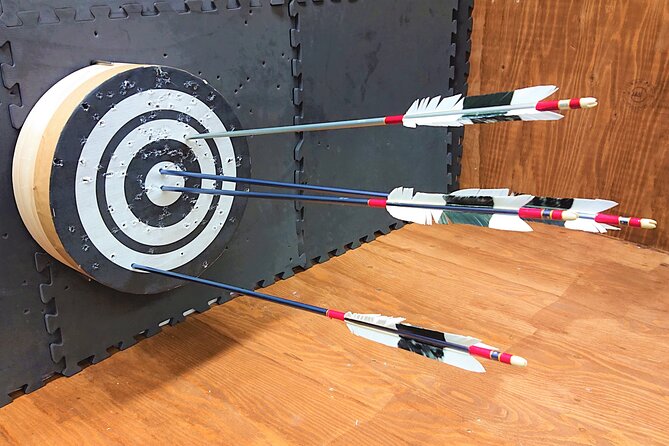
Once the basic steps are clear, you begin shooting. The exact number of arrows depends on how quickly your group learns, but the session includes an initial practice round and may continue with additional rounds.
A common format is eight arrows in a round, split into two groups of four. In a faster group, you might shoot more than 45 arrows during the hour, including practice shots and several competition rounds. A slower group may spend more time on form, which is not a bad trade. The point is to learn safely and enjoy the process, not to race through the arrows.
The bow can feel unfamiliar, and your hand or arm may become sore if you have never done this before. That is a normal consideration for a physical activity, but do not ignore pain. The experience is not recommended if you have an arm, hand, or shoulder injury or disability.
Your first arrows may curve, miss, or land far from the center. That is part of the fun. The instructors offer technique advice and encouragement, helping you adjust your form. Several sessions have been praised for patient, supportive teaching, especially with children and first-time archers.
I would pay more attention to the movement than to the score at the start. Once your body understands the sequence, aiming becomes less mysterious. Hitting the target feels satisfying because it reflects careful repetition rather than a lucky snap shot.
More castle tours:
- Hiroshima; Hiroshima Peace Memorial Museum and Castle Tour
★ 5.0 · 89 reviews - Osaka Castle: Museum and Tower Entry Ticket
★ 4.5 · 2,380 reviews - Tokyo Castle & Imperial PalaceーShogun Walking Tour
★ 4.7 · 1,068 reviews - Kyoto: Nijo-jo Castle and Ninomaru Palace Guided Tour
★ 4.7 · 1,020 reviews
The friendly contest and the high-score card
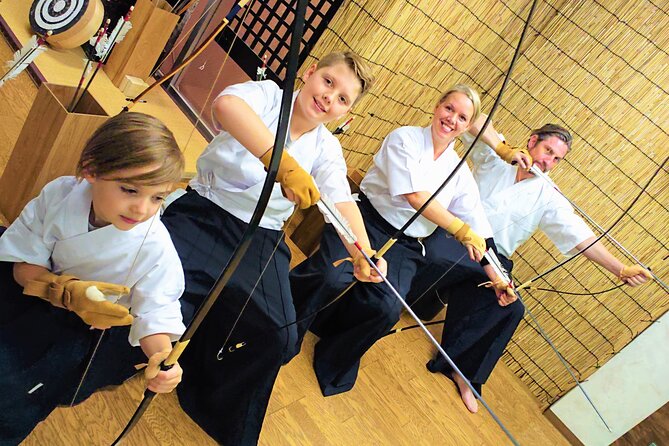
If your group picks up the technique quickly, the lesson can shift into a small competition. Each person shoots a set of arrows, and you compare scores with the others in your party.
This adds a welcome bit of energy after the careful instruction. Families can compete in teams, friends can keep score, and couples can settle a very small but entertaining argument about who has the steadier hand. It remains a light contest, not a high-pressure tournament.
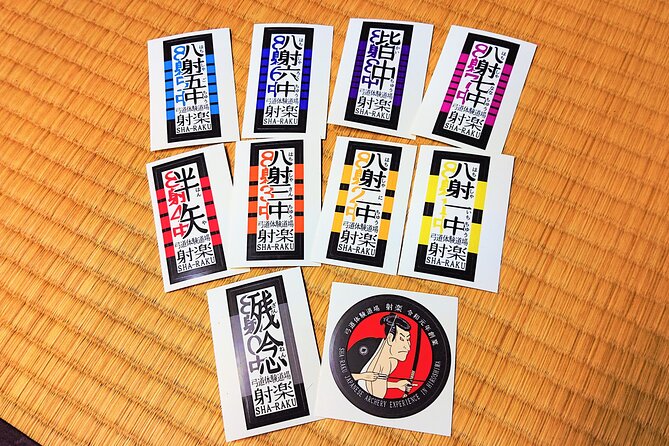
A perfect score is difficult. One special detail makes the game more fun: if you achieve a strong result, you may receive a high-score card, and a top score can earn a special place on the wall. You do not need to be an expert to enjoy the contest. The instructors continue helping you during the rounds.
The competition also gives the hour a clear shape. You learn the form, practice the shots, then use what you have learned in a game. That is more satisfying than firing a few arrows without context.
What makes the instructors effective
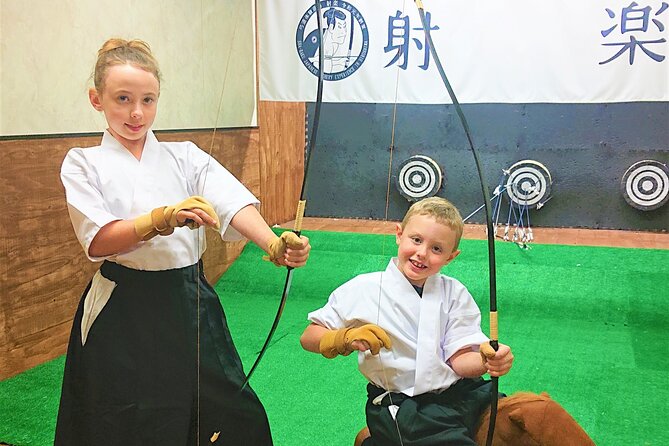
The strongest part of the activity is the close attention from the instructors and apprentices. They demonstrate the movements, watch your form, correct mistakes, and encourage you when an arrow goes astray.
The teaching style may vary. Most accounts describe the staff as polite, helpful, friendly, and patient. Some people found the instructor especially good with children, while others appreciated the effort made to communicate in English through a tablet translation app.
One less favorable experience described an instructor as impatient and too strict around the equipment. That seems to be an exception rather than the general pattern, but it is useful to know. Kyudo has formal rules, and the staff take the equipment seriously. If you prefer a loose, playful activity with little correction, this may feel more structured than expected.
For most people, that structure is the point. You are not simply handed a bow and told to shoot. You receive guidance in a traditional method, with enough help to make the first hour feel achievable.
Location, timing, and planning your visit
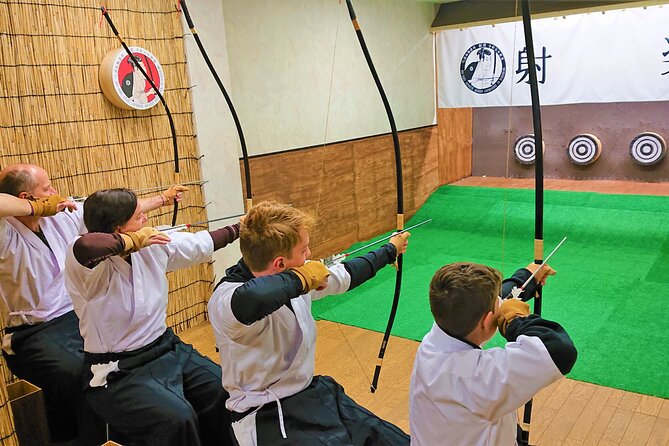
The meeting point is the Japanese Archery Experience HIROSHIMA CASTLE SHARAKU at the Hiroshima Castle Sannomaru Ruins. The activity ends at the same place, so you do not need to arrange a second pickup or find your way back across the city.
The location is close to major Hiroshima sights and public transportation, making it easy to add to a day of sightseeing. Give yourself extra time to find the range. Meeting point directions could be clearer, and parking nearby can be a headache. If you are driving, do not arrive at the last minute expecting a quick parking space.
The session lasts about one hour. That makes it easy to fit before or after other plans, but it also means the introduction, changing, instruction, shooting, and photos move at a steady pace. Arrive ready to listen and avoid treating the first ten minutes as wasted time. The formal instruction is what makes the later shooting possible.
The mobile ticket is practical, and confirmation is provided when you book. Free cancellation is available up to 24 hours before the start time. Changes or cancellations made less than 24 hours in advance are not accepted for a refund.
Is $43.11 a fair price?
At $43.11 per person, this is a fair price for a one-hour activity that includes the uniform, bow and arrows, instruction, practice, and a possible competition. You are paying for access to equipment and a guided introduction to a specialized Japanese art, not just a few casual shots at a target.
The small group limit improves the value. With no more than four people, you should receive more direct help than you would in a large class. Some sessions have two instructors, which gives beginners a better chance to receive useful corrections.
The price is especially reasonable if you want a cultural activity that breaks up sightseeing. Hiroshima has important museums, memorial sites, and castle grounds, but a hands-on lesson gives you a different way to spend an hour. It also works well for families, since children around ages 11 to 14 have enjoyed the instruction and competition.
The value is lower if you want a long archery lesson or advanced coaching. This is an introduction, not a certification course. Your time is short, and the focus is on a memorable first experience rather than perfect technique.
Who should book this kyudo experience?
I would recommend it to first-time archers, families, couples, and friends who want an activity with a clear Japanese cultural connection. It suits people who enjoy learning a sequence, trying something unusual, and laughing at a few crooked arrows along the way.
It is also a good choice for experienced archers. You will need to set aside familiar Western technique and accept that kyudo works differently. That challenge can make the hour more interesting, not less.
You should think twice if you dislike formal instruction or have limited use of your arms, hands, or shoulders. The bow requires physical effort, and the activity is specifically not recommended for people with arm, hand, or shoulder injuries or disabilities.
Families should be comfortable reminding children to handle the equipment only when instructed. The staff are there to teach and help, but the bows and arrows are not props for unsupervised play.
Should you book Japanese Archery Experience Hiroshima Castle Sharaku?
I would book this if you want a short, well-priced activity that feels distinctly Japanese. The traditional clothing, formal shooting routine, close instruction, and friendly contest give the hour more substance than a standard tourist photo stop.
The 4.9 rating and 98 percent recommendation fit the experience’s main strengths: supportive instruction, a small group, plenty of shooting, and a memorable cultural setting. Just allow time to find the meeting point, plan around parking if needed, and expect some translation by tablet rather than a fully English-speaking lesson.
If you follow directions, stay patient during the first few arrows, and do not worry about scoring like a samurai champion, this should be one of the more enjoyable side activities in Hiroshima.
FAQ
How long does the Japanese archery experience last?
The activity lasts approximately one hour, including the introduction, clothing, instruction, practice, shooting, and possible competition.
Where does the experience begin and end?
It begins at Japanese Archery Experience HIROSHIMA CASTLE SHARAKU, Hiroshima Castle Sannomaru Ruins, 21-7-2 Motomachi, Naka Ward, Hiroshima. It ends back at the meeting point.
Can a complete beginner take part?
Yes. The session is designed to let complete beginners try the real kyudo shooting process under instruction.
What clothing is provided?
You dress in an authentic kyudo uniform that includes a dogi, the upper garment, and a hakama, the lower garment.
How many people can join the activity?
The maximum group size is four people.
Can I cancel for a full refund?
Yes. You can cancel up to 24 hours before the experience start time for a full refund. Cancellations or changes made less than 24 hours before the start time are not accepted for a refund.
Just added around Hiroshima
- Hiroshima & Miyajima: Private Full-Day Tour with a Local Guide★ 5.0 · 39 reviews
- Hiroshima and Miyajima 1 Day Walking Tour★ 5.0 · 43 reviews
- Hiroshima History Tour : A-Bomb Dome, Peace Memorial & City★ 5.0 · 43 reviews
- The Journey of Hiroshima from Tragedy to Peace★ 4.8 · 44 reviews
- Cultural Activities :Kimono, tea ceremony, Calligraphy and Amulet★ 5.0 · 44 reviews
- Miyajima: Private Rickshaw Tour to Itsukushima Shrine★ 4.9 · 45 reviews
- Hiroshima Private Tour: Best Highlights in a Day★ 5.0 · 49 reviews
- Hiroshima & Miyajima All-Inclusive Tour w/Licensed guide Pancho★ 5.0 · 54 reviews
Castle Tours, compared.
Tokyo Castle & Imperial PalaceーShogun Walking Tour
Read our review →
Nijo-jo Castle and Ninomaru Palace Guided Tour
Read our review →
Ultimate Osaka Walking Tour: Castle, Dotonbori & Hidden Gems
Read our review →Tokyo Castle & Imperial PalaceーShogun Walking Tour
Read our review →
Nijo Castle, Kiyomizu & Fushimi Inari Guided Tour
Read our review →
Osaka Castle Walking Tour and Castle Tower Admission
Read our review →
Imperial Palace East Garden and Edo Castle Walking Tour in Tokyo
Read our review →Browse the lists this tour appears in