Reviewed · KYOTO TOURS
Kyoto Afternoon Tour from Kyoto or Osaka
Kyoto packs centuries into one afternoon. This guided outing links Fushimi Inari’s red torii gates, Sanjusangendo’s remarkable hall of 1,001 Kannon statues, and Kiyomizu-dera’s broad city views without asking you to sort out Kyoto’s complex transport. I especially like the mix of Shinto and Buddhist sites, plus the friendly guides, including Yoshi, Momo, Donna-San, Jessie, and Amy, who have been praised for making the history lively.
The air-conditioned bus and included admission fees are a real help on hot, humid days. The tradeoff is time: the tour lasts about 4 hours 40 minutes, and some stops can feel hurried, especially when crowds or traffic slow the day.
In This Review
- Key points to know before you book
- Why this half-day route works in Kyoto
- Fushimi Inari and the red gate approach
- Sanjusangendo’s hall of 1,001 statues
- Kiyomizu-dera and the climb above Kyoto
- What the guides add to the day
- How much value do you get for $82.58?
- Walking, crowds, and the pace
- The best time to choose this tour
- Booking advice for a smoother afternoon
- Should you book the Kyoto Afternoon Tour?
- FAQ
- How long does the Kyoto Afternoon Tour last?
- Where does the tour begin?
- Does the tour include transportation?
- Are entrance fees included?
- Which sights does the tour visit?
- Does the tour enter the Shin-en garden at Fushimi Inari?
- Is hotel pickup included?
- How much walking is involved?
- What is the cancellation policy?
Key points to know before you book
- Three major sights in one afternoon: Visit Fushimi Inari Taisha, Sanjusangendo Temple, and Kiyomizu-dera in a compact route.
- The best fit for a short Kyoto stay: This is useful if you have only one day, or if you want an easy orientation before exploring alone.
- Sanjusangendo is the indoor highlight: Its long wooden hall contains 1,001 life-size Kannon statues dating from the 13th century.
- Kiyomizu requires uphill walking: The approach includes a climb and a crowded shopping lane, so good shoes matter.
- The group can be fairly large: The stated maximum is 40 people, which may make it harder to hear the guide in busy areas.
- The price covers the main costs: At $82.58 per person, transportation, entrance fees, and a licensed English guide are included.
Why this half-day route works in Kyoto
Kyoto can be difficult to tackle by sight alone. Its temples and shrines are spread across the city, buses fill quickly, and major sites can be crowded at the very hours when you want to see them. This tour takes care of the basic movement between three important stops.
The meeting point is the Avanti Tour Desk near Kyoto Station in the afternoon. The office is in the basement of a large building, so give yourself extra time to find it. One person had trouble locating the office, and Kyoto Station’s size can turn a simple meeting into a small expedition of its own.
The route lasts roughly five hours, though the actual arrival times can shift with road conditions and congestion. You receive transportation, admission fees, and the services of a National Government Licensed English Guide Interpreter. Food and drinks are not included, and there is no hotel pickup or drop-off.
I see this tour as an efficient introduction rather than a slow, contemplative temple day. You get a useful sweep of Kyoto’s religious traditions, with a guide to explain what you are seeing. If you already know these sites well, the fixed schedule may feel restrictive. If you are new to Kyoto, the structure can save both time and guesswork.
A few more Kyoto experiences worth weighing up
- PERFECT KYOTO 1-Day Bus Tour
★ 5.0 · 13,518 reviews - Kyoto: Fushimi Inari, Kinkakuji, Bamboo Grove 1 Day Bus Tour
★ 4.8 · 4,316 reviews - Kyoto: Tea Ceremony in a Traditional Tea House in Kiyomizu
★ 4.9 · 3,519 reviews
Fushimi Inari and the red gate approach
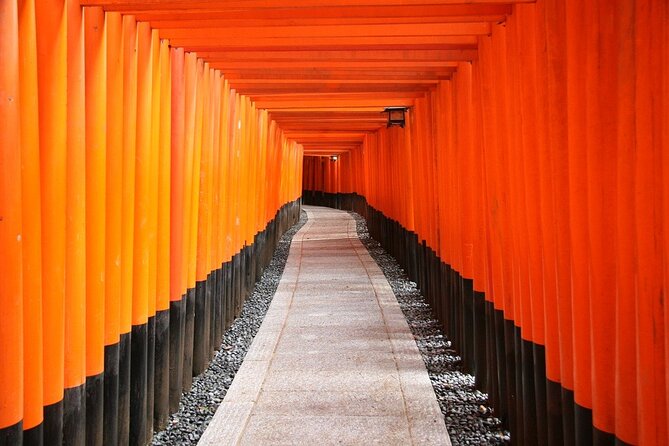
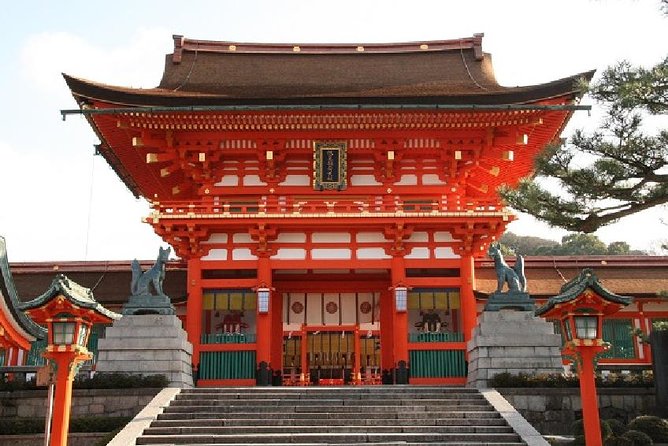
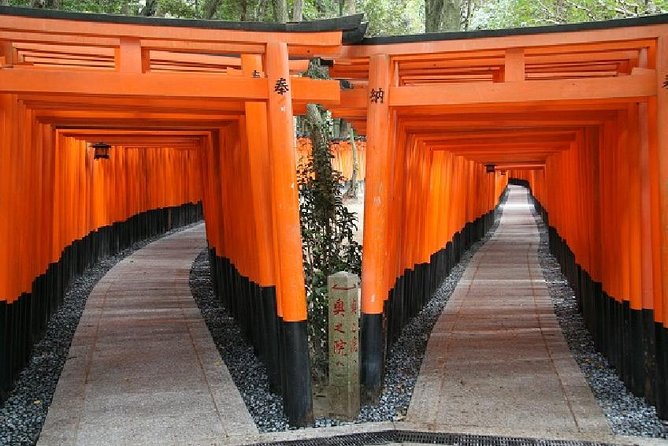
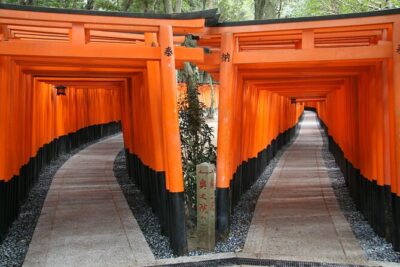
The first stop is Fushimi Inari Taisha, the head shrine of roughly 40,000 Inari shrines across Japan. The famous Senbon Torii, or thousand red gates, create the unforgettable corridor associated with the shrine.
The visit itself is listed as about 30 minutes, but the bus does not leave you directly at the shrine entrance. You walk from the parking area for about 15 minutes each way. That detail matters. Thirty minutes at the site sounds reasonable until you subtract the walk, gathering time, and the distance needed to reach the most photogenic gates.
You should expect a quick look rather than a full hike up Mount Inari. The tour introduces the shrine and gives you time for photographs, but it is not designed for walking the entire torii route. If you want to explore farther into the mountain, you would need to return on your own another day.
The shrine’s bright red gates make this a strong opening stop. It is also a good place to learn the difference between a Shinto shrine and a Buddhist temple, a distinction that becomes useful later in the afternoon. The grounds can be crowded, and the narrow approach requires attention to the meeting time.
There is one important limit: the tour does not enter the Shin-en garden. If you are hoping for a complete visit to every part of the shrine complex, this outing does not provide that.
Sanjusangendo’s hall of 1,001 statues
Sanjusangendo Temple is the tour’s most unusual stop. The temple is famous for its long wooden hall, which stretches more than 394 feet, or 120 meters. Inside are 1,001 life-size statues of Kannon, the Buddhist bodhisattva of compassion.
The scheduled visit is about 30 minutes. That may sound brief, but the hall gives you a concentrated experience. Unlike Kiyomizu-dera, where you move through terraces, lanes, and outdoor viewpoints, Sanjusangendo asks you to slow down and take in a single astonishing interior.
This is one place where a guide adds real value. The statues are not simply a row of similar figures to photograph. Their arrangement, scale, and visual effect are much easier to understand when someone explains the religious setting and points out details you might otherwise miss.
Photography rules inside the hall may limit what you can record, so treat this as a place to look carefully rather than a stop built around pictures. The atmosphere is more controlled and serious than at Fushimi Inari or the shopping street near Kiyomizu.
Of the three stops, this is the one most likely to reward attention over speed. Several comments about the tour singled out Sanjusangendo as especially powerful. Even people who found the overall schedule fast tended to value this temple because it offers something unlike the better-known outdoor sights.
Kiyomizu-dera and the climb above Kyoto
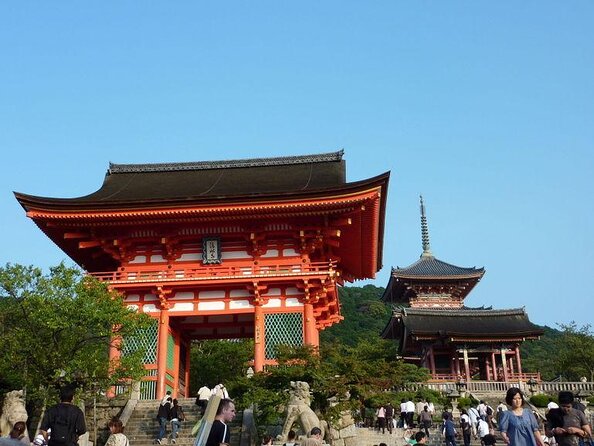
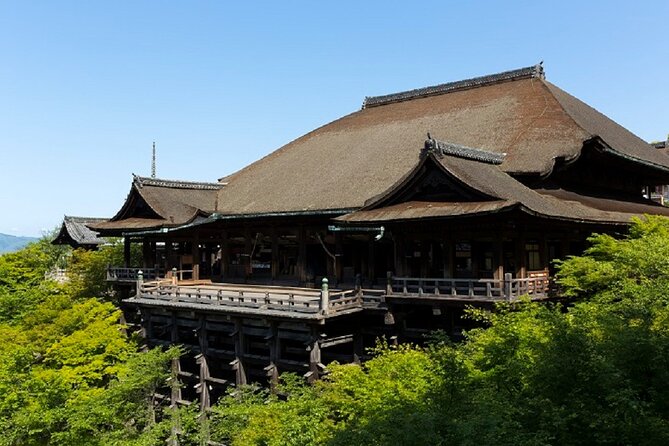
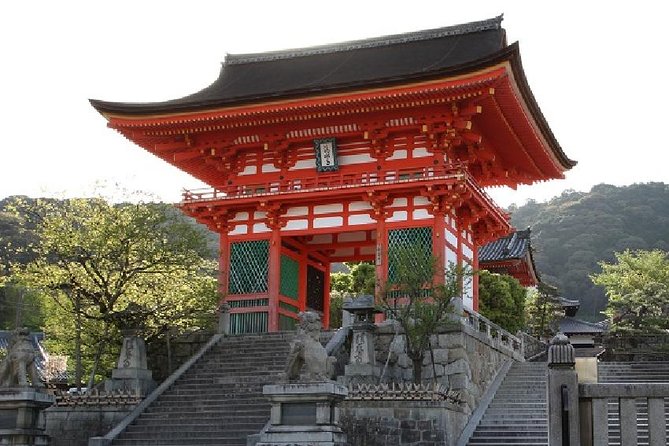
The final major stop is Kiyomizu-dera, one of Kyoto’s best-known UNESCO World Heritage sites. The temple sits high on the eastern side of the city, with views from its broad wooden terrace and nearby paths toward Kyoto and the surrounding hills.
The scheduled visit is 1 hour 10 minutes, making it the longest stop. That extra time is useful because Kiyomizu is not just one building. You have the temple itself, viewpoints, lanes, small shops, and the approach through the historic streets leading uphill.
The climb can be strenuous on a hot, sunny day. Wear shoes with a firm sole, and do not count on the visit being a flat stroll. The streets can also be noisy and crowded, especially around the shopping lanes. That congestion is part of the setting, but it can make the group harder to keep together.
The reward is the view. Kiyomizu’s terrace gives you a broad look over Kyoto, and the higher setting helps you understand how the city spreads between its surrounding hills. If you arrive near dusk, the character changes. One departure reached the temple around 4:30 p.m., leaving little daylight for foliage or daytime views. The exact timing depends on traffic, season, and the day’s pace, so do not assume every departure will offer the same light.
If photographs are important to you, ask the guide about the time available before you set off. This is also the stop where you may want to buy a snack, browse pottery, or look through the small shops. The schedule allows some of that, but not an extended shopping session.
A completely different kind of day out in Kyoto:
- Kyoto Geisha Walking Tour: Gion District & Hidden Gems
★ 4.7 · 3,273 reviews - Kyoto: Tea Ceremony Ju-An at Jotokuji Temple
★ 4.9 · 3,207 reviews - Kyoto: Gion Magical Night Walking Tour with Geisha Trivia
★ 4.9 · 2,393 reviews - Kyoto: 45-Minute Tea Ceremony Lesson Experience
★ 4.3 · 2,378 reviews
What the guides add to the day
The strongest feature of this outing is the human element. Guides have included Momo, Yoshi, Donna-San, Jessie, and Amy, with praise for humor, patience, organization, and clear explanations of Japanese customs.
Yoshi, in particular, was appreciated for keeping the afternoon friendly and lively. Donna-San was praised for looking after the group, while Amy was noted for managing a large party with care. These details matter because a temple tour can quickly become a procession of names and dates. A good guide helps you see how the sites function, not just when they were built.
The guide also helps with practical matters: where to meet, when to return, and how to move through crowded paths. That can be worth as much as the historical commentary. You are not left trying to read a map while watching the clock.
Still, group size affects the experience. The stated maximum is 40 people. At a busy shrine or on a narrow temple approach, that is a sizable group. You may need to stay close to the guide, and hearing every explanation could be difficult if you drift toward the back.
This is not a private tour, and it does not promise long one-on-one conversations. The quality of the day depends partly on the guide assigned to your departure, but the recorded guide feedback is consistently strong enough to make this a major reason to consider the tour.
How much value do you get for $82.58?
The price is $82.58 per person. That is not the cheapest way to see Kyoto, especially if you are comfortable using trains, buses, and local walking routes. But the fee includes transportation, three site visits, entrance fees for Sanjusangendo and Kiyomizu-dera, and a licensed English guide.
The value improves if you are staying in Osaka and want a simple Kyoto day without planning every connection. It also improves if you have only one afternoon in Kyoto. You can see three major places in a single route and return with a basic sense of the city’s religious traditions.
The price is less compelling for a slow, independent visitor. Fushimi Inari is free to enter, and Kyoto’s public transport can take you to the main areas. Going alone gives you control over how long you stay, especially at Sanjusangendo and Kiyomizu.
I would think of the fee as paying for coordination and explanation, not just admission. If you value an air-conditioned bus in hot weather, a fixed route, and a guide who can put the sites into context, the cost is reasonable. If you would rather spend two hours at one temple, the same money may be better used on independent sightseeing.
Walking, crowds, and the pace
This is a walking tour supported by a bus, not a bus tour with almost no walking. You walk to Fushimi Inari from the parking area, climb toward Kiyomizu, and move through busy lanes and temple grounds.
Most people can participate, and service animals are allowed. Children up to age five may join free, but they are not provided with a bus seat unless booked under the child rate. Written parental permission is required for participants under 18, and anyone under 15 or not yet in middle school must be accompanied by a parent or guardian.
Seats may not be designated. If you need a particular seating arrangement, this is worth considering before booking. Since the tour includes outdoor walking and a climb, anyone with limited stamina should plan for breaks when possible, while remembering that the group schedule remains fixed.
The pace is the central compromise. Some departures give enough time for photographs, a quick ice cream, and a little shopping. Others may feel rushed, especially when traffic reduces the time at the sites. You should arrive ready to keep moving rather than expecting long stretches of quiet.
The best time to choose this tour
This tour makes the most sense early in a Kyoto stay. It gives you a quick orientation to the city and shows you which areas deserve a second visit. Afterward, you can return independently to the place that caught your attention.
It is especially useful in these situations:
- You have one afternoon in Kyoto.
- You are staying in Osaka and want transportation handled.
- You want an English-speaking guide to explain customs and religious traditions.
- You prefer seeing several major sights instead of spending a full day at one.
- You are visiting in hot or humid weather and appreciate an air-conditioned bus.
- You do not want to organize tickets and connections yourself.
I would not choose it if Kiyomizu-dera is your only priority and you want time for every shop and viewpoint. I would also hesitate if you dislike group schedules, crowded attractions, or walking uphill.
Booking advice for a smoother afternoon
Arrive early at the Avanti Tour Desk near Kyoto Station. The basement location can be easy to miss, and being late creates stress before the sightseeing even begins.
Wear comfortable shoes and carry water, since food and drinks are not included. Keep your camera ready at Fushimi Inari, but do not assume you will have time to walk far beyond the main gate corridor.
At Kiyomizu, listen carefully for the meeting instructions. The streets and temple paths can be crowded, and the group may not be immediately visible if you stop to shop or take photographs.
The tour offers free cancellation if you cancel at least 24 hours before the local start time. Changes or cancellations made within 24 hours are not accepted for a refund.
Should you book the Kyoto Afternoon Tour?
Book it if you want three major Kyoto sights with transport and a guide, especially during a short stay or a first visit. Sanjusangendo is the strongest reason to go, while Kiyomizu-dera supplies the memorable views and Fushimi Inari gives you Kyoto’s most recognizable red gate setting.
Skip it if you want a slow temple day or prefer full control over your schedule. The afternoon is efficient, not leisurely, and the advertised group size can make close listening harder in crowded places.
For most first-time visitors with limited time, I think the tour offers fair value. Treat it as an introduction, keep your expectations realistic about the pace, and save room in your trip to revisit the site you like best.
FAQ
How long does the Kyoto Afternoon Tour last?
The tour lasts approximately 4 hours and 40 minutes.
Where does the tour begin?
You meet the guide in the afternoon at the Avanti Tour Desk near Kyoto Station.
Does the tour include transportation?
Yes. Transportation costs are included in the tour price.
Are entrance fees included?
Yes. Admission fees are included for the tour’s temple visits.
Which sights does the tour visit?
The itinerary includes Fushimi Inari Taisha Shrine, Sanjusangendo Temple, and Kiyomizu-dera Temple.
Does the tour enter the Shin-en garden at Fushimi Inari?
No. The tour does not enter the Shin-en garden.
Is hotel pickup included?
No. Hotel pickup and drop-off are not included.
How much walking is involved?
You walk about 15 minutes each way from the parking area to Fushimi Inari. The Kiyomizu-dera visit also includes an uphill approach, which can feel strenuous in hot weather.
What is the cancellation policy?
You can cancel up to 24 hours before the local start time for a full refund. Cancellations or changes made less than 24 hours before the start time are not accepted.
Just added around Kyoto
- Kyoto: Private Customizable Day Trip by Car★ 5.0 · 38 reviews
- Kyoto: Gion Night Walking Tour with Geisha Insight★ 5.0 · 39 reviews
- Kyoto: Full Day Bike Tour★ 4.9 · 39 reviews
- Private Japanese Calligraphy in Kyoto – Learn Shodō with a Master★ 5.0 · 39 reviews
- Experience a tea ceremony in an authentic tearoom, in Kyoto!★ 4.5 · 41 reviews
- Kyoto: Gion Evening Walk with Hidden Gems, Geisha & Sake★ 5.0 · 41 reviews
- Kyoto Private Photo Shoot & Tour by SnapKyoto★ 5.0 · 41 reviews
- The Way of Tea: Kyoto Crafts, Hidden Temples & Wabi-Sabi Walk★ 5.0 · 41 reviews
Kyoto Tours, compared.
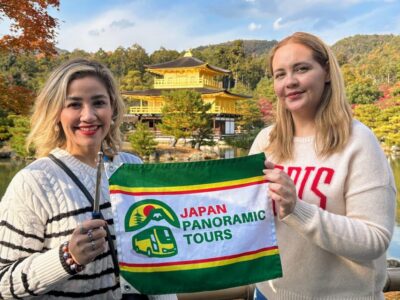
Fushimi Inari, Kinkakuji, Bamboo Grove 1 Day Bus Tour
Read our review →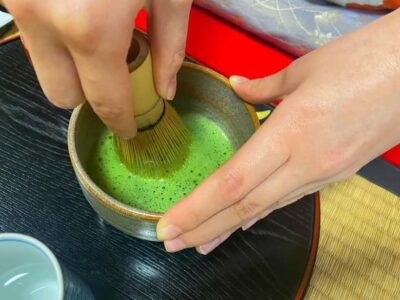
Tea Ceremony in a Traditional Tea House in Kiyomizu
Read our review →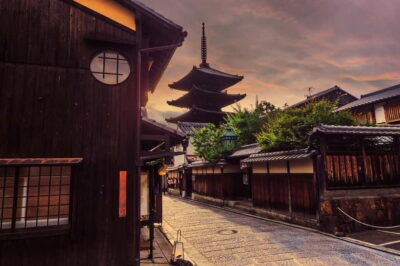
Kyoto Geisha Walking Tour: Gion District & Hidden Gems
Read our review →
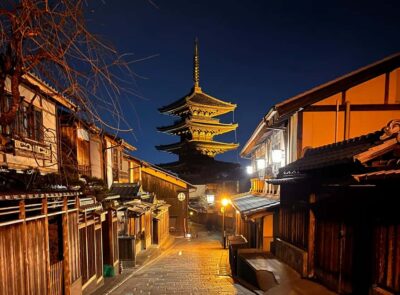
Gion Magical Night Walking Tour with Geisha Trivia
Read our review →