
Reviewed · CYCLING TOURS
Nara: Bike Tour in Ancient Capital UNESCO World Heritage
History feels better on two wheels. This two-hour ride around Nara’s Heijo Palace site gives you a calm, well-priced look at the ancient capital, with stops at major gates, gardens, museums, a tomb, and a reconstructed audience hall. I especially like the small group of up to eight and the chance to explore far more ground than you could on foot. The main drawback is that much of the palace site is open and spacious, so the experience may feel slow or slightly underwhelming if you are not interested in archaeology or early Japanese history.
I also like the gentle pace and the mixture of scenery and interpretation. You are not simply pedaling past ruins. A national government licensed guide explains how the site worked, points out what has been reconstructed, and helps you read the remains. English-speaking guide Kay has earned particularly warm praise for her patience, clear explanations, and kindness with families and children.
In This Review
- Key things to know before you book
- Why Heijo Palace is different from Nara Park
- Starting at Suzaku-Gate
- To-in Garden and the roots of Japanese garden design
- Reading the ground at the Excavation Site Exhibition Hall
- A quiet ride around Minakami Pond
- Hishiage Kofun and the ancient burial site
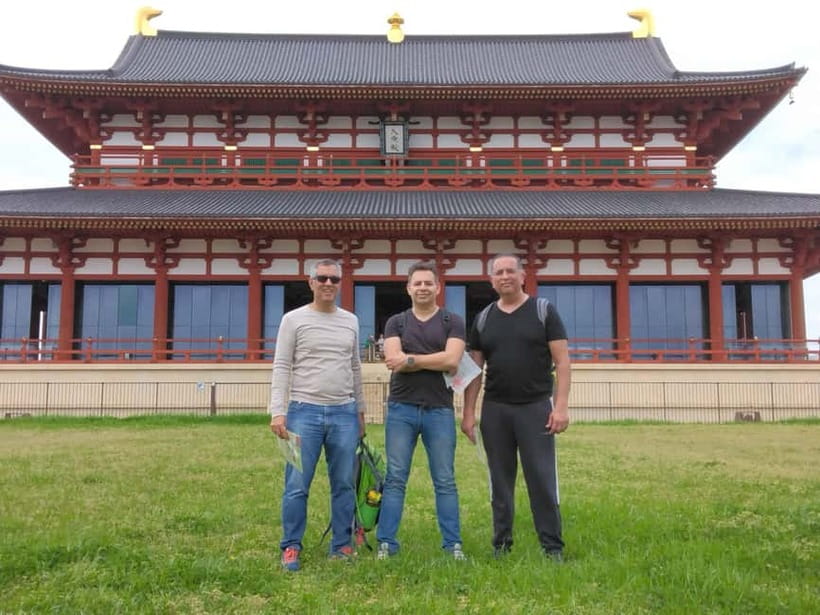
- The First Imperial Audience Hall
- The oldest palace-site museum
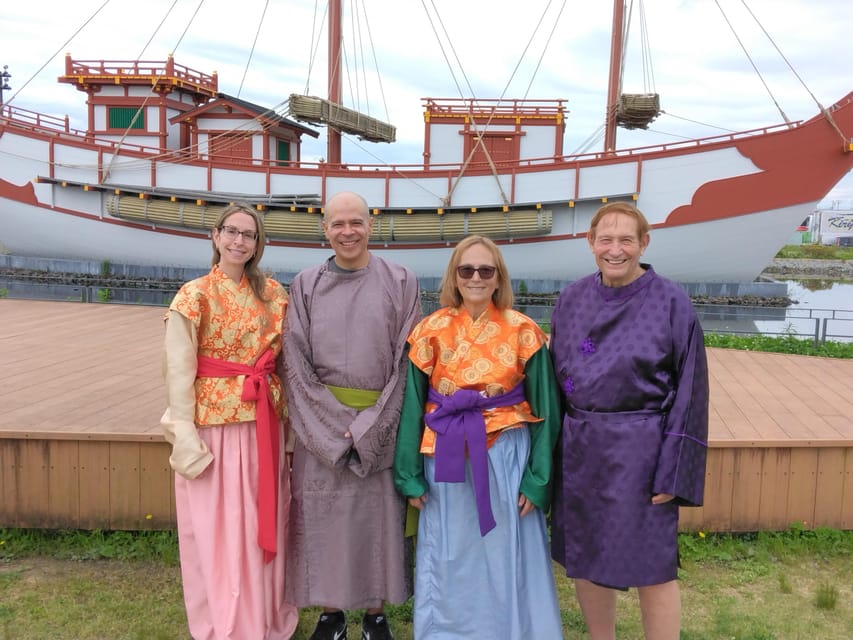
- The Tenpyo costume experience
- What the two-hour format feels like
- Getting to Suzaku-Gate Square
- Who will enjoy this ride most?
- Practical value and booking advice
- Should you book the Heijo Palace bike tour?
- FAQ
- How much does the Nara bike tour cost?
- How long does the tour last?
- Where does the tour meet?
- What languages are available?
- What is included in the price?
- Is hotel pickup included?
- Can I cancel for a full refund?
- Is the tour suitable for children?
Key things to know before you book
- Suzaku-Gate gives you a grand opening: Begin at the reconstructed main entrance to Heijo Palace, where the scale of the former capital starts to make sense.
- You cover a huge site efficiently: The bicycle lets you move between gardens, museums, tombs, and palace buildings without spending the entire visit walking.
- The Excavation Site Exhibition Hall is unusual: Archaeological remains are preserved where they were found, giving you a direct look at the work beneath the palace grounds.
- Minakami Pond adds a peaceful pause: Expect birds, ducks, turtles, and a pleasant change from museum interiors and formal buildings.
- The costume session adds a playful touch: You can wear Tenpyo-period clothing and take photos, an appealing extra for families and anyone who enjoys cultural activities.
- Summer heat matters: The ride can be relaxing, but the open grounds offer limited shelter, and August may feel uncomfortably hot.
Why Heijo Palace is different from Nara Park
Many people come to Nara for the deer and the famous temples around Nara Park. This tour takes you somewhere quieter and more spacious: the former site of Heijo-kyo, the capital during the Nara period.
That difference matters. You will not spend this two-hour outing feeding deer or moving through crowded temple lanes. Instead, you ride across broad grounds, look at archaeological remains, and learn how an imperial palace once organized political and ceremonial life.
The site does not present itself like a perfectly preserved medieval town. Some structures are reconstructed, while other parts appear as foundations, excavation areas, or open fields. I think that is the point, but you need to enjoy using your imagination. The guide helps connect the visible pieces to the city that once occupied this large area.
At $22 per person, the tour offers strong value. The price includes the rental bike, helmet, guide, admission fees, and the traditional costume experience. You are also paying for transport between scattered sights and for explanations that would be difficult to piece together alone.
More bike tours:
- E-Bike Nara Highlights – Todaiji, Knives, Deer, Shrine
★ 4.8 · 186 reviews - Nara – Highlights Bike Tour
★ 4.5 · 89 reviews - Hidden Kyoto E-Biking tour
★ 5.0 · 1,843 reviews
Starting at Suzaku-Gate
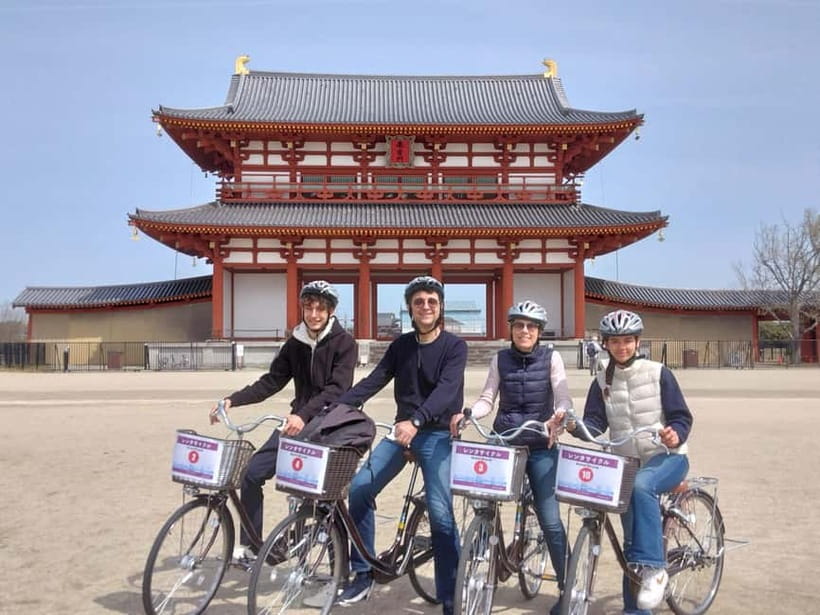
Meet at the rental-bike reception counter inside Miharashi-Kan in Suzaku-Gate Square. Arrive 10 minutes before the scheduled start so you have time to check in, collect your bicycle and helmet, and get ready.
Suzaku-Gate was the main entrance to Heijo Palace. It is one of the most useful places to begin because the gate gives you a visual sense of ceremony and scale. Your guide can explain the role of the ancient capital while you take photographs of the building and the open grounds around it.
This is also a good first stop for getting oriented. The palace complex is large, and the tour becomes easier to follow once you understand that the gates, gardens, halls, and administrative areas were part of a planned capital rather than isolated attractions.
The stop lasts about 15 minutes. That is enough time for an introduction and photographs without using too much of your limited riding time.
To-in Garden and the roots of Japanese garden design
From Suzaku-Gate, you ride to To-in Garden, also called the East Palace Garden. The stop takes around 10 minutes and focuses on the arrangement of bridges, buildings, rocks, and water.
This garden once served as a state guest house. That detail gives the setting more meaning than simply calling it a pretty Japanese garden. You can think about how gardens worked as part of court life, diplomacy, and formal visits.
I like the contrast here. Suzaku-Gate feels imposing, while To-in Garden is more measured and intimate. The garden also offers a chance to pause and take photographs before continuing to the archaeological parts of the tour.
The time is brief, so do not expect a long garden visit. The value comes from seeing the garden in its palace setting and hearing how its design served a practical social role.
Reading the ground at the Excavation Site Exhibition Hall
The Excavation Site Exhibition Hall is one of the most distinctive stops. Instead of displaying every object in a separate case, the museum preserves and presents remains in the same state in which archaeologists found them.
That makes the visit especially useful if you want to understand how the ancient capital is known today. You are looking at evidence in place, not just polished objects removed from their original setting.
The stop is scheduled for about 10 minutes. It is short, but the guide’s explanation is important because exposed foundations and post holes can be hard to interpret on your own. With context, a patch of earth becomes evidence of an older building or working area.
This stop may appeal most to people interested in archaeology. If you prefer fully reconstructed architecture, it may feel less dramatic than the main palace hall. Still, it is one of the places where the site feels most authentic.
More history tours:
- World Heritage Kyoto & Nara Uji Authentic Matcha Experience
★ 5.0 · 1,573 reviews - World Heritage Shirakawa-go and Experience Tours from Kanazawa
★ 5.0 · 4,049 reviews - Tokyo: Imperial Palace and Shogun Historical Walking Tour
★ 5.0 · 2,251 reviews - Kyoto Gion: 2-Hour Geisha Culture & History Walking Tour
★ 5.0 · 1,186 reviews
A quiet ride around Minakami Pond
The ride around Minakami Pond, also called Mizukami Pond, brings a welcome change of mood. You can feel the breeze, hear birds, and possibly see ducks and turtles near the water.
Several visitors have singled out this part of the route as especially peaceful. That makes sense. After gates, museums, and excavation remains, the pond gives you space to slow down and notice the natural setting around the palace grounds.
The pond stop also shows why the bicycle works so well here. You can move through the site without treating every section as a formal museum visit. The ride itself is part of the experience, and the open setting gives you a different view of Nara from the temple-centered route.
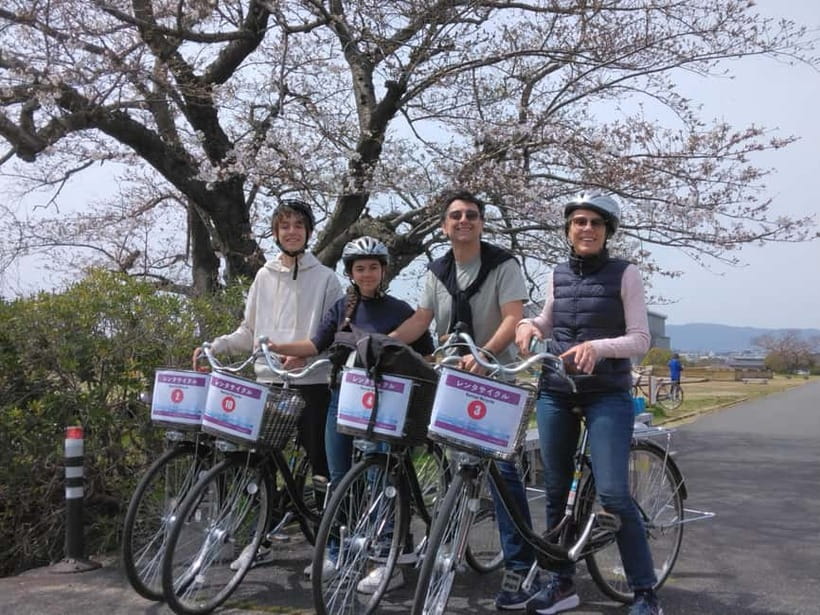
Keep the season in mind. Spring can bring pleasant scenes of local people enjoying hanami, while summer heat can make even an easy ride tiring. The pace is described as comfortable, but you should still dress for the weather and bring water if needed. Food and drinks are not included.
Hishiage Kofun and the ancient burial site
Hishiage Kofun is a 10-minute stop focused on an ancient tomb and its grave goods. This adds an earlier archaeological layer to the palace story.
The stop is not presented as a grand building or theatrical attraction. Its interest comes from the chance to consider burial customs and the objects connected with them. If you like seeing how historians build a picture of the past from physical remains, this is a useful part of the route.
For some people, the tomb may be less immediately impressive than the palace gates. The guide’s explanation makes the difference, especially if you are not already familiar with kofun burial sites or the broader timeline of Japanese history.
The First Imperial Audience Hall
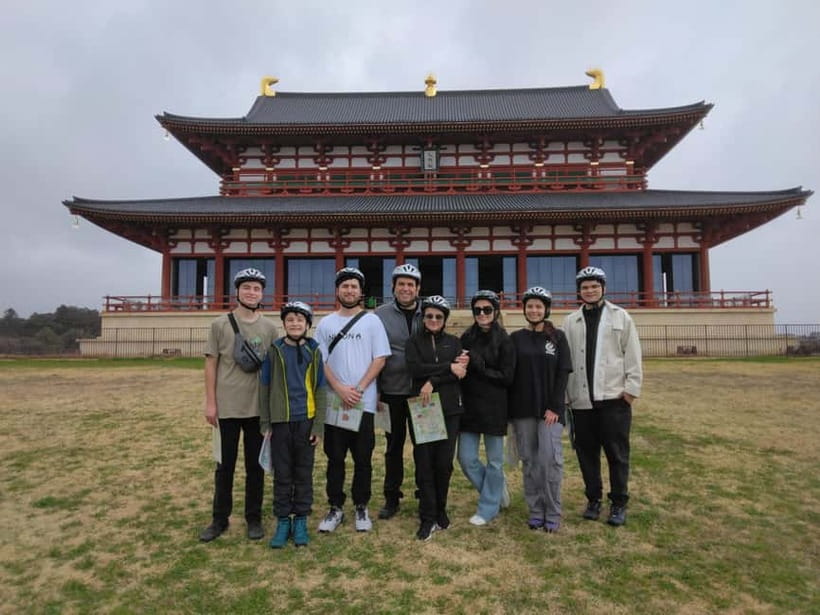
The Daiichiji Daigokuden, or First Imperial Audience Hall, is the tour’s major architectural stop. This reconstructed building was used for important ceremonies, rather than ordinary daily business.
Inside, you can see paintings, ornaments, and exhibitions connected with the hall. The building also gives you a high point from which to view the wider palace site.
The reconstruction needs a little explanation. You are not looking at an untouched Nara-period building. You are seeing a modern recreation based on historical research, design evidence, and archaeological findings. That does not make it worthless, but it does mean you should treat it as an interpretation of the past.
I find this distinction helpful. The hall gives you a strong visual image of imperial ceremony, while the excavation areas show the less polished evidence behind that image. The two types of stops work better together than either would alone.
The visit lasts about 15 minutes, followed by a short stop at the South Gate, or Nammon, of the First Imperial Audience Hall. That five-minute photo stop helps you see how the gates controlled movement into the ceremonial area.
The oldest palace-site museum
The Heijo Palace Site Museum is another 10-minute visit. It is described as the oldest museum at the palace site and displays ancient roof tiles, wooden tablets, and models.
These objects help fill in details that large buildings cannot show. Roof tiles hint at construction and decoration. Wooden tablets offer a more personal connection to administration and daily record keeping. Models help you picture the palace complex as a working capital rather than a collection of separate ruins.
The museum is compact, so you will not spend hours reading labels. That suits the tour’s format. Your guide can point you toward the objects that matter most and keep the visit connected to the stops you have already seen.
The Tenpyo costume experience
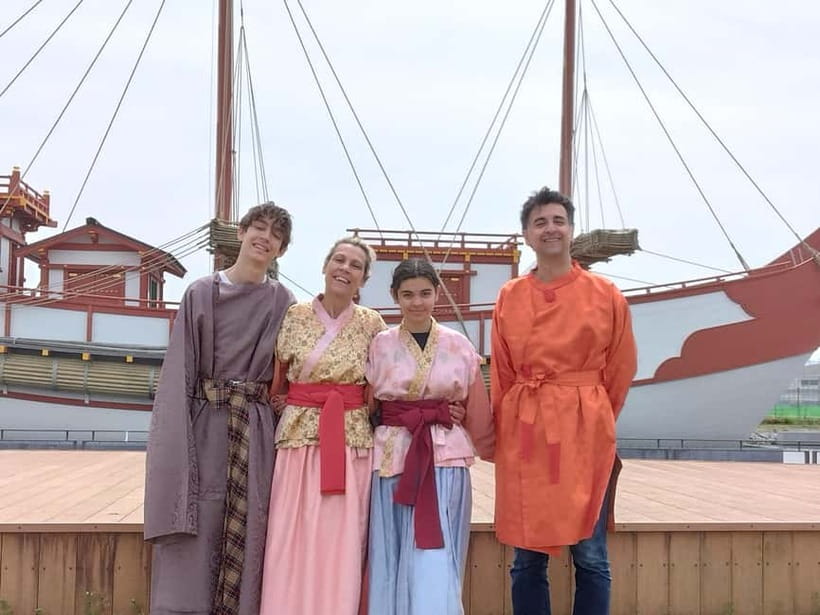
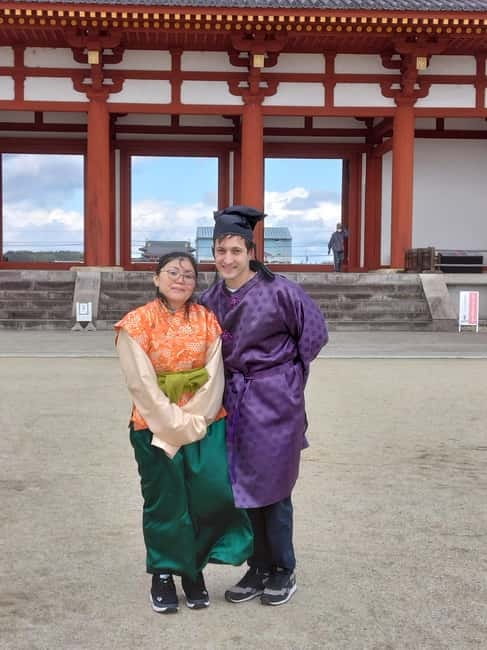
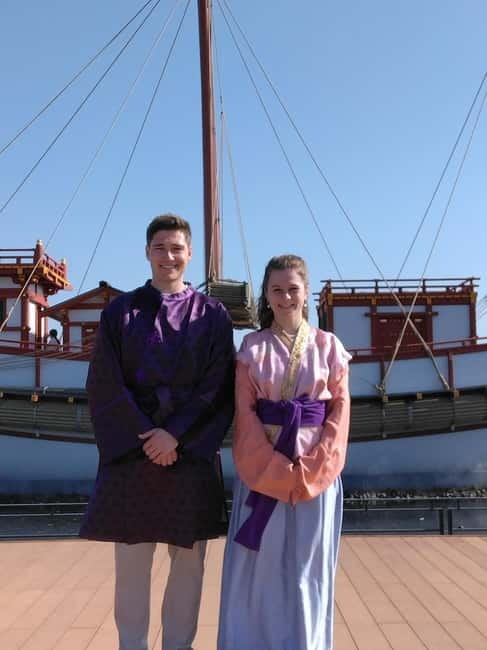
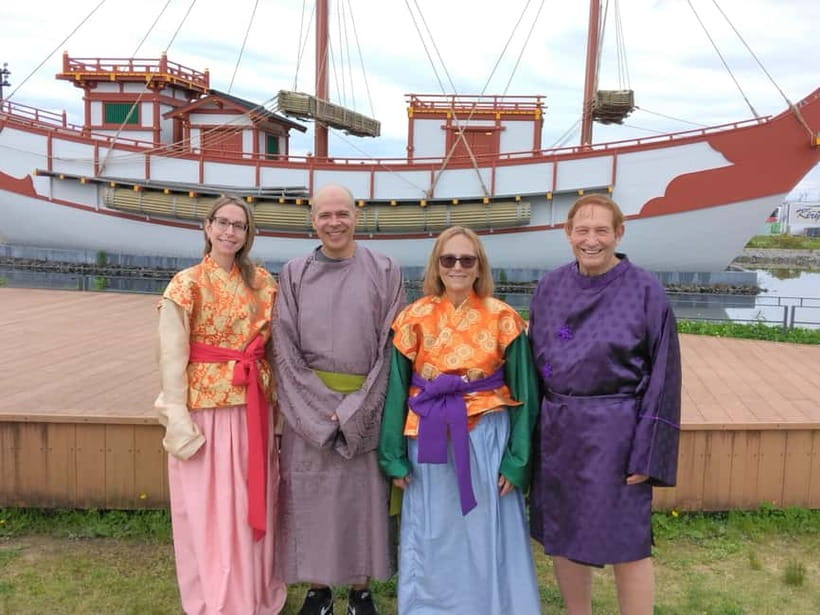
The traditional costume session is included in the price. You can wear Tenpyo, or Nara-period, clothing and take photos.
This is a lighter, more playful finish to a tour that otherwise concentrates on gates, archaeology, and court history. Families may enjoy it, and it gives you a personal souvenir beyond ordinary photographs of buildings.
Do not book the tour solely for a full costume production. The supplied details confirm the clothing experience and photos, but they do not describe a long dressing session or a staged performance. Think of it as a short cultural activity added to the sightseeing route.
For children, this can help break up the history. Kay has been praised for her patience with a six-year-old, and families have found the overall length manageable. Stamp collecting at local sites has also helped keep younger children interested.
What the two-hour format feels like
The route includes several stops, but none is very long. You spend about 15 minutes at Suzaku-Gate, 10 minutes at To-in Garden, 10 minutes at the Excavation Site Exhibition Hall, 10 minutes at Hishiage Kofun, 15 minutes at the First Imperial Audience Hall, five minutes at the South Gate, and 10 minutes at the palace-site museum. The remaining time is used for cycling, explanations, photographs, and the costume activity.
That rhythm works well for an introduction. You get a broad look at the site without committing an entire day. One guide has sometimes allowed extra time so the group could move at a comfortable pace, but you should plan around the advertised two hours.
The small-group limit of eight is a real advantage. A guide can answer questions, adjust explanations for children, and offer photo opportunities without managing a large crowd. English and Japanese tours are available.
The ride itself is not described as strenuous, and the pace has been praised as easy. Still, you must be able to ride a bicycle independently. The tour is not suitable for pregnant women, wheelchair users, people who cannot ride, or people with visual impairments.
Getting to Suzaku-Gate Square
The meeting point is not in central Nara’s main temple district. You meet at Miharashi-Kan in Suzaku-Gate Square, at coordinates 34.68628944048124, 135.7926401146025.
By Nara Kotsu bus, use the Suzakumon Hiroba Mae stop. From Kintetsu Nara Station, the bus ride takes about 16 minutes, followed by a five-minute walk north. From Kintetsu Yamato-Saidaiji Station’s South Exit, the bus takes about 10 minutes, followed by the same five-minute walk.
From JR Nara Station’s West Exit, the bus ride is about 10 minutes, then five minutes on foot. You can also walk about 20 minutes from Kintetsu Yamato-Saidaiji Station’s South Exit or about 20 minutes from Shin-Omiya Station.
Do not cut this close. Missing the start is nonrefundable, so allow time to find the reception counter rather than only the square.
Who will enjoy this ride most?
I would choose this tour if you have already seen Nara Park or want a different side of Nara. It suits you if you like archaeology, Japanese gardens, early Japanese government, reconstructed buildings, and quiet outdoor sightseeing.
Families can also do well here, especially with a patient guide such as Kay. The bicycles keep the outing active, while the short stops prevent the experience from becoming one long museum visit.
You may want to skip it if your main goal is deer, major Buddhist temples, or preserved original buildings. You should also think twice during very hot weather. One August visitor found the heat difficult and felt the site could seem modest without a strong interest in ancient Japanese culture.
Practical value and booking advice
At $22, this is an inexpensive guided activity for Nara. Bike rental, helmet, admissions, and costume experience are included, so the price is not simply covering transportation. You are getting access to a wide site plus a guide who can explain why each piece matters.
Free cancellation is available up to 24 hours before the start, with a full refund. You can also reserve now and pay later. Tours may be canceled for heavy rain, storms, or other poor weather, with a full refund in that case.
Should you book the Heijo Palace bike tour?
Book it if you want a calm, history-focused morning away from Nara’s busiest sights. The strongest reasons are the small group, easy cycling, excellent guide support, and the variety of stops packed into two hours.
Skip it if reconstructed buildings and archaeological traces do not interest you, or if you are visiting during punishing summer heat. For most people who want to understand Nara as Japan’s ancient capital, this is a smart $22 introduction, especially on a first day when you want helpful context before exploring more of the city.
FAQ
How much does the Nara bike tour cost?
The tour costs $22 per person.
How long does the tour last?
The advertised duration is two hours.
Where does the tour meet?
Meet at the rental-bike reception counter at Miharashi-Kan in Suzaku-Gate Square.
What languages are available?
The tour is available with a live guide in English or Japanese.
What is included in the price?
The price includes the bike tour, guide, rental bike, helmet, all admission fees, and the traditional Tenpyo costume experience.
Is hotel pickup included?
No. Hotel pickup is not included, so you must make your own way to Miharashi-Kan.
Can I cancel for a full refund?
Yes. You can cancel up to 24 hours in advance for a full refund. No-shows and missed tours are nonrefundable.
Is the tour suitable for children?
The provided information does not set a minimum age. Children must be able to ride a bicycle, and the tour has been manageable for families with a six-year-old.
Just added around Nara
- Private Nara Tour and Sake Tasting (Departing from Kyoto/Nara)★ 5.0 · 40 reviews
- Perfect Nara Park Half-Day Bus Tour with English Speaking Guide★ 5.0 · 49 reviews
- Discover Ancient Nara: Private Car Tour from Kyoto or Osaka★ 5.0 · 52 reviews
- Hammer a Pattern on Your Ring Workshop★ 5.0 · 57 reviews
- Nara: Great Buddha, Kasuga Shrine & Deer Park Tour★ 4.8 · 62 reviews
- Nara: Private Tour with Private Guide★ 4.8 · 66 reviews
- Nara Highlight Walking Tour with Furoshiki Experience with Lunch★ 5.0 · 73 reviews
- Nara – Highlights Bike Tour★ 4.5 · 89 reviews
Cycling Tours, compared.
3h Tokyo E-Bike Tour: Hidden Gems, and Local Life with guide
Read our review →
Arashiyama Bamboo Forest & Hidden Gems Bike Tour (Early Bird)
Read our review →
Hiroshima in a Nutshell: Morning Bike Adventure
Read our review →Browse the lists this tour appears in