
Reviewed · SAMURAI & NINJA EXPERIENCES
Samurai Training Tokyo Asakusa
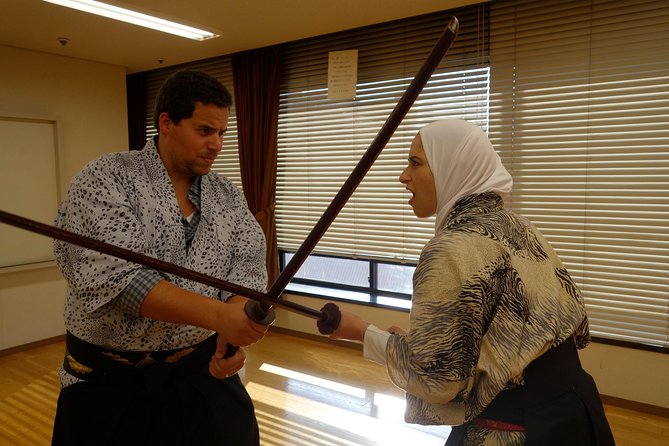
Stand ready, sword raised, and smile for the camera. This one-hour Asakusa experience gives you a playful but respectful introduction to samurai sword handling, complete with costume rental, private instruction, staged combat, and keepsakes to take home. I especially like the small private format, which lets the instructor adjust the lesson for children, couples, or adults. The second big plus is the photo and video package, since you can take part instead of standing behind the camera.
The main consideration is expectation-setting. This is an entertaining introduction, not a demanding martial arts course or a full day at a traditional dojo. You will learn basic movements, greetings, drawing and sheathing techniques, and a choreographed battle, but experienced martial artists may find the physical training fairly light.
In This Review
- Key points at a glance
- What this Asakusa samurai class is really like
- Meeting in Hanakawado, then changing into costume
- Learning battou, nattou, and samurai form
- The staged battle is the playful centerpiece
- Professional-looking photos without leaving your family behind
- Why the private format matters for families
- Is $85.89 a fair price?
- Planning your Asakusa day around the class
- Who should book this samurai experience?
- Should you book Samurai Training Tokyo Asakusa?
- FAQ
- How long does Samurai Training Tokyo Asakusa last?
- What is included in the price?
- What is the minimum age?
- Is the activity private?
- Where does the experience start?
- Do I need martial arts experience?
- What do I receive at the end?
Key points at a glance
- Private training with Jiro and assistants: Your group receives focused help rather than joining a large public class.
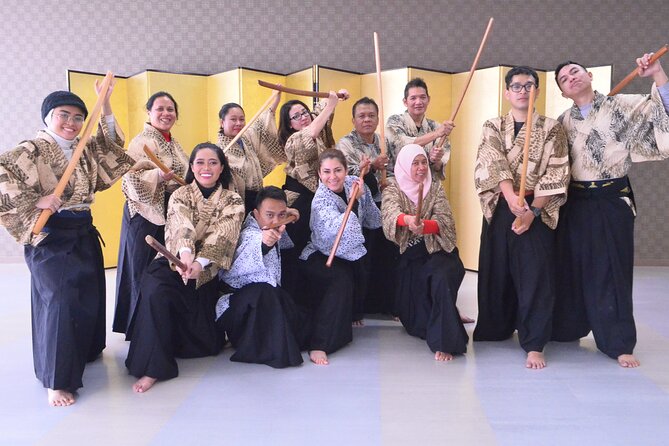
- Full samurai costume included: Dressing up is part of the experience, not an optional extra.
- Katana basics and staged combat: You practice battou, nattou, kata, slashing movements, and a simple battle routine.
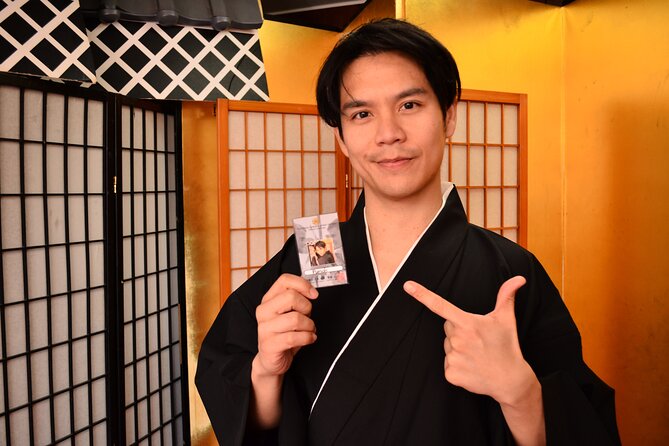
- Photos, video, and certificate: You receive photographs, video footage, an SD card or memory card, and a certificate with your photo.
- Well suited to children from age six: Children must have an adult with them, and the instructor can make the mock combat approachable for younger participants.
- Convenient Asakusa meeting point: The listed starting point is Hanakawado Sunny Mansion, though the exact training site can change with group size.
What this Asakusa samurai class is really like
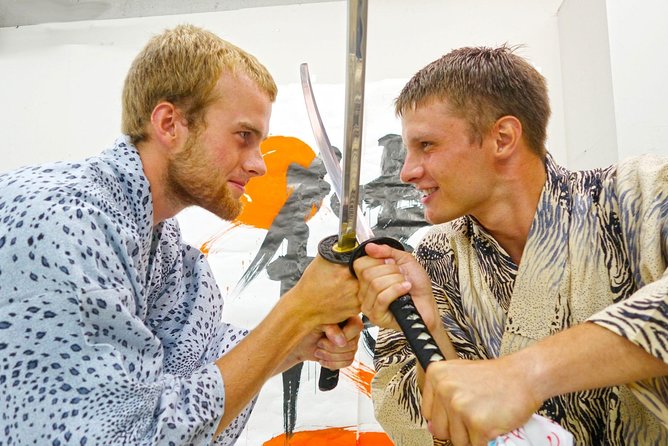
The experience is supervised by Ukon Takafuji, Iemoto of Kenbu Ukon-ryu, a samurai kenbu school. That gives the class a clear connection to a traditional sword performance style, while the lesson itself remains friendly and accessible to first-timers.
You are not expected to arrive with sword skills. The class begins with simple instruction and greetings before moving into controlled movements. The aim is to help you look and move like a samurai for a short time, not to test your fighting ability.
That balance works well for families. Children can enjoy the costume, pictures, and mock battle, while adults get a little cultural context and a chance to learn the correct sequence of movements. I would describe it as theatrical, educational, and lightly physical.
The experience is private, with a maximum of 10 people per booking. That matters because sword handling requires close attention. Instead of trying to copy an instructor from the back of a crowded room, you can ask for help and repeat a movement when needed.
The class is also compact. The advertised duration is about one hour, although one detailed description places the whole process closer to one to one and a half hours when meeting, changing, photographs, and the certificate are included. If you have a tightly planned Tokyo day, allow more than exactly 60 minutes.
More Samurai & Ninja Experiences in Tokyo
- Tokyo: Samurai Restaurant Show Ticket with 2 Drinks
★ 4.5 · 1,307 reviews - Tokyo: Samurai Ninja Museum Guided tour and Experience
★ 4.6 · 1,010 reviews - Tokyo: Samurai Sword & Archery Class from Samurai Descendant
★ 5.0 · 603 reviews
Meeting in Hanakawado, then changing into costume
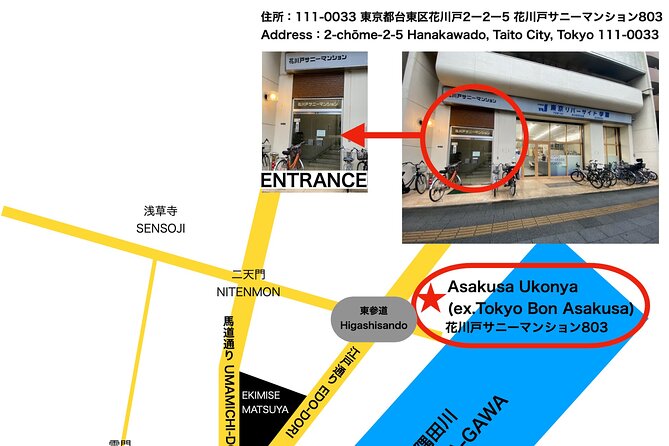
The listed meeting point is 2-chome-2-5 Hanakawado, Taito City, at Hanakawado Sunny Mansion. This is in Asakusa, a practical area for pairing the class with other Tokyo sightseeing.
One detail deserves attention: the meeting point and actual training location may vary depending on the number of participants. You are supposed to receive the final location at least two days before the reserved date. Read that message carefully rather than assuming the listed address is the room where every session takes place.
Once the group gathers, you change into the provided samurai costume. This is one of the most enjoyable parts for families because the transformation happens before the sword work begins. The costume also gives the photographs more character than ordinary vacation snapshots.
The process includes belting on the sword and posing for an initial picture. You get a few minutes to become comfortable in the outfit before the lesson starts. If you are visiting with children, this opening photo session helps them settle in and makes the experience feel special from the start.
The costume is included in the price, so you do not need to arrange rental clothing separately. The supplied information does not specify every costume piece or available size, so if fit is important for your group, ask the operator before booking.
Learning battou, nattou, and samurai form
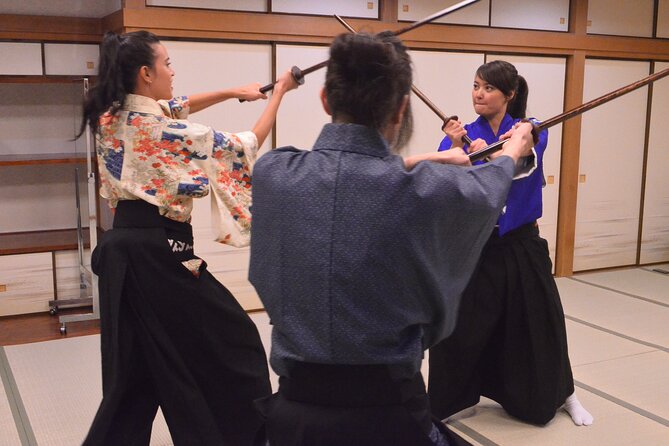
After changing, the group begins with greetings. This may sound small, but it sets the tone. Samurai training is presented as more than waving a sword around, and the class introduces posture, form, and respectful behavior before the action begins.
You then practice battou, drawing the katana, and nattou, returning it to its sheath. These are controlled actions that reward patience and careful listening. For a beginner, they are more interesting than simply making large swinging motions because they show how much attention goes into a formal sword routine.
Next comes kata, a sequence of set movements. You learn a routine that can be practiced and photographed. Several families found that the children remembered the choreography after returning home, which says something about the lesson’s ability to turn instruction into a clear, repeatable activity.
The class includes basic slashing movements and sword handling with a full-size sword. One detailed account notes that real swords were used for demonstration, while the mock combat is taught as a controlled practice routine. You should follow the instructor closely and avoid treating the sword as a toy.
This is where the private format earns its price. Instructor Jiro, often assisted by Aya or Akari, has been praised for being patient, funny, and easy to follow in English. The teaching style appears to be encouraging rather than stern, a good match for children and adults who have never held a katana.
The staged battle is the playful centerpiece
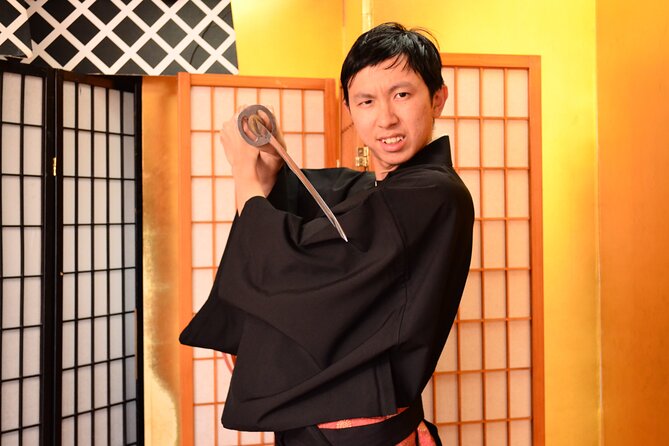
After the basic techniques, you practice sword fighting through samurai-style battle movements. This is not a full-contact contest. It is a choreographed exercise designed to help you perform a short scene safely and confidently.
For children, the staged battle can be the best part. Jiro has paired with younger participants, including an 11-year-old, and adjusted the exchange so the child felt comfortable. Parents can watch, join in, or take part themselves, depending on the group arrangement.
Adults should expect some laughter. The class is built for enjoyment, and the battle is meant to look good on camera rather than push you through an intense workout. You may work up a small sweat, but it is not a serious conditioning session.
That distinction is important for martial arts students. If you already hold a high rank in another discipline, you may find the material basic. Still, you can enjoy refining the routine, learning how the instructors present the movements, and taking part in the photo session.
I like that the combat portion gives the class a beginning, middle, and end. You first learn the movement, then repeat it with a partner, and finally perform it for the camera. Even a nervous beginner gets a clear goal.
A completely different kind of day out in Tokyo:
- Mt Fuji and Hakone 1-Day Bus Tour Return by Bullet Train
★ 5.0 · 26,383 reviews - 1-Day Tokyo Bus Tour
★ 5.0 · 14,250 reviews - Tokyo: TOKYO SKYTREE® Admission ticket
★ 4.5 · 11,192 reviews - Tokyo: teamLab Planets TOKYO Digital Art Museum Entry Ticket
★ 4.6 · 9,779 reviews
Professional-looking photos without leaving your family behind
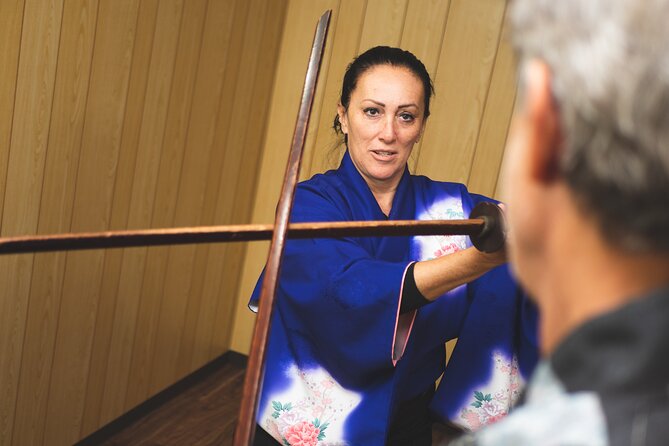
The included photography is one of the strongest reasons to consider this activity. The instructors take pictures during the costume portion and training, then record the staged battle as video.
This solves a common family-trip problem. One parent does not have to miss the activity while documenting it. The whole group can participate, and the resulting footage becomes a useful souvenir of the day.
The photos have been described as high quality, and the operator provides photo data on an SD card or memory card. Video may also be recorded using your phone or tablet if you allow it. Bring a device if you want additional footage captured on your own equipment.
At the end, you receive a certificate of recognition with your photo, along with the image data and a face photo. The certificate is a fun touch for children and a nicely silly souvenir for adults. It gives the experience a proper finish instead of ending with a quick change of clothes.
You should confirm the exact storage format and how the files will be transferred if that matters to you. The information refers to an SD card, memory card, and photo data, while some participants had footage made on their own tablet. The practical setup may depend on the equipment available that day.
Why the private format matters for families
The experience accepts children from age six, but children must be accompanied by an adult. That rule is sensible because the lesson involves a sword, costume changes, and a moderate level of physical activity.
The instructor’s patient manner is especially valuable for a mixed-age group. A younger child may need simpler instructions, while a teenager may want a more dramatic battle routine. A private class gives the staff room to make those adjustments.
Couples and solo participants can also book. A pair can work together through the routine, while a solo participant should still receive individual attention because the activity is private. The maximum booking size is 10 people, so a larger family or friend group can potentially train together without being split into a large public crowd.
The class suits people who want a memorable activity that does not consume half a day. It also works well on a rainy day or as a break from temple visits and shopping in Asakusa.
You should have a moderate level of physical fitness. The activities include standing, costume wear, sword movements, and staged combat. No special martial arts background is required, but you should be comfortable following physical instruction for about an hour.
Is $85.89 a fair price?
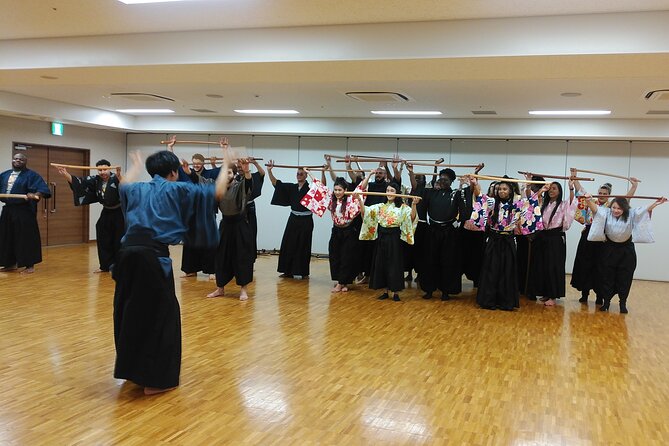
At $85.89 per person, this is not the cheapest short activity in Tokyo. You are paying for more than instruction: costume rental, a private class, an instructor and assistant, photography, video footage, and a personalized certificate are included.
For a family, the value depends on how much you care about participation and souvenirs. A simple costume photograph would cost less, but it would not give you the lesson, sword routine, or staged battle. A serious martial arts course would offer more technical depth, but it would not provide the same quick, holiday-friendly format.
I think the price is reasonable for a special occasion, a family highlight, or a couple looking for something beyond standard sightseeing. The photo and video material adds real value because it records the whole group in action. If you are mainly seeking rigorous sword training, spend your money elsewhere.
The experience is commonly booked well ahead, with an average booking time of about 48 days in advance. That suggests you should reserve early if your Tokyo dates are fixed, especially if you need a particular day for a family schedule.
Confirmation is sent within 48 hours of booking, subject to availability. The activity uses a mobile ticket, and hotel pickup and drop-off are not included. You will need to make your own way to Asakusa.
For cancellations, a full refund requires at least six full days before the local start time. A cancellation two to six full days ahead receives a 50 percent refund, while cancellations less than two full days ahead are not refunded. Changes follow the same time limits. If the minimum number of participants is not met and the operator cancels, you are offered another date or experience, or a full refund.
Planning your Asakusa day around the class
Asakusa is a good setting for this activity because you can combine it with other sights in the neighborhood. Keep your schedule flexible around the class, since the final training address can vary and the full visit may run longer than the advertised one-hour estimate.
Arrive with enough time to find the meeting point. One person initially felt uncertain about the meetup but found the staff and training once they were met and escorted to the building. That is a useful warning: do not cut the arrival time too close, and keep your phone available for messages.
If you are late, do not assume the class can always wait. One family was accommodated after arriving late by taxi, but that should be treated as kindness rather than a guarantee. Tokyo traffic and a missed meeting can quickly eat into a one-hour class.
Wear something that allows you to change comfortably. The costume is supplied, but the information does not specify changing-room details, so avoid bringing an unnecessarily complicated outfit. Keep your booking confirmation and phone accessible.
English support has been praised, and Jiro and his assistants are described as friendly and clear. Still, the activity involves physical demonstrations, so watch closely and ask for a repeat when you need one.
Who should book this samurai experience?
I would recommend it most strongly to families with children age six and older, particularly those who want an activity the whole group can remember together. Teenagers also seem likely to enjoy the staged battle and video, while parents benefit from not having to operate the camera throughout.
It is a good fit for couples who want a playful Tokyo date or for solo visitors who would enjoy a private lesson and a distinctive portrait. The private setup keeps the experience personal without requiring any previous sword experience.
It may be less suitable for someone seeking a long cultural lecture, advanced kenjutsu training, or a physically demanding workout. The lesson introduces samurai form through a short, friendly performance class. That is its strength, but it also defines its limits.
Should you book Samurai Training Tokyo Asakusa?
Book it if you want to wear a full samurai outfit, learn a basic katana routine, stage a battle, and leave with photos, video, and a certificate. The strongest parts are the patient instruction from Jiro and his assistants, the private attention, and the chance for every family member to be in the pictures.
Skip it if your main goal is serious martial arts training. For everyone else, especially families with a free hour in Asakusa, this offers a memorable change of pace at a fair price for the number of inclusions. Reserve ahead, confirm the final meeting details, and allow extra time beyond the stated hour.
FAQ
How long does Samurai Training Tokyo Asakusa last?
The advertised duration is about one hour. Including meeting, changing, photographs, and the certificate, you should allow roughly one to one and a half hours.
What is included in the price?
The price includes a local instructor, rental costume, photographs, and video footage. Hotel pickup and drop-off are not included.
What is the minimum age?
The minimum age is six. Children must be accompanied by an adult.
Is the activity private?
Yes. Only your group participates, with a maximum of 10 people per booking.
Where does the experience start?
The listed starting point is Hanakawado Sunny Mansion, 2-chome-2-5 Hanakawado, Taito City, Tokyo 111-0033. The meeting and training locations can vary with the number of participants, and the final details are sent at least two days before the reserved date.
Do I need martial arts experience?
No. The class is designed for beginners and teaches greetings, drawing and sheathing the katana, kata, basic slashing movements, and a staged sword fight. A moderate level of physical fitness is recommended.
What do I receive at the end?
After changing clothes, you receive a certificate of recognition with your photo, photo data on an SD card or memory card, and a photo of your face. Video footage is also included, with some footage recorded on a participant’s phone or tablet.
Just added around Tokyo
- Tokyo 6hr Instagram Highlights Private Tour with Licensed Guide★ 5.0 · 38 reviews
- Tokyo Small Group Tour with Guide★ 4.5 · 38 reviews
- Tokyo Sumo Experience with Live Show & Audience Challenge★ 5.0 · 38 reviews
- Japanese Food Cooking Class in Asakusa, Tokyo★ 5.0 · 39 reviews
- Very popular in Harajuku♡Animal petting zoo★ 4.6 · 39 reviews
- Ramen Making from Scratch with Tokyo Mom(Vegan Option Available)★ 5.0 · 39 reviews
- Tokyo JDM Night: 600hp C63s AMG Edition 1 (Private)★ 4.9 · 39 reviews
- Tokyo: Kimono Rental inside Shinjuku Gyoen National Garden★ 4.9 · 39 reviews
Samurai & Ninja Experiences, compared.
Samurai Ninja Museum Guided tour and Experience
Read our review →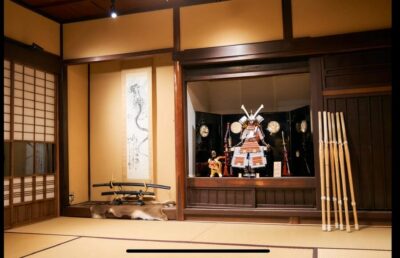
Kendo and Samurai Experience with Uniform and Gear
Read our review →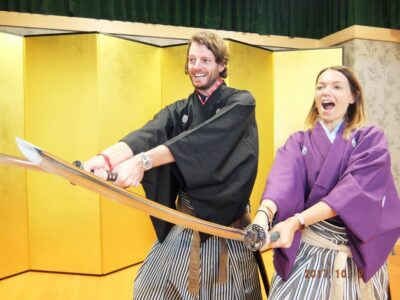
Samurai Sword Class by Experts in Traditional Arts
Read our review →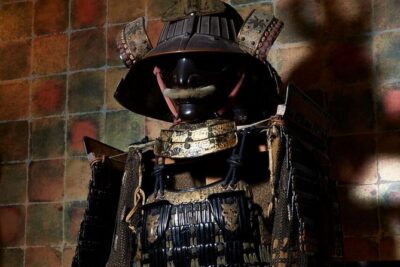
Skip the lines Basic Ticket at SAMURAI NINJA MUSEUM KYOTO
Read our review →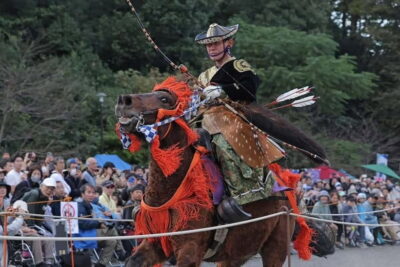
Samurai Sword & Archery Class from Samurai Descendant
Read our review →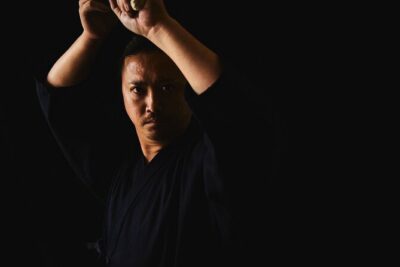
Browse the lists this tour appears in