Reviewed · MORNING
Explore Hidden Alleyway with a Local Expert (Morning tour)
Kyoto reveals itself slowly. This private morning e-bike tour makes the city easier to grasp, taking you from old geisha lanes to the Kamo River without the strain of walking across town. I like the small private group and the way an electric bike lets you cover far more ground than a standard walking tour. I also like that the route can bend to your interests, as it did for riders who asked to spend more time by the river or stop for coffee.
The main drawback is the weather plan. The tour operates in rain, with ponchos or public transportation as alternatives, but a wet bus-and-walking morning may not deliver the experience you imagined. English ability can also vary by guide, so detailed conversation may be easier with some guides than others.
In This Review
- Key points at a glance
- Why an e-bike works so well in Kyoto
- Miyagawacho: Kyoto’s quiet wooden lanes
- Gion: More than a famous photo stop
- Tatsumi Bridge and the willow-lined stream
- Kyoto Imperial Palace on two wheels
- Kashiwayacho and the Kamo River pause
- What the private format adds
- Is $103.04 a fair price?
- Rain, heat, and the practical details
- Who should book this Kyoto e-bike tour?
- Should you book it?
- FAQ
- How long does the Kyoto e-bike tour last?
- What time does the tour start?
- Where does the tour begin?
- Where does the tour end?
- How many people can join one guide?
- Can one person book this tour?
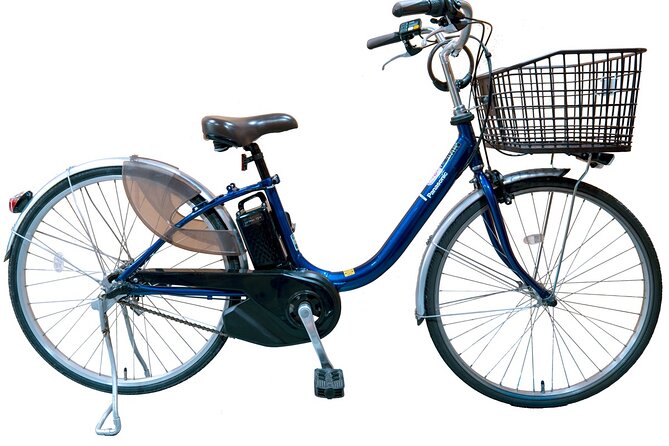
- Are e-bikes and equipment included?
- What happens if it rains?
- Can children join the tour?
- What is the cancellation policy?
Key points at a glance
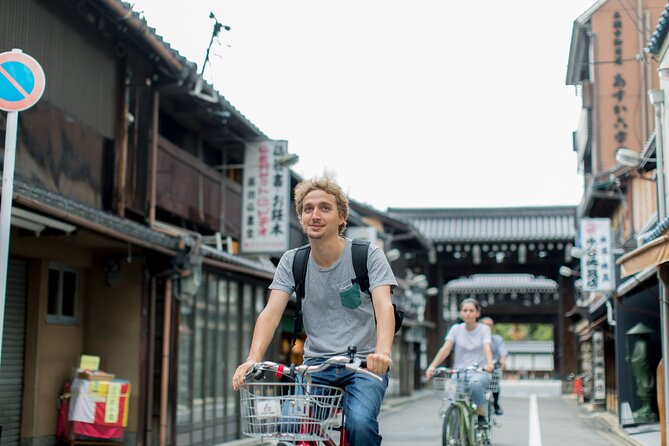
- Miyagawacho and Gion: Ride through two of Kyoto’s best-known geisha districts, where traditional wooden houses still line narrow lanes.
- Private group of two to six: You are not tied to a large group’s pace, and an extra guide can be arranged for groups of seven to twelve.
- Electric bikes included: The battery assistance helps on a hot morning and makes a broad city route less tiring.
- Kyoto Imperial Palace: Cycle along the gravel paths of the former imperial residence, now a public garden.
- Kamo River pause: Spend time at Kashiwayacho, a local riverside rest point, with a chance to slow down.
- Rain flexibility: Continue by bike with a free poncho, or switch to walking and public transportation at no extra transport charge.
Why an e-bike works so well in Kyoto
Kyoto is not difficult to explore because its sights are far-flung by world standards. It is difficult because the best parts are spread between busy corridors, quiet lanes, temple districts, river paths, and residential streets. Walking is rewarding, but a full day on foot can leave you too tired to enjoy the next stop.
This three-hour ride solves that problem in a practical way. You get the feel of Kyoto’s streets while the motor assistance takes some of the work out of the ride. That mattered especially to riders who took the tour on a hot day. The electric bikes made it possible to keep moving at a comfortable pace instead of treating every stretch between sights as an endurance test.
You should still be comfortable riding a bicycle on the road without help. The minimum age is 10, children must be at least 145 centimeters tall, and each child must be able to ride safely without assistance. This is not a bicycle-seat sightseeing trip for very young children.
The experience begins at 9:00 a.m. at 552-13 Higashiaburanokōjichō in Shimogyo Ward. It returns to the same meeting point, which is useful if you have luggage plans or another activity later in the day. Equipment rental is included, so you do not need to arrange your own e-bike.
A few more Kyoto experiences worth weighing up
- Kyoto Early Morning Tour with English-Speaking Guide
★ 5.0 · 1,427 reviews - Kyoto: Early Morning Tour with English-Speaking Guide
★ 4.9 · 1,128 reviews - From Kyoto: Nara Guided Morning Tour
★ 4.6 · 335 reviews
Miyagawacho: Kyoto’s quiet wooden lanes
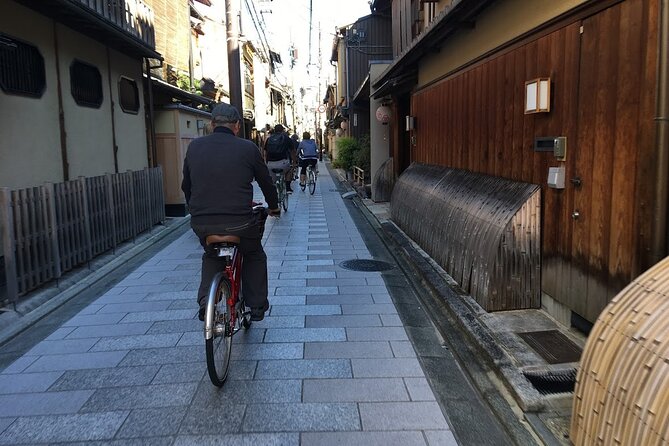
The first stop is Miyagawacho Kaburenjo, in Miyagawacho, one of Kyoto’s five traditional geisha districts. It is the second largest of those districts, and the setting immediately shows why a bicycle is useful here.
The route passes along an alley lined with traditional wooden houses. The buildings and narrow street create a calmer mood than the major sightseeing roads. This is a good early stop because it gives you a visual introduction to old Kyoto before the morning gets busier.
You get about 15 minutes here, with no admission charge. That is enough time to look closely at the architecture and hear about the district, but not enough for a long independent wander. If you hope to spend a great deal of time photographing every lane, the schedule may feel brisk.
Keep your expectations sensible around geisha districts. You are seeing historic neighborhoods where people live and work, not an outdoor performance venue. The value is in the atmosphere, the wooden architecture, and the guide’s explanation of how these districts fit into Kyoto life.
Gion: More than a famous photo stop
From Miyagawacho, the tour continues to Gion, Kyoto’s best-known geisha district. Gion developed around maiko and geiko culture, and traditional buildings still give parts of the area its refined old-town character.
You have around 15 minutes here. The stop is short, but the bicycle makes the overall visit more efficient because you do not spend the morning walking from one district to the next. Your guide can point out the character of the area while helping you move through it respectfully.
I would not choose this tour solely for a chance to see a maiko or geiko. The schedule does not promise encounters, and the tour is better understood as a look at the districts where that culture developed. You may find the short visit especially useful early in a Kyoto stay, since a guide can help you understand what you are seeing before you return to Gion on your own.
The private format helps here. If you want to ask about customs, architecture, or the difference between maiko and geiko, you can ask as you go rather than wait for a large group to catch up. Rich, one of the guides, received especially warm praise for answering questions throughout the morning. Yuichi also adapted the ride to individual interests and offered useful Kyoto tips.
Tatsumi Bridge and the willow-lined stream
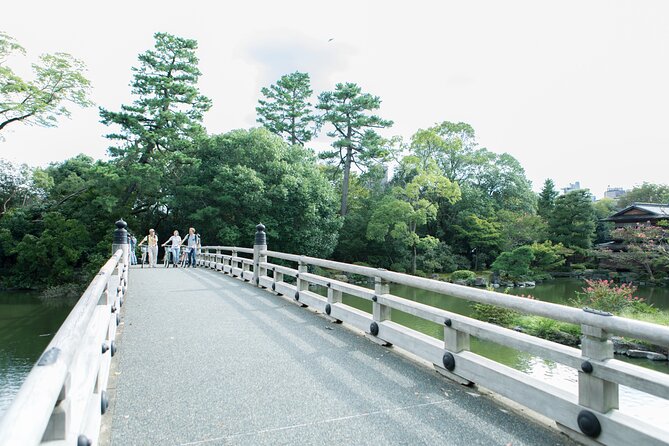
Tatsumi Bridge offers a change of pace after the two geisha districts. The path follows a small stream, with willows moving in the breeze and water close by. It is one of those brief Kyoto stops that works because it is quiet rather than grand.
The visit lasts about 15 minutes. You can pause, take in the scene, and let the guide explain why this corner feels so different from a main street only a short ride away.
This is also a good reminder that the tour is not just a checklist of major monuments. The route mixes cultural districts with small streets and waterside pauses. If you want only famous landmarks, some of the quieter stops may seem modest. If you want to understand Kyoto’s mood, they are part of the appeal.
The bridge and stream are also a useful place to appreciate the pace of the morning. You are not racing from attraction to attraction. The guide can keep the ride moving while still leaving room for pauses, questions, and small changes to the plan.
A completely different kind of day out in Kyoto:
- PERFECT KYOTO 1-Day Bus Tour
★ 5.0 · 13,518 reviews - Kyoto: Fushimi Inari, Kinkakuji, Bamboo Grove 1 Day Bus Tour
★ 4.8 · 4,316 reviews - Kyoto: Tea Ceremony in a Traditional Tea House in Kiyomizu
★ 4.9 · 3,519 reviews - Kyoto Geisha Walking Tour: Gion District & Hidden Gems
★ 4.7 · 3,273 reviews
Kyoto Imperial Palace on two wheels
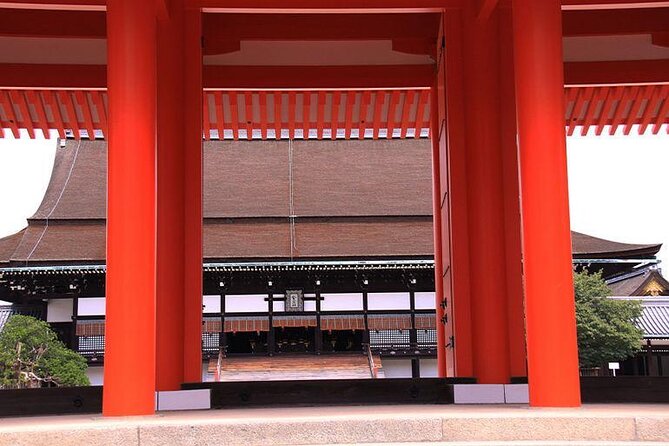
The tour then reaches Kyoto Imperial Palace, once the residence of Japan’s Imperial Family. Today, the palace grounds are open to the public as a national garden, with seasonal flowers and broad paths.
You spend about 20 minutes cycling along gravel paths. That detail matters. This is not a fast road ride, and you should expect a gentler pace over the garden surface. The setting gives you a break from narrow urban streets and a chance to see one of Kyoto’s major historic sites without making it a long indoor palace visit.
The tour does not describe an interior palace visit or a detailed palace admission program. You are cycling through the public garden area. That makes the stop a good fit if you want a sense of the site and its scale, but less suitable if the palace interiors are high on your list.
This was one of the points riders specifically wanted to visit. A flexible guide can make a difference when you have a priority such as the Imperial Palace or the river. Still, remember that the full route has several stops, so you will not have the kind of extended time you would get on a dedicated palace visit.
Kashiwayacho and the Kamo River pause
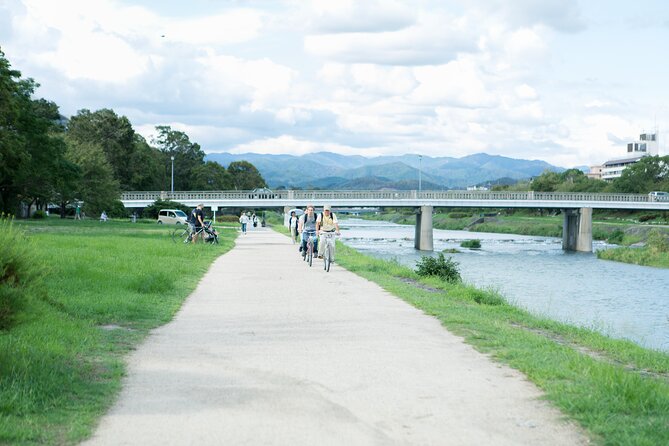
The final listed stop is Kashiwayacho, where you can relax beside the Kamo River. This is a local riverside resting place, and the 20-minute pause gives the morning a welcome finish.
After riding through traditional districts and palace grounds, the river provides open space and a chance to sit back. It is also where the tour feels most adaptable. One group specifically wanted to ride along the river and see the Imperial Gardens, and the guide shaped the morning around those wishes.
Another group asked for a coffee break, which the guide fitted into the three-hour schedule. That flexibility is one of the strongest reasons to book a private tour instead of a fixed large-group route. You can tell the guide what matters most, although you should not expect every requested stop to fit if it requires a major detour.
The tour ends back at the starting point. Since the activity lasts about three hours, a 9:00 a.m. departure should finish around noon, though the exact timing can change with riding speed, questions, weather, and requested pauses.
What the private format adds
The group limit is two to six people per guide. One-person bookings are not accepted, so solo visitors cannot reserve this activity by themselves under the stated rules. Groups of seven to twelve can request an additional guide.
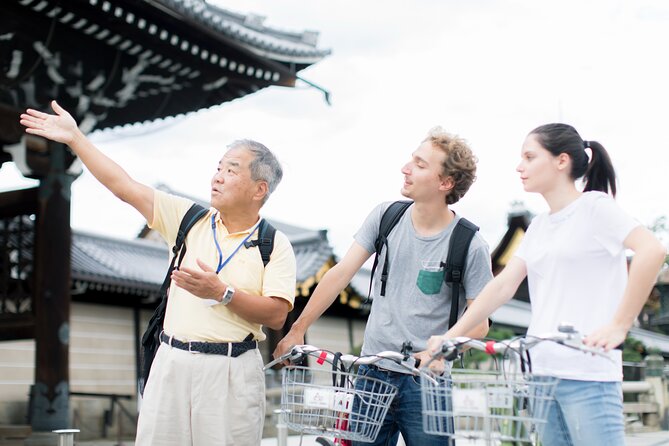
That small scale affects the feel of the morning. You can ask questions as they occur to you, request a moderate pace, and tell the guide if the river or palace matters more than another stop. Riders who spent the morning questioning Rich about Japanese history, culture, and religion found that the conversation kept going without the guide becoming impatient.
The guide roster includes Rich, Annie, and Yuichi. Annie was praised for being caring, well-informed, and generous with explanations and help. Yuichi was particularly good at adjusting the route to requests and adding a café pause. The English experience may not be identical with every guide. One rainy-day rider found communication difficult when the tour shifted to public transportation, which is worth keeping in mind if detailed English discussion is essential to you.
The strongest guides seem to add much of the tour’s value. Kyoto’s streets are easy enough to ride past, but a good explanation turns a wooden house, stream, or riverside path into part of a larger picture.
Is $103.04 a fair price?
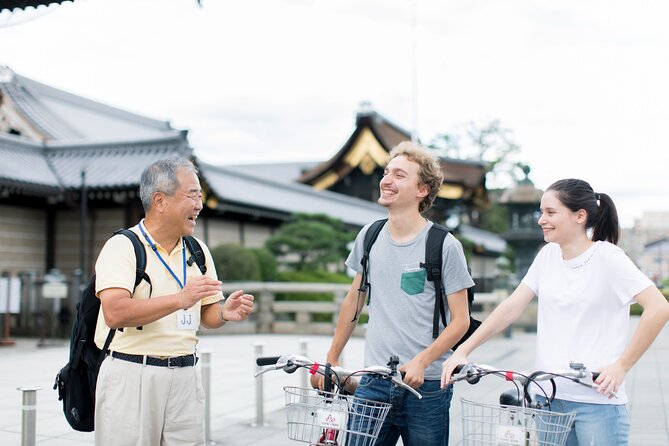
At $103.04 per person, this is not the cheapest way to see Kyoto. You are paying for a private guide, an e-bike, equipment, route planning, and the ability to shape the morning around your group.
The value improves when you consider what the ride replaces. You could spend much of the morning walking between Gion, Miyagawacho, the Imperial Palace, and the Kamo River. You could also rent bicycles separately, work out the route yourself, and handle navigation in unfamiliar streets. This tour removes much of that friction.
It is especially good value for a pair or small group that wants personal attention. It is less compelling if you already know Kyoto well, own a bicycle, and enjoy planning your own urban routes. The private format also means the cost is per person, not one flat fee for the whole group.
The experience is often booked about 47 days ahead, so early planning makes sense if your dates are fixed. Confirmation is sent within 48 hours of booking, subject to availability.
Rain, heat, and the practical details
The tour operates in rain rather than automatically canceling. You can continue by bike with a free rain poncho, or switch to a walking tour using buses or the metro, with that public transportation included in the tour fee.
That policy gives you a choice, but it does not make heavy rain pleasant. If rain is pouring, the bus-and-walking version may feel like a backup rather than an equal substitute. One rider felt it would have been better to cancel in those conditions, even though the guide was kind. I would book this with a flexible attitude toward weather, not with the expectation of a perfect cycling morning.
Hot weather is a different matter. The electric assistance received strong praise because it kept the ride manageable. You should still dress for outdoor activity and consider padded shorts or padded cycling trousers if you are not used to bike seats. That small bit of preparation could save your comfort.
The tour is mobile-ticket based. It is a private activity, and admission is free at Miyagawacho, Gion, Tatsumi Bridge, and Kyoto Imperial Palace. The Kashiwayacho stop is listed as included.
Cancellation information needs careful checking because the supplied terms conflict. One section says you can request a refund at least three days before the tour date by 6:00 p.m. Japan time, while the cancellation policy says the experience is non-refundable and cannot be changed. Ask KCTP to confirm the current rule before paying. If the minimum number of participants is not met and the operator cancels, you are offered another date or experience, or a full refund.
Who should book this Kyoto e-bike tour?
I would choose this tour for a first or second day in Kyoto. It gives you a broad orientation, introduces several different parts of the city, and leaves you with ideas for places to revisit at a slower pace.
It suits couples, families with older children who meet the height and riding requirements, and small groups that want a private morning. It is also useful for anyone who finds a full day of walking tiring but still wants to see traditional streets and major landmarks.
I would think twice if you dislike riding on roads, want long visits at each attraction, or need a guaranteed indoor sightseeing plan in wet weather. It is also not the right booking for a solo rider, since at least two people are required.
Should you book it?
Book it if you want to cover a wide slice of Kyoto in three hours, value a guide’s local context, and like the freedom to request a river ride, palace visit, or café stop. The combination of electric bikes and a private group is the main reason this tour earns its strong reputation.
Skip it if your priority is a slow, detailed visit to one district, a palace interior tour, or a weather-proof activity. For most small groups, though, this is an efficient and enjoyable first look at Kyoto, with enough quiet lanes and riverside time to keep it from feeling like a hurried sightseeing circuit.
FAQ
How long does the Kyoto e-bike tour last?
The tour lasts approximately three hours.
What time does the tour start?
It starts at 9:00 a.m.
Where does the tour begin?
The meeting point is 552-13 Higashiaburanokōjichō, Shimogyo Ward, Kyoto, 600-8235, Japan.
Where does the tour end?
The activity ends back at the meeting point.
How many people can join one guide?
A guide can take a minimum of two and a maximum of six people. Groups of seven to twelve can request an additional guide.
Can one person book this tour?
No. The stated minimum is two participants, and one-person bookings are not accepted.
Are e-bikes and equipment included?
Yes. The tour includes e-bike equipment rental.
What happens if it rains?
The tour can continue by bike with a free rain poncho, or you can switch to a walking tour using public buses or the metro. The public transportation is included in the tour fee.
Can children join the tour?
Children must be at least 10 years old, at least 145 centimeters tall, and able to ride a bicycle safely on the road without assistance.
What is the cancellation policy?
The supplied information gives conflicting terms. One section says a refund may be available when you notify the operator at least three days before the tour by 6:00 p.m. Japan time, while another says the experience is non-refundable and cannot be changed. Confirm the current policy with KCTP before booking.
Just added around Kyoto
- Kyoto: Private Customizable Day Trip by Car★ 5.0 · 38 reviews
- Kyoto: Gion Night Walking Tour with Geisha Insight★ 5.0 · 39 reviews
- Kyoto: Full Day Bike Tour★ 4.9 · 39 reviews
- Private Japanese Calligraphy in Kyoto – Learn Shodō with a Master★ 5.0 · 39 reviews
- Experience a tea ceremony in an authentic tearoom, in Kyoto!★ 4.5 · 41 reviews
- Kyoto: Gion Evening Walk with Hidden Gems, Geisha & Sake★ 5.0 · 41 reviews
- Kyoto Private Photo Shoot & Tour by SnapKyoto★ 5.0 · 41 reviews
- The Way of Tea: Kyoto Crafts, Hidden Temples & Wabi-Sabi Walk★ 5.0 · 41 reviews
Morning, compared.
Kyoto Early Morning Tour with English-Speaking Guide
Read our review →Early Morning Tour with English-Speaking Guide
Read our review →
World Heritage Shirakawa-go Morning Guided Tour
Read our review →
Nara Early Morning Tour (Kyoto or Osaka Departure Available)
Read our review →
Hiroshima in a Nutshell: Morning Bike Adventure
Read our review →