
Reviewed · CYCLING TOURS
Hiroshima: Peace Cycling Tour with Local Guide
History feels different from a bicycle seat. This small-group e-bike tour links Hiroshima’s Peace Memorial Park with lesser-known A-bomb sites across the city, giving you both the central memorials and a clearer sense of how far the destruction reached. Local guides such as Shin, Kana, Moe, and Bella add family stories and everyday context that a museum visit alone cannot provide.
I especially like the chance to ride beyond the Atomic Bomb Dome, and I like the calm, hopeful way the guides handle a painful subject. Shin’s family connection to August 6, 1945, and Moe’s stories about her relatives have made this experience especially personal for many participants. The main drawback is that you need to be comfortable riding a bicycle, and the shared group may slow down for children or less confident riders.
You can choose a two-hour route focused on the Peace Park and nearby suburbs, or a three-hour route with more stops, including Hiroshima Castle, Miyuki Bridge, the Red Cross Hospital, and a surviving weeping willow. At $52 per person, the price is fair if you want history, transport, and a local guide combined, though the tour is not designed as a broad city sightseeing ride.
In This Review
- Key points to know before booking
- Why cycling gives Hiroshima more meaning
- Starting at the Peace Memorial Park
- The two-hour route and the A-bombed streetcars
- The three-hour route from Hiroshima Castle to Peace Boulevard
- Hiroshima Castle and the Gokoku Shrine
- Central Park and Aioi Bridge
- The Atomic Bomb Dome, Motoyasu River, and Peace Bridge
- Higashisenda Park and the Red Cross Hospital
- Hiroshima Railway and the surviving transport story
- Miyuki Bridge, Kobayashi River, and the surviving willow
- Peace Boulevard and the return
- The guides are the heart of the experience
- What riding the electric bicycles is really like
- Is $52 a fair price?
- Who will enjoy this Hiroshima bike tour?
- FAQ
- Where does the Hiroshima Peace Cycling Tour meet?
- How long is the tour?
- Is the tour conducted in English?
- How many people can join?
- Are electric bicycles provided?
- Can young children join?
- What should I bring?
- Should you book it?
Key points to know before booking
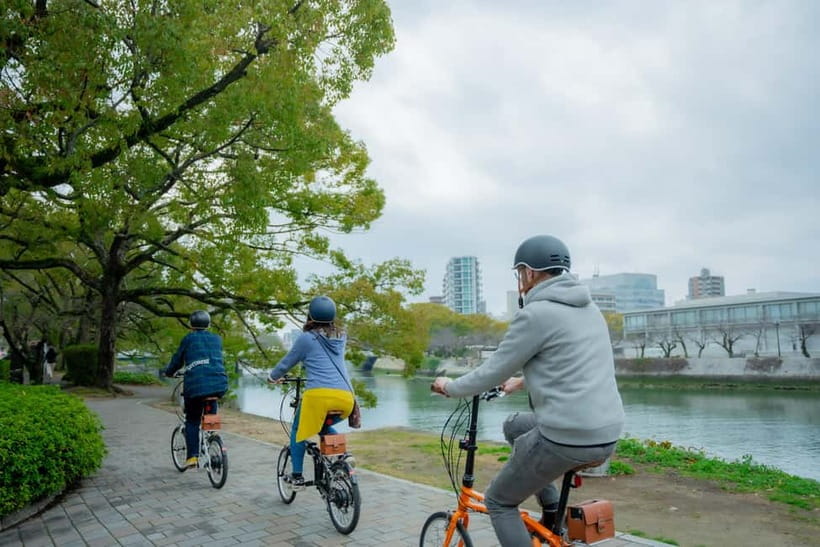
- Ride beyond the Atomic Bomb Dome: The route reaches suburbs and A-bomb heritage sites that are easy to miss on foot.
- Hear family stories from local guides: Shin, Kana, Moe, and other guides connect the bombing’s legacy to Hiroshima families today.
- Choose two or three hours: The shorter route covers the Peace Park and A-bombed streetcars, while the longer route adds a wider circuit.
- Electric bicycles reduce the effort: The bikes make the modest distances manageable, but you still need basic cycling ability.
- Small groups keep the tour personal: Groups are limited to 10 people, with time for questions and photographs.
- Plan for heat and punctuality: Bring water, a towel, and comfortable clothes, and arrive on time because late arrivals can lose the booking.
Why cycling gives Hiroshima more meaning
The Peace Memorial Park is the natural starting point for Hiroshima, but it can also make the city’s story feel concentrated in one carefully arranged area. Cycling changes that. You leave the central memorial zone and see how the city stretches outward from the hypocenter, with ordinary streets, bridges, hospitals, parks, and railway lines tied to the bombing.
The tour explains that an area within roughly 2.5 kilometers of the hypocenter suffered severe damage. That fact becomes easier to grasp as you move through the city rather than simply reading it on a museum panel. The distance between stops is short enough for an electric bicycle, yet wide enough to show that the bombing affected an entire urban community.
I like this balance. You still visit the essential memorials, but you are not confined to a single park. You also see Hiroshima as a living city, rebuilt with trees, roads, public buildings, and working transport. That contrast between destruction and recovery is one of the strongest parts of the experience.
The group size is capped at 10 people. That is small enough for a guide to answer questions, take photographs, and keep an eye on the group. The tradeoff is that this is a shared ride, not a private tour. If someone is new to cycling, the pace may be adjusted for everyone.
More Bike Tours in Hiroshima
- Hiroshima in a Nutshell: Morning Bike Adventure
★ 5.0 · 524 reviews - Hiroshima 2hr Peace Cycling Tour with Local Guide
★ 5.0 · 321 reviews - Hiroshima and Miyajima by Bike and Boat
★ 5.0 · 172 reviews
Starting at the Peace Memorial Park
The meeting point is the Rest House in Hiroshima Peace Park. From Hiroshima Station, take the Hiroshima Electric Railway to Atomic Bomb Dome Station. The ride takes about 20 minutes, followed by a walk of roughly five minutes.
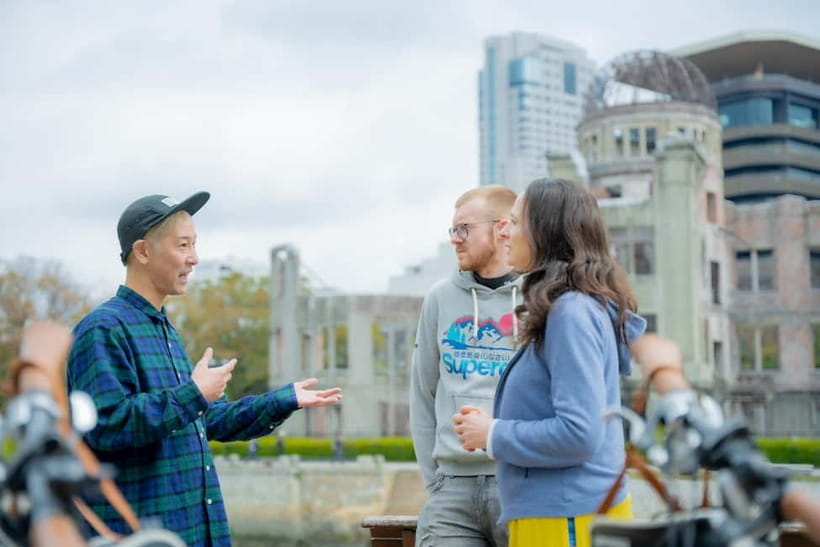
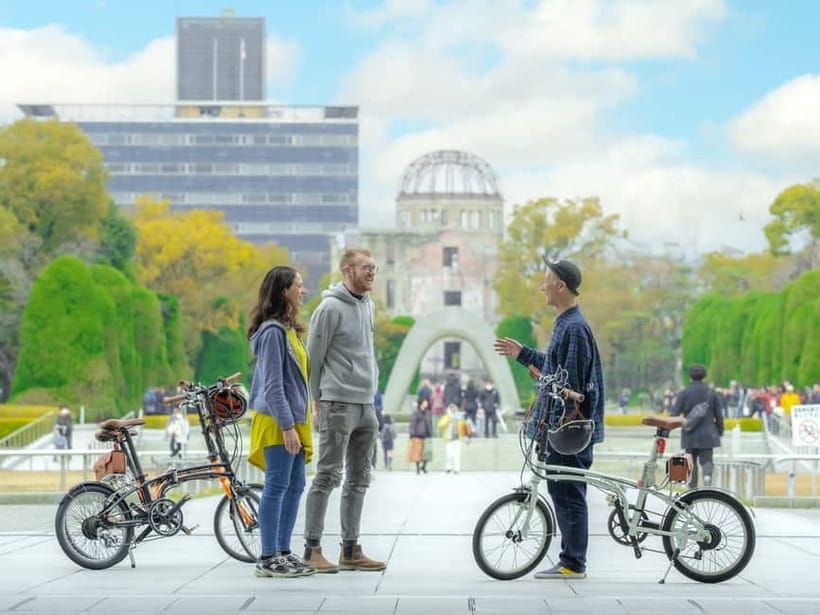
The tour begins with the Peace Memorial Park and its monuments. Your guide explains what the park represents, how its memorials fit together, and what happened in Hiroshima more than 70 years ago. You will also spend time at the Atomic Bomb Dome, the city’s best-known reminder of the bombing.
This first portion is not simply a photo stop. The guide places the Dome and surrounding memorials within the wider story of Hiroshima, including the feelings local people have carried through the decades. Several guides have shared family accounts passed down from grandparents or parents, and this can give the opening discussion a direct human quality.
The subject is heavy, but the tone is not intended to leave you without hope. Guides describe the suffering and destruction clearly, then connect it to Hiroshima’s recovery and its continuing message of peace. That balance matters, especially if you are visiting with children or teenagers.
You should still allow extra time to visit the Peace Memorial Museum separately if it is part of your plans. This bicycle tour focuses on outdoor sites, spoken explanation, and the city itself. It is not a replacement for the museum’s detailed exhibits.
The two-hour route and the A-bombed streetcars
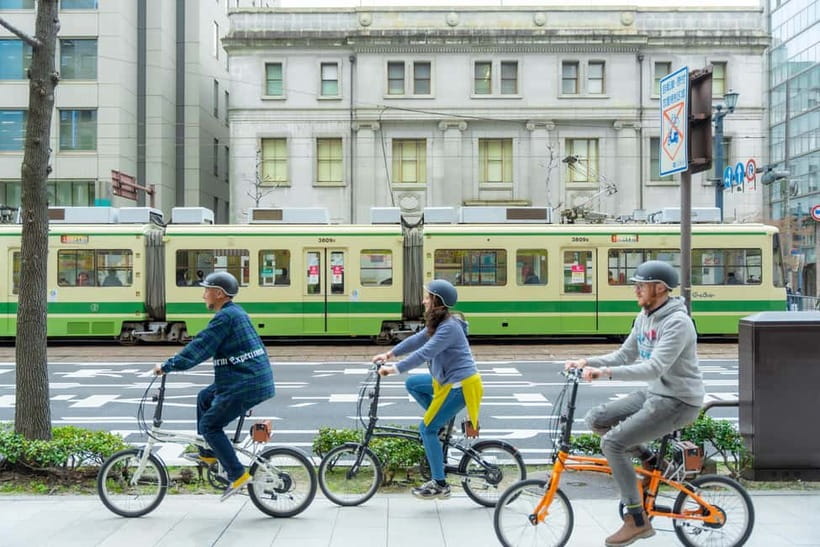
The shorter route meets at 11:00 or 15:00 and finishes around 13:00 or 17:00. It starts in the Peace Memorial Park, then moves into the suburbs at about noon or 4:00 p.m.
One of the most distinctive details is the A-bombed streetcar. A tram that survived the atomic bombing still runs today, linking Hiroshima’s present transport system with its wartime past. Seeing an actual working part of the city’s railway story is more memorable than hearing only a general explanation of survival and rebuilding.
The guide also points out townscapes away from the main tourist area. You will pass A-bomb heritage sites and hear episodes preserved in Hiroshima’s local memory. The value here is not the number of attractions. It is the connection between the sites, the people who lived nearby, and the city that grew back around them.
This route suits you if your Hiroshima schedule is tight. It gives you the Peace Park, the Atomic Bomb Dome, the streetcar story, and a look beyond the central monuments in two hours. If you want a slower ride with more landmarks and a longer explanation at each stop, choose the three-hour option.
The three-hour route from Hiroshima Castle to Peace Boulevard
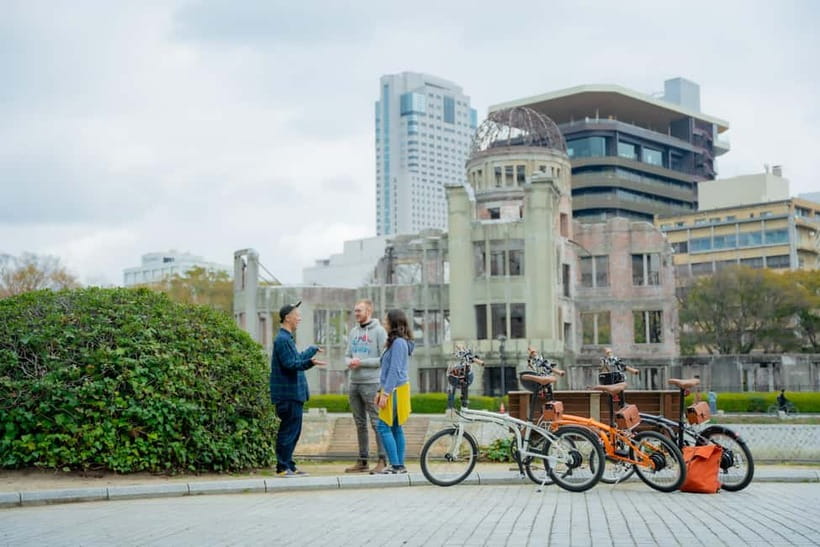
The longer route begins at 10:00 or 14:00 and finishes around 13:00 or 17:00. It adds a substantial circuit through central Hiroshima, with stops that show both the city’s prewar identity and the physical reach of the bombing.
A completely different kind of day out in Hiroshima:
- Peaceful Hiroshima & Miyajima UNESCO 1 Day Bus Tour
★ 5.0 · 5,309 reviews - Hiroshima: Hiroshima and Miyajima UNESCO Sites 1-Day Tour
★ 4.9 · 2,330 reviews - Hiroshima / Miyajima Full-day Private Tour with Government Licensed Guide
★ 5.0 · 1,298 reviews - Hiroshima Historical Walking Tour – Why A-Bomb was Dropped
★ 4.8 · 893 reviews
Hiroshima Castle and the Gokoku Shrine
The ride opens at Hiroshima Castle, followed by Hiroshima Gokoku Shrine and its shrine gate. These stops establish the character of Hiroshima before the route turns toward the Peace Park and atomic bombing sites.
The castle and shrine also help you see that Hiroshima is more than a memorial destination. The city had its own religious, civic, and military landmarks before 1945, and the route gives that earlier setting a place in the story.
Central Park and Aioi Bridge
At Hiroshima Central Park, the guide continues the discussion of the city’s recovery and green spaces. You then ride to Aioi Bridge, a key point in the central Hiroshima story, before reaching the Atomic Bomb Dome.
Aioi Bridge is especially important because of its connection to the bombing’s target area. Your guide explains the setting on site, where the relationship between the river, bridge, and Dome is easier to understand than it is on a map.
The Atomic Bomb Dome, Motoyasu River, and Peace Bridge
The Atomic Bomb Dome receives a fuller place in the longer route. You also visit the Motoyasu River and the Peace Bridge, seeing how waterways and bridges shape the central district.
I appreciate the way this portion shifts between major landmarks and the city around them. The riverside views are not just scenic pauses. They help you understand how Hiroshima’s streets and neighborhoods were arranged, and how the memorial district sits within a functioning city.
Higashisenda Park and the Red Cross Hospital
The route continues to Higashisenda Park and Hiroshima Red Cross Hospital. These are important A-bomb heritage sites, and the hospital gives the story a medical and human dimension.
The Red Cross Hospital is a useful counterpoint to the monuments. It brings attention to the immediate effects of the bombing on injured residents and the work of treating survivors. The guide’s explanation gives the site meaning without requiring you to rely on a museum display.
Hiroshima Railway and the surviving transport story
At Hiroshima Railway, the tour returns to the city’s tram history. The A-bombed streetcar is one of the details that gives this ride its special character. It is an ordinary vehicle with an extraordinary connection to August 6.
You may also hear more about how Hiroshima’s transport system continued and how the city rebuilt. This stop works well for anyone interested in seeing history through infrastructure rather than only through monuments.
Miyuki Bridge, Kobayashi River, and the surviving willow
The ride then reaches Miyuki Bridge and the Kobayashi River, followed by a surviving weeping willow tree. These stops move the tour farther from the most visited center and show the scale of the affected area.
The willow is a quiet stop, but that is part of its appeal. It gives you a living reminder of survival amid a city that has changed dramatically. Your guide can explain what happened in this area and how the tree became part of Hiroshima’s memory.
Peace Boulevard and the return
The final stop is Peace Boulevard, a broad green corridor leading back toward the central memorial area. After hearing about destruction at bridges, parks, hospitals, and railway sites, you finish among the trees and open space of modern Hiroshima.
The route ends back at the meeting point. You receive the day’s photographs as data, a thoughtful extra that is especially useful after a ride with many stops and group photographs.
The guides are the heart of the experience
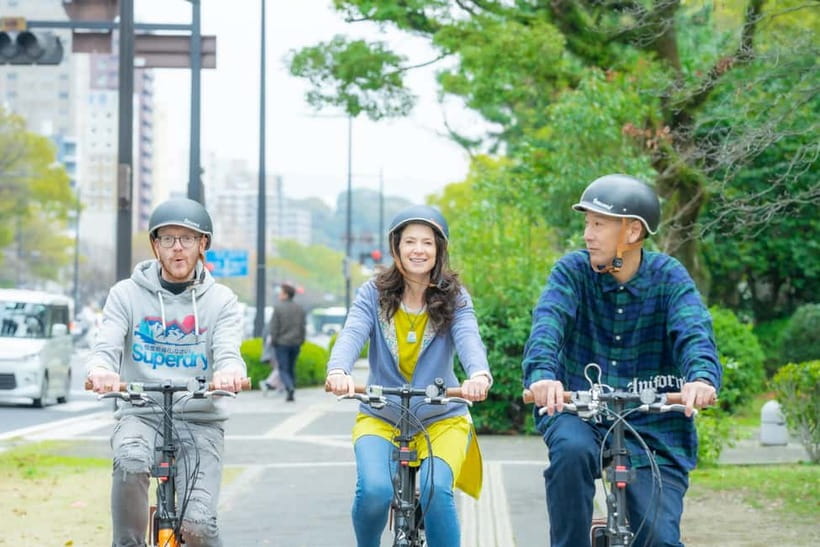
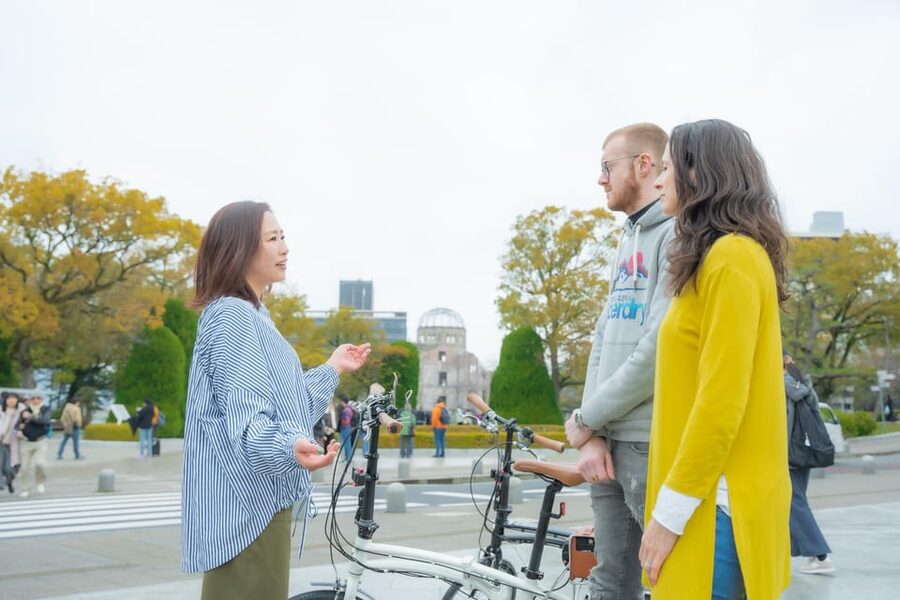
The bicycle is useful, but the guide determines how much you take away. Shin has received especially strong praise for his energy, humor, excellent English, and family connection to the bombing. He has shared stories passed through his grandparents and parents, then linked those memories to the peace message taught in Hiroshima today.
Kana is described as warm, passionate, and careful with details. She has balanced difficult facts with stories of hope and courage, and she has made the ride comfortable for families and solo participants. Moe has also shared personal family stories while keeping the tour engaging and approachable.
Other guides, including Bella, Mai, Hugo, Tomas, and Cotty, have been praised for clear English, thoughtful pacing, and attention to comfort. Bella has carried cold towels, salt candies, wet wipes, and ice packs during hot weather. Those small acts matter on a bicycle tour, particularly in Hiroshima’s humid summer conditions.
Guide quality can vary from one departure to another, as it does with any shared experience. The consistent strengths are local upbringing, strong English, and an ability to connect historical facts with personal stories. If you want a formal academic lecture, this may feel conversational. If you want the city explained by someone who cares about it, that conversational style is a major advantage.
What riding the electric bicycles is really like
The electric bicycles make this much less demanding than a conventional cycling tour. The route covers small distances, and several people have found the bikes easy to operate. You do not need to be especially fit, but you do need to know how to ride and control a bicycle in a group.
The bicycles are sized by height. Adult electric bicycles are for people 145 centimeters or taller. Children between 110 and 145 centimeters can use a children’s cross bike, with two children’s bicycles available per booking. Children under 15 can be charged at the child rate when using either a children’s or adult bicycle.
Infants from age 1 can ride free in a child seat, provided they weigh under 22 kilograms and are under 115 centimeters tall. Infant seats and children’s bicycles are limited, so contact the operator before reserving if you need one.
One practical warning comes from a taller rider who found the bike frame small. If you are tall, ask about bicycle sizing before you book. High heels are not allowed, and you should wear comfortable shoes and clothes.
Bring water and a towel. Summer heat can be intense, and one guide has stopped near a convenience store so a participant could cool down and buy water. The tour includes bicycle accident insurance, but that does not remove the need to ride sensibly and follow the guide.
Is $52 a fair price?
At $52, this is not the cheapest way to see the Peace Park. You can walk through the central memorial area for free and use Hiroshima’s tram system separately. The price begins to make sense when you count the electric bicycle, English-speaking guide, accident insurance, route planning, local stories, and access to sites beyond the usual walking circuit.
The three-hour tour offers particularly good value if you have only one day in Hiroshima. It covers a wide selection of landmarks without requiring you to work out the route or decode the city’s history alone. The two-hour option is better if you want a focused introduction before visiting the museum or continuing to another part of the city.
Food and drinks are not included. That is easy to manage, but you should carry your own water, especially in warm weather. Free cancellation is available up to 24 hours before the start, and you can reserve first and pay later, which helps if your Japan schedule is still changing.
Arrive early. If you are late without contacting the operator, the tour can be cancelled with a full same-day charge. That rule is strict and worth taking seriously.
Who will enjoy this Hiroshima bike tour?
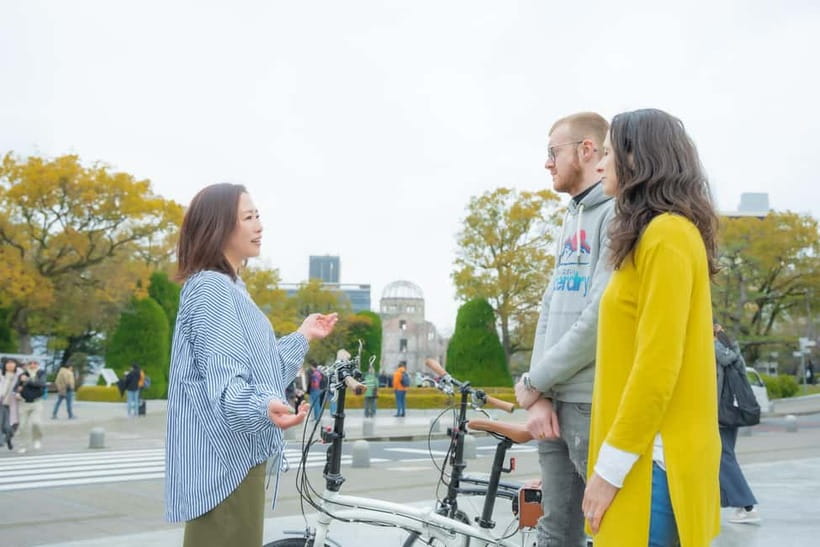
I would recommend it to first-time visitors who want the main memorial sites explained in context. It is also a good choice for solo visitors, couples, and families with older children, especially if walking between scattered sites sounds tiring.
The tour works well for people who want a serious subject handled with warmth. The guides do not turn Hiroshima into a sightseeing checklist. They make room for sadness, personal memory, recovery, and hope.
It is less suitable if you cannot ride a bicycle, are under 145 centimeters without a suitable child bicycle, or want to explore a large part of Hiroshima beyond the central historic area. It is also not the right pick if you prefer complete independence or a private pace.
If you are unsure about the emotional weight, expect a moving experience rather than a light recreational ride. The electric bicycles add ease and enjoyment, but the purpose remains learning about the bombing and its lasting effect on Hiroshima.
FAQ
Where does the Hiroshima Peace Cycling Tour meet?
The meeting point is the Rest House in Hiroshima Peace Park. From Hiroshima Station, take the Hiroshima Electric Railway to Atomic Bomb Dome Station, which takes about 20 minutes, then walk about five minutes.
How long is the tour?
You can choose a two-hour or three-hour route. The two-hour departures are scheduled for 11:00 and 15:00, while the three-hour departures are scheduled for 10:00 and 14:00, subject to change.
Is the tour conducted in English?
Yes. The tour has a live English-speaking guide.
How many people can join?
It is a shared small-group tour for up to 10 participants. The pace may be adjusted if someone in the group, particularly a child, is not used to cycling.
Are electric bicycles provided?
Yes. Bicycle rental is included, along with bicycle accident insurance. Adult electric bicycles are available for people at least 145 centimeters tall.
Can young children join?
Children aged 1 and older can be reserved. Infants can ride free in a child seat if they are under 22 kilograms and under 115 centimeters. Children’s bicycles and infant seats are limited, so contact the operator before booking if you need one.
What should I bring?
Bring comfortable shoes, comfortable clothes, a towel, and drinks. High-heeled shoes are not allowed.
Should you book it?
Book this tour if you want to understand Hiroshima beyond the Atomic Bomb Dome and Peace Memorial Park. The combination of electric bicycles, suburban A-bomb sites, and local family stories gives you a fuller picture of both the destruction and the city’s recovery.
Choose the three-hour route for the broadest experience, or the two-hour route if your schedule is tight. Just arrive early, wear practical clothes, confirm the bike size if you are tall, and remember that the ride is easy physically but serious in subject. For $52, it is a thoughtful and efficient way to see Hiroshima with someone who can connect its streets to its story.
Just added around Hiroshima
- Hiroshima & Miyajima: Private Full-Day Tour with a Local Guide★ 5.0 · 39 reviews
- Hiroshima and Miyajima 1 Day Walking Tour★ 5.0 · 43 reviews
- Hiroshima History Tour : A-Bomb Dome, Peace Memorial & City★ 5.0 · 43 reviews
- The Journey of Hiroshima from Tragedy to Peace★ 4.8 · 44 reviews
- Cultural Activities :Kimono, tea ceremony, Calligraphy and Amulet★ 5.0 · 44 reviews
- Miyajima: Private Rickshaw Tour to Itsukushima Shrine★ 4.9 · 45 reviews
- Hiroshima Private Tour: Best Highlights in a Day★ 5.0 · 49 reviews
- Hiroshima & Miyajima All-Inclusive Tour w/Licensed guide Pancho★ 5.0 · 54 reviews
Cycling Tours, compared.
3h Tokyo E-Bike Tour: Hidden Gems, and Local Life with guide
Read our review →
Arashiyama Bamboo Forest & Hidden Gems Bike Tour (Early Bird)
Read our review →
Hiroshima in a Nutshell: Morning Bike Adventure
Read our review →Browse the lists this tour appears in