
Reviewed · GEISHA & GION DISTRICT TOURS
Kyoto: Meet the Geisha Maiko with Gion Walking Tour
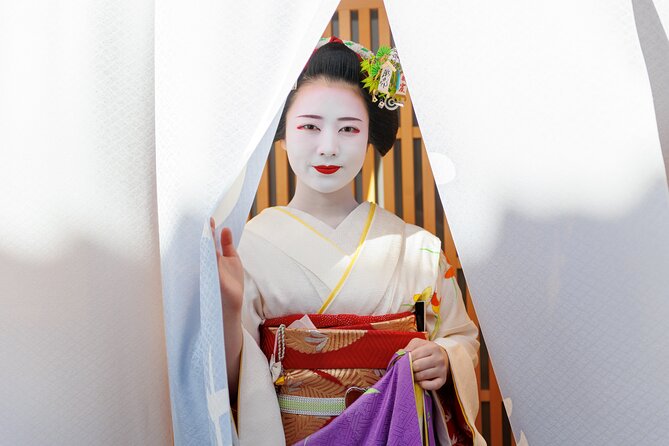
Gion’s real magic happens behind closed doors. This three-hour Kyoto experience combines a guided walk through Gion with a rare visit to a private ochaya, where you meet a working maiko and a retired geiko, watch a traditional performance, and ask questions through an English-speaking guide.
I especially like the chance to meet these artists without chasing them through the streets, and the visit to a private ochaya is a privilege that most independent visitors will not arrange easily. The main drawback is the walking section, which some people may find repetitive, while translation can be difficult to hear in a larger group.
The tour costs $109.43 per person, includes a mobile ticket, and is limited to 30 people. The performance itself may feel much smaller, sometimes with around 10 people, but you should not count on a tiny group every time. The tour earns a 4.9 rating from 400 reviews, with 98 percent recommending it, although the lower ratings point to real concerns about price, pacing, and audibility.
In This Review
- What Makes This Gion Experience Different
- Why Meeting a Maiko Beats Chasing One
- Beginning at Gion Shirakawa
- Tatsumi Daimyojin Shrine and Tatsumi Bridge
- Hanamikoji Street and the Gion Neighborhood
- Entering a Private Ochaya in Miyagawasuji
- The Question and Answer Session
- Photography, Socks, and Rainy Weather
- Is $109.43 a Fair Price?
- Who Will Enjoy This Tour Most?
- Practical Details Before You Book
- Should You Book the Kyoto Maiko Experience?
- FAQ
- How long does the Kyoto maiko and Gion tour last?
- Where does the tour start and end?
- Will I meet both a maiko and a geiko?
- Can I take photographs or videos?
- Are children allowed on the tour?
- What should I wear or bring?
What Makes This Gion Experience Different
- A private ochaya visit: You enter a traditional entertainment house normally closed to first-time visitors and most independent tourists.
- A maiko and retired geiko together: You see both an apprentice artist and a woman who has completed her geiko career.
- Live dance and music: The program includes a graceful maiko performance, with shamisen music provided by the house mother on some occasions.
- A guided walk through Gion: The route covers Gion Shirakawa, Tatsumi Daimyojin Shrine, Tatsumi Bridge, Hanamikoji Street, and nearby temple grounds.
- Questions with translation: Your guide interprets the conversation, giving you a chance to ask about training, customs, and daily life.
- Strict venue etiquette: You must wear socks, and the upstairs performance room is reached by stairs.
Why Meeting a Maiko Beats Chasing One
Kyoto’s maiko and geiko are working artists, not street attractions. Visitors who crowd them for photographs can make it harder for these women to get to appointments, and the custom has caused serious tension in Gion. This tour offers a far better way to learn about the tradition: you meet the performers in a setting prepared for conversation and photography.
The distinction between maiko and geiko matters. A maiko is an apprentice, still training in dance, music, etiquette, and conversation. A geiko is fully trained. In this experience, the contrast becomes personal rather than merely academic because you meet a maiko and a retired geiko, hear from them directly, and see how the tradition continues across generations.
The question-and-answer period is one of the strongest parts. Your guide translates, so you can ask about their work and customs instead of simply watching a short show and leaving. Guides such as Haruki, Takuma, Miko, Mika, Ayako, Naomi, Chiko, Yoko, and Ellie have received praise for clear explanations, friendly manners, and good English. Guide quality can vary, but the best guides make the cultural details much easier to understand.
This is not a staged street encounter. The performers are there to perform, speak with you, and explain their world. That makes the experience feel more respectful and useful.
More Walking Tours in Kyoto
- Kyoto Geisha Walking Tour: Gion District & Hidden Gems
★ 4.7 · 3,273 reviews - Kyoto: Gion Magical Night Walking Tour with Geisha Trivia
★ 4.9 · 2,393 reviews - Kyoto: Gion Geisha District Walking Tour – Stories of Geisha
★ 4.7 · 2,187 reviews
Beginning at Gion Shirakawa
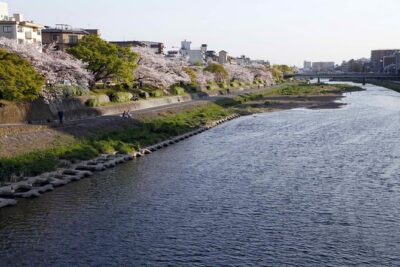
The walking portion starts in or near the traditional streets of Gion. Gion Shirakawa provides a gentle introduction, with wooden buildings, narrow lanes, and a calmer atmosphere beside the water. Here, your guide explains who the geisha of Kyoto are and how maiko and geiko live and work.
You will hear about the customs surrounding the profession, the training involved, and the role of the hanamachi, or geisha districts. The walk focuses mainly on geisha culture rather than giving a broad survey of Kyoto. That focus is helpful if this subject is new to you, but it may feel narrow if you want temple history, architecture, or a wider look at the city.
Allow yourself time to listen carefully. Several people have found their guides thoughtful and highly informed, while one critical experience found the English too quiet. A group of up to 30 people can make a soft-spoken guide hard to hear, especially in a narrow street with passing traffic. Stay close to the guide and ask for repetition when needed.
Tatsumi Daimyojin Shrine and Tatsumi Bridge
The short stop at Tatsumi Daimyojin Shrine adds a little religious context to the neighborhood. The shrine dates to the Heian period, from 794 to 1185, and is linked with protection, good fortune, and safety for travelers and warriors.
You will not spend long here, around five minutes, but it helps show that Gion is not simply a collection of restaurants and old-looking façades. It is a lived-in district where shrines, homes, businesses, and entertainment houses share tight urban spaces.
Tatsumi Bridge is a small traditional bridge that has become one of Gion’s most recognizable photo spots. The surrounding wooden machiya houses and quiet lanes can look wonderfully cinematic. The guide uses this area to explain how the district developed and where geiko and maiko traditionally meet patrons.
This is also where the tour’s limitations become clear. You mainly view buildings from the outside. If you already know Gion well, or if you prefer a faster route to the performance, the walk may seem longer than necessary. Several people felt the route circled back over familiar ground and could have been shortened.
Hanamikoji Street and the Gion Neighborhood
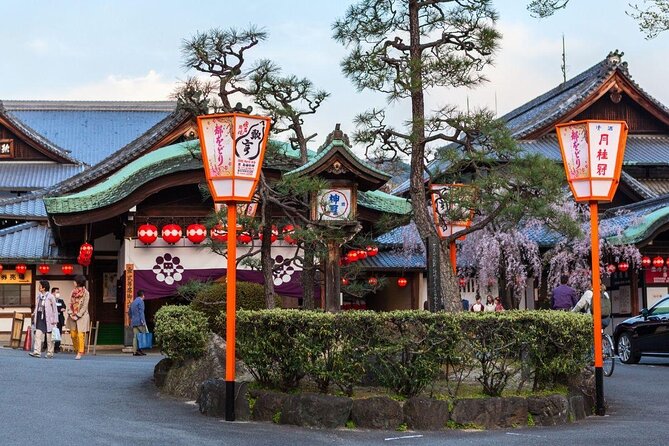
Hanamikoji Street is the main thoroughfare through Gion, lined with traditional wooden machiya, restaurants, shops, and teahouses. It is attractive, but it is also a public street, so do not expect every doorway to open for inspection.
Your guide points out the kinds of places connected to geiko and maiko life and explains why the district remains so private. That background changes how you see the street. Instead of treating Gion as a film set, you begin to recognize it as a working neighborhood with rules about privacy and behavior.
The itinerary also refers to Gion Corner, a venue known for presenting several forms of traditional Kyoto performance. You should confirm the exact amount of time spent there, as the supplied schedule does not list a separate admission or fixed duration for this stop. The same applies to the nearby Zen temple precinct. You walk through the grounds like local pedestrians but do not enter the temple buildings.
That temple walk can provide a quiet pause before the performance. Still, the central purpose of this outing is geisha culture, not temple sightseeing. I would choose a different tour if your main goal is interior temple visits.
More geisha district walks in Kyoto:
- Best of Kyoto: Gion, Geisha, Pagodas & Cobblestones
★ 4.9 · 2,058 reviews - Night Walk in Gion: Kyoto’s Geisha District
★ 4.5 · 2,003 reviews - Kyoto Night Foodie Tour in Gion (9+ dishes + 6 Sake tastings)
★ 5.0 · 1,762 reviews - Kyoto Gion Geisha District Walking Tour – The Stories of Geisha
★ 5.0 · 1,441 reviews
Entering a Private Ochaya in Miyagawasuji
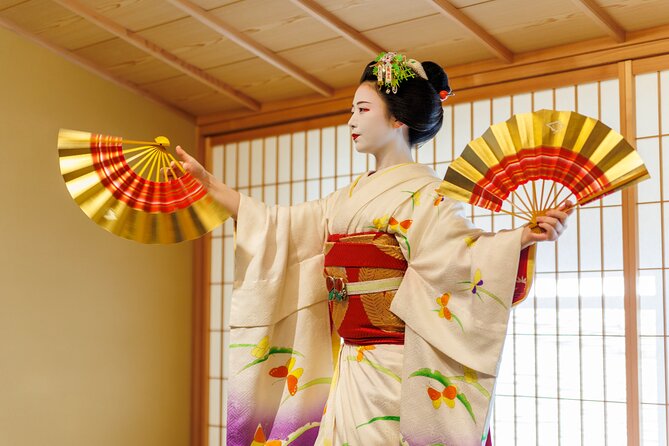
The most important part takes place in Miyagawasuji, another historic geisha district. Here you enter a private ochaya, a traditional establishment used for entertainment with geiko and maiko. It is not a café or a standard tea ceremony venue. The term can be confusing, but an ochaya is connected to hosted entertainment, performances, conversation, food, and drink.
The provider describes entry as an exceptional privilege because these establishments are normally closed to first-time visitors without an introduction. That access is the main reason to consider paying for this tour rather than simply walking around Gion.
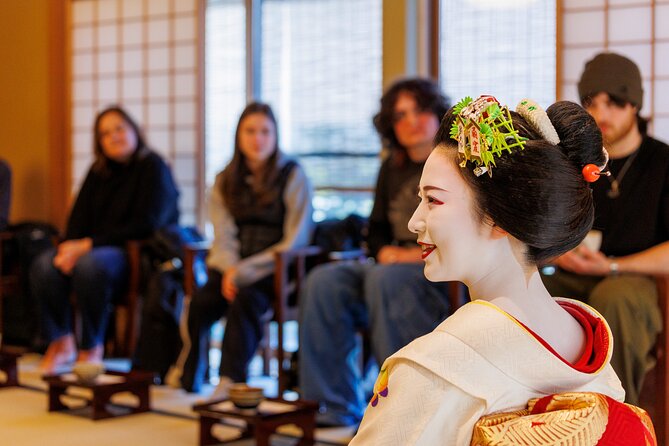
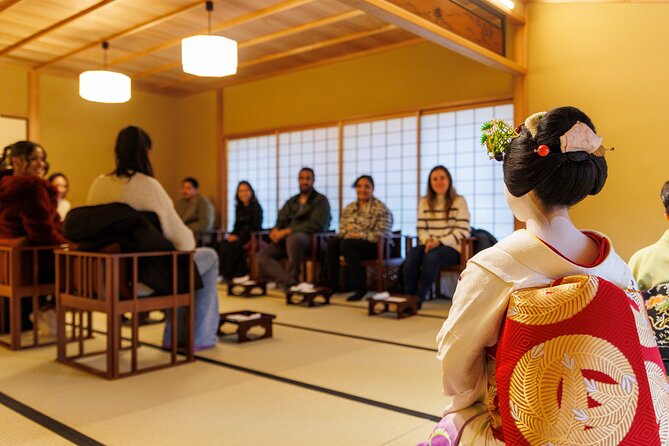
Inside, you meet a maiko and a retired geiko. The setting allows you to see their formal presentation at close range, then hear personal accounts and explanations through your guide. A traditional dance follows, and some experiences include shamisen music performed by the house mother, also called the okaasan.
The performance is elegant rather than flashy. You are watching a highly trained art form shaped by posture, timing, costume, music, and controlled movement. It may last only part of the 90-minute visit, with the rest devoted to discussion, translation, and photographs.
The conversation is what gives the performance meaning. You can ask about the life of a maiko, the path toward becoming a geiko, and how the tradition functions today. The retired geiko adds a useful point of comparison, since she can speak from experience after leaving active performance.
The Question and Answer Session
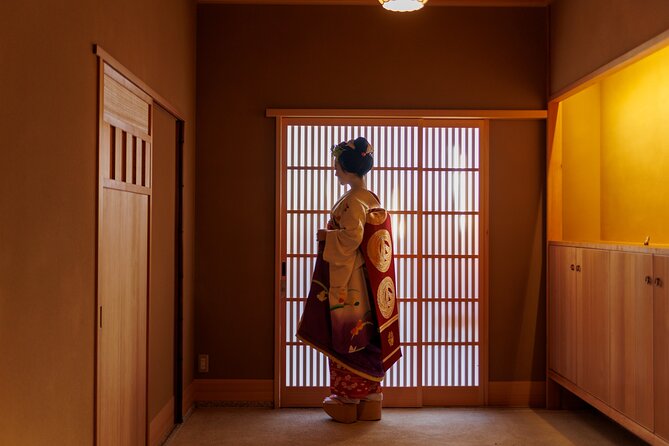
Many cultural shows leave you seated in the dark with no chance to ask anything. This tour does the opposite. After the dance, you have time to speak with the maiko and retired geiko, with the guide translating between Japanese and English.
The quality of this exchange depends heavily on your guide and the size of your group. Guides praised by name include Miko, who was described as an effective translator, and Naomi, who was praised for making the history easy to follow. Ayako was also noted for being helpful beyond the scheduled activity, including walking one person to a restaurant afterward.
The weak point is sound. One person found the translation difficult to hear and felt that much of the discussion was lost. With as many as 30 people in the overall group, voices may not carry well. You should sit near the performers and guide if possible, and do not hesitate to ask the guide to repeat an answer.
The Q and A may also repeat topics covered during the walking portion. That can be useful for reinforcement, especially if you are new to the subject. If you prefer a compact show, however, the repeated explanations may make the three-hour length feel excessive.
Photography, Socks, and Rainy Weather
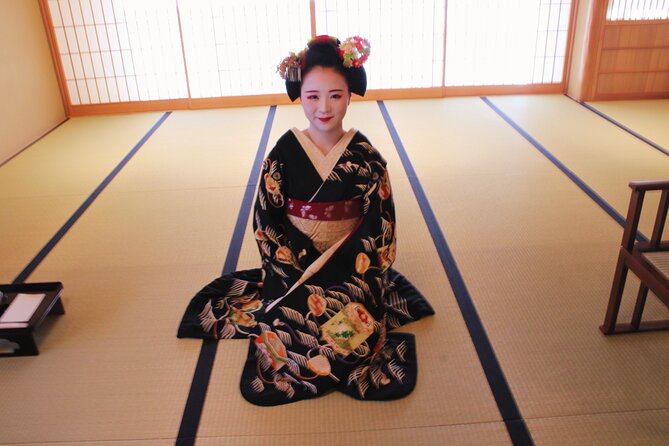
Photography and video are allowed only during the performance and designated photo session. You must ask the maiko directly before posting images on social media. This is an important rule, not a minor formality. The tour is built around respect for the performers, and permission should be clear before you share anything publicly.
Wear socks to the venue. You cannot enter barefoot, and the instructions specifically warn against wet cloth and wet socks on rainy days. Carry an umbrella during the walk and arrive at the house dry.
The performance takes place on the second floor of the private house, reached by stairs. The information provided does not describe an elevator or step-free access, so anyone who has difficulty with stairs should check before booking.
Comfortable walking shoes are sensible. The tour runs in rain or shine, and the schedule can stretch beyond three hours depending on the day. Plan your dinner or train connection with some extra time.
Children under 10 are not permitted. The stated fitness requirement is moderate, which fits a walking route through several Gion streets rather than a strenuous hike.
Is $109.43 a Fair Price?
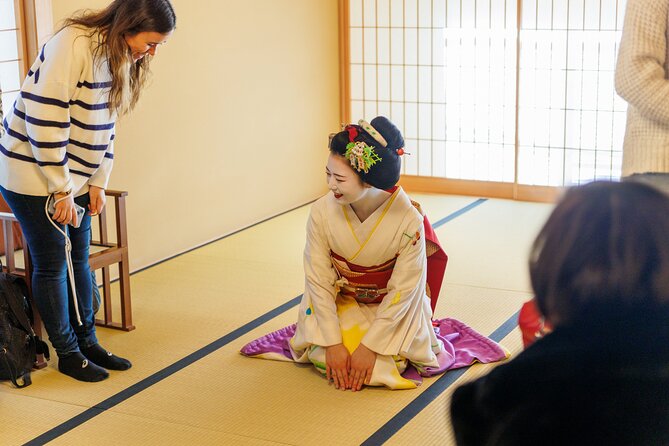
At $109.43, this is not a cheap Kyoto activity. The walking route alone would not justify the cost for me. You can stroll through Gion independently, see Tatsumi Bridge, pass Hanamikoji Street, and visit public shrines without paying for admission.
The price is mainly for access and interpretation. A private ochaya visit is difficult to arrange on your own, and the performance, conversation, translation, and photo session are bundled into the experience. If you place high value on direct contact with living traditional arts, the price can be reasonable.
Food, drinks, hotel pickup, hotel drop-off, and transportation to and from the meeting point are not included. This matters because the experience is often compared with cheaper evening activities that include refreshments. You are paying for cultural access, not a meal.
I would book it if meeting a maiko is a top Kyoto priority and you want a respectful alternative to street photography. I would skip it if your budget is tight, you mainly want food and drink, or you dislike tours that spend time explaining the same subject in several locations.
Who Will Enjoy This Tour Most?
This tour suits you if you want more than a photograph of a kimono. It is a good fit for first-time visitors who need an introduction to maiko and geiko customs, and for returning visitors who want access to a place normally closed to the public.
It also works well after exploring Higashiyama, since the route is close to the eastern side of central Kyoto. You can connect a day of temples and old streets with an evening focused on performance and conversation, though you should allow time to reach the meeting point independently.
You may be less satisfied if you expect a broad Kyoto history tour. The guide’s attention stays on Gion, geisha culture, and the arts. The public walking route can feel slow, and the experience is not ideal if you need step-free access or cannot follow translated conversation in a group setting.
The group limit is 30 people, but the private-house segment may feel more intimate. Some people have experienced a group of about 10 during the maiko meeting. That smaller feeling is a possibility, not a guarantee.
Practical Details Before You Book
The meeting and ending point is in Miyagawasuji, in Kyoto’s Higashiyama Ward. The tour does not provide hotel pickup or transportation, so you need to arrange your own route to the start.
You receive confirmation when booking, and the ticket is mobile. Free cancellation is available up to 24 hours before the local start time. Cancellations or changes inside that window are not refunded or accepted, and the operator does not cover incidental hotel or bullet train costs if plans change.
Keep your schedule flexible. The tour may run longer than expected, and the performance room is upstairs. Bring an umbrella in wet weather, wear comfortable shoes and clean, dry socks, and arrive ready to follow the photography rules.
Should You Book the Kyoto Maiko Experience?
I would recommend this tour to anyone who sees a meeting with a maiko as a highlight of Kyoto. The private ochaya, live dance, translated conversation, and chance to meet a retired geiko offer access you are unlikely to get by wandering Gion alone.
I would not book it simply because you want to see pretty streets. The walking segment is useful background, but it is not the main value, and some people find it too long. At this price, you should be comfortable paying for the private setting and cultural access rather than for a sightseeing route.
Book it when respectful contact with Kyoto’s traditional performing arts matters more to you than a low-cost outing. Choose another activity when you want a shorter walk, a meal, or a polished show with guaranteed strong sound. For the right visitor, this is a rare and memorable window into a living Kyoto tradition.
FAQ
How long does the Kyoto maiko and Gion tour last?
The experience lasts approximately three hours. It may run a little longer depending on the day.
Where does the tour start and end?
The listed meeting and ending location is in Miyagawasuji, Higashiyama Ward, Kyoto. The tour ends at a special private house used for the performance.
Will I meet both a maiko and a geiko?
You meet a maiko and a retired geiko during the private-house visit. The tour includes conversation and a performance.
Can I take photographs or videos?
Photography and video are allowed only during the performance and the photo session. You must get direct permission from the maiko before posting photos on social media.
Are children allowed on the tour?
Children under 10 years old are not permitted.
What should I wear or bring?
Wear comfortable walking shoes and socks. Socks are required at the performance venue. In rainy weather, use an umbrella during the walk and do not arrive with wet clothing or wet socks.
Just added around Kyoto
- Kyoto: Private Customizable Day Trip by Car★ 5.0 · 38 reviews
- Kyoto: Gion Night Walking Tour with Geisha Insight★ 5.0 · 39 reviews
- Kyoto: Full Day Bike Tour★ 4.9 · 39 reviews
- Private Japanese Calligraphy in Kyoto – Learn Shodō with a Master★ 5.0 · 39 reviews
- Kyoto: Gion Evening Walk with Hidden Gems, Geisha & Sake★ 5.0 · 41 reviews
- Experience a tea ceremony in an authentic tearoom, in Kyoto!★ 4.5 · 41 reviews
- Kyoto Private Photo Shoot & Tour by SnapKyoto★ 5.0 · 41 reviews
- The Way of Tea: Kyoto Crafts, Hidden Temples & Wabi-Sabi Walk★ 5.0 · 41 reviews
Geisha & Gion District Tours, compared.
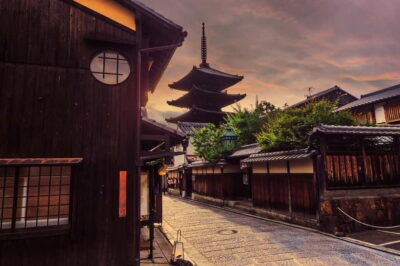
Kyoto Geisha Walking Tour: Gion District & Hidden Gems
Read our review →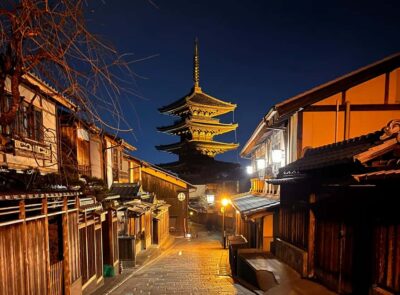
Gion Magical Night Walking Tour with Geisha Trivia
Read our review →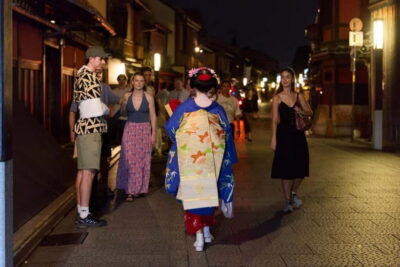
Gion Geisha District Walking Tour – Stories of Geisha
Read our review →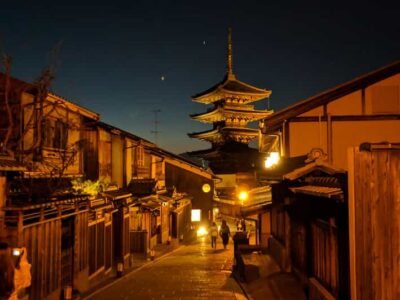
Best of Kyoto: Gion, Geisha, Pagodas & Cobblestones
Read our review →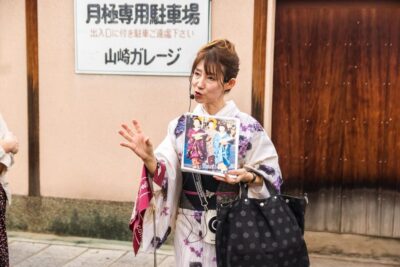
Kyoto Night Foodie Tour in Gion (9+ dishes + 6 Sake tastings)
Read our review →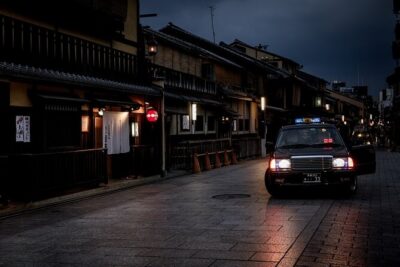
Kyoto Gion Geisha District Walking Tour – The Stories of Geisha
Read our review →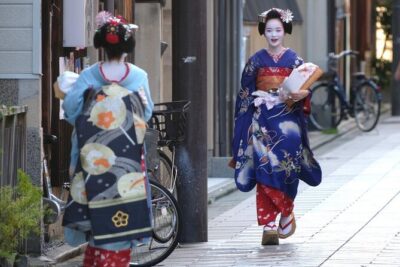
Kyoto Gion: 2-Hour Geisha Culture & History Walking Tour
Read our review →Browse the lists this tour appears in