
Reviewed · GEISHA & GION DISTRICT TOURS
The Art of Geisha: Exclusive Show & Gion Walking Tour
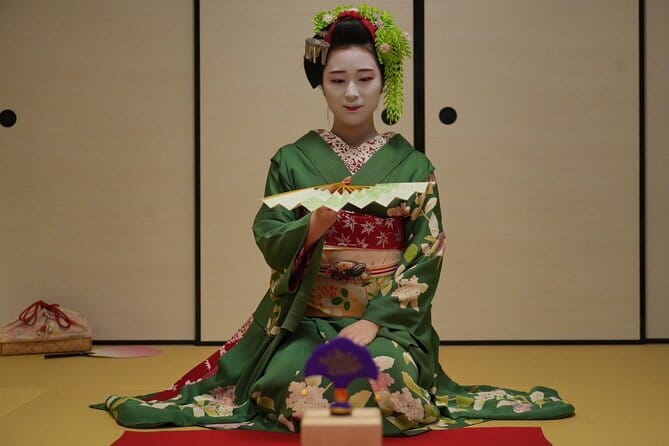
Kyoto’s most private arts come into view. This small-group outing pairs a walk through Gion with a live maiko performance, tea, snacks, questions, and a traditional Japanese game. I like the maximum group size of six, which gives the meeting a personal feel, and I like that you do more than watch from a distance. You can speak with the maiko and take part in the action.
The main point to consider is the price: at $124.21 per person, this is not a casual add-on. The tour lasts about one to two hours, with the listed Gion portion taking one hour, so you are paying for access to a rare cultural meeting rather than a long sightseeing day. Children under six cannot join.
In This Review
- Key points at a glance
- Why this Gion experience feels different
- Beginning at the Statue of Izumo-no-Okuni
- The maiko performance and what you will see
- Asking questions instead of only taking pictures
- The traditional Japanese game adds a playful turn
- What the small group means for your afternoon
- Is $124.21 a fair price?
- Timing, meeting point, and the end of the walk
- How to get the most from the maiko meeting
- Who should book this Kyoto tour?
- Should you book The Art of Geisha?
- FAQ
- Where does the tour begin?
- What time does the tour start?
- Where does the tour end?
- How long does the experience last?
- How many people can join?
- Is a guide included?
- What is included in the price?
- Will I meet a maiko?
- Can I take part in an activity with the maiko?
- Can children join the tour?
- Is public transportation nearby?
- Is cancellation free?
Key points at a glance
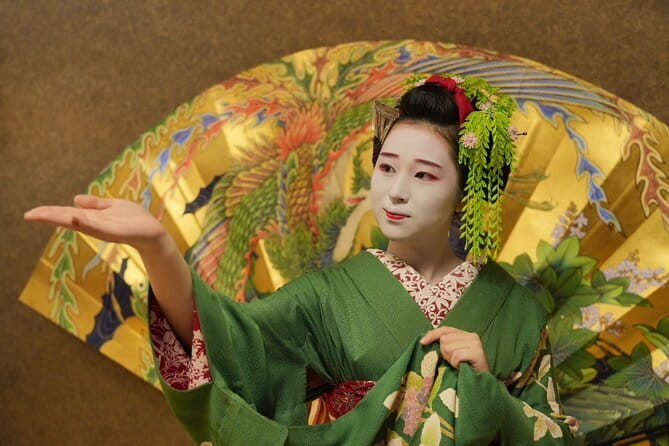
- A maiko performs traditional arts: You watch an apprentice geisha dance and take part in a Japanese game.
- Small groups make a difference: The maximum of six helps you ask questions without shouting across a crowded room.
- Tea and snacks are included: The refreshments add a simple but fitting touch to the cultural presentation.
- Gion provides the setting: The tour begins near the Statue of Izumo-no-Okuni and explores the district before the meeting.
- English support is included: An English-speaking guide explains Gion, maiko life, and geisha culture.
- The strongest appeal is personal contact: You have time to chat with the maiko instead of only watching a staged show.
Why this Gion experience feels different
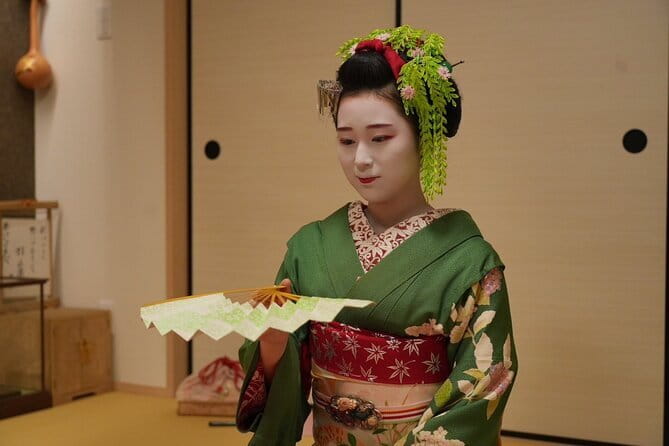
Kyoto offers many ways to see its famous districts, but the world of geisha and maiko is usually kept behind closed doors. You may catch a glimpse of a maiko moving quickly through Gion, but a sighting tells you very little about her training, performance skills, or daily role.
This tour gives you a more direct introduction. You walk through Gion with a guide, then sit down for a performance by a maiko, the apprentice stage of a geisha. The meeting includes tea, snacks, conversation, and a game, so the session has a social side as well as a stage performance.
I especially like the limited group size. With only six people allowed, you have a better chance to hear the explanations and ask a question that is specific to your own curiosity. That matters here. A large group could turn a quiet cultural meeting into a basic photo stop, while this format aims for conversation.
The experience also received a 99 percent recommendation rate and a five-star rating from 129 ratings. Those figures suggest strong satisfaction, but the real reason for the positive response is clear: the maiko meeting is the heart of the afternoon, and the format lets you interact rather than simply observe.
More Walking Tours in Kyoto
- Kyoto Geisha Walking Tour: Gion District & Hidden Gems
★ 4.7 · 3,273 reviews - Kyoto: Gion Magical Night Walking Tour with Geisha Trivia
★ 4.9 · 2,393 reviews - Kyoto: Gion Geisha District Walking Tour – Stories of Geisha
★ 4.7 · 2,187 reviews
Beginning at the Statue of Izumo-no-Okuni
The meeting point is the Statue of Izumo-no-Okuni at Kawabatacho in Kyoto’s Higashiyama Ward. The start time is 3:00 pm, and the location is near public transportation.
That starting point gives the guide a useful place to begin explaining Gion and its connection to traditional entertainment. You should arrive with enough time to identify the statue and find your guide without rushing. A mobile ticket is accepted, and booking confirmation is provided at the time of purchase.
The opening walk is not just a transfer to the show. It is part of the orientation. Your guide introduces the Gion district and explains the difference between a maiko and a geisha, along with the customs surrounding their work. This context helps you understand the performance later instead of seeing it as a colorful but unfamiliar display.
The walk is also a good fit if you want a first look at several geisha neighborhoods. One account described the route as a chance to discover parts of Kyoto that might otherwise be missed. Since the main focus is the maiko meeting, do not expect a full afternoon walking tour of every corner of Gion. Think of this portion as a compact introduction with a clear purpose.
The maiko performance and what you will see
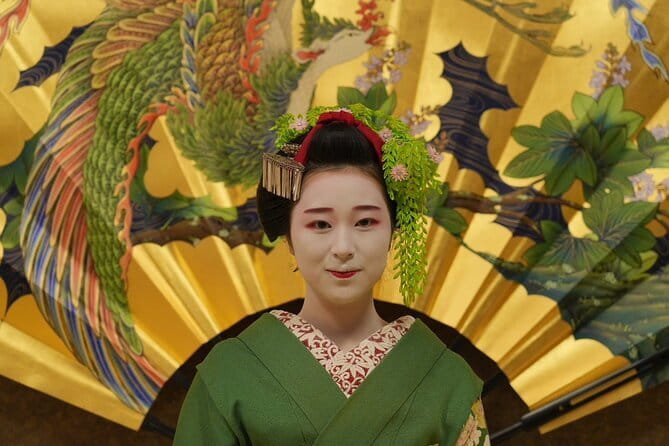
The performance is the central reason to book. A maiko presents traditional arts, including dance, in an intimate setting. You can enjoy Japanese tea and snacks while watching, which makes the event feel more like a small cultural gathering than a theater production.
The setting has been described as a beautiful tea house, though the exact room may vary. The mood is intended to be close and personal, with the maiko performing for a small audience rather than a large crowd. Some past sessions had only a handful of people, with one maiko meeting four guests. That ratio gives you a good sense of how much attention the format can allow.
The dance is not a quick photo opportunity. The skill behind it is one of the main points of the presentation. You learn that becoming a maiko requires years of training, dedication, and practice. The show therefore works best when you pay attention to the details of movement, clothing, gesture, and musical tradition, not only the final picture.
I would keep your expectations realistic. This is a cultural demonstration and conversation, not a full evening of multiple performances. The available information does not promise a long stage program, a full dinner, or an elaborate theater production. You are buying a close meeting with one maiko and an explanation of her art.
Asking questions instead of only taking pictures
The conversation is one of the best parts of the format. After the performance, you have the chance to ask the maiko questions through the English-speaking guide. This gives you a clearer picture of the person behind the formal appearance.
Past sessions were led by guides including Ai and Yoshino, both praised for making the cultural material easy to follow. Ai was described as friendly and strong on Kyoto’s history. Yoshino was praised for guiding visitors through Gion and interpreting questions during the maiko meeting.
Guide quality matters here because the cultural gap can be wide. A good interpreter does more than translate words. The guide helps explain why a custom matters, clarifies unfamiliar terms, and keeps the exchange comfortable for everyone in the room.
You should also come prepared with a few questions. The format specifically allows conversation, so this is your chance to ask about training, performance, the difference between maiko and geisha, or other parts of the culture explained during the session. The available information does not provide a fixed question list, so your own curiosity can shape the discussion.
More geisha district walks in Kyoto:
- Best of Kyoto: Gion, Geisha, Pagodas & Cobblestones
★ 4.9 · 2,058 reviews - Night Walk in Gion: Kyoto’s Geisha District
★ 4.5 · 2,003 reviews - Kyoto Night Foodie Tour in Gion (9+ dishes + 6 Sake tastings)
★ 5.0 · 1,762 reviews - Kyoto Gion Geisha District Walking Tour – The Stories of Geisha
★ 5.0 · 1,441 reviews
The traditional Japanese game adds a playful turn

The experience is not completely formal. You also get the chance to play a traditional Japanese game with the maiko and test your own skill against her.
This detail came up repeatedly in the strongest accounts because it changes the tone of the meeting. Instead of sitting silently through a presentation, you participate. One person even managed to beat the maiko, which sounds like a fine souvenir in story form.
The game is a small part of the tour, but it helps break down the distance between performer and audience. You still need to show respect for the setting and the maiko, yet the activity gives the meeting a natural, human moment. If you are traveling with family members or friends, this may become the part you talk about later.
Do not book this solely for the game. The performance, explanations, and chance to ask questions remain the main attractions. Consider the game an added feature that makes the visit less passive.
What the small group means for your afternoon
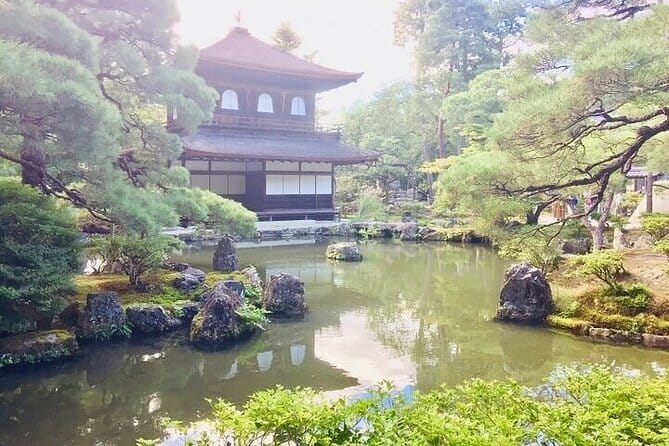
A maximum of six people is a major practical advantage. It supports conversation, keeps the room from feeling crowded, and gives you a better view of the performance. If the group is not full, the session may feel especially personal. One past booking had only two participants, while another had one maiko with four people.
The small group also helps the guide manage questions and interpretation. In a larger party, each question can take time and the exchange can become rushed. Here, you are more likely to hear the answer clearly and follow up if something interests you.
There is one tradeoff. Small-group cultural meetings have less flexibility if you prefer to remain anonymous in the back. The format encourages polite participation, and you may be invited to join the game or speak with the maiko. If you strongly prefer a private, no-interaction performance, a standard theater show may suit you better.
Most people can participate, and the activity is near public transportation. The stated age restriction is simple: children under six cannot join. No other special participation limits are specified.
Is $124.21 a fair price?
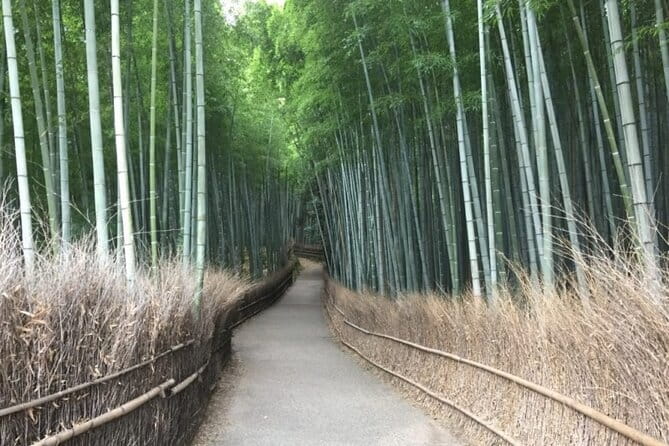
At $124.21 per person, this is expensive for a one to two-hour activity. If you measure value by minutes, it will not compare well with a full-day Kyoto tour. The listed Gion section is one hour, so you should not expect several hours of sightseeing for this fee.
The value improves if you care about access and scale. Your price includes the maiko show, Japanese tea and snacks, and an English-speaking guide. More important, it covers a small-group meeting that includes conversation and participation. Those elements are difficult to recreate on your own by walking through Gion.
I would see it as a special-occasion purchase. It suits a first visit to Japan, a milestone trip, or anyone who has long wanted to learn about geisha culture in a respectful setting. It makes less sense if you are mainly seeking inexpensive sightseeing or a long walking tour.
The high satisfaction rate also supports the idea that the format delivers what it promises. The most praised elements are the intimate group, the quality of guides such as Ai and Yoshino, the maiko’s performance, and the chance to play a game and ask questions. Those are precisely the features that justify the cost.
Timing, meeting point, and the end of the walk
The tour begins at 3:00 pm at the Statue of Izumo-no-Okuni, Kawabatacho, Higashiyama Ward, Kyoto, 605-0076. It ends at Hangesho, 535 Morishitacho, Higashiyama Ward, Kyoto, 605-0836.
The scheduled length is approximately one to two hours. Since the Gion stop is listed as one hour, allow room for the performance and conversation to make up the remaining time. The exact flow may depend on the walking pace, group questions, and the session itself.
The end point places you in Higashiyama as well, so you can continue exploring Kyoto afterward. The details provided do not specify a return transfer or hotel drop-off. Plan to make your own way from the ending address.
The mobile ticket is convenient, especially if you are already carrying a full day’s worth of Kyoto reservations. Still, I would save the confirmation on your phone before setting out, since you need to meet the guide at a specific public location.
How to get the most from the maiko meeting
A little preparation will improve the session. I would read the basic difference between maiko and geisha before arriving, then use the guide’s explanation to fill in the details. You will follow the conversation more easily and ask better questions.
Keep your questions respectful and focused on the art and training. The point is not to treat the maiko as a costume model. Pay attention to the work behind the appearance, including the years of preparation and the discipline required for performance.
You should also allow yourself to watch quietly. The tea, snacks, conversation, and game make the event interactive, but the dance deserves your full attention. A phone can wait for a moment.
Because the group is small, arrive ready to take part. You may be seated close to the performance, and you may have a chance to join the game. That closeness is the main benefit of this tour, so it is worth accepting a little social participation.
Who should book this Kyoto tour?
I recommend it most strongly for you if you have a real interest in Japanese performing arts, Kyoto culture, or the world of maiko and geisha. It is also a strong choice if you have tried to spot a maiko in Gion and want something more reliable than waiting on a street corner.
Couples, solo visitors, and small family groups should fit the format well. The six-person limit keeps the outing personal, and the English-speaking guide makes the cultural explanations accessible.
You may want to skip it if you need a long sightseeing tour, dislike scheduled group activities, or are watching every yen. The price is high for the duration, and the event focuses tightly on one cultural subject.
Should you book The Art of Geisha?
Book it if personal access matters more to you than tour length. The combination of a Gion introduction, maiko dance, tea, snacks, questions, and a traditional game offers far more than a quick street sighting.
I would make this a planned highlight rather than a filler activity. The small group and strong guide support give the meeting a calm, personal feel, while the performance shows the skill behind the tradition. At $124.21, it asks for a serious budget choice, but it is a sensible purchase for anyone who sees meeting a maiko as a once-in-a-lifetime part of visiting Kyoto.
FAQ
Where does the tour begin?
It begins at the Statue of Izumo-no-Okuni in Kawabatacho, Higashiyama Ward, Kyoto, postal code 605-0076.
What time does the tour start?
The stated start time is 3:00 pm.
Where does the tour end?
It ends at Hangesho, 535 Morishitacho, Higashiyama Ward, Kyoto, 605-0836.
How long does the experience last?
The approximate duration is one to two hours. The Gion portion is listed as one hour.
How many people can join?
The maximum group size is six people.
Is a guide included?
Yes. An English-speaking tour guide is included.
What is included in the price?
The price includes the geisha show, Japanese tea and snacks, and an English-speaking tour guide.
Will I meet a maiko?
Yes. The experience includes a performance by a maiko, an apprentice geisha, along with a chance to chat and ask questions.
Can I take part in an activity with the maiko?
Yes. You have the opportunity to play a traditional Japanese game with her.
Can children join the tour?
Children under six cannot join. The provided information does not give a different age policy for older children.
Is public transportation nearby?
Yes. The meeting area is near public transportation.
Is cancellation free?
Yes. You can cancel at least 24 hours before the local start time for a full refund. Cancellations or changes made less than 24 hours before the start time are not accepted for a refund.
Just added around Kyoto
- Kyoto: Gion Night Walking Tour with Geisha Insight★ 5.0 · 39 reviews
- Kyoto: Private Customizable Day Trip by Car★ 5.0 · 38 reviews
- Kyoto: Full Day Bike Tour★ 4.9 · 39 reviews
- Private Japanese Calligraphy in Kyoto – Learn Shodō with a Master★ 5.0 · 39 reviews
- Kyoto: Gion Evening Walk with Hidden Gems, Geisha & Sake★ 5.0 · 41 reviews
- Experience a tea ceremony in an authentic tearoom, in Kyoto!★ 4.5 · 41 reviews
- Kyoto Private Photo Shoot & Tour by SnapKyoto★ 5.0 · 41 reviews
- The Way of Tea: Kyoto Crafts, Hidden Temples & Wabi-Sabi Walk★ 5.0 · 41 reviews
Geisha & Gion District Tours, compared.

Kyoto Geisha Walking Tour: Gion District & Hidden Gems
Read our review →
Gion Magical Night Walking Tour with Geisha Trivia
Read our review →
Gion Geisha District Walking Tour – Stories of Geisha
Read our review →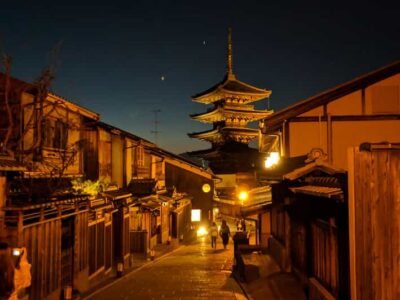
Best of Kyoto: Gion, Geisha, Pagodas & Cobblestones
Read our review →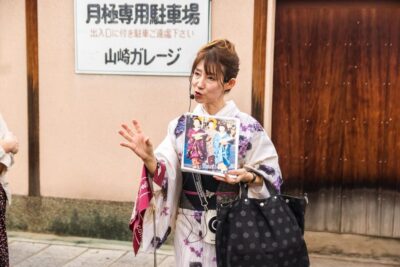

Kyoto Night Foodie Tour in Gion (9+ dishes + 6 Sake tastings)
Read our review →
Kyoto Gion Geisha District Walking Tour – The Stories of Geisha
Read our review →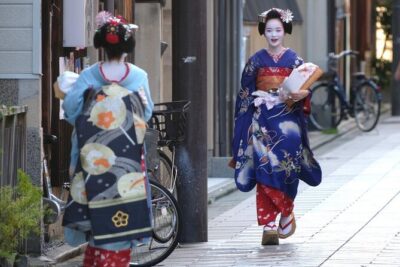
Kyoto Gion: 2-Hour Geisha Culture & History Walking Tour
Read our review →Browse the lists this tour appears in