Reviewed · SHOW
Traditional Japanese Comedy, Juggling & Magic Live Show in Tokyo
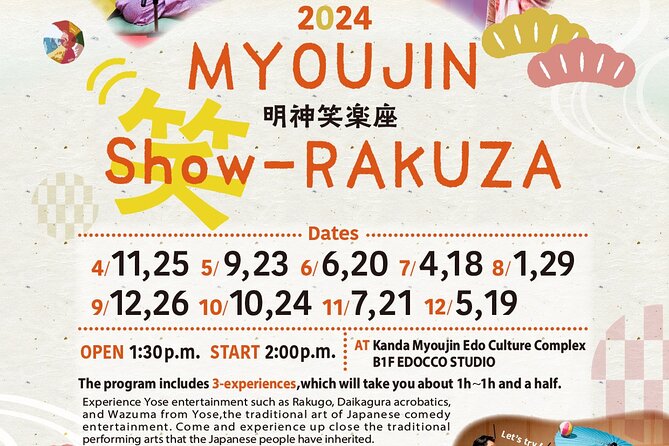
Traditional Japanese performance can be wonderfully hands-on. This 90-minute show near Akihabara brings together Rakugo comedy, Daikagura juggling, and Wazuma magic in a small theater inside Kanda Myoujin Shrine. I like the clear interpretation, which makes the acts accessible without Japanese skills, and the chance to try simple tricks yourself. The main consideration is that the show runs only on Thursdays, so it may not fit every Tokyo schedule.
I also like the setting: you watch modern entertainment inside the grounds of one of Tokyo’s historic shrines. The $36.24 price is fair for a 90-minute performance with audience participation and small traditional gifts, though this is best for you if you want cultural contact rather than a large, polished stage production.
In This Review
- Key things to know before you go
- A short show with a wide cultural reach
- Entering EDOCCO STUDIO at Kanda Myoujin Shrine
- Rakugo: comedy with a fan and a hand towel
- Daikagura brings the umbrella act to life
- Wazuma adds simple Japanese magic
- Why the English interpretation matters
- Price and what you receive for $36.24
- Who will enjoy this Tokyo experience most
- Timing your visit around Akihabara
- Booking, cancellation, and participation details
- Should you book this show?
- FAQ
- Where does the Japanese comedy and magic show take place?
- What time does the show begin?
- What types of entertainment are included?
- Do I need to speak Japanese?
- Can I participate in the performance?
- Is a gift included with admission?
- Can I cancel for a full refund?
Key things to know before you go
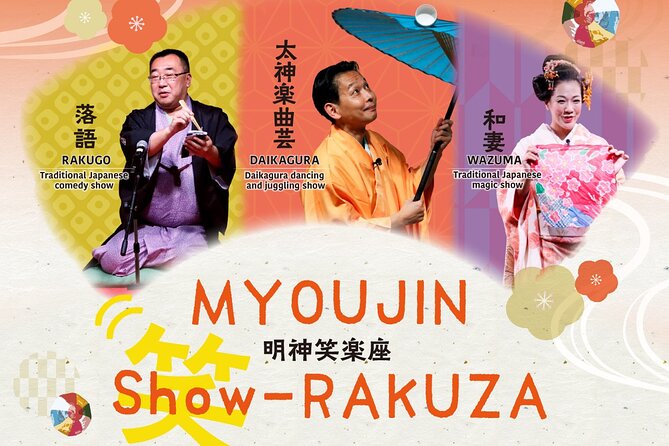
- Three traditional acts in one show: Rakugo comedy, Daikagura acrobatics, and Wazuma Japanese magic give you a broad introduction to old-style Japanese entertainment.
- English-friendly presentation: Interpretation helps you follow the comedy and instructions, even if you know no Japanese.
- Audience participation is part of the fun: You may learn basic Rakugo expressions and try simple Daikagura or Wazuma techniques.
- A shrine setting near Akihabara: EDOCCO STUDIO sits within Kanda Myoujin Shrine, making the show easy to pair with sightseeing in central Tokyo.
- Small cultural gifts are included: You receive traditional props such as a tenugui hand towel, folding fan, or paper balloon.
- Plan around Thursday afternoon: Doors open at 1:30 p.m., and the show begins at 2 p.m. for about 90 minutes.
A short show with a wide cultural reach
Many Tokyo performances ask you to sit quietly and watch. This one takes a different path. You see three kinds of Japanese entertainment, then get a chance to handle some of the same ideas and props used onstage.
The format is useful for first-time visitors because it avoids a common problem: traditional performance can be hard to understand when the language, gestures, and customs are unfamiliar. Here, an interpreter helps explain the action, and the performers teach simple elements directly to the audience.
The tone is welcoming rather than formal. The show has enough structure to feel like a real performance, but it also has the easy pace of a cultural demonstration. That combination suits families, solo visitors, and couples who want something more personal than a major theater production.
The experience lasts about 1 hour and 30 minutes. That is long enough to feel worthwhile, but short enough to place between other Tokyo plans. Since the start time is 2 p.m., you could visit an area attraction before the show, then continue into the evening after it ends.
A few more Tokyo experiences worth weighing up
- Mt Fuji & Hakone Cruise, Drum Show Bullet Train 1 Day from Tokyo
★ 4.0 · 7,413 reviews - Tokyo: Sumo Show Experience with Chicken Hot Pot and a Photo
★ 4.8 · 6,678 reviews - Tokyo: Sumo Show and Dining Experience
★ 4.8 · 2,742 reviews
Entering EDOCCO STUDIO at Kanda Myoujin Shrine
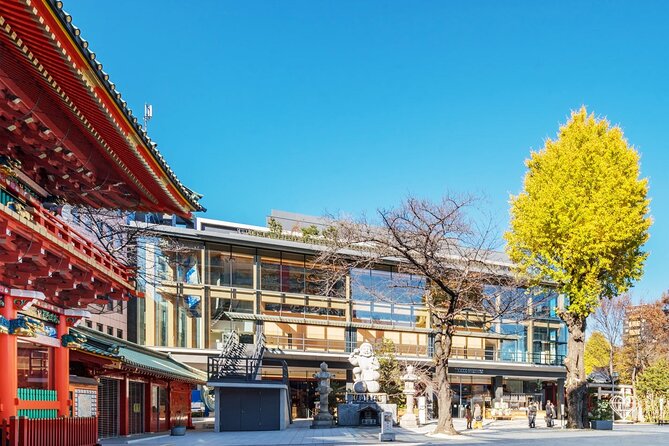
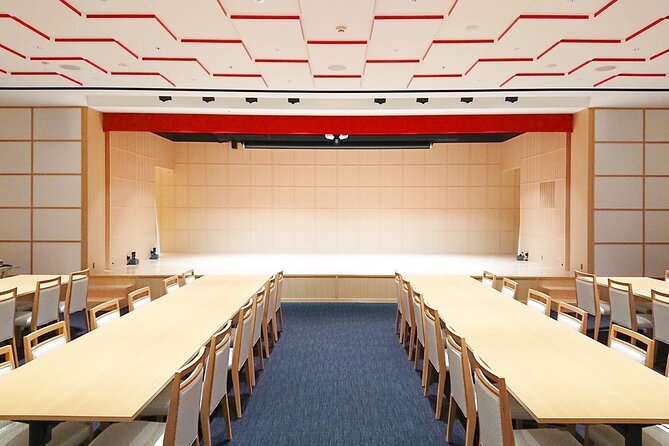
The meeting point is EDOCCO STUDIO, at 2-chome-16-2 Sotokanda in Chiyoda City. The studio is located within Kanda Myoujin Shrine, a setting that gives the afternoon a stronger sense of place than a plain indoor venue would.
Kanda Myoujin is close to Akihabara, so this show works well with a day focused on electronics, anime, arcades, or central Tokyo sightseeing. The location is near public transportation, but you should still allow time to find the studio within the shrine grounds. Doors open at 1:30 p.m., with the performance starting at 2 p.m.
The indoor venue is a practical choice in Tokyo. You are protected from heat, rain, or cold while watching the performance. The information also says the activity requires good weather, so check the booking notice if conditions are poor. If the show is canceled because of weather or because the minimum number of participants is not reached, you are offered another date or a full refund.
The maximum group size is 100 people. That is not a tiny private class, but the theater format and audience participation should still give the show a more direct feel than a huge commercial stage.
Rakugo: comedy with a fan and a hand towel
Rakugo is traditional Japanese comic storytelling. A performer sits onstage and uses voice, facial expression, timing, a folding fan, and a tenugui hand towel to suggest a whole cast of characters and objects.
You do not need to understand Japanese to enjoy the basic performance. Interpretation helps you follow the story and the jokes, while the performer’s physical style makes the changes between characters easier to see. The translated explanation is especially important here because Rakugo humor often depends on wordplay and small shifts in speech.
The show also introduces you to basic Rakugo expressions. That teaching element gives the performance extra value. Instead of seeing Rakugo as an old art that belongs only to specialists, you get a simple entry point into how one person can build a scene with very few props.
A memorable part of the experience may be the chance to step onto the Rakugo stage. This is not just a lecture about Japanese culture. You may get to try a small part of the tradition under guidance, which can be amusing even if you are not normally comfortable performing in public.
The comedy section is likely the most language-dependent part of the show, but the interpreter helps bridge that gap. If you expect every joke to land exactly as it would for a Japanese audience, keep your expectations sensible. The pleasure comes from the storytelling style, the physical acting, and the chance to see how the art works.
Daikagura brings the umbrella act to life
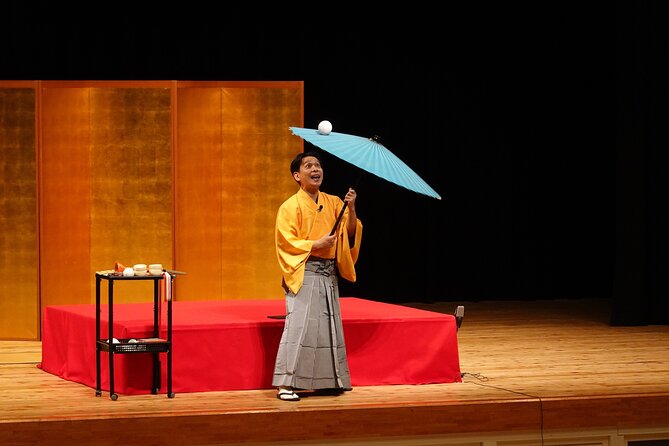
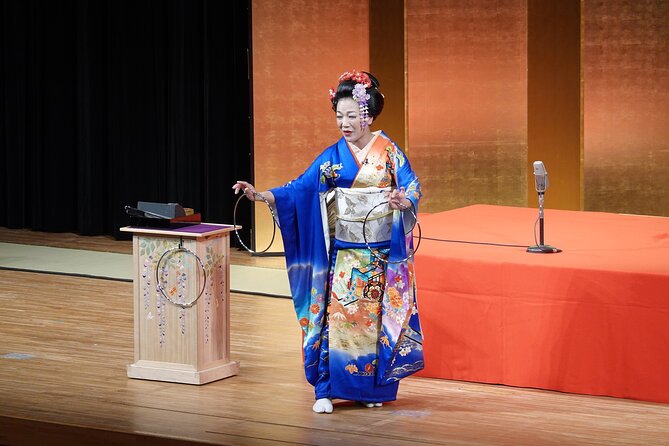
Daikagura is known for balance and juggling skills, often using traditional objects in ways that look simple until you consider the control required. The umbrella-spinning act is one of the clearest visual highlights.
A performer balances or spins an object on a traditional Japanese umbrella, turning a familiar item into a stage tool. You can understand the basic challenge without translation, which makes this part especially effective for an international audience.
The act is not presented only as something to watch. You get the chance to try Daikagura firsthand. The exact level of participation can vary, but the important point is that the show lets you move from spectator to beginner.
That hands-on section should be fun for children and adults alike. It also gives you a better sense of why these traditional acts require practice. A short demonstration can look effortless, while a beginner quickly discovers that balance and timing are not automatic.
If you prefer to stay completely out of the spotlight, the participation is described as interactive but not overly forceful. You can enjoy the spectacle without treating the activity like a compulsory stage performance.
A completely different kind of day out in Tokyo:
- Mt Fuji and Hakone 1-Day Bus Tour Return by Bullet Train
★ 5.0 · 26,383 reviews - 1-Day Tokyo Bus Tour
★ 5.0 · 14,250 reviews - Tokyo: TOKYO SKYTREE® Admission ticket
★ 4.5 · 11,192 reviews - Tokyo: teamLab Planets TOKYO Digital Art Museum Entry Ticket
★ 4.6 · 9,779 reviews
Wazuma adds simple Japanese magic
The Wazuma section introduces Japanese magic, with a magician explaining and teaching basic tricks. This is one of the strongest parts for anyone who enjoys learning something they can take home and repeat.
The teaching is designed to be accessible. You are not expected to arrive with special skills, and the presentation includes simple instructions rather than treating the secrets as something completely out of reach.
The magic section also adds variety to the program. Rakugo depends on language and character work. Daikagura depends on balance and visual skill. Wazuma brings mystery and participation. Together, the three acts keep the 90-minute format moving through different kinds of performance.
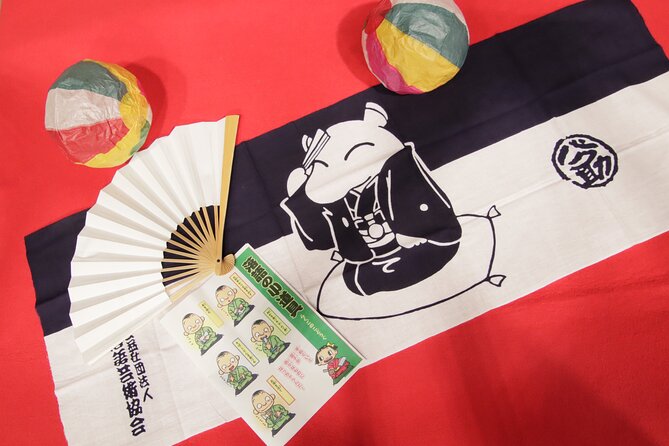
The included gifts connect directly to this part of the show. You may receive a tenugui, folding fan, paper balloon, or another small traditional prop featured in the performance. These are modest souvenirs, not expensive merchandise, but they are more meaningful than a generic key ring because they relate to what you have just seen and tried.
Why the English interpretation matters
The show is made for an international audience, but that does not mean every cultural detail becomes instantly obvious. Interpretation is a key part of the experience.
It helps with the Rakugo story, explains the basic expressions, and gives you enough context to follow the rules of the magic and juggling demonstrations. Clear translation can make the difference between watching a sequence of unfamiliar actions and understanding why the performer is doing them.
The language support is also useful during the interactive sections. If you are asked to try a trick or prop, you need simple instructions you can follow quickly. The show’s welcoming staff add to that ease, especially for solo visitors who might otherwise feel awkward joining a group activity.
Still, this is an introduction, not a full course in Japanese performing arts. You will learn the basic shape of each tradition, not its entire history or technical vocabulary. That is the right way to approach it: come for a lively first contact, then look for more performances if one of the styles catches your interest.
Price and what you receive for $36.24
At $36.24 per person, the show costs more than a casual street performance, but the price covers several parts of the experience:
- Admission to the 90-minute performance
- English-friendly interpretation
- Audience participation in basic traditional techniques
- A small cultural gift
- An indoor venue within Kanda Myoujin Shrine
The value depends on what you want from Tokyo. If you only want a quick spectacle, the price may feel high for an afternoon show. If you want a planned cultural activity with a clear start time, a comfortable venue, and something you can actively take part in, the cost is reasonable.
The gifts help, but they should not be the main reason to book. Their value is symbolic and practical rather than financial. The real benefit is the combination of performance and instruction. You see professional artists demonstrate skills, then get a small taste of how those skills work.
The show is booked an average of 62 days ahead, and the stated capacity is limited to 100 people. That suggests you should not leave it until the last day if the Thursday afternoon slot is important to your plans.
Who will enjoy this Tokyo experience most
I would recommend this show to you if you fit one or more of these descriptions:
- You are visiting Japan for the first time and want an easy introduction to traditional performance.
- You do not speak Japanese but still want to understand what you are watching.
- You enjoy activities that include a small amount of participation.
- You are traveling with children or teenagers who may lose interest during a purely historical presentation.
- You want an indoor plan near Akihabara.
- You are curious about Japanese comedy, juggling, or magic but do not know where to begin.
- You are traveling alone and want a structured cultural activity with friendly staff.
The show may be less suitable if you want a long, formal theater production performed entirely for silent spectators. It is also not the best match if Thursday at 2 p.m. is difficult for your schedule.
Solo visitors should feel comfortable booking. The audience interaction is described as friendly rather than pressuring, and the staff help make the room welcoming. Families should also find the mix of visual acts, comedy, and simple magic easier to enjoy than a performance built around one long story.
Timing your visit around Akihabara
The afternoon schedule gives you useful flexibility. Doors open at 1:30 p.m., and the show starts at 2 p.m. You should aim to arrive before the start rather than cutting it close, since the meeting point is inside the shrine grounds.
After the 90-minute performance, you finish back at the same meeting point. That makes the activity simple to combine with Akihabara, and you do not need to arrange a separate return transfer.
Because the venue is in central Tokyo and near public transportation, the show can fit into a day that already includes other parts of the city. The practical limit is the fixed Thursday schedule, not the length of the activity.
The indoor setting is useful for planning, but remember the stated weather condition. A cancellation caused by poor weather comes with the option of a different date or a full refund, so you are not left without a remedy.
Booking, cancellation, and participation details
Your mobile ticket provides the basic admission method. Confirmation is normally issued at booking. If you book within two hours of the start time, confirmation is subject to availability and may arrive as soon as possible.
Most people can participate, and service animals are allowed. The activity is near public transportation, and the maximum group size is 100. No special Japanese language ability is required.
Free cancellation is available up to 24 hours before the local start time for a full refund. Changes or cancellations inside that 24-hour window are not accepted for a refund.
The experience also requires a minimum number of participants. If that minimum is not reached, you are offered another date or experience, or a full refund.
Should you book this show?
Book it if you want a friendly, compact introduction to Japanese performing arts and like the idea of trying a few techniques yourself. The strongest reasons are the three-part format, clear interpretation, kind staff, and the chance to leave with a small prop connected to the show.
I would especially choose it for a first Tokyo visit, a family afternoon, or a rainy-day plan near Akihabara, while keeping the weather cancellation rule in mind. Skip it if you want a major theater spectacle or cannot make a Thursday afternoon.
For $36.24, you are paying for more than a seat. You are getting a guided look at Rakugo, Daikagura, and Wazuma, plus a brief chance to perform, learn, and laugh along the way. That makes this a strong choice for curious visitors who want culture to feel active rather than distant.
FAQ
Where does the Japanese comedy and magic show take place?
The show takes place at EDOCCO STUDIO, located within Kanda Myoujin Shrine at 2-chome-16-2 Sotokanda, Chiyoda City, Tokyo 101-0021, Japan.
What time does the show begin?
Doors open at 1:30 p.m., and the show begins at 2 p.m. The performance lasts approximately 1 hour and 30 minutes.
What types of entertainment are included?
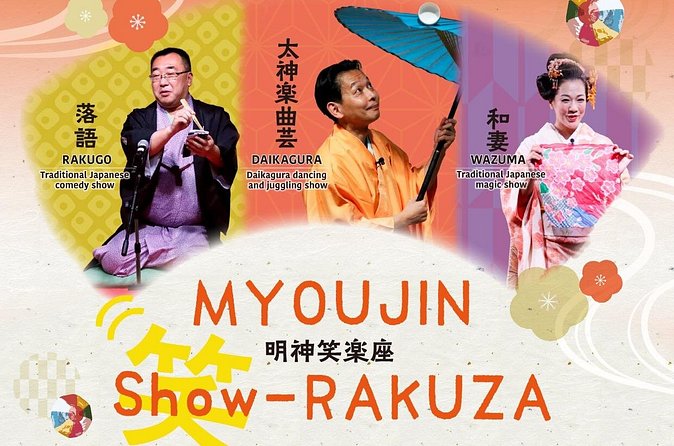
The program includes Rakugo traditional comedy, Daikagura acrobatics and juggling, and Wazuma Japanese magic.
Do I need to speak Japanese?
No. The experience is designed for international visitors, and interpretation is provided to help you follow the comedy, explanations, and participation instructions.
Can I participate in the performance?
Yes. The experience includes opportunities to try basic Daikagura and Wazuma techniques. You may also learn simple Rakugo expressions and have a chance to perform on the Rakugo stage.
Is a gift included with admission?
Yes. A small traditional gift is included. Examples include tenugui hand towels, folding fans, and paper balloons.
Can I cancel for a full refund?
Yes. You can cancel at least 24 hours before the local start time for a full refund. Cancellations or changes made less than 24 hours before the start are not refunded or accepted.
Just added around Tokyo
- From Tokyo: Tokyo Private Customize Tour With English Driver★ 5.0 · 37 reviews
- Tokyo Time Machine: Exploring Old School Monzen-Nakacho★ 5.0 · 37 reviews
- Tokyo Tsukiji Fish Market Food & Culture Walking Tour★ 5.0 · 37 reviews
- Private Tokyo with Exceptional Guide Tailored to Your Needs★ 5.0 · 37 reviews
- Tokyo Photoshoot Tour with a Local Photographer★ 5.0 · 37 reviews
- Tokyo Tower Observation Deck E-Tickets.★ 4.0 · 37 reviews
- Tokyo: 7 Kinds of Sake Tasting with Japanese Food Pairings★ 4.9 · 37 reviews
- Kyoto: Nijo Castle World Heritage Guided Tour with Admission★ 4.9 · 37 reviews
Show, compared.

Mt Fuji & Hakone Cruise, Drum Show Bullet Train 1 Day from Tokyo
Read our review →
Tokyo Shinjuku Sumo Show & Experience with Photo
Read our review →

Mt Fuji & Hakone Cruise, Drum Show Bus 1 Day from Tokyo
Read our review →