
Reviewed · FISH MARKET TOURS
Tokyo: Guided Walking Tour of Tsukiji Market with Breakfast
Tokyo tastes best before lunch. This 150-minute walk through Tsukiji Outer Market pairs seven local tastings with an easy introduction to Japanese food, religion, and daily market life. I especially like the small group limit of 10, which makes it easier to ask questions, and the way guides help with ordering and translation. The main drawback is that the tour includes a lot of food in a short time, so picky eaters or anyone with dietary limits should speak up early.
The meeting point is simple to find, right outside Tsukiji Hongwanji Temple and about 50 meters from Tsukiji Station’s A1 exit. I also like that the tour ends early enough for you to keep exploring the market on your own, though English ability can vary between guides and some explanations may take patience.
In This Review
- Key points to know before booking
- Meeting at Tsukiji Hongwanji Temple
- Entering Tsukiji Outer Market
- Seven tastings, from grilled skewers to dashi
- Why a guide adds real value at Tsukiji
- Watching the market work
- A good fit for families and first-time Tokyo visits
- Timing, pace, and what to bring
- Is $85 a fair price?
- Who should book this Tsukiji experience?
- FAQ
- Where does the Tsukiji market tour meet?
- How long does the tour last?
- What language is the tour conducted in?
- How many food tastings are included?
- What foods are included in the tastings?
- Is the temple visit included?
- Is the tour wheelchair accessible?
- What should I bring?
- Can I cancel the booking?
Key points to know before booking
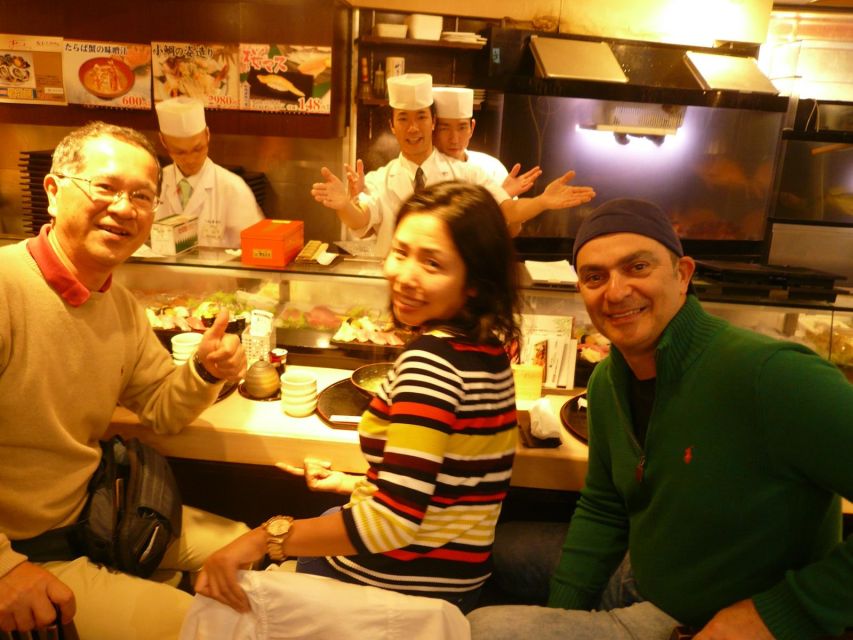
- Seven tastings replace a standard breakfast: Expect grilled seafood or beef, omelette, tuna sandwich, fish paste, tea, dashi, and a drink.
- Tsukiji Hongwanji Temple sets the scene: You see the unusual Indian-inspired exterior before entering the market.
- Small groups make a difference: With no more than 10 people, guides can help with food choices and translation.
- Guides often adjust the food: You can say no to dishes you do not want and ask for alternatives.
- The market is busy and crowded: Wear comfortable shoes and be ready for a lively, fast-moving morning.
- The $85 price buys convenience: You pay for seven tastings, local guidance, cultural context, and help navigating a complicated food district.
Meeting at Tsukiji Hongwanji Temple
The tour begins in front of Tsukiji Hongwanji Temple, a useful landmark and a worthwhile first stop. From Tsukiji Station on the Hibiya Line, take Exit A1, turn left, and walk about 50 meters to the temple entrance.
The temple’s exterior is unusual in Tokyo. Its design has ancient Indian-inspired Buddhist influences, giving it a look that is very different from the classic wooden temple image many people expect in Japan. You visit the exterior rather than taking part in a full temple visit, but the stop gives your guide a chance to explain the connection between religion, ritual, and food.
That context matters. Japanese cuisine is not separate from culture and belief. Ideas about seasonality, respect for ingredients, offerings, hospitality, and careful preparation all connect to the way food is bought and eaten. Even a short explanation here helps you see Tsukiji as more than a place to collect snacks.
The meeting point also removes one common source of morning stress. You do not need to search inside a crowded market for a guide. Just look for the temple at the station exit and arrive ready to walk.
More Market Tours in Tokyo
- Tokyo Tsukiji Fish Market Food and Culture Walking Tour
★ 5.0 · 3,184 reviews - Tokyo: Tsukiji Fish Market Food and Walking tour
★ 5.0 · 1,724 reviews - Tokyo: Tsukiji Fish Market Guided Walking Tour
★ 4.9 · 1,397 reviews
Entering Tsukiji Outer Market
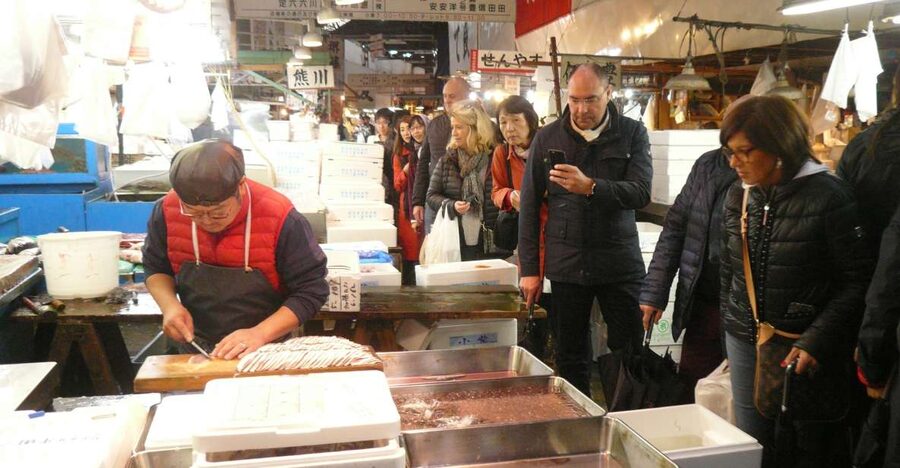
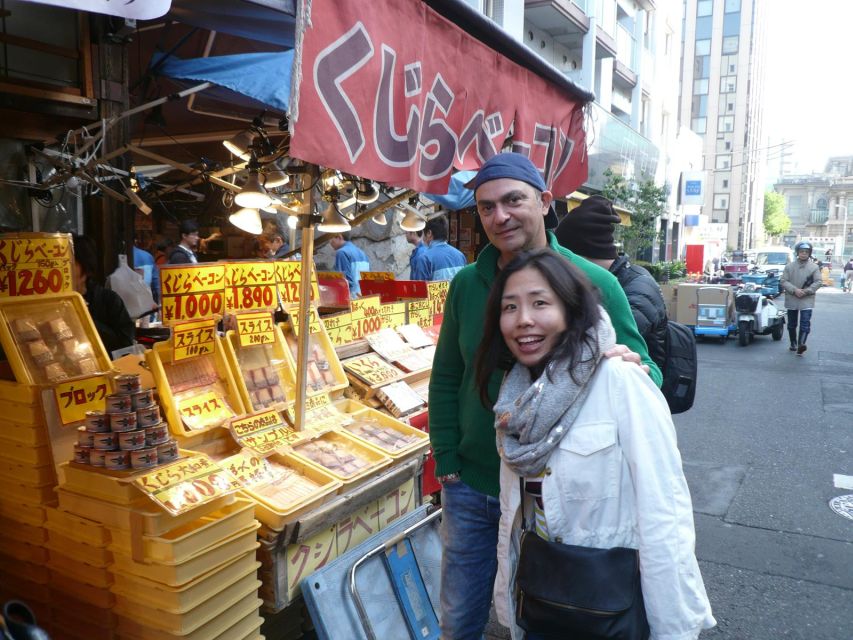
After the temple, you head into Tsukiji Outer Market, a dense food district filled with shops, restaurants, stalls, and businesses serving both local customers and curious visitors. This is not a quiet museum-style market. It is an active working area where expert wholesalers and food sellers handle products at a quick pace.
Your guide helps you move through the streets without wasting time at every tempting counter. That is valuable because Tsukiji can feel confusing on a first visit. You may see unfamiliar cuts of fish, unusual ingredients, prepared foods, knives, tea, and cooking supplies, all competing for your attention.
The market is also crowded. You will need to stay close to the group and watch where you step. Comfortable shoes are essential, and a light breakfast beforehand would defeat the purpose of the tour. The food comes in several portions, and the tastings add up quickly.
One of the best parts is seeing the working side of the market rather than only the most photographed stalls. Guides can point out what is being sold, explain how it is used, and help you understand why certain shops draw such long lines. You get a sense of the market as a place where food professionals work, not simply a backdrop for photographs.
Seven tastings, from grilled skewers to dashi

The central promise is straightforward: you receive seven tastings of local specialties. The exact flow can change with availability and your group’s preferences, but the listed selection includes:
- Grilled seafood or wagyu beef skewers
- Japanese-style omelette
- Tuna sandwich
- Fried fish paste skewer
- A drink
- Japanese tea
- Dashi soup stock
This is a generous breakfast. The skewers bring the most obvious street-food appeal, with grilled seafood or beef served in an easy-to-eat format. Wagyu beef gives the tasting a special treat, while seafood keeps the meal tied to Tsukiji’s identity.
The omelette offers a different texture and flavor. Japanese-style omelette is often softly layered and lightly sweet, so it may not resemble the savory breakfast eggs you know at home. The tuna sandwich is another useful reminder that market food is not limited to raw fish or traditional dishes. Tsukiji’s sellers also adapt familiar formats around fresh ingredients.
The fried fish paste skewer introduces a more everyday Japanese snack. It is a good example of why a guided tasting helps. The name alone may not tell you much, but your guide can explain what you are eating and how it fits into local food habits.
Dashi is perhaps the most educational tasting. This soup stock forms the base of countless Japanese dishes, and sampling it by itself lets you focus on its savory depth. Japanese tea provides a gentler pause between foods, while the drink rounds out the breakfast.
Several people who took the tour appreciated being able to adjust the menu. If you do not eat everything, tell your guide what you prefer before the food is ordered. Guides have replaced unwanted items with alternatives in some cases, and they have helped guests communicate with vendors. That flexibility is especially useful for families, selective eaters, or anyone unsure about unfamiliar ingredients.
Still, do not assume every substitution is guaranteed. The safest plan is to explain allergies, restrictions, or strong dislikes at the start. Also remember that the tour is built around market food, so it works best if you are open to trying small portions of unfamiliar dishes.
Why a guide adds real value at Tsukiji
You can visit Tsukiji Outer Market without a tour. The challenge is knowing where to go, what to order, how to avoid wasting time, and how to understand what you are seeing. At $85 per person, this experience is not the cheapest way to eat breakfast in Tokyo, but it includes seven tastings and a guide for two and a half hours.
The strongest value comes from the practical help. Guides can speak with vendors, translate menus or questions, and wait in food lines while you look around. One person described a guide helping the group get exactly the food they wanted, while another appreciated help finding the next tour after the market visit.
That kind of assistance can save you from ordering something by accident or missing a stall because the line looks too confusing. It also lowers the pressure for first-time visitors who do not speak Japanese.
The guides have received especially warm praise for their friendly approach. Yumi was singled out for guiding the group smoothly through the market and arranging tastings along the way. Nori was remembered as a good companion who even helped with the return to a hotel. Rico was thanked for adjusting the experience to the group’s preferences, while Minoko and a second guide were praised for answering questions and working well as a team.
The staff setup can vary. Some groups have had two guides, while other bookings became nearly private experiences because only one family or pair attended. The maximum group size is 10, so you should expect a small-group setting, but not necessarily a private tour.
English is the tour language. Most people have found communication workable, though one person found an English-speaking guide difficult to understand at times. Keep that in mind if detailed spoken explanations are very important to you. The market sights and food remain accessible, but the amount of cultural detail you take away may depend on the guide assigned that day.
More Walking Tours in Tokyo
- Tokyo: Imperial Palace and Shogun Historical Walking Tour
★ 5.0 · 2,251 reviews - Tokyo: Shinjuku Local Bar and Izakaya Guided Walking Tour
★ 4.9 · 1,794 reviews - Tokyo: Asakusa Walking Tour with Sensoji Temple Visit
★ 4.8 · 1,583 reviews - Tokyo Castle & Imperial PalaceーShogun Walking Tour
★ 4.7 · 1,068 reviews
Watching the market work

The market’s character comes from its workers and sellers. As you move through the streets, you may see wholesalers handling seafood, shopkeepers arranging products, and cooks preparing food for immediate sale. The experience is more interesting when you observe rather than treat every stall as a shopping stop.
Your guide can explain unusual products and help you notice details you would likely miss. You may also have time to buy extra food or gifts, though those purchases are separate from the seven included tastings.
This is where the tour feels most authentic. It does not try to turn the market into a polished show. You see narrow passages, busy counters, lines, and the ordinary work that keeps Tokyo’s food culture moving. The trade-off is that the setting can be noisy, crowded, and less comfortable than a sit-down food tour.
Be considerate while taking photographs. The market is a place of business, and sellers are working around you. Follow your guide’s lead, stay out of the way, and do not block shop entrances or food counters.
A good fit for families and first-time Tokyo visits
This tour suits you if you want food and orientation at the same time. You get an introduction to one of Tokyo’s best-known food districts without having to plan each stop yourself.
It also works well for families. One family with a teenager found the guides accommodating when certain foods were not appealing, offering alternatives instead. That is useful, but the tour still requires a willingness to walk, stand, and eat several different foods.
Solo visitors and couples can benefit from the social side of a small group. You meet other people while moving between tastings, and the guides often make the experience feel informal rather than rigid. At times, the group may be small enough to feel almost private.
The tour is wheelchair accessible, but Tsukiji is a working market with crowded streets and active businesses. Accessibility does not mean every moment will feel spacious or effortless. If you use a wheelchair, confirm that the current route suits your needs when booking.
This is not the best choice if you want a slow, formal temple visit or a long sit-down meal. The temple portion is exterior viewing, and the food is eaten as you move through the market.
Timing, pace, and what to bring
The tour lasts 150 minutes, usually long enough to cover the temple, several market streets, seven tastings, and basic cultural explanations without taking up your whole day. The pace is active because the group needs to move with the market and fit food stops into the morning.
Wear comfortable shoes. You will walk and may spend time standing in lines. Come hungry, since the food portions can amount to a full breakfast and more. If you are sensitive to crowds, an early starting time may feel easier, but the available start times depend on the date you select.
The tour ends early enough for you to continue exploring Tsukiji on your own. That is a useful feature. You can return to a shop you noticed, buy ingredients or snacks, or simply wander without the group schedule.
The booking terms are also practical for a complicated Tokyo itinerary. You can cancel up to 24 hours ahead for a full refund, and the reserve-now, pay-later option lets you hold a place without paying immediately.
Is $85 a fair price?
At $85 per person, this is a midrange food experience rather than a budget breakfast. If you only want to eat seven small market items, you could likely spend less by choosing stalls yourself.
You are paying for more than the food. The cost includes a live English-speaking guide, seven tastings, translation help, cultural explanations, and a planned route through a busy district. For a first morning in Tokyo, that structure can be worth the extra money.
The value is strongest when you are unsure how to order or want context with your meal. It is weaker if you already know Tsukiji well, speak Japanese, or prefer to make spontaneous choices at your own pace.
The rating of 4.4 from 134 reviews suggests a very good experience overall, but not a perfect fit for everyone. The recurring strengths are clear: friendly guides, generous food, easy navigation, cultural information, and flexibility around preferences. The main cautions are the amount of food, the crowds, and occasional difficulty understanding spoken English.
Who should book this Tsukiji experience?
Book it if you want a friendly introduction to Tokyo food culture, especially on your first visit. It is a strong choice for people who want to try unfamiliar dishes without guessing what they are ordering.
Families, couples, solo visitors, and small groups can all benefit. It is particularly helpful for picky eaters when you explain your preferences at the beginning. The tour also makes a sensible first activity because it gives you both breakfast and an introduction to an important part of the city.
Skip it if you want complete independence, a quiet meal, or a deep temple visit. You may also prefer to explore alone if you are comfortable reading menus, speaking with vendors, and choosing your own route.
For most first-time visitors, I think the convenience and generous tasting list justify the $85 price. Arrive on time, wear good shoes, come hungry, and tell your guide what you do and do not want to eat. That is the best way to get a relaxed and personal morning at Tsukiji.
FAQ
Where does the Tsukiji market tour meet?
The meeting point is in front of Tsukiji Hongwanji Temple. From Tsukiji Station on the Hibiya Line, take Exit A1, turn left, and walk about 50 meters to the temple entrance.
How long does the tour last?
The tour lasts 150 minutes, or two and a half hours.
What language is the tour conducted in?
The live tour guide speaks English, and English is the listed tour language.
How many food tastings are included?
Seven local specialties are included in the experience.
What foods are included in the tastings?
The listed tastings include grilled seafood or wagyu beef skewers, Japanese-style omelette, a tuna sandwich, a fried fish paste skewer, a drink, Japanese tea, and dashi soup stock.
Is the temple visit included?
The tour begins at Tsukiji Hongwanji Temple, where you admire its unusual exterior. The stated visit focuses on the outside of the temple.
Is the tour wheelchair accessible?
Yes, the activity is listed as wheelchair accessible. The market can still be crowded, so you may want to confirm the current route when booking.
What should I bring?
Bring comfortable shoes. You will walk through the market and may spend time standing during food stops.
Can I cancel the booking?
Yes. You can cancel up to 24 hours in advance for a full refund. The reserve-now, pay-later option lets you book without paying immediately.
More Shopping Tours in Tokyo
- Tsukiji Fish Market Small-Group Food Walking Tour
★ 5.0 · 621 reviews - Tokyo: Tsukiji Fish Market Sushi Making Class with Pro Chef
★ 4.9 · 506 reviews - Tokyo Food Tour Taste Fresh Delights at Tsukiji Market
★ 5.0 · 429 reviews - Tokyo Tsukiji Fish Market Tour and Sushi Making Lesson
★ 5.0 · 390 reviews
More Fish Market Tours in Tokyo
- Tokyo Sushi Making Class in Tsukiji with Professional Chef
★ 5.0 · 1,177 reviews - Tsukiji Fish Market Guided Tour and Sushi Making with Pro Chef
★ 5.0 · 775 reviews - Tokyo: Tsukiji Fish Market Food and Culture Walking Tour
★ 4.7 · 757 reviews - Tsukiji Fish Market: Street Food & Culture Walking Tour
★ 5.0 · 669 reviews
Just added around Tokyo
- Tokyo 6hr Instagram Highlights Private Tour with Licensed Guide★ 5.0 · 38 reviews
- Tokyo Small Group Tour with Guide★ 4.5 · 38 reviews
- Tokyo Sumo Experience with Live Show & Audience Challenge★ 5.0 · 38 reviews
- Japanese Food Cooking Class in Asakusa, Tokyo★ 5.0 · 39 reviews
- Very popular in Harajuku♡Animal petting zoo★ 4.6 · 39 reviews
- Ramen Making from Scratch with Tokyo Mom(Vegan Option Available)★ 5.0 · 39 reviews
- Tokyo: Kimono Rental inside Shinjuku Gyoen National Garden★ 4.9 · 39 reviews
- Tokyo JDM Night: 600hp C63s AMG Edition 1 (Private)★ 4.9 · 39 reviews
Fish Market Tours, compared.

Tokyo Tsukiji Fish Market Food and Culture Walking Tour
Read our review →


Tokyo Sushi Making Class in Tsukiji with Professional Chef
Read our review →
Tsukiji Fish Market Guided Tour and Sushi Making with Pro Chef
Read our review →Tsukiji Fish Market Food and Culture Walking Tour
Read our review →
Tsukiji Fish Market: Street Food & Culture Walking Tour
Read our review →
Tsukiji Fish Market Small-Group Food Walking Tour
Read our review →Browse the lists this tour appears in