
Reviewed · JAPANESE CALLIGRAPHY CLASSES
Calligraphy Workshop in Namba, Dotonbori
Slow down in Osaka. This two-hour calligraphy workshop gives you a calm, hands-on break from Namba’s bright streets, with step-by-step instruction, cultural context, and your own name written in kanji or katakana. I like the small maximum of six people, which allows plenty of help, and I like that you leave with a handmade keepsake rather than a shop-bought souvenir.
The instructors, including calligraphy teacher Nao and English-speaking helpers such as Stephen or Stephan, are praised for making beginners feel at ease. The main consideration is that shodo looks simple but takes concentration, so this is not a quick photo stop. Also, the meeting point can be a little hard to spot, with a suggestion to add clearer signage near the elevator and the nail salon sign.
In This Review
- Key points to know before booking
- A quiet room near the heart of Namba
- What happens during the two-hour class
- Why the cultural explanation matters
- The souvenir is better because you make it
- A good fit for couples, solo visitors, and families
- How much value do you get for $49.54?
- Pair it with Dotonbori, Nihonbashi, and Kuromon Market
- What the strong praise tells you
- Booking and cancellation details
- Should you book this Namba calligraphy workshop?
- FAQ
- How long does the calligraphy workshop last?
- Where does the workshop begin?
- Where does the activity end?
- How many people can join the workshop?
- Is the workshop suitable for beginners?
- Will I learn to write my name in Japanese?
- What souvenir do I take home?
- Is the workshop near public transportation?
- Can I visit Dotonbori or Kuromon Market on the same day?
- How late can I cancel for a full refund?
Key points to know before booking
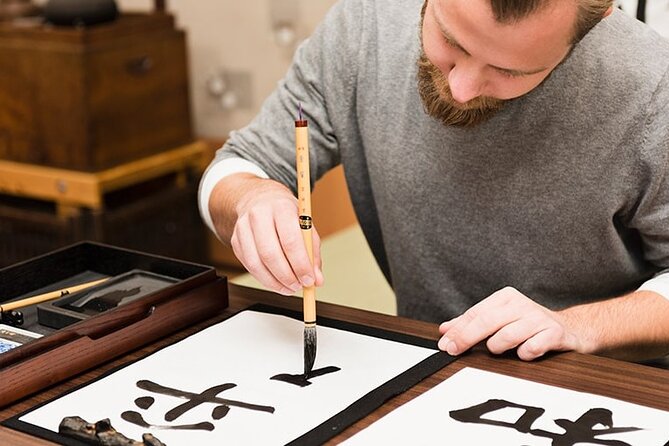
- Write your own name in Japanese: You learn how your name can be expressed in kanji or katakana, then put it on colored paper or a luggage tag.
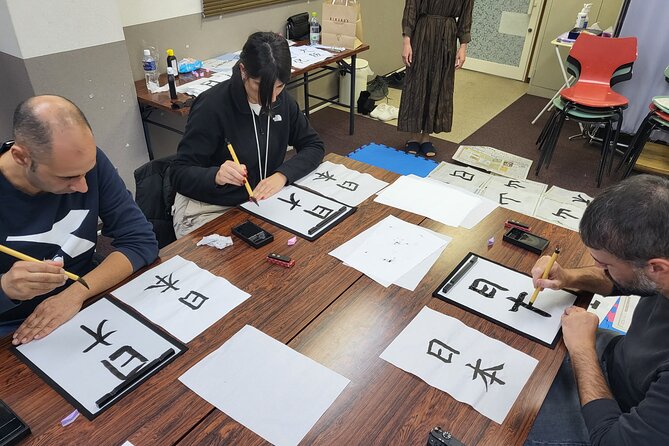
- Small groups make a difference: The class accepts no more than six people, and some sessions may have two instructors for extra guidance.
- Learn the meaning behind shodo: The workshop explains Japanese calligraphy, kanji, and the cultural ideas connected to the art.
- Suitable for complete beginners: Nao provides careful, patient instruction, while an English-speaking interpreter helps explain the process.
- Easy to pair with sightseeing: Dotonbori, Nihonbashi, and Kuromon Market are close enough to visit before or after class.
- Allow two focused hours: You will practice brushwork, learn characters, and prepare a personal souvenir, not simply write one character and leave.
A quiet room near the heart of Namba
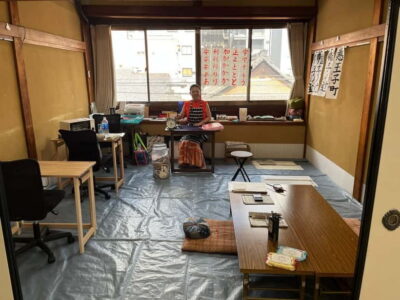
The workshop takes place in central Osaka, at イスク英語学院Japan, 3F, Takeda Building, 1-6-1 Nambanaka, Naniwa Ward, Osaka 556-0011. It is near public transportation and close to some of the city’s best-known food and shopping areas.
That location gives the activity its appeal. You can spend the morning around Kuromon Market, walk through Nihonbashi, eat in Dotonbori, and then settle into a quieter room for two hours. Or reverse the order and use the class as a thoughtful start to an afternoon in Namba.
The address is worth checking carefully before you go. The meeting point is inside a building, and one participant found the entrance signage less obvious than ideal. Look for the building and go to the third floor. A little extra time for finding the door is sensible.
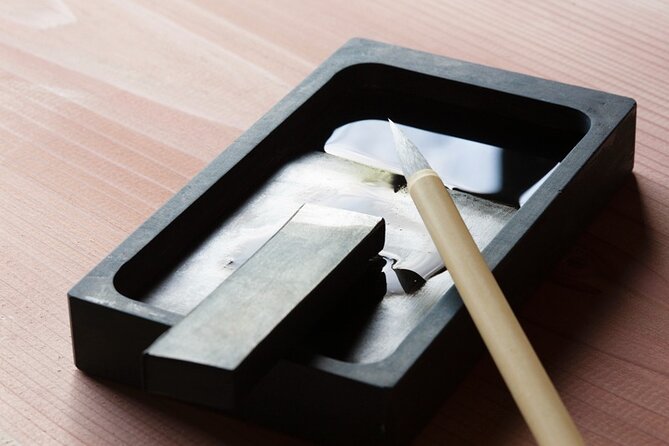
Once inside, the pace changes. The bright signs and crowds of Namba give way to a more measured activity built around paper, ink, brush control, and concentration. Several families described the class as peaceful, which is a useful point for anyone who wants something beyond Osaka’s usual eating and shopping circuit.
More Calligraphy Classes in Osaka
- Osaka: Private Japanese Calligraphy Experience
★ 5.0 · 66 reviews - Learning Zen of Japanese Calligraphy in kimono near Osaka Castle
★ 4.5 · 53 reviews - Osaka: Private Tea Ceremony and Calligraphy Experience
★ 5.0 · 50 reviews
What happens during the two-hour class
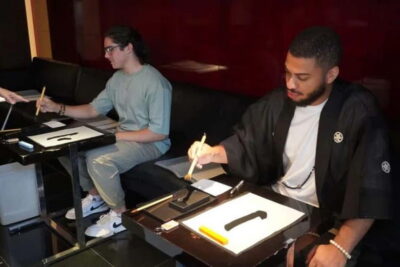
The workshop is short enough to fit into a busy Osaka day, but long enough to teach more than a souvenir trick. You begin with an introduction to Japanese calligraphy and the meaning of shodo. The aim is not just to copy a shape. You learn why the characters matter and how brush movement affects the final form.
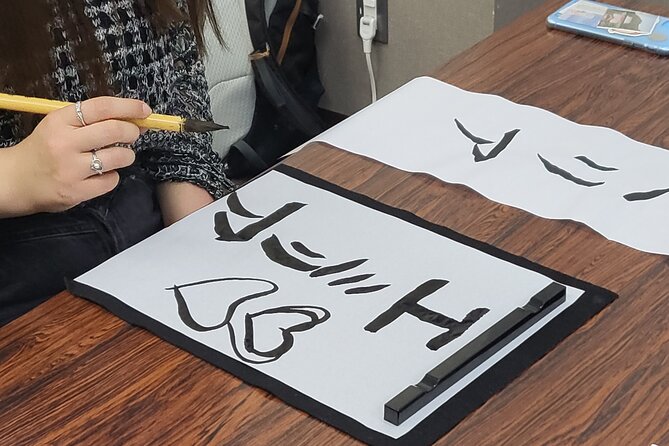
The instructors then guide you through the basic technique. You practice using a brush and ink, following the teacher’s demonstrations and corrections. The process can be harder than it appears. A small change in pressure or direction can alter the look of a stroke, so you may find yourself concentrating more intensely than expected.
That is part of the value. You are not asked to produce perfect calligraphy immediately. You are given room to try, adjust, and try again. Nao is repeatedly praised for being calm and patient, while the English-speaking interpreter helps make the instructions and cultural explanations clear.
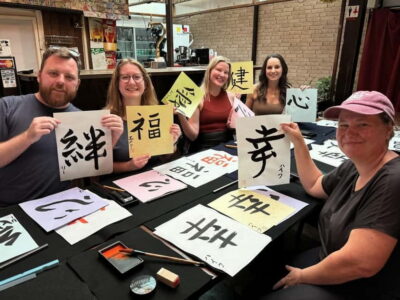
The class also includes practice with kanji. You learn about the characters you are writing instead of treating them as attractive symbols with no meaning. That extra context is important because it turns the activity into a cultural lesson, not simply an arts-and-crafts session.
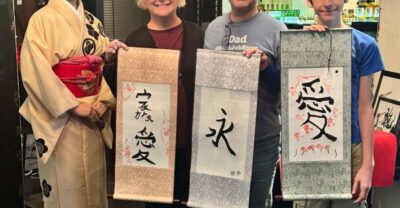
The final stage is personal. You write your name in Japanese, using kanji or katakana, and place it on colored paper or a luggage tag. The exact presentation may vary, but the idea remains the same: you create a one-of-a-kind item in your own handwriting and take it home.
Why the cultural explanation matters
Japanese calligraphy is easy to reduce to brush, ink, and attractive characters. This workshop gives you a better starting point by explaining what the practice represents and how kanji fits into Japanese culture.
I especially like that the teaching is paired with the physical act of writing. You first hear about the meaning, then try to form the character yourself. That connection helps you remember the lesson long after the ink has dried.
The instructors also appear to treat shodo as a practice that rewards patience and careful attention. You are encouraged rather than judged. One solo participant even received the class with two instructors when no one else had booked, showing the flexible and personal approach the teaching team can offer, though you should not assume every session will be private.
English support is another practical strength. The instructor may not conduct every explanation in English, but the interpreter helps bridge the gap. Stephen or Stephan is named in several accounts, and Hannah is also praised for being helpful and patient. The exact staff combination can vary, so it is best to think of the workshop as a class supported by an English-speaking assistant rather than a lesson guaranteed to have one particular person.
The souvenir is better because you make it
Osaka offers no shortage of things to buy. A handmade name card or luggage tag gives you something different: a reminder of the time you spent learning, not just a product chosen from a shelf.
Writing your name makes the souvenir personal even if your first attempts are uneven. In fact, the imperfect brush marks are part of the story. You can remember the effort, the concentration, and the moment when the character began to look right.
Families found this especially rewarding. Children around ages nine and eleven were able to take part, and a family of six with four teenagers enjoyed learning the history of kanji before making their own pieces. The class seems well suited to families who want a shared activity that does not depend on athletic ability or advanced artistic skill.
That said, young children need to be comfortable sitting, listening, and handling ink and a brush with care. The activity is family-friendly, but it is not a free-running children’s attraction. The two-hour length may feel long for a child who dislikes quiet, focused tasks.
A completely different kind of day out in Osaka:
- Osaka Go Karting Tour with Funny Costume
★ 5.0 · 2,658 reviews - Osaka Castle: Museum and Tower Entry Ticket
★ 4.5 · 2,380 reviews - Osaka: Shinsekai Food Tour with 13-15 Dishes at 5 Eateries
★ 4.8 · 2,204 reviews - Osaka Food Tour: 13 Dishes at 5 Local Eateries
★ 5.0 · 2,149 reviews
A good fit for couples, solo visitors, and families
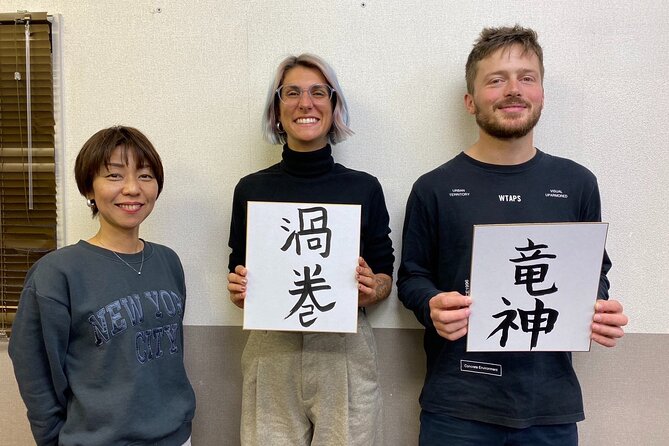
For couples, this makes a pleasant change from sightseeing side by side. You can compare your brushwork, help each other remember the instructions, and leave with two different versions of your names.
Solo participants can also feel comfortable here. The small group limit means you are unlikely to disappear into a large class. The account of a one-person session suggests that the instructors value the booking even when attendance is low, although the stated maximum of six does not promise a private lesson.
Families and small groups benefit from the same setup. Everyone gets a chance to practice, and the instructors can respond to different levels of confidence. The activity is also a useful option for a rainy afternoon because its appeal does not depend on the weather.
I would be more cautious about recommending it to anyone seeking a fast, highly polished result. Your finished name may be meaningful and attractive, but the point is learning the process. If you want a professional calligrapher to create a flawless name for you, this is the wrong format.
How much value do you get for $49.54?
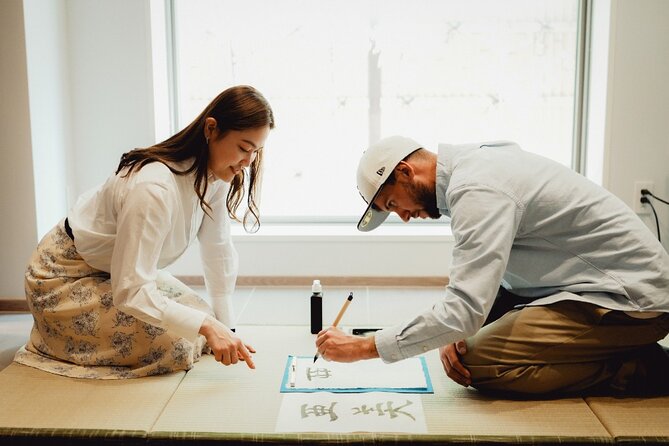
At $49.54 per person, the price is reasonable if you value instruction and a personal souvenir. You are paying for about two hours of teaching, interpretation, practice materials, cultural explanation, and the chance to make something in your own handwriting.
The value improves if you treat the class as a compact cultural activity rather than a craft purchase. A souvenir alone would not justify the cost for everyone. The teaching, the small group size, and the chance to ask questions are what make the price easier to accept.
It also saves planning time. You do not need to search for materials, learn the basics from a book, or work out how to turn a foreign name into Japanese characters on your own. The instructor handles that part and guides you through the writing.
The price may feel less attractive if your Osaka schedule is already packed with paid attractions. Two hours is a meaningful block of time, and you will get the most from it if you are genuinely interested in Japanese writing and culture. For someone who only wants a quick name written on a souvenir, this class may offer more instruction than needed.
Pair it with Dotonbori, Nihonbashi, and Kuromon Market
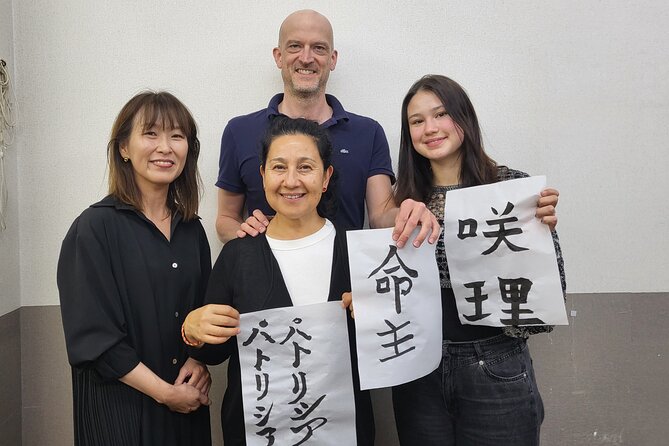
The workshop is easy to build into a Namba day. Dotonbori is close by, so you can walk through its famous canal-side entertainment area and then trade neon lights for quiet concentration.
Nihonbashi is another nearby choice, especially if you enjoy shopping and city wandering. Kuromon Market works well before class, when you want to eat or browse, or afterward, when you are ready for another look at Osaka’s food scene.
Plan your timing with care. The class ends back at the meeting point, which makes it easy to continue exploring from the same central area. Still, avoid booking a meal or timed attraction immediately afterward if you dislike rushing. Finding the building, checking in, and allowing for the full two hours will make the day more comfortable.
A practical plan would be Kuromon Market first, the workshop in the middle of the day, and Dotonbori afterward. This gives you food, culture, and sightseeing without sending you across Osaka between activities.
What the strong praise tells you
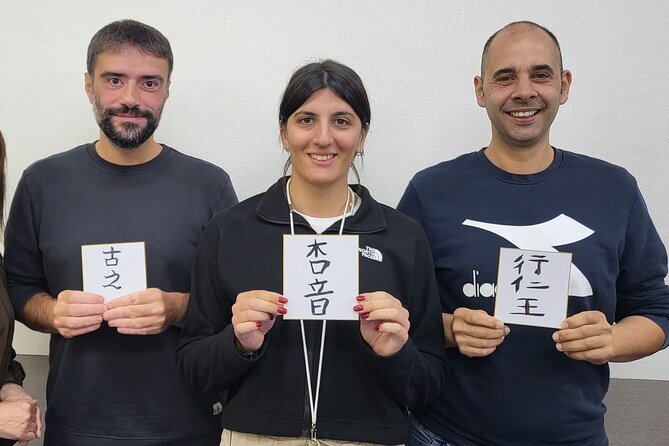
The experience has a five-star rating from 57 ratings and a 100 percent recommendation figure. More useful than the numbers is the pattern behind them: the teaching, the peaceful setting, the cultural background, and the personal souvenir receive the strongest praise.
The staff also seem to create a welcoming tone. Nao is described as patient and calm, while the interpreters are praised for clear explanations and friendly conversation. That matters in calligraphy, where beginners can feel awkward at first.
The class also appears to work well for different ages and group types. Families, couples, solo participants, and people from several language backgrounds all found ways to take part. One participant left inspired to buy calligraphy materials and continue practicing at home, which says something about the lesson’s ability to spark real interest.
No activity is perfect, and the unclear building signage is a practical weakness. The writing itself can also feel intense because brush control is difficult. Go in expecting a patient lesson, not an effortless souvenir machine, and you will have a more satisfying time.
Booking and cancellation details
This activity is often booked about 38 days ahead, so planning early is sensible, especially if you need a particular date or are visiting during a busy period. Confirmation is provided when you book, and a mobile ticket is available.
You can cancel for a full refund up to 24 hours before the local start time. Changes or cancellations made within 24 hours are not accepted for a refund. The class also requires a minimum number of participants, so if the provider cancels because that minimum is not reached, you are offered another date or experience, or a full refund.
Should you book this Namba calligraphy workshop?
I would book it if you want a personal, low-key cultural activity that fits neatly into a day around Namba. The small group limit, patient instruction, English interpretation, and handmade name souvenir give it more substance than a quick demonstration.
It is particularly good for families with older children, couples, solo visitors, and anyone curious about the meaning behind Japanese characters. Book it early, allow extra time to find the third-floor meeting point, and plan nearby sightseeing around the two-hour class.
Skip it if you want to cover sights at maximum speed or if sitting still with repeated brush practice sounds tedious. For everyone else, this is a thoughtful way to slow down in central Osaka and take home something you made yourself.
FAQ
How long does the calligraphy workshop last?
The workshop lasts approximately two hours.
Where does the workshop begin?
It begins at イスク英語学院Japan, 3F, Takeda Building, 1-6-1 Nambanaka, Naniwa Ward, Osaka 556-0011.
Where does the activity end?
The activity ends back at the meeting point.
How many people can join the workshop?
The maximum group size is six participants.
Is the workshop suitable for beginners?
Yes. The Japanese calligraphy instructor provides detailed, step-by-step instructions for beginners.
Will I learn to write my name in Japanese?
Yes. You learn to write your name in kanji or katakana.
What souvenir do I take home?
You create a handwritten souvenir by writing your name on colored paper or a luggage tag.
Is the workshop near public transportation?
Yes. The meeting point is near public transportation.
Can I visit Dotonbori or Kuromon Market on the same day?
Yes. Dotonbori, Nihonbashi, and Kuromon Market are close to the workshop location.
How late can I cancel for a full refund?
You can cancel at least 24 hours before the local start time for a full refund. Cancellations made less than 24 hours before the start time are not refunded.
Just added around Osaka
- Osaka Food Tour with 10 Classic Japanese Tastings & Drinks★ 5.0 · 38 reviews
- Osaka: Highlights & Hidden Gems Private Walking Tour★ 4.7 · 38 reviews
- Kyoto private tour (Shore excursion available from Osaka or Kobe port)★ 5.0 · 39 reviews
- Osaka Private Day Trip – Enjoy Your First-Time Visit to Osaka!★ 5.0 · 39 reviews
- Kyoto & Nara & Uji: Full Day Sightseeing Tour from Osaka or Kyoto★ 4.5 · 39 reviews
- Authentic SUSHI Course Cooking Class★ 5.0 · 39 reviews
- Osaka: Mind & Spirit Balance Temple Reiki Healing★ 5.0 · 41 reviews
- Osaka Afternoon Walking Tour with Osaka River Cruise★ 3.5 · 42 reviews
Japanese Calligraphy Classes, compared.
Calligraphy class at Buddhist temple in city center
Read our review →
Let’s experience calligraphy in YANAKA, Taito-ku, TOKYO !!
Read our review →
Calligraphy Workshop & Original T-Shirt Creation
Read our review →
Calligraphy Workshop & Original T-Shirt Creation
Read our review →Browse the lists this tour appears in