
Reviewed · GOVERNMENT-LICENSED GUIDE TOURS
Nara 6hr Private Tour with Government-Licensed Guide
Nara rewards slow looking. This six-hour private walking tour lets you shape the day around three or four sights, with a licensed English-speaking guide to explain the temples, shrines, deer, gardens, and the beginnings of Japan. I like the flexible plan and the chance to ask questions without a fixed group schedule. I also like that guides such as Junichi, Ken, Toshi, Rie, and Hiro have adapted tours for families, history fans, food lovers, and first-time visitors.
The main caution is the amount of walking. Some routes include hills, stairs, buses, and long stretches between sights. At $155.86 per person, the tour can be good value for a private group that wants serious cultural context, but admission fees, meals, and transportation are extra.
In This Review
- Six things to know before you book
- Why a private guide helps in ancient Nara
- Todai-ji and Nara Park: the classic opening
- Kasuga Taisha and Wakakusayama Hill
- Kofuku-ji, Isuien, and Yoshikien
- Naramachi for ordinary old Nara
- Horyu-ji, Yakushiji, and Shin-Yakushiji
- The Nara National Museum and the old palace site
- Toshodai-ji and building your four-stop plan
- Six hours, walking, and extra costs
- Guides, food, and the human side of the day
- Should you book this Nara tour?
- FAQ
- How long does the Nara private tour last?
- How many sights can I choose?
- Where does the tour begin?
- Is transportation included?
- Are entrance fees included?
- Is lunch included?
- Is this a private group experience?
- Can most people participate?
- What is the cancellation policy?
Six things to know before you book
- Choose three or four sights: You select from temples, shrines, gardens, museums, old neighborhoods, and former palace grounds.
- Meet at Nara Station: The experience begins on foot within the designated Nara meeting area, rather than with a private car.
- Expect a full walking day: The tour lasts about six hours, and several guides have led groups over long routes with hills and stairs.
- Todai-ji is the essential stop: Its enormous Buddha hall is the day’s major sight and a powerful introduction to Nara.
- The guide can shape the day: Guides have added sake tasting, mochi, sword and knife shops, traditional houses, gardens, and local noodle restaurants when time allowed.
- Costs are not all-inclusive: You pay your own entry fees, food, and transport. Free cancellation is available up to 24 hours before the start time.
Why a private guide helps in ancient Nara
Nara is easy to reach and easy to underestimate. The central park is pleasant enough for a casual walk, but its major temples and shrines tell very different stories. Without context, you may see a huge Buddha, rows of stone lanterns, deer, and elaborate gates without understanding how Shinto and Buddhism took root here.
A private guide gives you room to stop and ask why. Guides have explained the relationship between Japan’s early imperial court, Buddhism, Chinese influence, and the old capital of Heijo-kyo. Ken has even prepared a handout linking Nara’s past with events beyond Japan, while Haru used a book to explain the meaning of the sites visited.
That kind of help matters most at Todai-ji, Kasuga Taisha, and Kofuku-ji. Each place has its own religious purpose and political background. A guide can also adjust the amount of detail. A history teacher may want long explanations, while a family with children may prefer shorter talks mixed with deer, food, and hands-on stops.
The private format is especially useful for families and small groups. One party of five appreciated being able to move at its own pace. Hiro adjusted the plan for teenage daughters, and another guide helped a young child learn how to feed the deer safely. You are not tied to the interests or speed of strangers.
More licensed guide tours:
- Tokyo 6hr Private Tour with Government-Licensed Guide
★ 5.0 · 3,902 reviews - Tokyo 4hr Private Tour with Government-Licensed Guide
★ 5.0 · 1,394 reviews - Kyoto 6hr Private Tour with Government-Licensed Guide
★ 5.0 · 1,369 reviews
Todai-ji and Nara Park: the classic opening
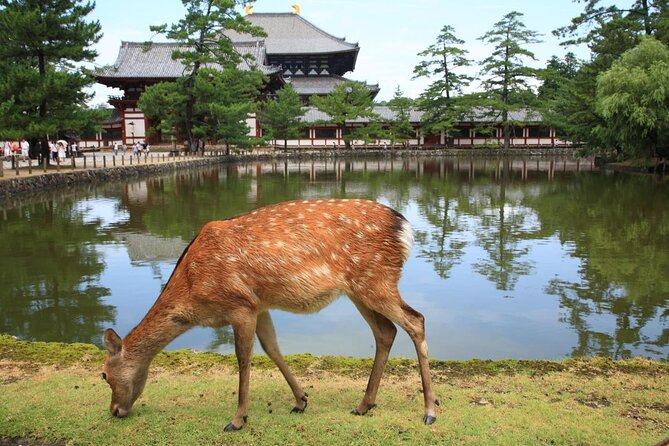
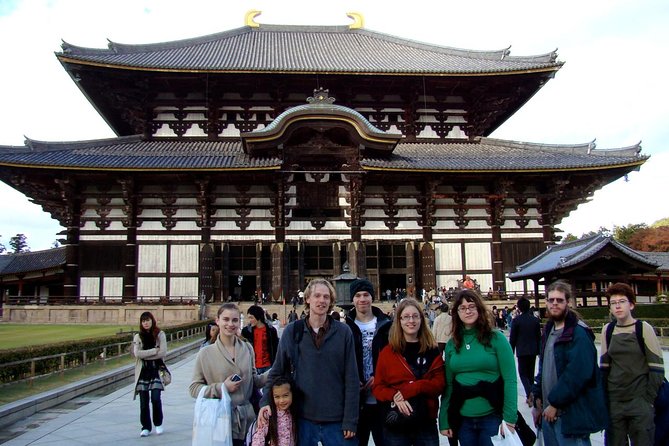
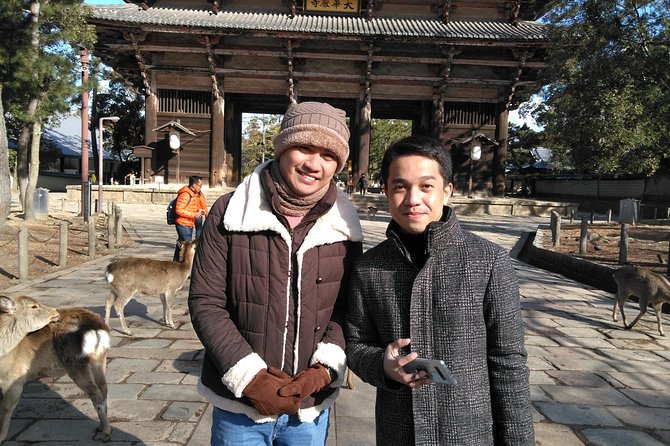
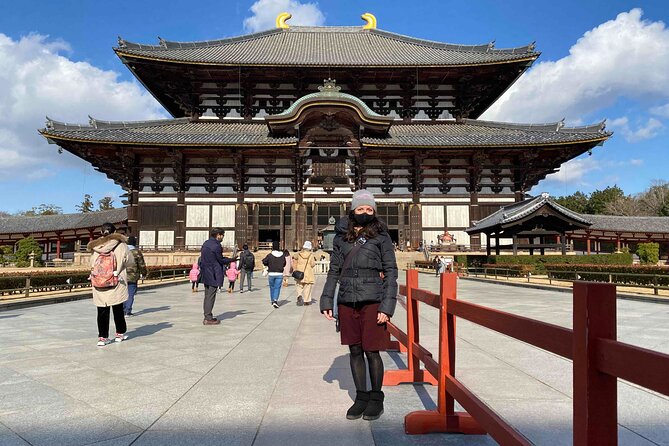
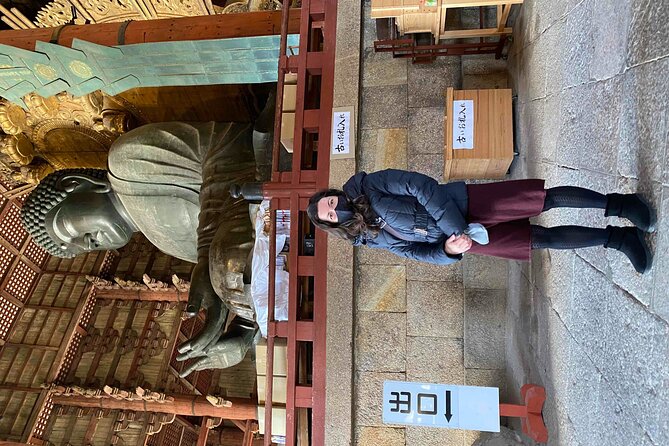
Todai-ji is the strongest reason to come to Nara. Founded in 752, it became the head temple for provincial temples throughout Japan. The temple’s Giant Buddha is the visual center, but the scale of the wooden hall and the approach through the great gate are nearly as impressive.
The scheduled stop is listed as 30 minutes, though your actual time depends on your chosen plan and entry arrangements. Admission is not included for you. Your guide’s own entry fee is covered only at sights included in the tour plan, so ask clearly which costs you will pay before the day begins.
A good guide will do more than point out the Buddha. You can ask about Buddhist images, temple architecture, rebuilding, and the way Todai-ji fits into Nara’s role as Japan’s 8th-century capital. One guide helped a family avoid long lines, an advantage that can save time during busy periods.
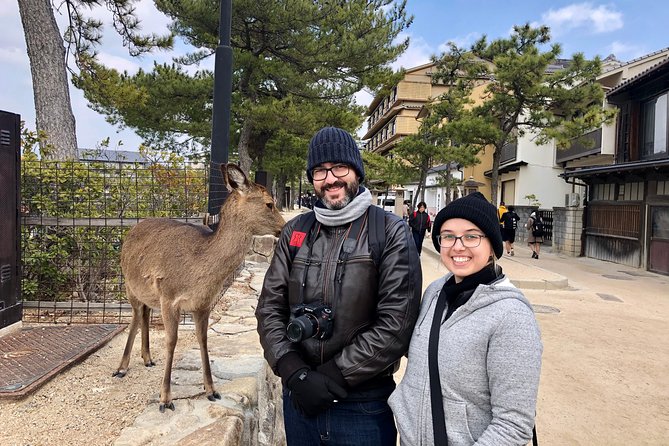
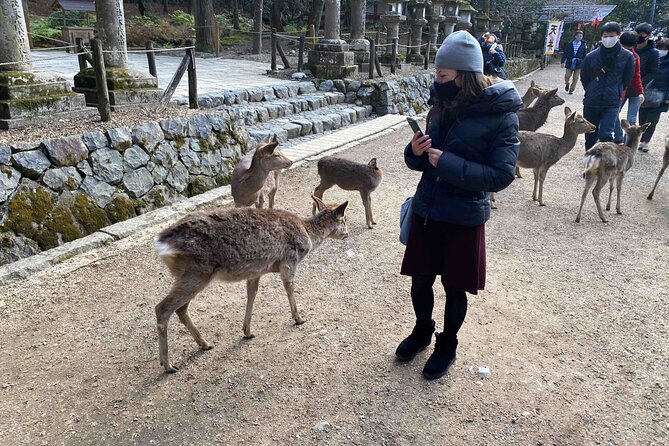
Nara Park surrounds Todai-ji and several other major sights. Entry to the park itself is free. Deer roam throughout the grounds, and they are one of the pleasures of the day, though they are not always as gentle as their appearance suggests. One guide specifically warned a group to prepare for deer that can be pushy around food.
The park is also where the tour begins to feel less like a checklist. You can pause for the animals, watch the flow of people, and walk between temple grounds under the trees. On a cold and windy day, families still found the park enjoyable, but weather will affect your comfort. Bring suitable shoes and clothing, since you will spend much of the day outside.
Kasuga Taisha and Wakakusayama Hill
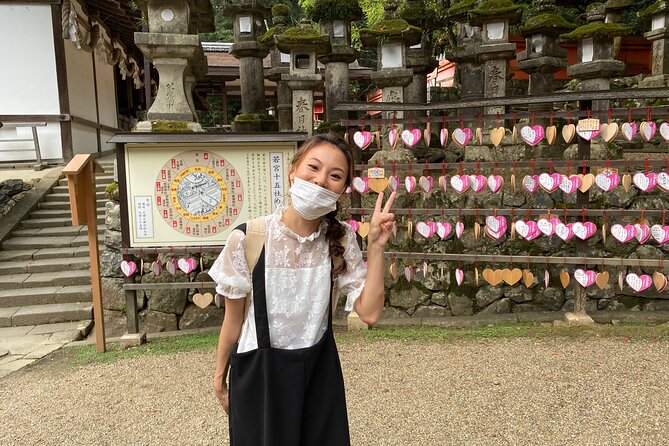
Kasuga Taisha is Nara’s best-known Shinto shrine. It was established when the capital was founded and is dedicated to the deity associated with protecting the city. Its approach, lanterns, forest setting, and religious traditions offer a useful contrast with Todai-ji’s Buddhist grandeur.
This is a place where a guide can explain how Shinto and Buddhism have shared space in Japan. That connection came up repeatedly in the strongest tour experiences, especially for people interested in religion and culture rather than just architecture.
Wakakusayama Hill offers a different kind of stop. The grass-covered mountain rises behind Nara Park between Todai-ji and Kasuga Taisha, reaching about 350 meters. From above, you get broad views over Nara. The listed visit takes about 30 minutes and admission is not included.
Do not choose the hill casually if you have mobility concerns or dislike climbing. One person described the day as worthwhile but stressed the stairs and walking. Another group made the climb with Toshi. If the view matters more than the climb, discuss the route with your guide before committing to it.
Kofuku-ji, Isuien, and Yoshikien
Kofuku-ji was the family temple of the Fujiwara clan, one of the most powerful aristocratic families during the Nara and Heian periods. Its position near the park makes it a natural choice if you want another major temple without moving far from the central sights.
Admission is not included. The temple is worth choosing for its place in court politics and the development of Buddhism, not simply as another historic building. A guide can help you see how religious institutions were tied to powerful families and the state.
Isuien Garden is one of the best choices for a quieter break. Its design uses borrowed scenery, including Todai-ji’s Nandaimon Gate and Wakakusayama Hill. The garden’s name means a garden founded on water, and its appeal comes from careful views, water, paths, and changing perspectives.
Several guides have paid close attention to guests who wanted gardens. One person especially valued a quiet moment listening to a stream at Isuien. That detail captures the garden’s value: it gives you space to slow down after crowded temple approaches.
Yoshikien is another central garden, named for the Yoshikigawa River beside it. It was built on the former site of Kofuku-ji’s priests’ quarters. The listed stop is only 15 minutes, so it works best as part of a garden-focused route rather than a major standalone visit. Admission is not included.
A few more Nara experiences worth weighing up
- World Heritage Kyoto & Nara Uji Authentic Matcha Experience
★ 5.0 · 1,573 reviews - Nara Half Day Trip Walking Tour (Private Option Available)
★ 5.0 · 937 reviews - Nara Early Morning Tour (Kyoto or Osaka Departure Available)
★ 5.0 · 676 reviews - Osaka: Nara and Uji Day Trip with Deer Park and Hot Spring
★ 4.4 · 302 reviews
Naramachi for ordinary old Nara
Naramachi was once the city’s merchant district. Traditional homes and storehouses remain, and some are open to the public. The area also has boutiques, shops, and cafes, making it a useful change from formal temple grounds.
I would choose Naramachi if you want to see how people lived and worked, not only where emperors and monks worshipped. Guides have taken families to a preserved merchant house and local shops. Junichi has also mixed the old streets with mochi, sake tasting, and food stops when guests showed interest.
This part of the tour can make Nara feel more like a living city. It is also a good place to tell your guide what you want before the tour starts. If you are interested in crafts, food, old houses, or everyday culture, say so clearly.
Horyu-ji, Yakushiji, and Shin-Yakushiji
Horyu-ji is a major choice for serious history fans. Founded in 607 by Prince Shotoku, it is among Japan’s oldest temples and contains the world’s oldest surviving wooden structures. The site is not in the central Nara Park cluster, so fitting it into a six-hour walking tour requires careful planning and transport.
Ken guided one group through Horyu-ji, Toshodai-ji, the Nara Palace Site, and Todai-ji in one day, timing trains, buses, and walks closely. That is a strong example of where a private guide can add real value. It also shows why you should not assume every four-site combination will feel relaxed.
Yakushiji was built in the late seventh century by Emperor Tenmu for his sick wife. Its strict symmetry makes it attractive to visitors interested in temple design. Shin-Yakushiji, founded during the Nara period for an ailing emperor, is devoted to Yakushi Buddha, the Buddhist figure associated with healing.
Both are outside the simplest central route. They are better choices for repeat visitors, religious art fans, or people who have already seen the main park sights. Admission fees are extra.
The Nara National Museum and the old palace site
The Nara National Museum sits in Nara Park and focuses mainly on Japanese Buddhist art. Founded in 1889, it is a good choice when weather is poor or when you want objects and sculpture to support what you see at the temples.
The listed visit lasts about 30 minutes, so the museum stop may feel brief for someone who wants a serious art visit. Ask your guide how much time is realistic. If your main interest is Buddhist images, it could be a better choice than adding another temple.
The Heijo Palace Site Historical Park covers the former palace of Heijo-kyo, where Nara served as Japan’s capital during most of the period from 710 to 794. The palace complex once stretched about one kilometer by one kilometer.
The stop is listed at only 15 minutes, and admission is not included. That short timing suggests a quick orientation rather than a complete visit. Still, the site gives you essential political context. Nara was not simply a temple town. It was the seat of government during a formative stage of Japan.
Toshodai-ji and building your four-stop plan
Toshodai-ji was founded in 759 by Ganjin, a Chinese priest invited to Japan to train priests and improve Buddhist practice. It is a strong choice if you want to understand the links between Japan and the advanced Tang dynasty civilization of mainland China.
This temple pairs well with Horyu-ji or the palace site for a history-heavy day. It is less practical to combine with every central Nara Park sight, since transport time matters. The listed visit is 15 minutes, and admission is extra.
The tour’s real strength is not trying to see all 14 choices. It is choosing the right four. You might build your day like this:
- Classic Nara: Todai-ji, Nara Park, Kasuga Taisha, and Naramachi.
- Gardens and temples: Todai-ji, Isuien, Yoshikien, and Kofuku-ji.
- Early Buddhist Japan: Horyu-ji, Toshodai-ji, Yakushiji, and the palace site.
- Family-friendly mix: Todai-ji, Nara Park, Naramachi, and a food or craft stop if time permits.
These are planning examples, not fixed routes. Tell the agency and guide what matters most before the meeting. One of the best experiences described by guests began with pre-tour questions about interests and expectations, followed by help with Japan travel basics such as transit cards, taxi apps, and cash exchange.
Six hours, walking, and extra costs
The advertised price is $155.86 per person. For a private group, that buys personal attention and a guide who can answer questions, adjust the pace, and help with routing. It is harder to justify if you only want a quick introduction to Todai-ji and the deer, since you can visit the central sights independently.
Your final cost will be higher. Transportation fees, entrance fees, lunch, and personal expenses are not included. There is no private vehicle. The meeting and pickup are on foot within the designated Nara area, so you need to be comfortable getting to the starting point near Nara Station.
The tour is described as suitable for most people and is near public transportation. Service animals are allowed. Still, the practical issue is stamina. Six hours can include long walks, stairs, hills, and transfers. One unhappy experience came from a group that felt rushed at some stops and was surprised by the final walking distance. That is useful advice: tell your guide your preferred pace and ask for a cab or shorter route if needed.
The experience is private, and you cannot combine separate tour groups. Group discounts may improve the price for larger parties, but check the final rate for your exact group size.
Guides, food, and the human side of the day
The most praised part of this tour is the guides’ ability to connect facts with real curiosity. Junichi, a former English professor, has been praised for clear English, humor, and enthusiasm. He has taken people to a small tasting bar, a noodle shop, a mochi store, and a sword collection.
Ken has been praised for careful route planning, strong English, and explanations that connect Nara to wider Japanese and Asian history. Toshi has helped families through the park and shrine grounds, including on hot days and up Wakakusayama. Rie has added sake tasting, recommended sushi, and shown people her hometown from a local’s point of view.
The quality can vary by assigned guide, as with any guide service. One account described a friendly guide who did not spend enough time explaining each site and moved too quickly. The lesson is simple: give clear instructions before the tour. Say how much walking you want, which sites are essential, and if you prefer detailed talks or a lighter day.
Lunch is at your own expense, but guides can help you choose. Junichi has taken groups to excellent udon and sushi places. That is a small but useful benefit when you are hungry and do not want to spend half an hour searching.
Should you book this Nara tour?
Book it if you want a private, flexible day with cultural explanation, especially if Nara is your first stop in Japan, your group includes children, or you care about history, religion, architecture, and local food. It is also a smart choice if you want to combine distant sites such as Horyu-ji and Toshodai-ji with central Nara.
Skip it if you prefer to wander alone, plan to visit only Todai-ji and Nara Park, or dislike long walks and extra transport costs. Before booking, request your priority sites, confirm the walking plan, and ask which admissions and transfers you will pay.
For most people, the best version is Todai-ji, Nara Park, Kasuga Taisha, and either Naramachi or Isuien. That mix gives you the Giant Buddha, deer, Shinto tradition, old streets, and a peaceful garden without turning the day into a race.
FAQ
How long does the Nara private tour last?
The tour lasts approximately six hours.
How many sights can I choose?
You can customize the tour by selecting three or four sites from the prepared list.
Where does the tour begin?
You meet the licensed guide at or near Nara Station, within the designated Nara meeting area. Pickup is on foot.
Is transportation included?
No. Transportation fees are not included, and the tour does not provide a private vehicle.
Are entrance fees included?
Your entrance fees are not included. The guide’s entry fees are covered only for sights included under the tour’s listed expectations.
Is lunch included?
No. Lunch is at your own expense.
Is this a private group experience?
Yes. Only your own group participates, and separate tour groups cannot be combined.
Can most people participate?
The experience states that most people can participate. It is a walking tour, so you should be prepared for extended walking, stairs, and possible hill climbing.
What is the cancellation policy?
You can cancel up to 24 hours before the experience start time for a full refund. Cancellations or changes made less than 24 hours before the start time are not accepted for a refund.
Just added around Nara
- Private Nara Tour and Sake Tasting (Departing from Kyoto/Nara)★ 5.0 · 40 reviews
- Nara: Bike Tour in Ancient Capital UNESCO World Heritage★ 5.0 · 43 reviews
- Perfect Nara Park Half-Day Bus Tour with English Speaking Guide★ 5.0 · 49 reviews
- Discover Ancient Nara: Private Car Tour from Kyoto or Osaka★ 5.0 · 52 reviews
- Hammer a Pattern on Your Ring Workshop★ 5.0 · 57 reviews
- Nara: Great Buddha, Kasuga Shrine & Deer Park Tour★ 4.8 · 62 reviews
- Nara: Private Tour with Private Guide★ 4.8 · 66 reviews
- Nara Highlight Walking Tour with Furoshiki Experience with Lunch★ 5.0 · 73 reviews
Government-Licensed Guide Tours, compared.
Tokyo 6hr Private Tour with Government-Licensed Guide
Read our review →
Tokyo 4hr Private Tour with Government-Licensed Guide
Read our review →
Kyoto 6hr Private Tour with Government-Licensed Guide
Read our review →
Hiroshima / Miyajima Full-day Private Tour with Government Licensed Guide
Read our review →
Kyoto 4hr Private Tour with Government-Licensed Guide
Read our review →
Hiroshima City 4hr Private Walking Tour with Licensed Guide
Read our review →
Private Kyoto Tour with Licensed Guide & Vehicle (Max 15 persons)
Read our review →Browse the lists this tour appears in