
Reviewed · GEISHA & GION DISTRICT TOURS
Kyoto: Meet-and-Greet, Maiko Show and Experience
A small room can hold a big tradition. This 45-minute Kyoto experience gives you a respectful look at maiko culture through two traditional dances, an English-led introduction, and a personal question-and-answer session. I especially like the close seating, which lets you notice the careful hand movements and ornate kimono, and the chance to take your own commemorative photograph with the maiko. The main limitation is simple: the dancing lasts only about 8 to 10 minutes, so anyone hoping for a full evening performance may find the show brief.
The event takes place at the Kyoto Handicraft Center, not in a traditional teahouse or historic dance theater. That setting feels practical rather than atmospheric, but it also keeps the experience accessible, family-friendly, and free of the awkwardness that can come with trying to spot a maiko in Kyoto’s Gion district. At $44 per person, I see it as a fairly priced introduction, especially because the Q&A and photo session add real value.
In This Review
- Key points at a glance
- What a maiko is, and why this meeting matters
- Arriving at the Kyoto Handicraft Center
- The opening introduction and stage welcome
- Two traditional dances, lasting 8 to 10 minutes
- The question-and-answer session
- The 10 to 15 minute photo session
- Is $44 a fair price?
- Group size, children, and practical comfort
- Allow extra time for Kyoto transport
- Who will enjoy this experience most?
- Should you book the Kyoto maiko meeting?
- FAQ
- Where does the maiko experience take place?
- How long does the activity last?
- How much does the experience cost?
- Is the event conducted in English?
- Is this a private experience?
- Can I take photographs during the event?
- Is a professional photographer included?
- Are children allowed to attend?
- Is the experience wheelchair accessible?
Key points at a glance
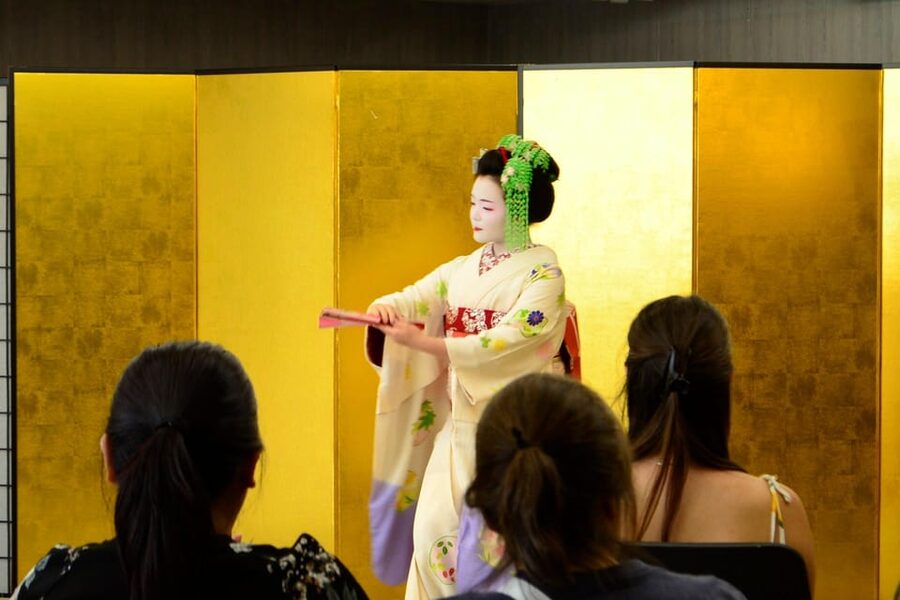
- Two dances in close view: The maiko performs two traditional pieces lasting about 8 to 10 minutes altogether.
- English explanations throughout: An English-speaking host explains the maiko tradition, her clothing, training, and role.
- Real question time: You can ask the maiko questions through the interpreter rather than simply watching from a distance.
- Small-group setting: The room holds up to 30 people, and everyone has a seat.
- Personal photo included: You use your own camera or smartphone for a commemorative picture.
- Easy add-on shopping: The Kyoto Handicraft Center has Japanese crafts, gifts, paintings, dolls, and museum-level pieces in display cases.
What a maiko is, and why this meeting matters
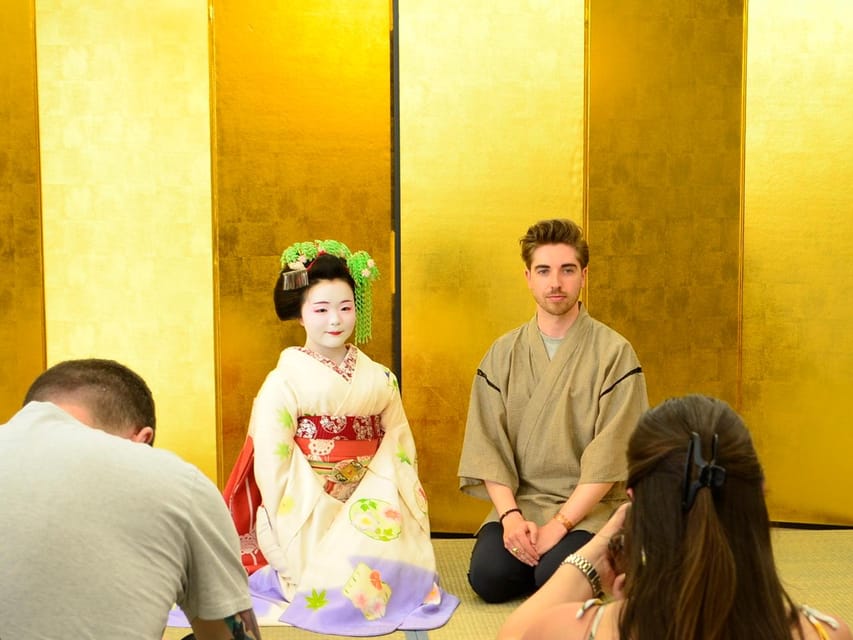
A maiko is a young apprentice geiko, the Kyoto term for geisha. She is not simply a performer wearing a costume for tourists. A maiko trains in traditional dance, music, tea ceremony, conversation, social manners, and hospitality. Her time as an apprentice is part of a demanding path toward becoming a geiko.
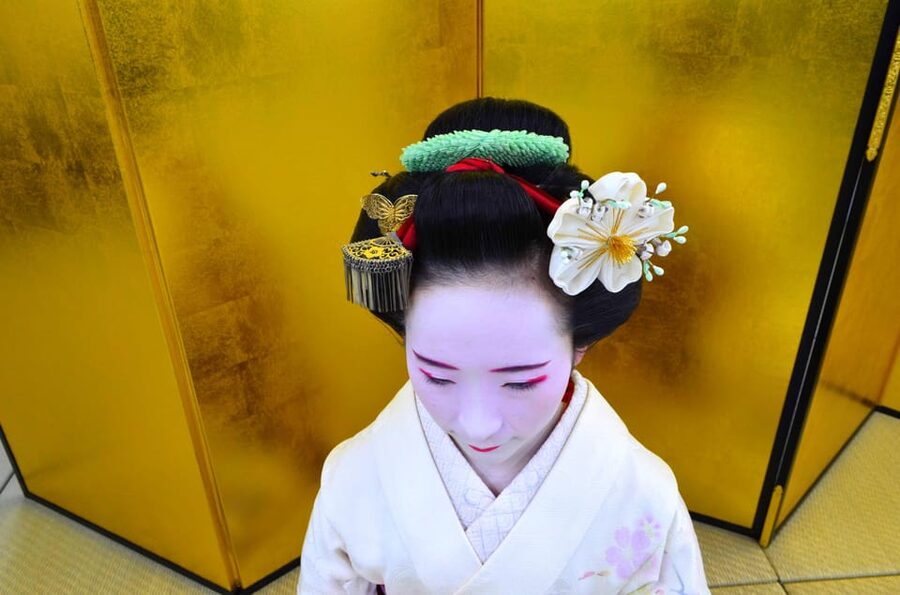
Her appearance carries clear visual markers. You can expect an elaborate kimono, a carefully arranged hairstyle with distinctive hair ornaments, and white face makeup accented with red and black. The clothing is beautiful, but it is also part of a working tradition with rules, meaning, and years of training behind it.
That context is important. Without an explanation, it is easy to treat a maiko appearance as a colorful photo opportunity. Here, the host gives you a short introduction before the performance and explains details of the attire. The result is more thoughtful. You begin to see the person and the profession, not only the makeup and costume.
The Q&A makes the biggest difference. You can ask about her training, daily life, work, and decision to become a maiko. The questions are translated between Japanese and English, allowing the conversation to go beyond a standard stage presentation. Several visitors found this part more informative than expected, and I can see why. A short dance shows skill, but a direct conversation gives the tradition a human shape.
More geisha district walks in Kyoto:
- Kyoto Geisha Walking Tour: Gion District & Hidden Gems
★ 4.7 · 3,273 reviews - Kyoto: Gion Magical Night Walking Tour with Geisha Trivia
★ 4.9 · 2,393 reviews - Kyoto: Gion Geisha District Walking Tour – Stories of Geisha
★ 4.7 · 2,187 reviews
Arriving at the Kyoto Handicraft Center
The meeting point is the Kyoto Handicraft Center’s West Building. Enter on the first floor, take the elevator to the second floor, and look for the MEET MAIKO welcome sign.
Reception opens 30 minutes before the scheduled start. I recommend arriving at least 10 minutes early, since seats are free seating rather than assigned. Everyone can sit, but arriving early gives you a better chance of choosing your preferred position in the room.
The center is also useful if you are planning your day around this activity. It contains Japanese handicrafts and gifts, so you can browse before or after the show. Items mentioned by visitors include locally made paintings, dolls, and other Japanese goods. Some display cases contain pieces marked not for sale, including museum-level works. Give yourself extra time to look around, even if you are not planning to buy anything.
The venue’s practical setting is both a strength and a weakness. You are inside a recognizable shopping and arts center, so it is easier to find than a private teahouse. On the other hand, the room can feel corporate or sterile compared with the atmosphere you might imagine for a maiko performance. If candlelight, tatami, and old Kyoto architecture are important to you, this will not provide that mood.
The opening introduction and stage welcome
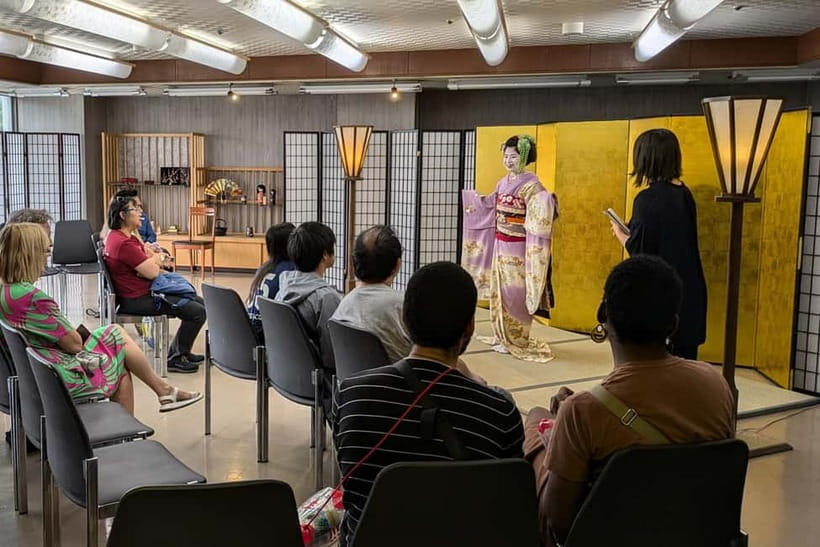
The event begins with an introduction from the English-speaking staff. The host explains the role of a maiko and invites her onto the stage. This opening helps you understand what you are seeing before the dancing begins.
The explanation also covers the maiko’s attire. Pay attention to the hair ornaments, makeup, kimono, and other details, because they can be difficult to interpret on your own. The costume is ornate, but the host helps connect the visual details to the maiko’s position as an apprentice.
The English presentation is one of the activity’s strongest features. Several hosts have received warm praise for explaining the subject clearly and translating questions without making the exchange feel stiff. Mina is one interpreter specifically praised for her excellent explanations, while other visitors described the moderators as gentle, professional, and helpful.
The format is moderated, so you are not expected to know the correct etiquette in advance. That matters for a subject that many people know mainly through films, popular culture, or brief sightings in Kyoto streets. The host creates a clear bridge between you and the maiko.
Two traditional dances, lasting 8 to 10 minutes
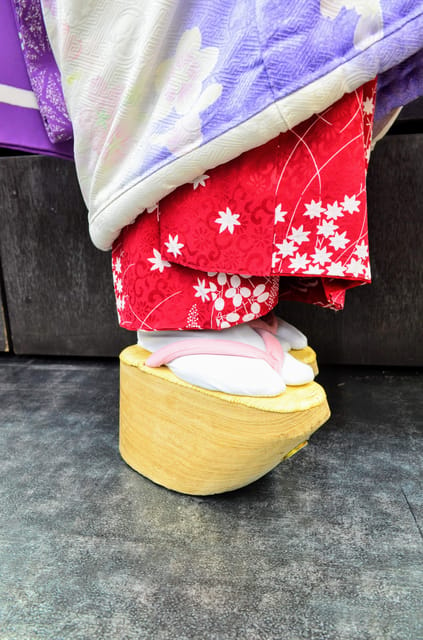
The maiko performs two traditional dances, with the total performance time lasting roughly 8 to 10 minutes. This is the visual center of the experience, and the close seating works in its favor.
The dances are not presented as a long theatrical production. They are short examples of a traditional art form, with gestures that can be quiet and controlled rather than dramatic. You may find yourself watching the hands, posture, facial expression, and slow changes in direction as much as the overall choreography.
The small room makes these details easier to see. At the same time, the short length is the clearest drawback. Some people would gladly trade part of the photo session for another dance. If your main goal is an extended performance, check the timing carefully and keep your expectations modest.
This format suits people who want an introduction rather than a full stage show. You see enough to appreciate the discipline and elegance of the art, then have time to ask what you just watched. The performance and explanation support each other.
Photography is allowed during the event. Even so, I would keep your attention on the dances instead of viewing everything through your phone. You have a separate photo opportunity at the end, so there is no need to spend the entire performance trying to capture every movement.
A few more Kyoto experiences worth weighing up
- Kyoto Gion Cultural Walk & Geisha Show with Dining Options
★ 5.0 · 518 reviews - Kyoto Gion Cultural Walk & Geisha Show with Dining Options
★ 5.0 · 483 reviews - 1 Hour Geisha Show in Kyoto
★ 5.0 · 452 reviews - Kyoto: Samurai Kenbu Traditional Sword Dancing Show
★ 4.5 · 426 reviews
The question-and-answer session
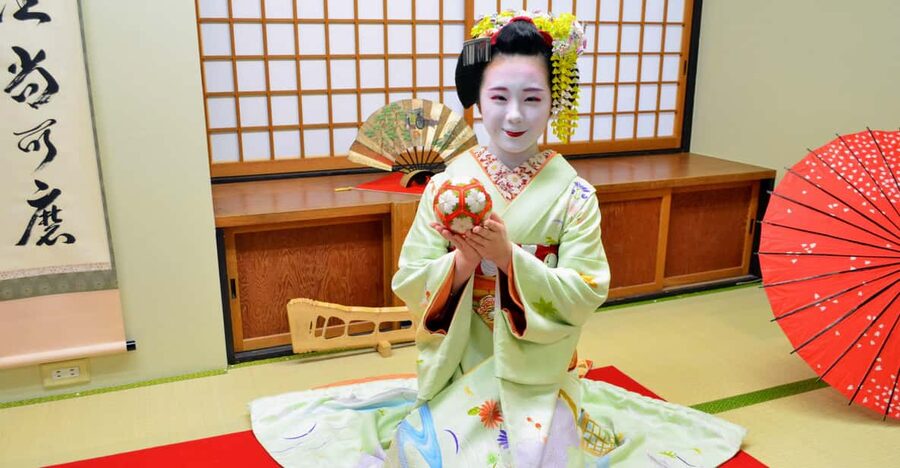
After the dances, the host invites questions. This is where the activity becomes personal and educational instead of simply decorative.
You can ask the maiko about her training, work, and life. The interpreter translates the questions and answers, and the host adds background where needed. The conversation is not private, since this is a shared event, but the capacity is limited to 30 people and the seated format gives the room a relatively personal feel.
Several specific details make this session valuable. The maiko may be very young, sometimes 18, which can prompt questions about choosing this demanding path. A good host keeps the discussion respectful and places her answers in the context of modern maiko life. One visitor particularly appreciated learning about the process of becoming a maiko and later a geiko, while another valued hearing the maiko’s own views on her training.
The schedule does need some discipline. The full event lasts 45 minutes, so questions cannot continue indefinitely. One person found the Q&A slightly rushed when many people wanted to ask something. To make the most of the time, think of one or two questions before you arrive.
Good questions might focus on training, performance preparation, the meaning of parts of the outfit, or the path from maiko to geiko. Avoid treating the session as an interrogation. The best tone is curious, polite, and specific.
The 10 to 15 minute photo session
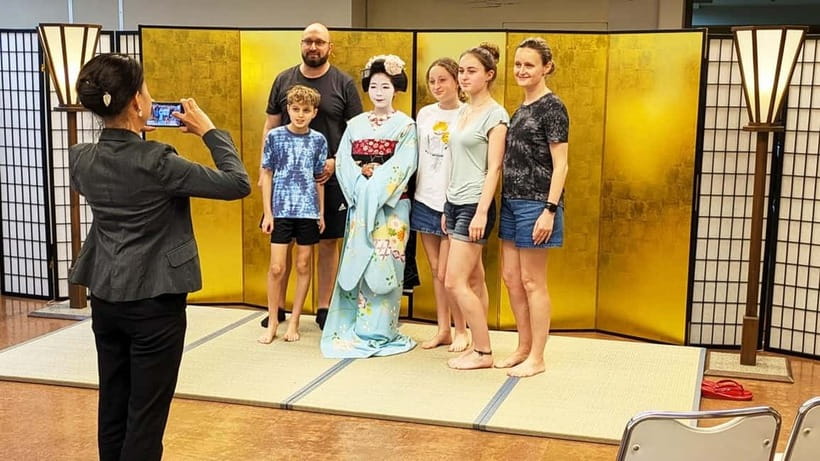
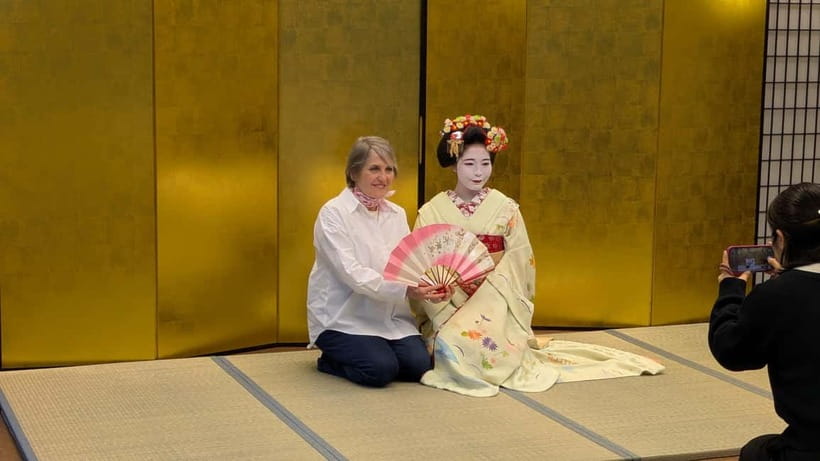
The final main part of the event is a 10 to 15 minute photo session. You may take a commemorative picture with the maiko using your own camera or smartphone.
The staff helps organize the photographs, which is useful when several people want a picture. You do not need to hire a photographer because the experience does not include one. Instead, prepare your phone before the session and ask someone in your group to handle the camera.
The photo is a pleasant souvenir, but it is worth understanding the format. This is a shared group event, not a private portrait appointment. You should expect a brief turn rather than a long personal photo shoot. Some people would prefer more performance time, while others see the photograph as an important part of the memory.
I like that the picture is taken at the end. You can watch the dances and join the discussion without worrying about arranging a portrait earlier. It also gives you a tangible reminder of the meeting without encouraging you to photograph the maiko continuously during her performance.
A small souvenir gift is provided as you leave. It is a modest extra, not a reason by itself to book, but it completes the experience nicely.
Is $44 a fair price?
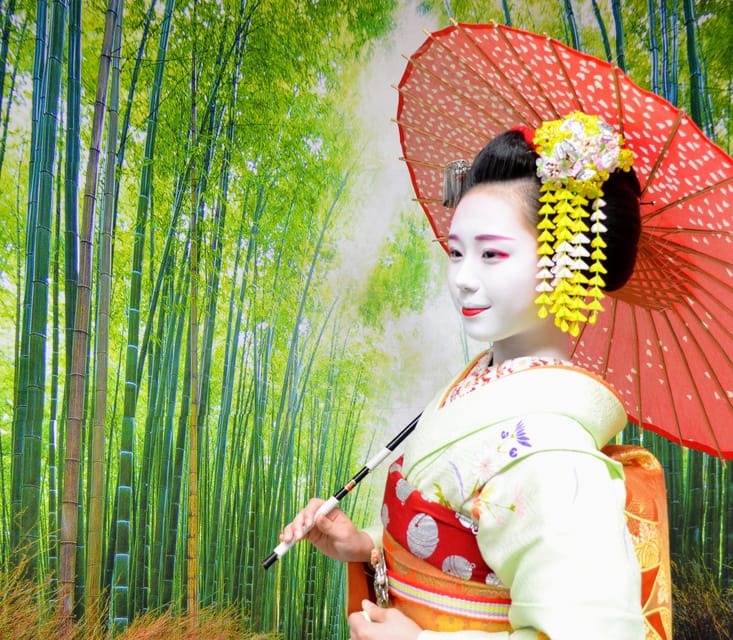
At $44 per person, this is not the cheapest cultural activity in Kyoto, but it is not an unreasonable price for the format. You receive an English-led introduction, two dances, a moderated Q&A, a personal photo opportunity, and a small gift.
The strongest value comes from the access. Seeing a maiko in Gion is uncertain, and trying to observe someone working in a teahouse setting is not the same as being invited into a respectful educational meeting. Here, the purpose is clear from the start, and the host explains how to engage.
The price is less attractive if you only want to watch dancing. The performance is short, and there is no meal, drink, local guide, transportation, or professional photographer included. You are paying mainly for the organized meeting and the cultural explanation.
For families, first-time visitors to Japan, and people curious about geiko culture, the price feels easier to justify. It is also a useful choice when you want something short between sightseeing stops. Couples who want a longer, more formal evening may prefer a different kind of performance, if available during their visit.
Group size, children, and practical comfort
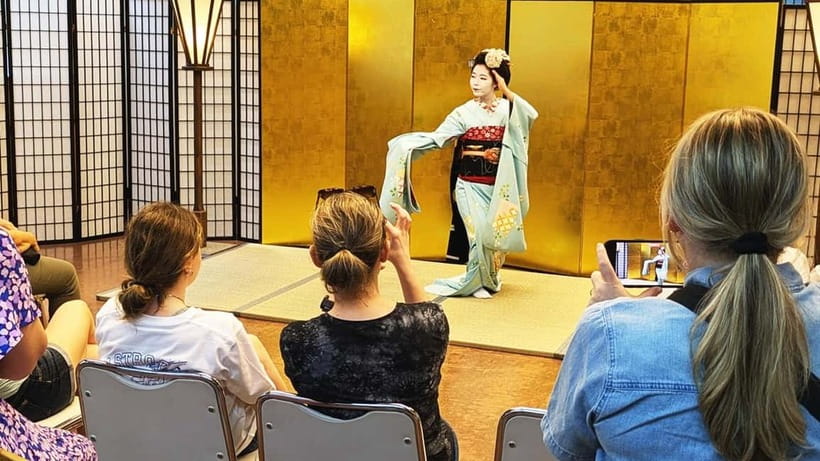
The event is not private. You join other people, with a maximum capacity of 30. The seats are free seating, but everyone can be seated.
Children aged 0 to 2 can attend free if they do not occupy a separate seat. The activity is designed for a broad age range, including children, but parents should consider the quiet nature of the performance. A child who becomes restless or noisy may affect the atmosphere for everyone, especially during the dances and translated answers.
One difficult incident involved children crying and a disagreement between adults. The host worked to manage the situation, but it disturbed the room. This is not a regular feature of the activity, but it is a useful reminder that a small performance space depends on considerate behavior.
The event is wheelchair accessible. English is the event language, and an English-speaking host or greeter is provided. If you arrive late, you can still enter during the event, though arriving on time is the polite and sensible choice.
Allow extra time for Kyoto transport
Transportation is not included, so you make your own way to the Kyoto Handicraft Center. Taxis can be difficult to catch during high season, and city buses may be crowded. I would not plan a tight connection immediately before the show.
The 45-minute duration is fixed, but your overall visit can take longer if you browse the handicraft center afterward. That is a useful pairing: cultural presentation first, Japanese crafts second. It also gives you somewhere to spend time if you arrive early for reception.
The center’s shop may tempt you into spending more. Along with ordinary souvenirs, you might find higher-quality Japanese goods and locally made art. Do not rush past the display cabinets. The pieces marked not for sale can be as interesting as the items available to purchase.
Who will enjoy this experience most?
I recommend it most strongly if you want a clear and respectful introduction to maiko culture without committing to a long evening. The short length fits neatly into a busy Kyoto schedule, and the English explanations make it accessible even if you know little about geiko traditions.
It is especially suitable for:
- First-time visitors to Kyoto
- Families seeking a cultural activity suitable for several ages
- People interested in traditional dance and costume
- Visitors who want to ask questions rather than only watch
- Couples looking for a memorable photograph
- Anyone unsure how to encounter maiko culture respectfully
You may want to choose another option if you expect a long dance program, a historic teahouse, candlelight, a meal, or a private meeting. The venue is functional, the performance is brief, and the photo session is shared.
The overall rating is 4.8 from 286 reviews, and that high score makes sense. The most consistent strengths are the beautiful dancing, friendly interpretation, intimate seating, and chance to ask direct questions. The less positive points are also clear: the room may feel too modern, the dance portion may feel short, and the schedule can feel tight during a lively Q&A.
Should you book the Kyoto maiko meeting?
I would book this experience if you want a compact, well-organized introduction with genuine interaction. The Q&A and interpreter turn a pretty performance into a lesson about training, work, and tradition. The final photograph and small gift are welcome extras.
I would skip it only if your priority is a lengthy dance performance or a traditional setting. For most people, $44 buys a considerate first look at an important Kyoto art form, with enough personal contact to make the subject memorable. Arrive early, prepare a question, leave time to browse the handicraft center, and treat the 8 to 10 minutes of dancing as a focused sample rather than a full show.
FAQ
Where does the maiko experience take place?
It takes place at the Kyoto Handicraft Center in the West Building. Enter on the first floor, take the elevator to the second floor, and look for the MEET MAIKO welcome sign.
How long does the activity last?
The scheduled duration is 45 minutes. The two dances together last about 8 to 10 minutes, followed by explanations, questions, and a photo session.
How much does the experience cost?
The listed price is $44 per person.
Is the event conducted in English?
Yes. English-speaking staff host the event and translate the questions and answers.
Is this a private experience?
No. You join other people, and the capacity is 30 people.
Can I take photographs during the event?
Yes. Photography is allowed, and you can take a commemorative photo with the maiko using your own camera or smartphone.
Is a professional photographer included?
No. A photographer is not included. You take the commemorative picture with your own device.
Are children allowed to attend?
Yes. Children aged 0 to 2 can attend free if they do not occupy a separate seat.
Is the experience wheelchair accessible?
Yes. The activity is wheelchair accessible.
Just added around Kyoto
- Kyoto: Private Customizable Day Trip by Car★ 5.0 · 38 reviews
- Kyoto: Gion Night Walking Tour with Geisha Insight★ 5.0 · 39 reviews
- Kyoto: Full Day Bike Tour★ 4.9 · 39 reviews
- Private Japanese Calligraphy in Kyoto – Learn Shodō with a Master★ 5.0 · 39 reviews
- Kyoto: Gion Evening Walk with Hidden Gems, Geisha & Sake★ 5.0 · 41 reviews
- Experience a tea ceremony in an authentic tearoom, in Kyoto!★ 4.5 · 41 reviews
- Kyoto Private Photo Shoot & Tour by SnapKyoto★ 5.0 · 41 reviews
- The Way of Tea: Kyoto Crafts, Hidden Temples & Wabi-Sabi Walk★ 5.0 · 41 reviews
Geisha & Gion District Tours, compared.

Kyoto Geisha Walking Tour: Gion District & Hidden Gems
Read our review →
Gion Magical Night Walking Tour with Geisha Trivia
Read our review →
Gion Geisha District Walking Tour – Stories of Geisha
Read our review →
Best of Kyoto: Gion, Geisha, Pagodas & Cobblestones
Read our review →

Kyoto Night Foodie Tour in Gion (9+ dishes + 6 Sake tastings)
Read our review →
Kyoto Gion Geisha District Walking Tour – The Stories of Geisha
Read our review →
Kyoto Gion: 2-Hour Geisha Culture & History Walking Tour
Read our review →Browse the lists this tour appears in