Reviewed · SHOW
Traditional Japanese Music show & Experience Tour in Kyoto
Hear Kyoto before you see it. This one-hour experience pairs a 25-minute traditional music concert with 25 minutes of guided instrument practice, so you are not left sitting quietly while someone else does all the work. I like the direct contact with the shamisen, koto, and wadaiko, and I like the small group size, capped at 12 people. The main consideration is timing: it runs only at 11:00 am on Monday, Tuesday, Thursday, and Friday.
The session costs $46.24 per person, which feels fair for a live performance plus personal instruction and photo time. I also appreciate that no musical background is needed. Your playing may sound a little lopsided at first, but the patient guidance is part of the fun. The activity requires at least two participants to run, so keep that condition in mind when planning.
In This Review
- Key points to know before you book
- Why this Kyoto music session feels different
- Starting at 11:00 in Nakagyo Ward
- The 25-minute concert: listen before you play
- The 25-minute hands-on session
- The final 10 minutes for photos
- What the $46.24 price really covers
- Who should choose this experience?
- Practical planning, timing, and cancellations
- A small cultural experience with real participation
- Should you book the Kyoto traditional music experience?
- FAQ
- How long does the traditional Japanese music experience last?
- What time does the experience start?
- Which days is the experience available?
- Where does the activity begin and end?
- Which instruments can I try?
- Do I need musical experience?
- How many people can join the activity?
- Is transportation included?
- Can I cancel for a full refund?
Key points to know before you book
- Two experiences in one hour: You get a 25-minute concert, 25 minutes playing instruments, and 10 minutes for photos.
- Try real Japanese instruments: The choices include shamisen, koto, wadaiko, and other traditional instruments.
- Small group setting: A maximum of 12 people allows for more direct help than a large stage show.
- Central Kyoto meeting point: The activity starts and ends at 5f, 306 Higashidaimonjichō, Nakagyo Ward.
- Limited weekly schedule: Sessions begin at 11:00 am on Monday, Tuesday, Thursday, and Friday.
- Flexible cancellation: You can receive a full refund if you cancel at least 24 hours before the start time.
Why this Kyoto music session feels different
Many cultural shows ask you to watch from a seat and move on. This one gives you a short concert first, then places an instrument in your hands. That change matters. You hear the instruments used properly before trying them yourself, so the second half has some context instead of feeling like a random music lesson.
The format also keeps the experience manageable. One hour is long enough to learn something, but short enough to fit into a busy Kyoto day. You could schedule it before lunch, then continue sightseeing without giving up an entire morning.
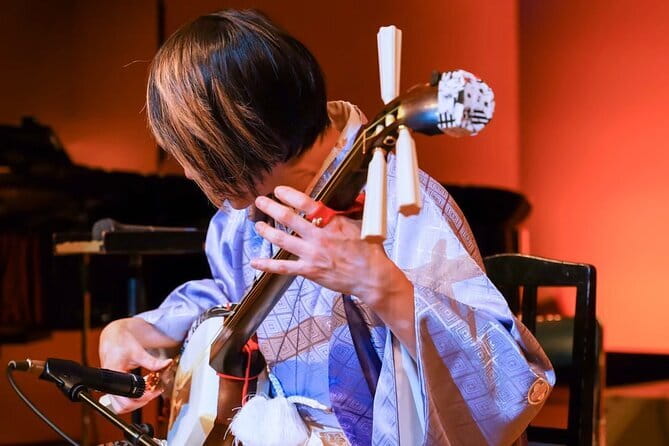
The listed instruments include the shamisen, a three-stringed Japanese lute, the koto, a long zither often described as a Japanese harp, and wadaiko, Japanese drums. The selection may change by day, and the concert content varies, so you should not expect exactly the same program at every session. That is a positive if you enjoy variety, though it means you cannot choose a fixed performance in advance.
A few more Kyoto experiences worth weighing up
- Kyoto Gion Cultural Walk & Geisha Show with Dining Options
★ 5.0 · 518 reviews - Kyoto Gion Cultural Walk & Geisha Show with Dining Options
★ 5.0 · 483 reviews - 1 Hour Geisha Show in Kyoto
★ 5.0 · 452 reviews
Starting at 11:00 in Nakagyo Ward
You meet at 5f, 306 Higashidaimonjichō, Nakagyo Ward, Kyoto, postal code 604-8043. The session begins at 11:00 am and returns to the same location when finished. The supplied information places it near public transportation, but it does not list a private pickup service, so you need to make your own way there.
I would allow enough time to find the building and reach the fifth floor without rushing. A mobile ticket is provided, which is handy for a morning activity. Keep the address available on your phone, especially if you are fitting this between other Kyoto plans.
The fixed start time is both useful and limiting. A morning appointment gives your day structure, but the four-day schedule excludes Wednesday, Saturday, and Sunday. If your Kyoto stay is short, check the available day before building the rest of your itinerary.
The 25-minute concert: listen before you play
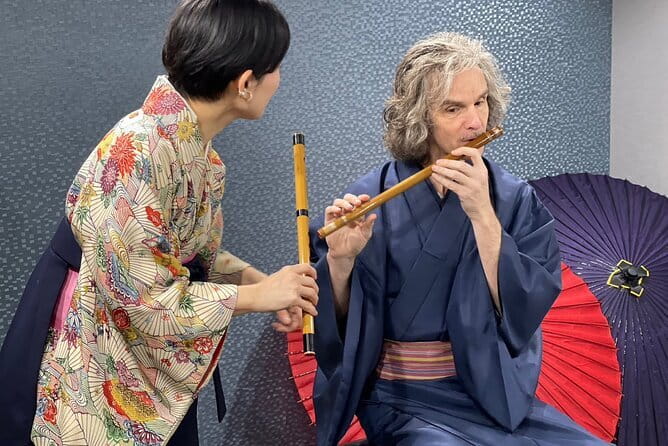
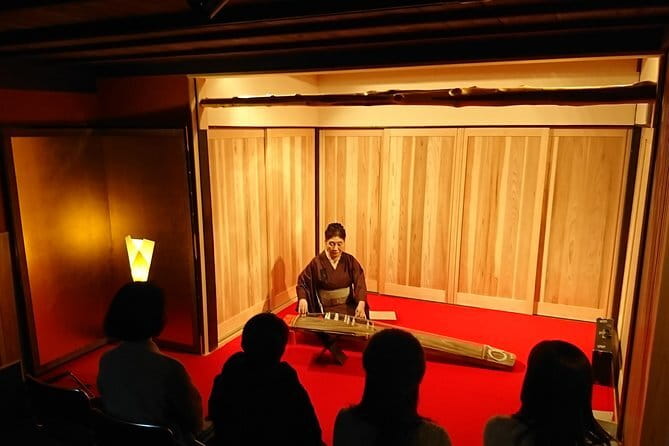
The first part is an approximately 25-minute authentic Japanese music concert. You see performers play traditional instruments, and the program can include singing and participation in some songs. This is not merely background music before the activity. It gives you a chance to hear the instruments in a skilled performance and notice the contrast between their sounds.
The shamisen can provide a clear, percussive tone. The koto offers a different sound, with plucked strings and a more flowing quality. Wadaiko brings physical force and rhythm. The mix gives you a useful introduction to several parts of Japanese musical culture in a short period.
The concert has received strong praise for its combination of performance and participation. That balance is important for the price. A short concert alone might feel too brief, while a lesson without a demonstration could leave you unsure how the instruments should sound. Here, you get both.
The program changes depending on the day. I would treat that as a reason to return if you have time, not as a promise of a particular song list. If you have a special interest in one instrument or a question about the program, the provider invites you to make contact before the visit.
The 25-minute hands-on session
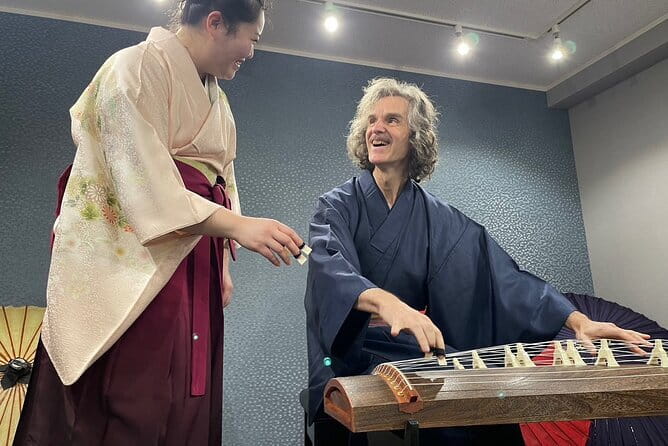
After the concert, you spend about 25 minutes trying traditional Japanese instruments yourself. You can choose from the instruments available, including shamisen, koto, and wadaiko. The information does not promise that every instrument will be available at every session, so ask if one particular instrument is especially important to you.
You do not need previous musical training. The instructors provide guidance, and the small group helps them give attention to each participant. A maximum of 12 people is not the same as a private class, but it is far more personal than a crowded demonstration where you only watch from the back.
I like this portion because it removes the pressure to be good. You are there to try the instruments, not perform a concert. One direct account describes the playing as lopsided, while also praising the organizers for their patience. That is exactly the right expectation: you will probably make imperfect sounds, and that is part of the memory.
The session also turns Japanese culture into something physical. You feel how an instrument responds to your hands, how much control a drum needs, or how difficult it is to produce a clean sound on a stringed instrument. Even a short attempt can give you more respect for the performers you have just watched.
A completely different kind of day out in Kyoto:
- PERFECT KYOTO 1-Day Bus Tour
★ 5.0 · 13,518 reviews - Kyoto: Fushimi Inari, Kinkakuji, Bamboo Grove 1 Day Bus Tour
★ 4.8 · 4,316 reviews - Kyoto: Tea Ceremony in a Traditional Tea House in Kiyomizu
★ 4.9 · 3,519 reviews - Kyoto Geisha Walking Tour: Gion District & Hidden Gems
★ 4.7 · 3,273 reviews
The final 10 minutes for photos
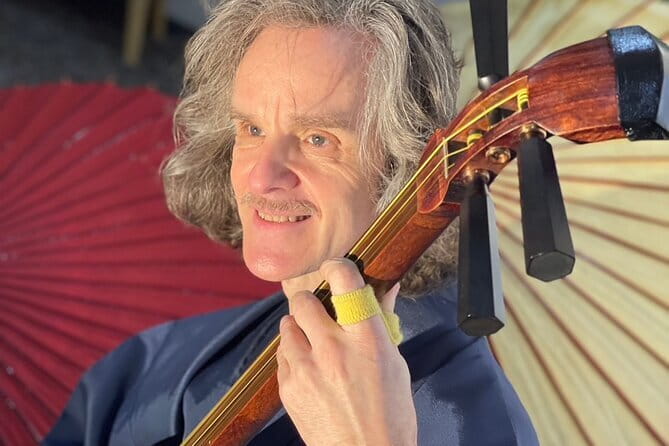
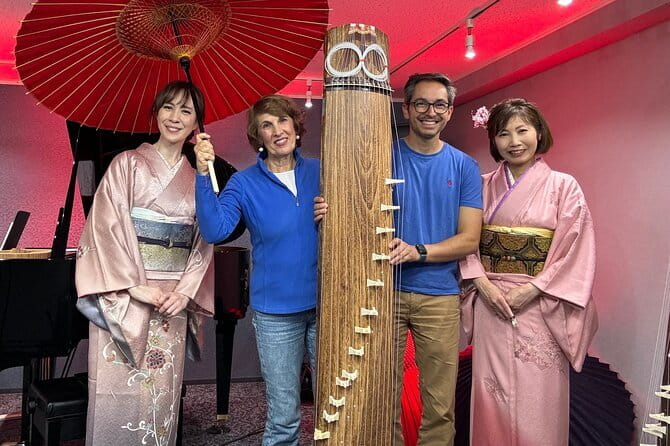
The last 10 minutes are set aside for photographs with the instruments and performers. This is a small part of the schedule, but it gives the experience a clear finish and lets you record the hands-on moment without interrupting the concert or practice session.
Ten minutes is not a long portrait session, so keep your camera or phone ready and follow the staff’s instructions. The photo time is best viewed as a quick keepsake, not a full photo shoot. You may be able to capture yourself with the shamisen, koto, or wadaiko you tried, depending on the day’s setup.
For families, couples, and solo visitors, this closing section can help preserve the memory of an activity that is otherwise hard to explain in photographs. A picture of a Kyoto temple is easy to take. A picture of you attempting a traditional instrument tells a more personal story.
What the $46.24 price really covers
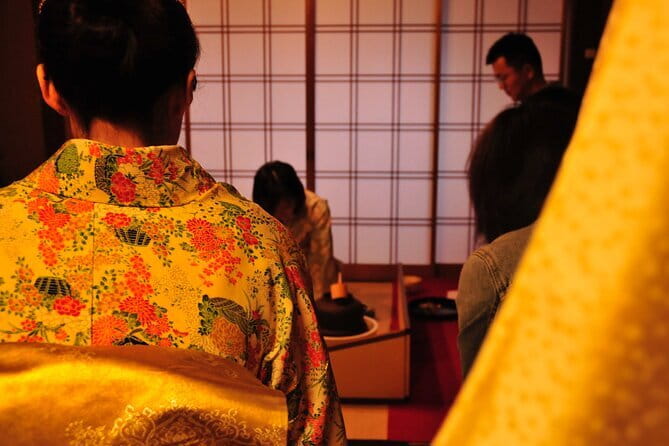
At $46.24 per person, the fee is not just admission to a concert. It includes the live music, use of a Japanese musical instrument for the practice session, guidance during the activity, and the photo period. You also get the convenience of a compact schedule in a central Kyoto area.
The strongest value comes from the two-part design. If you only wanted a performance, you might prefer a longer concert with more music. If you only wanted a lesson, you might look for a class with more practice time. This activity sits between the two, giving you a taste of both in one hour.
I think the price works best for someone who values access and participation more than length. You are paying for a focused introduction rather than an extended course. The 25 minutes of playing time will not make you an accomplished shamisen or koto musician, but it can make traditional music feel less distant.
The maximum group size of 12 also supports the value. Personal help is included, and the session is not designed as a huge audience event. The experience may be less satisfying if you want a long, formal concert, but it is a sensible choice if you want to do something cultural rather than simply observe.
Who should choose this experience?
I would recommend it to first-time visitors who want a clear, low-pressure introduction to Japanese music. You get explanations, a performance, practical instruction, and a chance to ask questions or request more information. It also suits families and mixed-age groups because the activity does not require previous musical ability.
It works well for couples looking for a shared activity that is more distinctive than a standard sightseeing stop. It is also a good option for solo visitors who want a structured cultural experience in a small group.
Music lovers may enjoy hearing several instruments played in a professional setting, then comparing that sound with their own attempt. You do not need to know the names of Japanese musical forms to appreciate the difference between a live demonstration and hands-on practice.
I would be more cautious if you want a full-length concert, advanced instruction, or a completely private session. The available details promise a maximum of 12 participants, not one-to-one teaching. The schedule is also narrow, and the program changes from day to day.
Practical planning, timing, and cancellations
Plan around the 11:00 am start rather than treating this as a flexible drop-in show. The activity lasts about 60 minutes and ends at its starting point. There is no private transportation included, so public transportation or your own route to Nakagyo Ward is your responsibility.
Confirmation arrives at booking, and the mobile ticket makes entry simpler. Service animals are allowed, and most people can participate. The provider also welcomes questions and special requests, so it is sensible to contact them ahead of time if you need clarification about an instrument or another part of the session.
Free cancellation is available up to 24 hours before the start time for a full refund. Changes or cancellations made less than 24 hours before the start are not accepted for a refund. The cutoff uses Kyoto local time.
The activity needs at least two participants to operate. If it is canceled because that minimum is not met, you are offered another date or experience, or a full refund. That policy protects you, but I would still avoid placing this on the final hour of a tightly packed Kyoto itinerary.
A small cultural experience with real participation
The best feature here is the shift from watching to doing. In the concert, you hear the instruments in capable hands. In the practice session, you discover that making a convincing sound is not as easy as it looks. That small surprise gives the music more meaning.
The experience also offers a respectful introduction without asking you to commit half a day. You get a taste of several instruments, a short explanation, and a chance to participate. The setting may not answer every question about Japanese music, but it can give you enough interest to notice traditional instruments during the rest of your time in Japan.
The excellent overall rating and 100 percent recommendation reflect the parts that matter most here: fun instruction, strong performances, patience, and a reasonable price. The most praised feature is the successful mix of demonstration and personal playing. I would give that more weight than the short duration when deciding.
Should you book the Kyoto traditional music experience?
Book it if you want a friendly, compact cultural activity with both music and participation. The $46.24 fee is reasonable for a live 25-minute concert, 25 minutes of instrument practice, and 10 minutes of photographs, especially with a group limit of 12.
Skip it if your schedule cannot accommodate an 11:00 am start, if you need a weekend session, or if you want an extended concert or advanced music class. For most visitors with an open Monday, Tuesday, Thursday, or Friday morning, this is an easy way to hear Kyoto’s traditional sound and make a little music yourself, even if your first attempt is gloriously uneven.
FAQ
How long does the traditional Japanese music experience last?
The experience lasts approximately 60 minutes. It includes a 25-minute concert, 25 minutes of playing traditional instruments, and 10 minutes for photographs.
What time does the experience start?
The session starts at 11:00 am.
Which days is the experience available?
It is available on Monday, Tuesday, Thursday, and Friday. No Wednesday, Saturday, or Sunday schedule is provided.
Where does the activity begin and end?
It begins at 5f, 306 Higashidaimonjichō, Nakagyo Ward, Kyoto, 604-8043, Japan. It ends back at the same meeting point.
Which instruments can I try?
The available instruments include shamisen, koto, and wadaiko, along with other traditional Japanese instruments. The specific selection may vary.
Do I need musical experience?
No. Previous experience is not required, and guidance is provided during the hands-on portion.
How many people can join the activity?
The experience has a maximum of 12 participants. At least two participants are required for the activity to operate.
Is transportation included?
No. Private transportation is not included. The meeting point is near public transportation.
Can I cancel for a full refund?
Yes. You can cancel at least 24 hours before the local start time for a full refund. Cancellations or changes made less than 24 hours before the start are not refunded.
Just added around Kyoto
- Kyoto: Private Customizable Day Trip by Car★ 5.0 · 38 reviews
- Kyoto: Gion Night Walking Tour with Geisha Insight★ 5.0 · 39 reviews
- Kyoto: Full Day Bike Tour★ 4.9 · 39 reviews
- Private Japanese Calligraphy in Kyoto – Learn Shodō with a Master★ 5.0 · 39 reviews
- Experience a tea ceremony in an authentic tearoom, in Kyoto!★ 4.5 · 41 reviews
- Kyoto: Gion Evening Walk with Hidden Gems, Geisha & Sake★ 5.0 · 41 reviews
- Kyoto Private Photo Shoot & Tour by SnapKyoto★ 5.0 · 41 reviews
- The Way of Tea: Kyoto Crafts, Hidden Temples & Wabi-Sabi Walk★ 5.0 · 41 reviews
Show, compared.

Mt Fuji & Hakone Cruise, Drum Show Bullet Train 1 Day from Tokyo
Read our review →


Tokyo Shinjuku Sumo Show & Experience with Photo
Read our review →

Mt Fuji & Hakone Cruise, Drum Show Bus 1 Day from Tokyo
Read our review →