
Reviewed · GEISHA & GION DISTRICT TOURS
Dinner with Maiko in a Traditional Kyoto Style Restaurant Tour
Kyoto’s geisha quarter comes alive after dark. This experience pairs a 40-minute walk through Gion with a private dinner, maiko performance, traditional games, and time for questions through an English-speaking guide. I like the small maximum of seven people and the chance to meet a maiko in an intimate setting rather than simply watching one pass in the street. I also like the thoughtful interpretation from guides such as Hikari, Josh, Peco, and Hikaru. The main drawback is the price: at $299.95 per person, this is a major splurge, and the seating may not give everyone a clear view of the dance.
You should also know what kind of evening this is. It offers a performance and guided interaction, but it may not become a long, free-flowing conversation with the maiko. The food receives high praise overall, though one account found it only average. Bring patience, arrive on time, and come ready to respect a formal cultural setting.
In This Review
- Key points to know before booking
- Why this Gion evening feels different
- Starting near the Izumo-no-Okuni statue
- Meeting the maiko in a private room
- Dance, games, and the question period
- What you eat and drink during dinner
- Is $299.95 a fair price?
- Walking, weather, age, and practical fit
- How to get the most from the evening
- Who should book this Kyoto experience?
- Should you book Dinner with Maiko?
- FAQ
- Where does the tour begin?
- Where does the tour end?
- How long does the experience last?
- How large is the group?
- What is the minimum age?
- Is dinner included?
- Are drinks included?
- Can dietary requests or allergies be accommodated?
- Can I cancel for a refund?
Key points to know before booking
- A small group of no more than seven makes questions and conversation easier.
- The evening begins at the Izumo-no-Okuni statue near the Kamogawa River and ends at the restaurant in Gion.
- You get about an hour or more with a maiko or geiko, including dancing, games, and translated questions.
- The meal includes multiple Japanese dishes, with one account describing nine small courses and many drink choices.
- This is not a good fit for limited mobility, since the evening includes walking through Gion and standing or moving around a traditional setting.
- The official minimum age is 15, and children or babies are not permitted on the shared tour.
Why this Gion evening feels different
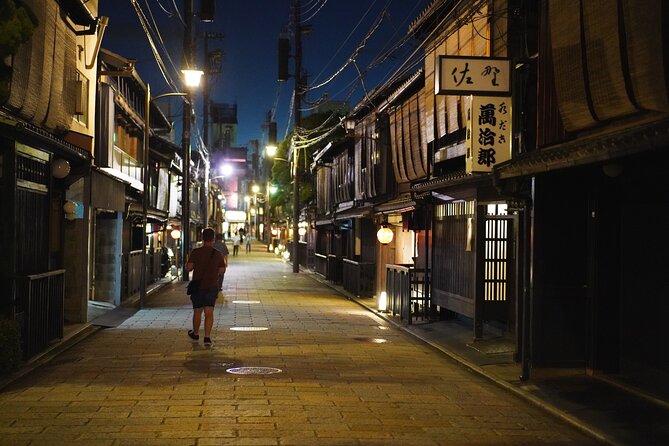
Gion is easy to admire and hard to understand. Its wooden machiya houses, quiet lanes, teahouses, and polished façades can look like a movie set, but the district is also a working neighborhood tied to traditional arts. Walking through it with a guide gives you some context before the dinner begins.
That context matters. Without it, you may see a maiko and know only that she is dressed beautifully. With an explanation, you begin to understand that her hairstyle, kimono, makeup, movements, and training all carry meaning. The guide also helps you explore the district respectfully, which is important in a place where residents and performers deserve privacy.
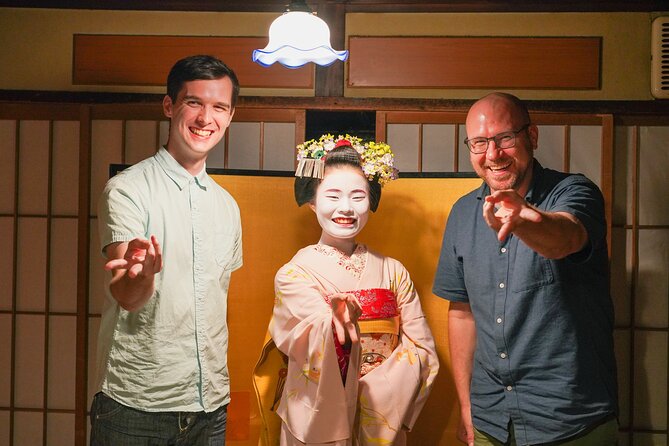
The setting is intimate by design. With a maximum of seven people, you are not being moved through a large entertainment package. You sit together, eat together, ask questions, and watch the performance from a traditional restaurant or teahouse room.
The strongest part of the experience is the combination of access and interpretation. You are not simply handed a meal and a dance. Your guide acts as translator and cultural bridge, helping you ask about the maiko’s life, work, ambitions, and decision to enter this demanding profession.
More geisha district walks in Kyoto:
- Kyoto Geisha Walking Tour: Gion District & Hidden Gems
★ 4.7 · 3,273 reviews - Kyoto: Gion Magical Night Walking Tour with Geisha Trivia
★ 4.9 · 2,393 reviews - Kyoto: Gion Geisha District Walking Tour – Stories of Geisha
★ 4.7 · 2,187 reviews
Starting near the Izumo-no-Okuni statue
The meeting point is the Statue of Izumo-no-Okuni in Kawabatacho, Higashiyama Ward. This is near public transportation and provides a practical starting place near the Kamogawa River and Gion area.
Arrive early. The tour begins at the scheduled time, and the organizer makes clear that late starts can affect the whole group. Since the first portion is a walking orientation, you want enough time to find the statue, check your mobile ticket, and settle in before the group moves off.
The opening walk lasts about 40 minutes. It is not meant to cover every corner of Gion. Instead, it helps you read the district: traditional wooden houses, narrow lanes, and details you might otherwise pass without noticing.
One especially memorable detail mentioned by a participant was a school timetable spotted during the walk. That small discovery says a lot about the experience. The value is not just in famous streets. It is also in seeing how ordinary local life sits alongside the district’s formal entertainment culture.
The walk can be especially useful on a first evening in Gion. You learn how the area fits together, then return later on your own with a better sense of place. You may also hear guidance about proper behavior around performers and private businesses, although the exact commentary can vary by guide.
Rain does not automatically ruin the evening. One group had heavy rain and still praised Hikari’s energy and explanations. Still, wear suitable shoes and bring rain protection when the forecast calls for wet weather. The tour may be canceled for unsafe conditions, and Kyoto’s summer heat and winter cold can be serious.
Meeting the maiko in a private room
The central portion takes place in Kyoto and lasts about 2 hours and 40 minutes. This includes the dinner, the performance, the question period, and the time spent in the restaurant.
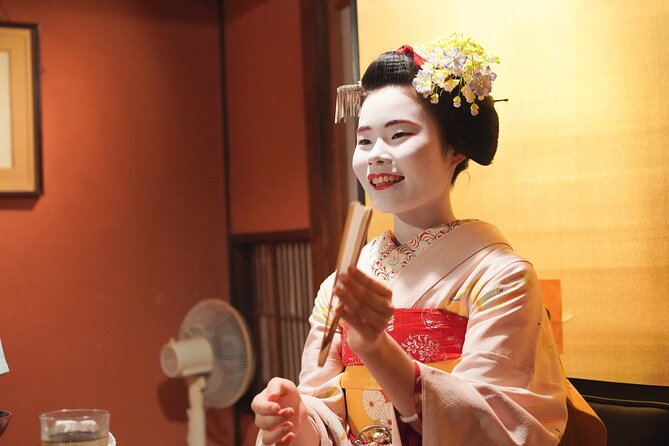
The room is described as a small teahouse or traditional restaurant with a private space for the group. That privacy is a real part of the price. You are not trying to hear a performer across a crowded dining hall, and the small group gives you a better chance to participate.
A maiko is an apprentice geisha. In some cases, a geiko, the Kyoto term for a fully trained geisha, may attend instead. One couple expected a maiko and was delighted when a geisha appeared, but you should not book on the assumption that a particular person or rank will be present.
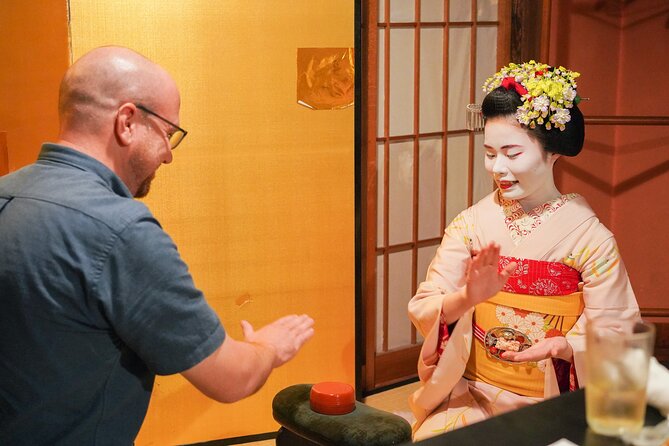
The maiko’s role combines conversation, performance, and traditional entertainment. You can ask questions about her life and career, with the guide translating. Several accounts describe this as the best part of the evening, especially because the questions went beyond costume and included her ambitions and reasons for choosing this path.
The guide is important here. Hikari is praised for strong interpretation and broad cultural explanations. Josh received credit for both the Gion walk and the dinner arrangement, while Peco was described as exuberant and warmly engaged. Hikaru also helped one group feel comfortable asking questions. Your guide can make the difference between a stiff encounter and a relaxed one.
Set your expectations correctly. This is not a private interview with unlimited conversation. A lower-rated account felt that the interaction was less conversational than expected and more focused on performance and traditional games. That is fair criticism. The maiko is there to present an established cultural program, not to serve as a personal storyteller on demand.
The respectful approach is to prepare a few thoughtful questions, listen carefully, and enjoy the parts that are not verbal. Even if the conversation is brief, the chance to see the gestures, formal movements, and performance style up close is unusual.
Dance, games, and the question period
The performance is repeatedly praised for its elegance. Expect a refined dance rather than a loud stage show. The effect comes from control, costume, music, and small movements, so your view matters.
This is where the seating concern deserves attention. One participant found that people at the far end could not see the maiko well because other diners blocked the view. The problem was more serious for a deaf person, who depended on a clear line of sight. The room may simply not offer a perfect arrangement for every seat.
If seeing the dance clearly is essential, ask the guide or organizer about seating when you arrive. The provided information does not promise assigned seats or a guaranteed front-facing position, so you should treat this as a possible limitation.
The traditional games add a lighter note. They help break the formality and give the maiko and group something easy to share. They also make the evening more interactive than a simple meal followed by a stage performance.
The question time works best when you participate. Ask about training, daily life, performance customs, or career goals. The guide can translate questions and answers, giving you access that would otherwise be impossible for most English-speaking visitors.
A few more Kyoto experiences worth weighing up
- Kyoto Gion Cultural Walk & Geisha Show with Dining Options
★ 5.0 · 518 reviews - Kyoto Gion Cultural Walk & Geisha Show with Dining Options
★ 5.0 · 483 reviews - Kyoto: Geisha Dinner & Gion Cultural Walk
★ 5.0 · 73 reviews - Private Dinner with a Geisha
★ 5.0 · 65 reviews
What you eat and drink during dinner
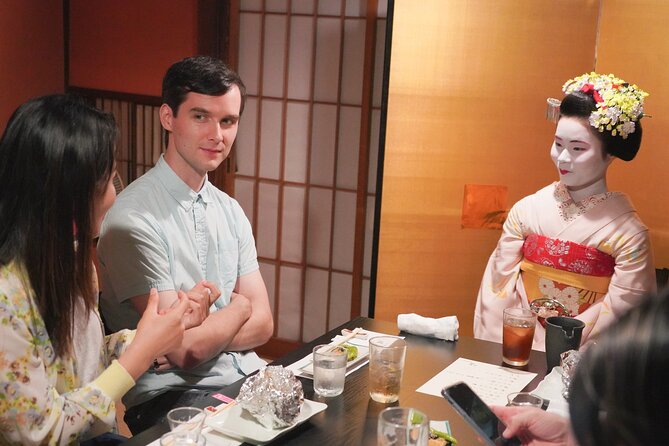
Food is a major part of the evening, not a side dish to the entertainment. The meal is served in many courses, and one account specifically describes nine small typical dishes. That style lets you sample a range of flavors and textures rather than filling up on one large plate.
Several accounts call the food delicious or top notch. One person enjoyed the meal but rated it only okay, so I would keep expectations sensible. This is a cultural dinner in a traditional setting, not necessarily a destination restaurant selected for ambitious modern cuisine.
The drinks are another useful value point. The experience includes free-flowing drinks, with choices described as wine, sake, plum wine, tea, beer, and other options. This can make the $299.95 cost feel less severe, especially if you would otherwise pay separately for a multicourse meal, drinks, a guide, and a performance.
Do not assume every dietary request can be handled. You must tell the operator about allergies or food needs at least one day before the tour. Requests made on the day cannot be accepted, and allergy-free meals or substitutions are not guaranteed because the food is prepared in kitchens outside the operator’s control.
If you have a serious allergy, read that warning carefully. The meal may not be suitable even if you notify the company in advance. The same applies to strict dietary restrictions, where a private tour may offer more flexibility but still does not guarantee replacements.
Is $299.95 a fair price?
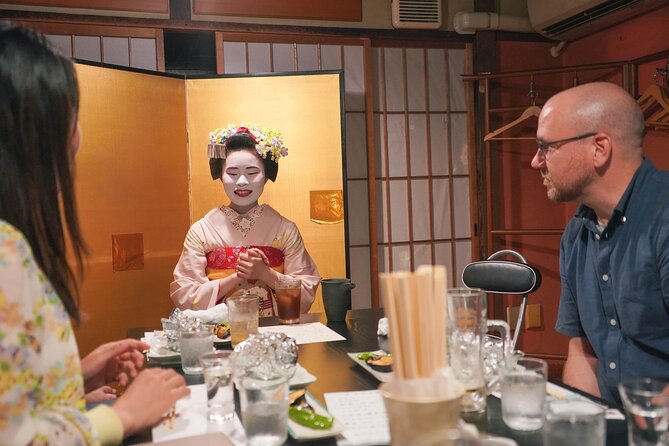
At nearly $300 per person, this is expensive for a three-and-a-half-hour evening. You are paying for more than dinner, but you are also paying for access to a highly restricted cultural world, a small group, translation, a Gion orientation, drinks, and a live performance.
I see the price as reasonable only if the maiko encounter is central to your Kyoto plans. If you mainly want a good Japanese meal, you can spend far less elsewhere. If you want a polished introduction to Gion and do not speak Japanese, the guide and translation add real value.
The group limit helps justify the cost. Seven people is small enough for direct questions, though the exact feel depends on who else books that night. A full group may still have uneven sightlines during the dance, but it is much more personal than a large bus outing.
The experience also saves you from trying to arrange this world on your own. Access to geisha entertainment is not something most visitors can simply book by walking into a teahouse. You get an organized introduction without needing local connections or advanced cultural knowledge.
I would not choose this tour for a budget-focused trip. I would consider it for a special evening, a first visit to Kyoto, or a couple who wants one high-cost cultural experience rather than several ordinary attractions.
Walking, weather, age, and practical fit
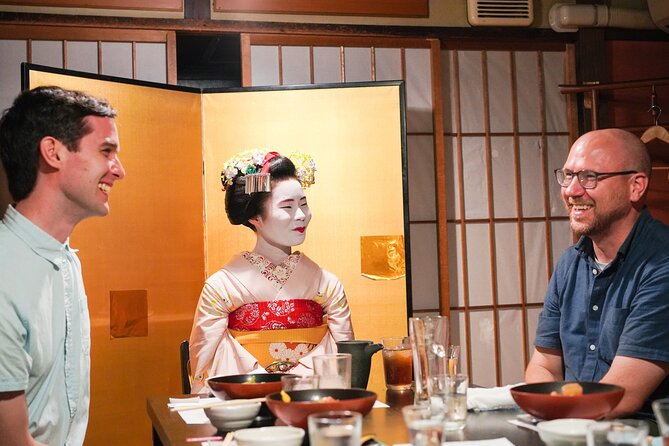
The evening lasts approximately 3 hours and 30 minutes. The walking portion is not long on paper, but the operator says the tour is not recommended for people with mobility issues. If walking is difficult, a private tour is recommended.
Wear comfortable shoes. Gion’s traditional streets are best enjoyed slowly, and you do not want to spend the opening walk worrying about your feet. Kyoto can reach around 40°C in summer and fall to about -5°C in winter, so plan clothing for the actual forecast rather than the season name alone.
The shared tour is for people aged 15 and older. Small children and babies are not allowed, even when accompanied by parents. Families who want to include younger children are directed toward a private tour instead.
The meeting point is near public transportation, but the tour ends at the restaurant in Gion. Plan your onward route from there. Since the evening ends in Gion rather than returning you to the starting statue, this matters if you have a hotel reservation, train connection, or another scheduled activity.
The mobile ticket is convenient. Still, convenience does not replace punctuality. Have the ticket ready, know the meeting point, and allow extra time for finding the statue.
How to get the most from the evening

I would prepare a short list of questions before arriving. Good questions are specific and open-ended, such as what drew the maiko to the profession, what part of training she finds hardest, or how a performance is prepared.
Keep your expectations cultural, not celebrity-focused. The maiko is a working artist, and the evening is built around traditional etiquette. Politeness, attentive listening, and modest photography habits will help preserve the tone of the room.
Ask where you will sit as soon as the group reaches the restaurant. This is particularly important if someone in your party needs a clear visual view of the performance.
Tell the operator about food restrictions at least one day ahead. Do not wait until dinner begins. The company warns that substitutions and allergy-free preparation are not guaranteed, but early notice gives the restaurant its best chance to respond.
Use the walking portion as more than filler. Look at the machiya façades, notice the transition from public streets to quiet lanes, and listen for the guide’s explanation of how Gion functions. That first 40 minutes gives the dinner a setting and meaning.
Who should book this Kyoto experience?
I would recommend it to adults and older teenagers with a strong interest in Japanese culture, traditional performing arts, or the history of Gion. It suits someone who wants direct access, translation, and a well-organized evening rather than an independent restaurant meal.
It is also a good choice for a special occasion. The private room, many-course dinner, drinks, and performance create a memorable package. Several people considered it a highlight of their Kyoto or Japan trip, and I can understand why.
I would be more cautious if you need guaranteed seating, have major mobility limits, require strict dietary substitutions, or want a long personal conversation with the maiko. The experience includes interaction, but its main structure is a performance and traditional games.
Should you book Dinner with Maiko?
Book it if meeting a maiko is one of your top Kyoto goals and you can accept the high price. The strongest reasons are the small group, skilled guide interpretation, traditional meal, drinks, and rare chance to ask questions in a private setting.
Skip it if you mainly want inexpensive food, a flexible evening, or a guaranteed front-row dance view. For everyone else, this is a thoughtful splurge that offers more cultural context than a quick photo outside a teahouse. Just arrive early, prepare your questions, notify the operator about dietary needs, and remember that the experience is a respectful introduction, not a private celebrity encounter.
FAQ
Where does the tour begin?
It begins at the Statue of Izumo-no-Okuni in Kawabatacho, Higashiyama Ward, Kyoto.
Where does the tour end?
The tour ends at the restaurant in Gion, rather than returning to the starting point.
How long does the experience last?
The total duration is approximately 3 hours and 30 minutes. The Gion walk takes about 40 minutes, the restaurant portion takes about 2 hours and 40 minutes, and the final walk takes about 10 minutes.
How large is the group?
The shared tour has a maximum of seven travelers.
What is the minimum age?
Participants must be at least 15 years old. Small children and babies are not permitted on the shared tour.
Is dinner included?
Yes. The experience includes a meal in a traditional restaurant or teahouse setting. One account describes nine small Japanese dishes.
Are drinks included?
The experience includes free-flowing drinks. Options described include wine, sake, plum wine, tea, and beer.
Can dietary requests or allergies be accommodated?
You must provide dietary requests or allergy information at least one day before the tour. Requests made on the day cannot be accommodated, and allergy-free meals, dietary restrictions, or substitutions are not guaranteed.
Can I cancel for a refund?
You can receive a full refund if you cancel at least 24 hours before the scheduled start time. Cancellations or changes made less than 24 hours before the start are not accepted for a refund.
More Dining Experiences
- Kyoto Evening Gion Food Tour Including Kaiseki Dinner
★ 5.0 · 62 reviews - Kyoto: Maiko Dinner in Traditional Restaurant and Tour
★ 4.8 · 55 reviews - Kyoto: Lunch or Dinner with Maiko
★ 4.2 · 52 reviews - Tokyo Bar Hopping Tour in Shinjuku (All-You-Can-Drink + Dinner)
★ 5.0 · 3,587 reviews
Just added around Kyoto
- Kyoto: Gion Night Walking Tour with Geisha Insight★ 5.0 · 39 reviews
- Kyoto: Private Customizable Day Trip by Car★ 5.0 · 38 reviews
- Kyoto: Full Day Bike Tour★ 4.9 · 39 reviews
- Private Japanese Calligraphy in Kyoto – Learn Shodō with a Master★ 5.0 · 39 reviews
- Kyoto: Gion Evening Walk with Hidden Gems, Geisha & Sake★ 5.0 · 41 reviews
- Experience a tea ceremony in an authentic tearoom, in Kyoto!★ 4.5 · 41 reviews
- Kyoto Private Photo Shoot & Tour by SnapKyoto★ 5.0 · 41 reviews
- The Way of Tea: Kyoto Crafts, Hidden Temples & Wabi-Sabi Walk★ 5.0 · 41 reviews
Geisha & Gion District Tours, compared.
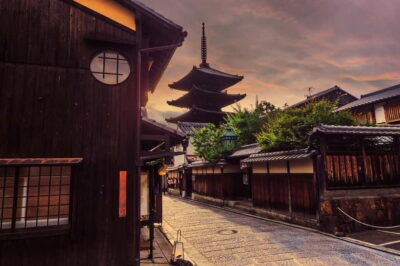
Kyoto Geisha Walking Tour: Gion District & Hidden Gems
Read our review →
Gion Magical Night Walking Tour with Geisha Trivia
Read our review →
Gion Geisha District Walking Tour – Stories of Geisha
Read our review →
Best of Kyoto: Gion, Geisha, Pagodas & Cobblestones
Read our review →

Kyoto Night Foodie Tour in Gion (9+ dishes + 6 Sake tastings)
Read our review →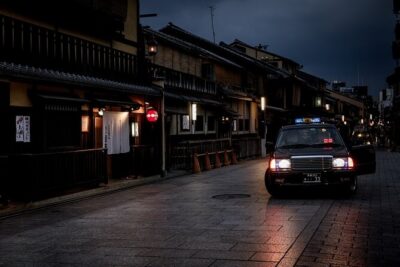
Kyoto Gion Geisha District Walking Tour – The Stories of Geisha
Read our review →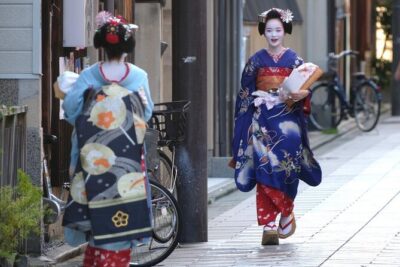
Kyoto Gion: 2-Hour Geisha Culture & History Walking Tour
Read our review →Browse the lists this tour appears in