
Reviewed · WORKSHOPS
Kyoto: Beginner Knife Sharpening & Handle Fitting Workshop
Make your own Kyoto souvenir. This small workshop combines wet-stone sharpening, handle fitting, and a short lesson on Japanese knives, so you leave with more than a shopping-bag purchase. I especially like the hands-on instruction and the fact that your finished knife comes home with you. The main consideration is the $161 price, which is worthwhile if you value the lesson and craft experience, but high if you only want an inexpensive kitchen knife.
You choose a Santoku, Deba, or Yanagi blade, then learn how to sharpen it before fitting a magnolia-wood handle. The English support is clear and patient, and instructors such as Julio have earned praise for making beginners feel comfortable. Still, fire is used during handle fitting, so your clothes may pick up a smoky smell.
In This Review
- Key points at a glance
- Why this Kyoto workshop feels different from buying a knife
- Arriving at Japanese knife shop HIRAI
- Choosing between Santoku, Deba, and Yanagi
- Learning Japanese knife sharpening on a wet stone
- Fitting the magnolia handle over an open flame
- Taking home a knife with a story
- Is $161 a fair price?
- Who will enjoy the two-hour format?
- Practical advice before you book
- FAQ
- How long does the knife workshop last?
- Where does the workshop meet?
- Which knives can I choose?
- Can I take the knife home?
- Is handle fitting included?
- Can I have the knife engraved?
- Are whetstones included to take home?
- Is the workshop offered in English?
- Who cannot join the workshop?
- Should you book it?
Key points at a glance
- You sharpen the knife you keep: The included blade is not just a practice tool. You work on it and take it home afterward.
- Three knife styles are available: Pick a Santoku, Deba, or Yanagi knife for the workshop.
- Handle fitting adds a personal touch: The included handle is magnolia wood, with paid upgrades available.
- The teaching suits complete beginners: Demonstrations, corrections, and guided practice make wet-stone sharpening less intimidating.
- The group is very small: With a maximum of three participants, you receive close attention during the practical work.
- Plan for smoke and concentration: Fire is part of the handle-fitting process, and sharpening requires steady hands and focus.
Why this Kyoto workshop feels different from buying a knife
Kyoto has no shortage of shops selling Japanese kitchen knives. You can choose a polished blade, pay, and continue sightseeing. This workshop takes a slower and more useful approach: you learn how to care for the knife, shape its edge, and fit the handle yourself.
That difference matters. A Japanese knife is a working tool, not just a decorative souvenir. If you have ever tried sharpening at home and ended up with mixed results, the guided practice can save you a lot of frustration. You learn by watching a demonstration, trying the motion yourself, and receiving corrections while the instructor can still fix small mistakes.
I also like the personal connection created by the handle-fitting stage. You select a handle and help attach it to the blade, rather than taking home an object that was finished entirely by someone else. The result is still made with professional help, but it carries a small piece of your own effort.
The workshop is run by Japanese knife shop HIRAI, and the experience includes an explanation of Japanese knife history. That introduction gives useful context before the practical work begins. You learn why different blade shapes exist and how Japanese knives fit into cooking traditions, though the main focus remains practical rather than academic.
A few more Kyoto experiences worth weighing up
- Kyoto: 45-Minute Tea Ceremony Lesson Experience
★ 4.3 · 2,378 reviews - Ramen Cooking Class at Ramen Factory in Kyoto
★ 5.0 · 1,937 reviews - Kyoto : Chopsticks Making Workshop in Gion with Engraving Option
★ 5.0 · 958 reviews
Arriving at Japanese knife shop HIRAI
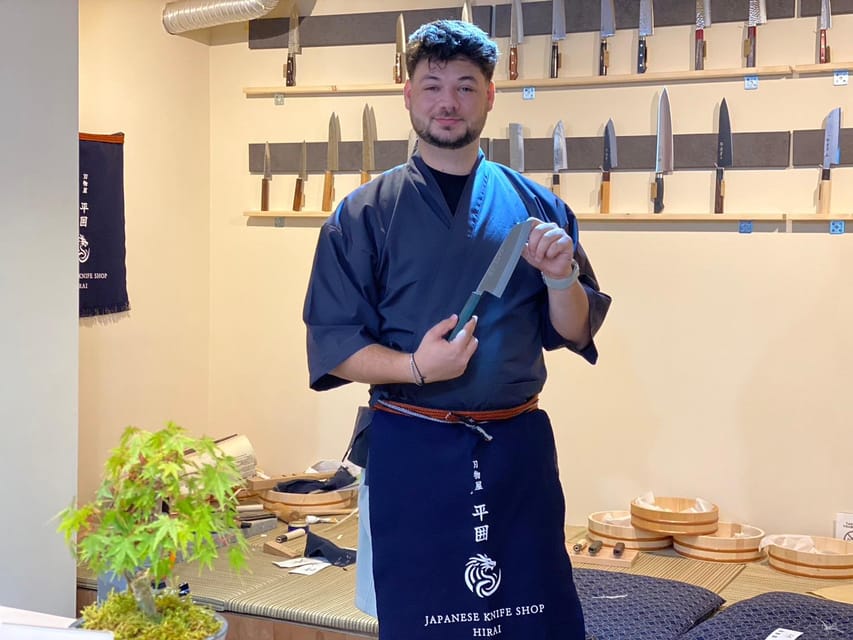
You go directly to the shop rather than meeting a guide elsewhere in Kyoto. Look for the white storefront curtain at the shop building, and arrive at least five minutes early so the session can begin without a rushed introduction.
Finding the entrance may take a little attention, especially around the Nishiki Market area. The market streets can be crowded, and one participant found the shop slightly difficult to locate. I would allow extra time rather than arriving at the last minute with a phone map open and a knife lesson waiting.
The workshop lasts two hours and is limited to three participants. That small size is one of the strongest practical features. Knife sharpening is a hands-on skill, so personal correction matters. In a larger class, you might spend more time watching other people work. Here, you have a better chance to receive direct help with your angle, pressure, and movement.
Instruction is available in English and Japanese. English-speaking instructors or translation support help make the technique easy to follow. Names such as Julio and Tatsu appear in the teaching team connected with the experience, and the strongest praise has focused on patience, clarity, and encouragement.
You wear a Japanese working uniform and apron during the activity. That makes the session feel like a proper workshop rather than a casual shop demonstration, while also providing some protection for your everyday clothes.
Choosing between Santoku, Deba, and Yanagi
Before sharpening begins, you choose one knife for the workshop. The options are Santoku, Deba, and Yanagi, and each shape suits a different kind of cook.
A Santoku is the most familiar all-purpose choice for many home kitchens. It is a sensible pick if you want one Japanese knife for everyday chopping and general meal preparation. Several participants chose a Santoku and planned to use it for years at home.
A Deba is associated with heavier fish preparation. It has a more substantial shape and can appeal to someone interested in seafood work or traditional Japanese cooking.
A Yanagi is a long, narrow slicing knife. It is especially associated with precise fish slicing. This is a more specialized choice, so I would think about how you cook before selecting it.
The workshop gives you a standard knife as part of the experience. You can also buy additional knives in the shop, but those purchases are not included in the $161 price. Some participants upgraded to a larger or more specialized blade, while others found the standard options more than good enough.
That no-pressure choice is important. You do not need to upgrade to make the workshop worthwhile. The included knives are described as good quality, and the lesson remains useful even if you select the standard blade. If you have a clear preference for a certain steel, size, or purpose, ask about additional purchases before you begin.
Learning Japanese knife sharpening on a wet stone
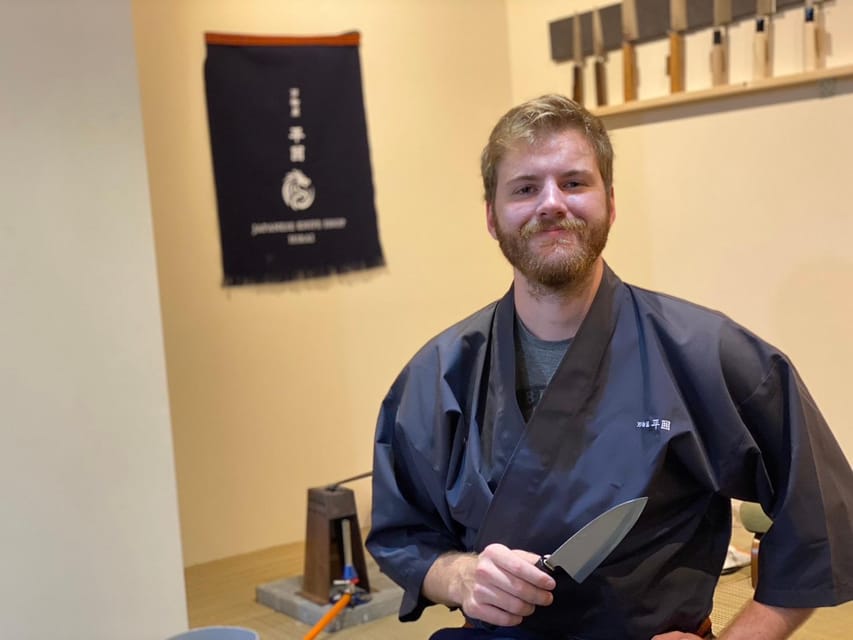
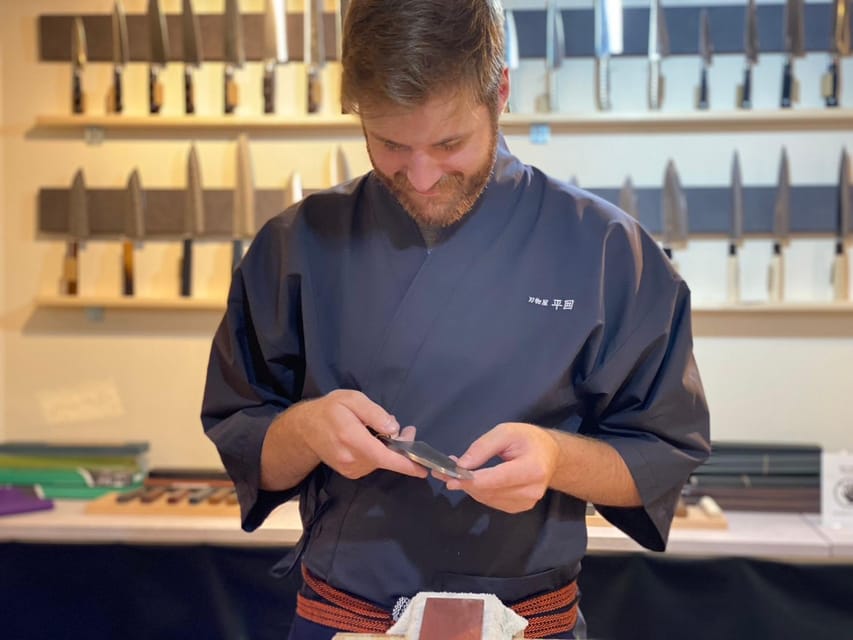
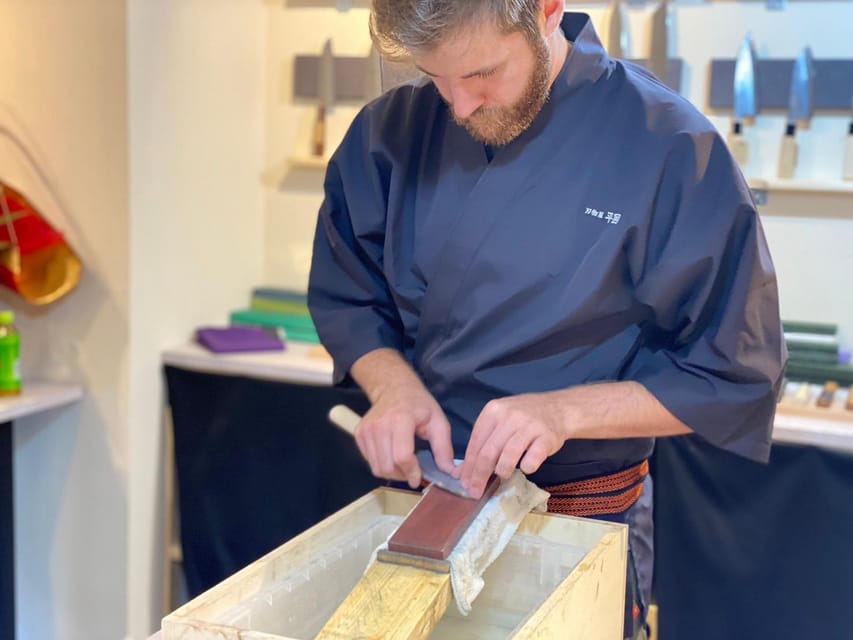
The sharpening lesson is the heart of the workshop. You first see a demonstration, often using practice knives, then work on your own blade with the provided whetstones.
The instructor explains the method in simple steps. You learn how to position the blade, maintain the correct angle, and use controlled movement across the stone. This sounds straightforward, but it requires concentration. The value of having an instructor beside you is that small problems can be corrected before they become habits.
Many people are intimidated by wet stones. Online videos can show the broad motion, but they cannot feel your pressure or watch the angle of your blade. Here, the teacher can offer immediate feedback and confirm when your technique is working. That physical correction is the part you cannot get from a screen.
The class is beginner-friendly without being completely passive. You do real work, and you need to pay attention. One participant would have liked a written guide to the sharpening method as a reminder at home, so you may want to take mental notes or ask questions before leaving. There is no indication that a printed instruction sheet is provided.
The whetstones belong to the shop and are supplied for use during the class. Purchasing a whetstone afterward is optional and costs extra. If your aim is to maintain knives at home, ask about suitable stones before you finish, but do not assume one is included.
The lesson is practical for daily use. You are not simply watching an expert create a sharp edge. You are practicing a repeatable maintenance skill. That makes this a good match for home cooks who want to care for their own blades instead of sending them out for sharpening every time.
A completely different kind of day out in Kyoto:
- PERFECT KYOTO 1-Day Bus Tour
★ 5.0 · 13,518 reviews - Kyoto: Fushimi Inari, Kinkakuji, Bamboo Grove 1 Day Bus Tour
★ 4.8 · 4,316 reviews - Kyoto: Tea Ceremony in a Traditional Tea House in Kiyomizu
★ 4.9 · 3,519 reviews - Kyoto Geisha Walking Tour: Gion District & Hidden Gems
★ 4.7 · 3,273 reviews
Fitting the magnolia handle over an open flame
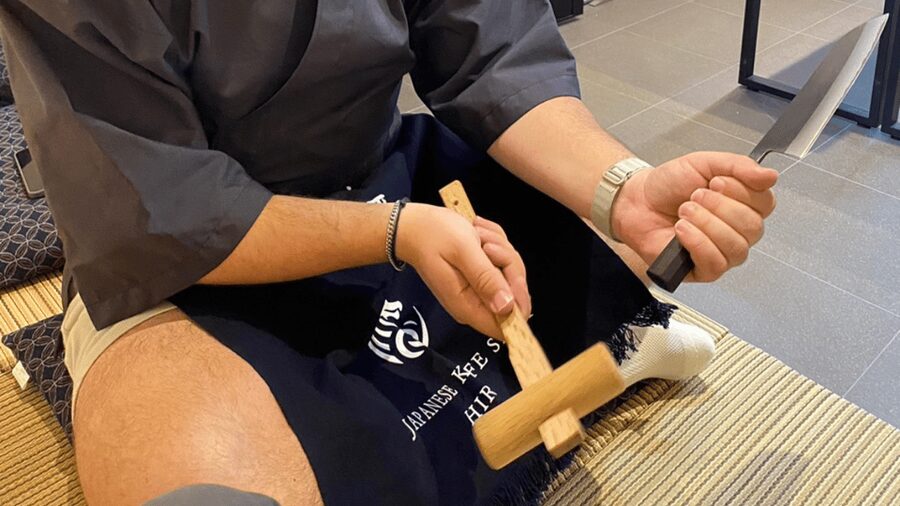
After sharpening, you move to handle fitting. The included handle is made from magnolia wood, and you choose and attach it with help from the workshop staff.
This section gives the knife a more finished, personal character. You have already selected the blade and worked on its edge. Now you select the handle and take part in assembling the complete tool. The process is guided, so you do not need prior woodworking experience.
Fire is used during this part of the workshop. Smoke may come out, and the smell can cling to your clothing. Wear clothes you do not mind smelling smoky afterward. This is a small point, but it can matter if the workshop is scheduled between a morning activity and a nicer dinner.
The standard magnolia handle is included. Other handle types are available for an additional fee, with the price changing according to the material or style you choose. Ask about the extra cost before selecting an upgrade.
Engraving is also available and is included in the experience fee according to the supplied details. You must request it in advance and provide the characters you want, with a limit of four letters. This is a useful way to mark the knife as a personal souvenir or gift, but do not wait until the day of the workshop to mention it.
Taking home a knife with a story
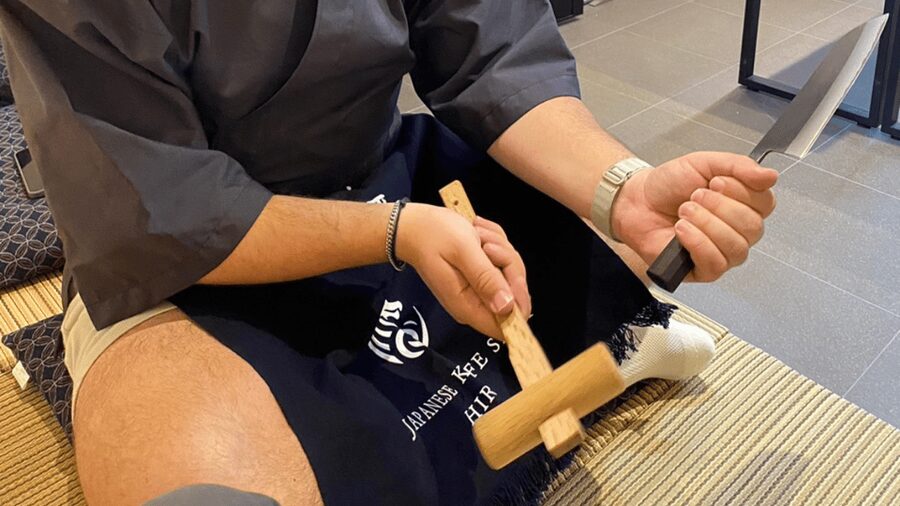
At the end, the shop packages the knife so you can take it home. The finished item is more meaningful than a knife bought straight from a shelf because you sharpened the blade and helped fit the handle.
That does not mean the knife is entirely handmade by you. The professional staff provide the blade, equipment, instruction, and technical support. Your role is real, but it takes place within a carefully supervised process. I see that as a strength for beginners: you get a genuine craft experience without being expected to master knife making in two hours.
The workshop also gives you a better chance of using the knife properly. You learn basic care and maintenance instead of treating the blade as a fragile ornament. If you already cook often, that practical knowledge may be more valuable than another standard souvenir.
Pack the knife securely for your journey and check your airline and local rules before departure. The activity says you can take it home, but it does not provide specific advice about checked luggage, carry-on rules, or international customs.
Is $161 a fair price?
At $161 per person, this is not a cheap way to buy a kitchen knife. You can find less expensive souvenirs in Kyoto, and you might pay less for a knife without a two-hour lesson.
The value becomes clearer when you separate the price into three parts: the knife, the instruction, and the experience of fitting the handle. Your fee includes the blade you sharpen, the magnolia handle, the working uniform and apron, the workshop instruction, and engraving if requested in advance. You also receive access to the shop’s whetstones during the lesson.
Several people felt the price was close to what they might have paid for the knife alone. That is the best argument for the workshop. If you were already planning to buy a quality Japanese knife, paying somewhat more for guided sharpening and handle fitting can make good sense.
The value is weaker if you do not cook, do not expect to sharpen knives at home, or simply want a decorative object. In that case, the hands-on lesson may not justify the added cost.
Upgrades can increase the final bill. A different handle costs extra, and additional knife purchases are not included. I would set a budget before arriving and treat upgrades as optional, not necessary.
Who will enjoy the two-hour format?
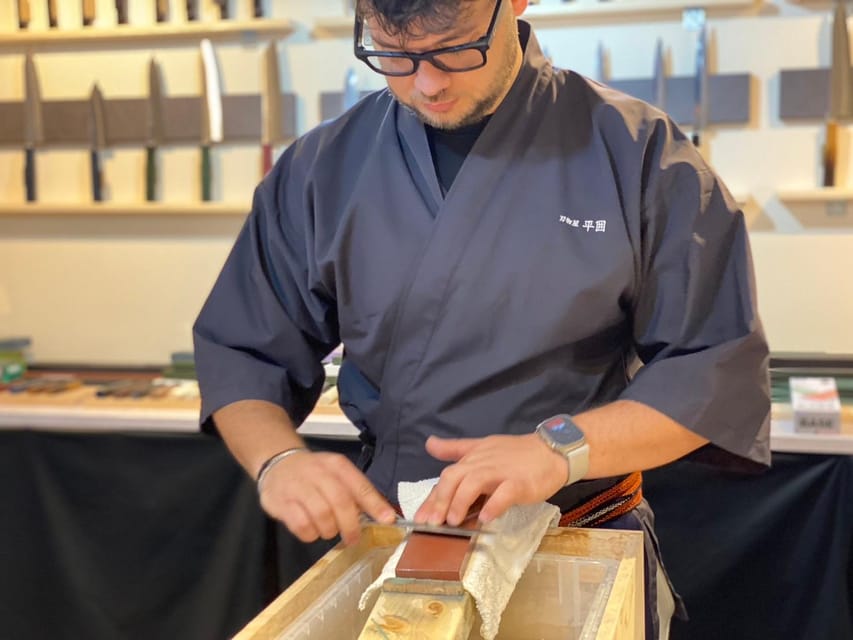
I would recommend this workshop to home cooks, food enthusiasts, chefs, and anyone who has wanted to learn wet-stone sharpening but felt unsure where to begin. It also suits a parent and older teenager, friends, or couples who want an activity with a useful souvenir at the end.
The small group helps people who prefer close instruction. You can ask questions without trying to compete with a large class, and the teacher can watch your technique. The English support makes the workshop accessible to international participants, while Japanese instruction is also available.
It is not suitable for children under 15, wheelchair users, or people over 80. The activity also bans pets, baby strollers, smoking, alcohol, drugs, and loud behavior. Those rules fit the setting: you are handling sharp tools and working near fire, so calm attention is required.
This is not a quick photo stop. You need to concentrate during sharpening and follow directions during handle fitting. If you want a relaxed but active experience, that focus can be satisfying. If you prefer a purely passive demonstration, choose a different Kyoto activity.
Practical advice before you book
Choose your knife type in advance if possible. Think about your cooking habits rather than picking the longest or most impressive-looking blade. Santoku is the practical all-round choice, while Deba and Yanagi are more specialized.
Tell the shop about engraving before the workshop. You can request up to four letters, but the characters must be supplied in advance.
Wear clothes that can tolerate smoke. The handle-fitting stage uses fire, and the shop warns that smoke can sometimes come out. An apron and uniform are included, but I would still avoid clothing you plan to wear to a formal meal afterward.
Arrive five minutes early. The shop is in the Nishiki Market area, where the white curtain helps identify the entrance, but the location can be easy to miss.
Cancellation is flexible if your plans change: you can cancel up to 24 hours before the activity for a full refund. You can also reserve now and pay later, which helps if you are arranging several Kyoto activities at once.
FAQ
How long does the knife workshop last?
The workshop lasts two hours. Starting times depend on availability.
Where does the workshop meet?
You go directly to Japanese knife shop HIRAI. The shop has a white storefront curtain at the building.
Which knives can I choose?
You can choose one knife from three types: Santoku, Deba, or Yanagi.
Can I take the knife home?
Yes. The knife you sharpen is packaged after the workshop, and you can take it home.
Is handle fitting included?
Yes. The included handle is made from magnolia wood. Other handle types cost extra.
Can I have the knife engraved?
Yes. Engraving is available, but you must request it in advance and provide up to four letters.
Are whetstones included to take home?
No. You use the whetstones supplied by the shop during the workshop. Buying a whetstone is not included.
Is the workshop offered in English?
Yes. Instruction is available in English and Japanese.
Who cannot join the workshop?
The activity is not suitable for children under 15, wheelchair users, or people over 80. Pets, baby strollers, smoking, alcohol, drugs, and loud behavior are not allowed.
Should you book it?
Book this experience if you want a useful Kyoto souvenir and the satisfaction of learning a skill you can repeat at home. The small class, patient teaching, and included knife make the price easier to justify, especially if you were already considering a quality Japanese blade.
Skip it if your budget is tight or you have no interest in knife care. For everyone else, this is a thoughtful two-hour activity that connects shopping with craft. Choose your blade carefully, request engraving early, wear smoke-friendly clothes, and leave room in your luggage for a knife with a story behind it.
Just added around Kyoto
- Kyoto: Gion Night Walking Tour with Geisha Insight★ 5.0 · 39 reviews
- Kyoto: Private Customizable Day Trip by Car★ 5.0 · 38 reviews
- Kyoto: Full Day Bike Tour★ 4.9 · 39 reviews
- Private Japanese Calligraphy in Kyoto – Learn Shodō with a Master★ 5.0 · 39 reviews
- Kyoto: Gion Evening Walk with Hidden Gems, Geisha & Sake★ 5.0 · 41 reviews
- Experience a tea ceremony in an authentic tearoom, in Kyoto!★ 4.5 · 41 reviews
- Kyoto Private Photo Shoot & Tour by SnapKyoto★ 5.0 · 41 reviews
- The Way of Tea: Kyoto Crafts, Hidden Temples & Wabi-Sabi Walk★ 5.0 · 41 reviews
Workshops, compared.
Sushi Making Tokyo Roll and Authentic Japanese Sushi Class
Read our review →

Roll and Authentic Sushi Making Class in Asakusa
Read our review →
Ramen Cooking Class at Ramen Factory in Kyoto
Read our review →
Sushi Making Class in a Happi Coat near a Famous Spot
Read our review →
Sushi Making Osaka Roll and Authentic Japanese Sushi Class
Read our review →Browse the lists this tour appears in