
Reviewed · MARKETS
Kyoto: Nishiki Market Brunch Walking Tour-7 Tastings+Brunch
Kyoto tastes better before noon. This three-hour walk links quiet Gion lanes, Pontocho, a local shrine, and Nishiki Market, with seven food tastings and brunch included for $66 per person. I like the early start because the streets feel calm, and I like having a local guide explain the food instead of simply pointing at stalls. The main drawback is dietary flexibility: vegan and gluten-free requests cannot be accommodated, and allergy-free food is not guaranteed.
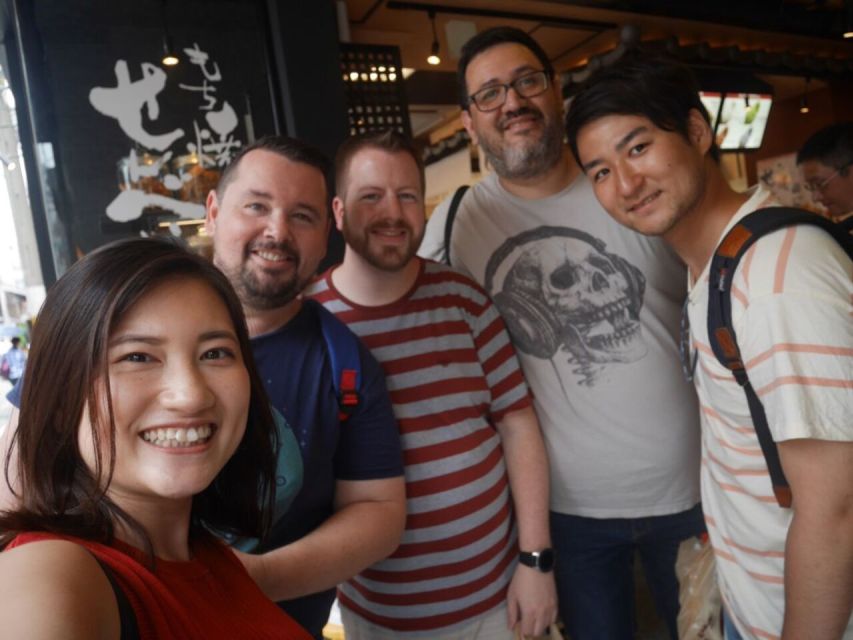
The small group, limited to seven people, is another strong point. Guides such as Chie, Yutaka, Hikaru, Yuki, and Takaya have been praised for clear English, useful recommendations, and taking group photos along the way. You should arrive hungry, carry cash, and wear comfortable shoes. This is a walking and eating tour, not a sit-back sightseeing ride.
In This Review
- Key points at a glance
- Starting beside Gion Shijo Station
- Shijo-ohashi Bridge and the quiet side of Gion
- Pontocho in the morning
- A calm pause at Nishiki-Tenmangu Shrine
- Two hours and 15 minutes inside Nishiki Market
- What the seven tastings are really worth
- Brunch is more than a final snack
- The guides make or break the morning
- How the $66 price measures up
- Who should book this food walk
- Weather, clothing, and the walking pace
- Should you book the Nishiki Market brunch tour?
- FAQ
- Where does the Nishiki Market brunch tour meet?
- How long does the tour last?
- What food is included?
- Is the tour conducted in English?
- Can the tour accommodate vegan, gluten-free, or allergy-related diets?
- Is the route accessible for wheelchairs and strollers?
Key points at a glance
- A morning route through old Kyoto: Walk from Gion Shijo through Pontocho and on to Nishiki Market while the area is still relatively peaceful.
- Seven food stops plus a proper meal: You get four or five market tastings, other small bites, and a restaurant brunch.
- Nishiki Market with local guidance: The guide helps explain unfamiliar foods, market customs, Kyoto specialties, and what may be worth buying later.
- A shrine visit along the way: Nishiki-Tenmangu adds a quiet cultural stop and a chance to learn basic shrine etiquette.
- Personal attention in a group of seven or fewer: The size makes it easier to ask questions, keep together, and adjust the pace.
- A few important limits: The route is not suitable for wheelchair users or strollers, and gluten-free and vegan diets cannot be accepted.
Starting beside Gion Shijo Station
The meeting point is just outside Exit 5 of Gion Shijo Station, at the Statue of Izumo-no-Okuni. Your MagicalTrip guide will hold a sign with the company name, which keeps the start simple even if you are new to Kyoto.
From there, the tour heads toward Shijo-ohashi Bridge. This first section is short, but it gives you a useful orientation to central Kyoto. You are not being rushed straight to the market. Instead, the walk sets up the relationship between Kyoto’s streets, entertainment districts, religious sites, and food culture.
The tour is conducted in English by a certified local guide. That matters here because Nishiki Market is easy to visit on your own, but less easy to understand. A stall may display an unfamiliar ingredient or snack without much explanation. A good guide turns a quick taste into a lesson about how the food fits into daily life.
More Market Tours in Kyoto
- Nishiki Market Brunch Walking Tour (7 Tastings + Brunch)
★ 5.0 · 1,355 reviews - Kyoto Nishiki Market Food and Culture Walking Tour
★ 5.0 · 412 reviews - Kyoto: Nishiki Market Tea Ceremony with Koto Performance
★ 4.8 · 294 reviews
Shijo-ohashi Bridge and the quiet side of Gion
The bridge stop lasts about five minutes. It is a brief pause, not a long sightseeing visit, but the location helps frame the walk through central Kyoto.
The route description refers to Gion, though one useful point from the tour details is that you do not actually visit the famous Gion street. Instead, you pass through nearby areas and hear about the district, its customs, and its connection to Kyoto’s traditional entertainment world.
That distinction is worth knowing before you book. If your main goal is photographing the well-known lanes of Gion, this is not a dedicated Gion photo walk. The value here is the combination of a morning stroll, local explanation, and food stops that follow.
Several guides have made the walking portion especially strong. Hikaru was praised for explaining how to tell a shrine from a temple and for showing visitors how to pray properly. Yutaka was described as friendly, funny, and full of useful background about Kyoto. Chie brought a strong interest in Japanese history and took many photographs during the route.
Pontocho in the morning
The group spends roughly 15 minutes in Pontocho. This narrow district is closely linked with Kyoto’s dining and evening entertainment, yet the morning mood is much quieter than it is after dark.
That contrast is one of the best reasons to take this tour early. You can see the shape and character of the area without the nighttime crowds and bright signs competing for attention. Your guide can explain what you are seeing instead of leaving you to guess at the district’s role in Kyoto.
The walk also helps you build an appetite. The route is gentle rather than strenuous, but you will be on your feet and moving through streets before settling in for the main meal. I would avoid eating breakfast before meeting the group. The tastings arrive throughout the market visit, and brunch is substantial enough that a full meal beforehand would be a mistake.
A calm pause at Nishiki-Tenmangu Shrine
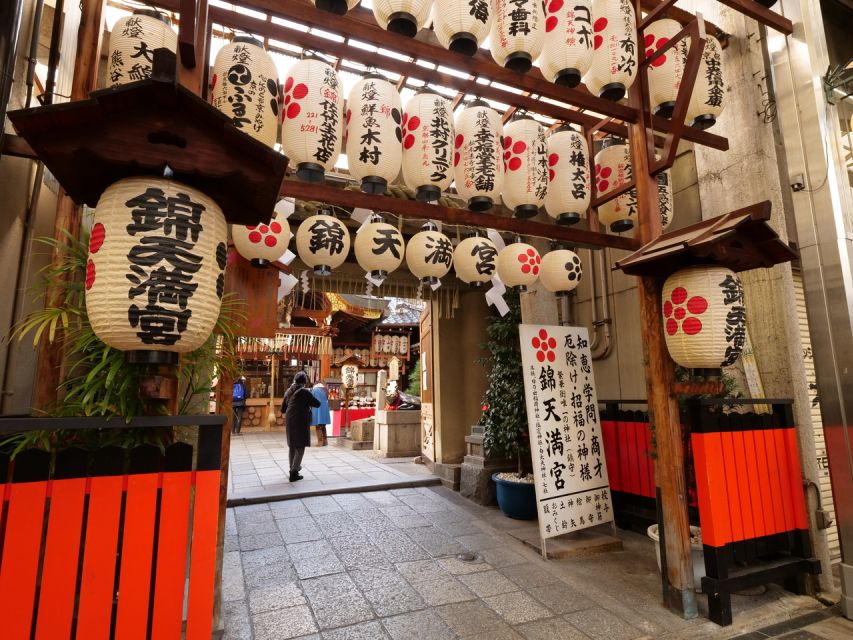
Before entering the market, the group visits Nishiki-Tenmangu Shrine for about 15 minutes. This gives the morning some balance. You are not only moving from one snack to another, but also stopping to learn about a place used by local people.
The shrine visit is a good chance to ask questions about Japanese religious customs. Several guides have taken time to explain prayer rituals and the difference between shrines and temples. That kind of information is practical because it helps you behave respectfully at other religious sites during the rest of your Kyoto stay.
The stop also breaks up the food focus. Nishiki Market can easily become a sensory rush, with stalls, smells, souvenirs, seafood, sweets, and cooking displays competing for your attention. A quiet shrine beforehand gives you a slower cultural moment before the market portion begins.
More Walking Tours in Kyoto
- Kyoto Geisha Walking Tour: Gion District & Hidden Gems
★ 4.7 · 3,273 reviews - Kyoto: Gion Magical Night Walking Tour with Geisha Trivia
★ 4.9 · 2,393 reviews - Kyoto: Gion Geisha District Walking Tour – Stories of Geisha
★ 4.7 · 2,187 reviews - Night Walk in Gion: Kyoto’s Geisha District
★ 4.5 · 2,003 reviews
Two hours and 15 minutes inside Nishiki Market
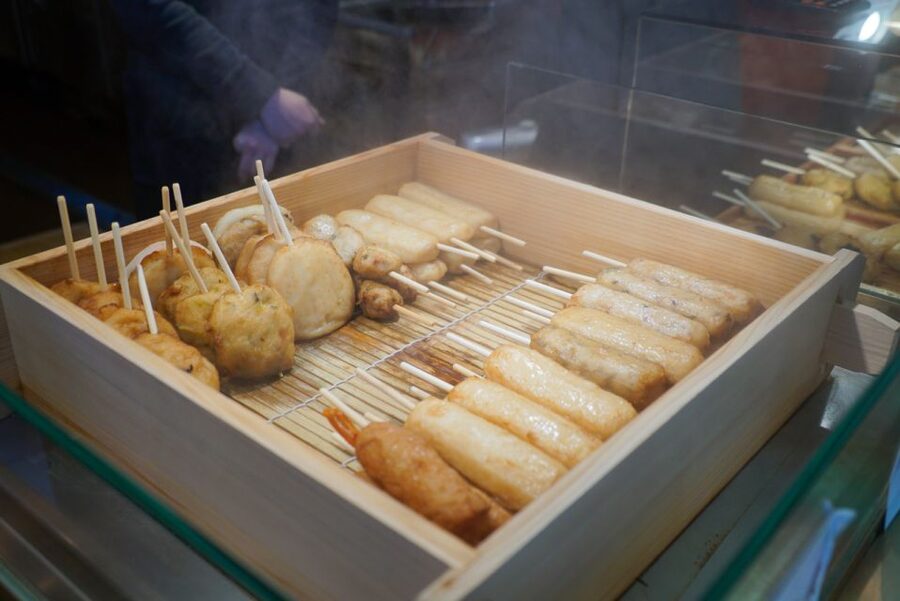
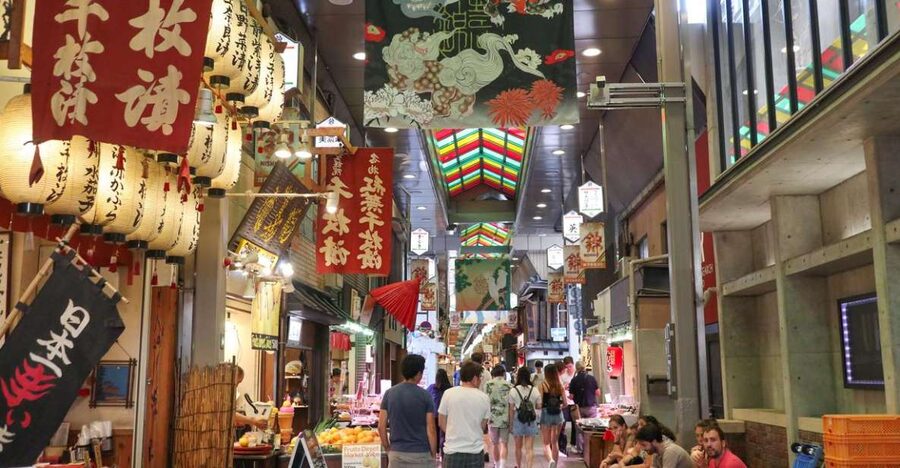
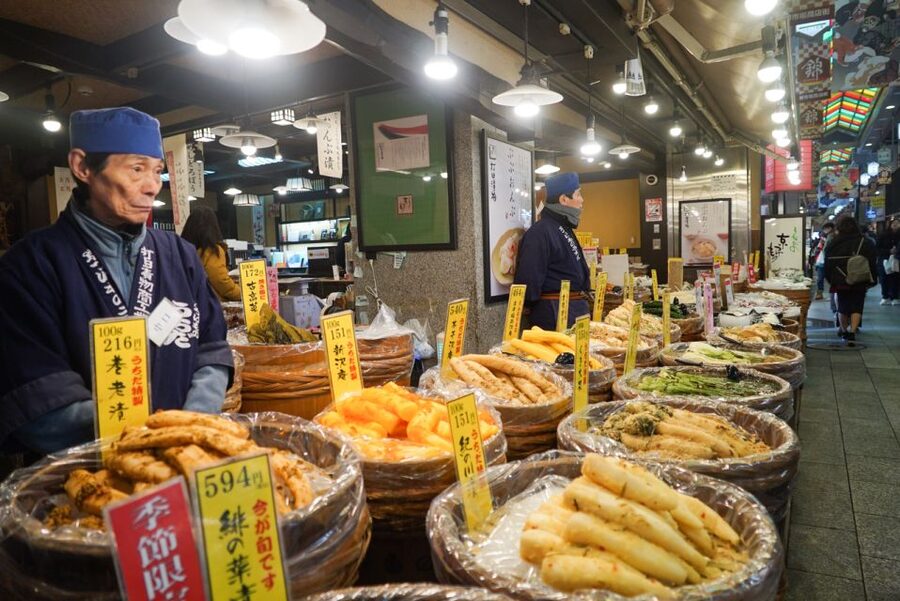
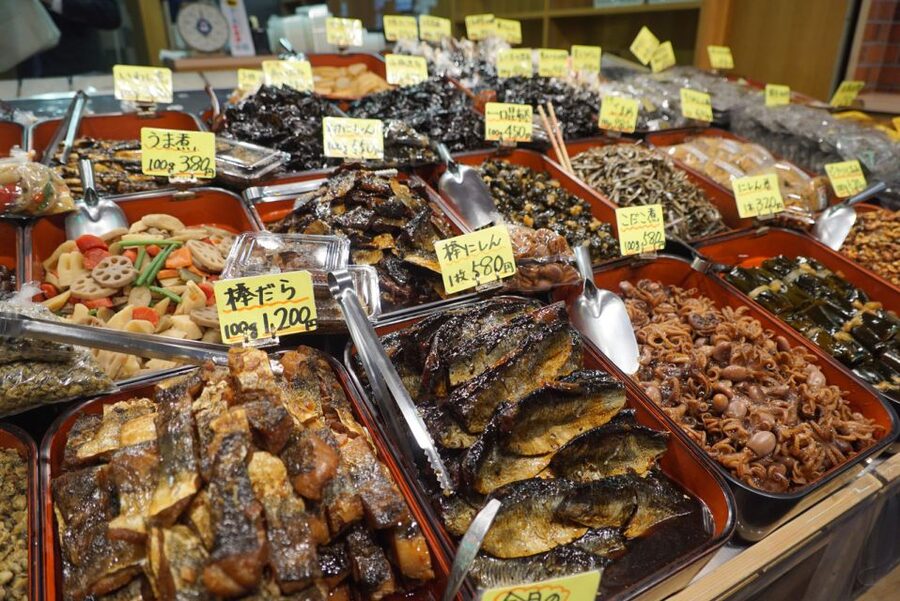
The largest part of the tour takes place at Nishiki Market, often called the Kitchen of Kyoto. The market has more than 400 years of history and runs as a long row of food stalls and shops. It is not an enormous maze, so do not expect a giant indoor market covering many blocks. Its appeal comes from the tight line of vendors and the mix of food, household goods, gifts, soaps, honey, seafood, and other local products.
You spend about two hours and 15 minutes here, which is enough time to sample food without treating the market like a speed contest. The guide selects four or five market dishes, and the full tour includes seven kinds of tastings. The precise foods can change, but the point is variety. You may try items you would otherwise pass by because the name, appearance, or preparation is unfamiliar.
This is where the small group helps most. Nishiki’s passage can become crowded, especially later in the day. With no more than seven participants, the guide can keep people together, answer questions, and make it easier to stop at a stall without blocking everyone else.
Several guides have also adjusted the pace or route to reach the market early. That is useful during busy seasons. The morning timing does not make the market empty, but it can make popular stops easier to manage.
What the seven tastings are really worth
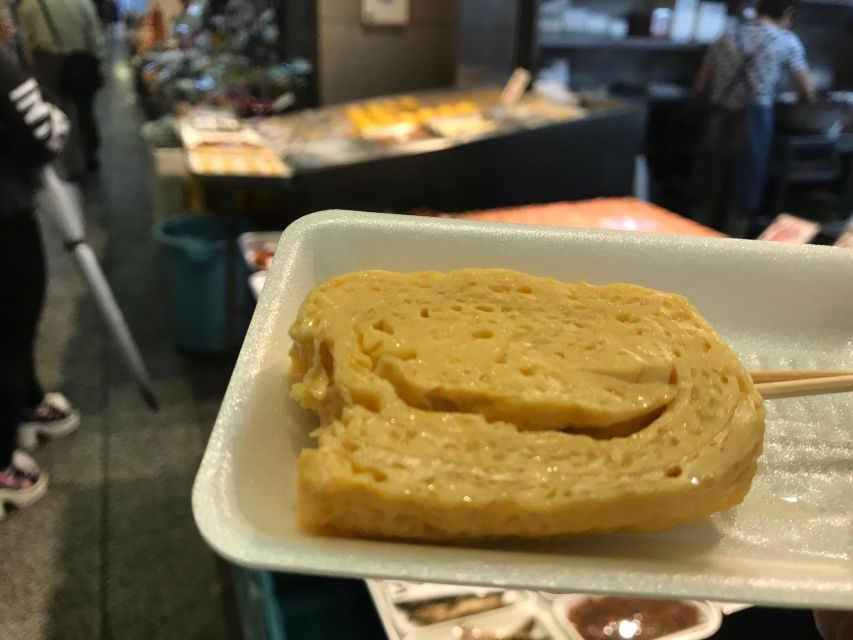
The food is the center of the tour, but the value is not simply the number seven. A market snack purchased alone may cost little. The advantage of the tour is that you can sample several foods without having to choose every stop yourself, struggle with unfamiliar ordering, or wonder what is worth trying.
Guides have helped participants try foods they might normally reject, then explained what they were eating and why it matters in Kyoto. That is a better approach than a generic food crawl built around only familiar items.
You should also expect the tastings to include more than one type of bite. The tour combines market samples, snacks or desserts, and a proper brunch. Some participants have enjoyed seafood, sake, traditional sweets, and other local specialties. Exact choices depend on the available stalls and the guide’s selection, so do not book this expecting a fixed menu.
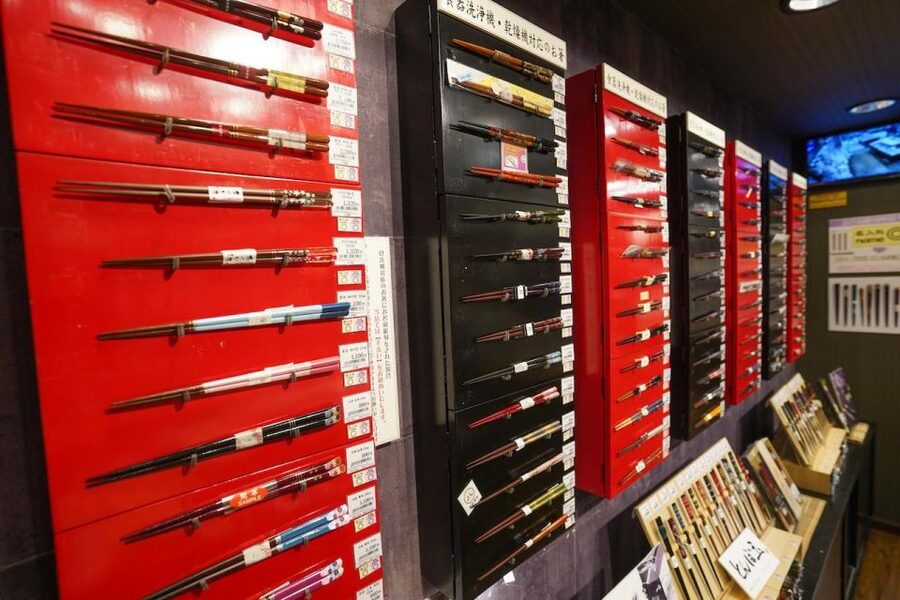
Cash is specifically recommended. Even though the included tastings and brunch are handled as part of the tour, you may want to buy something for later, and additional food or drinks are not included. A little spending money lets you return to a favorite stall instead of simply making a mental note and moving on.
Brunch is more than a final snack
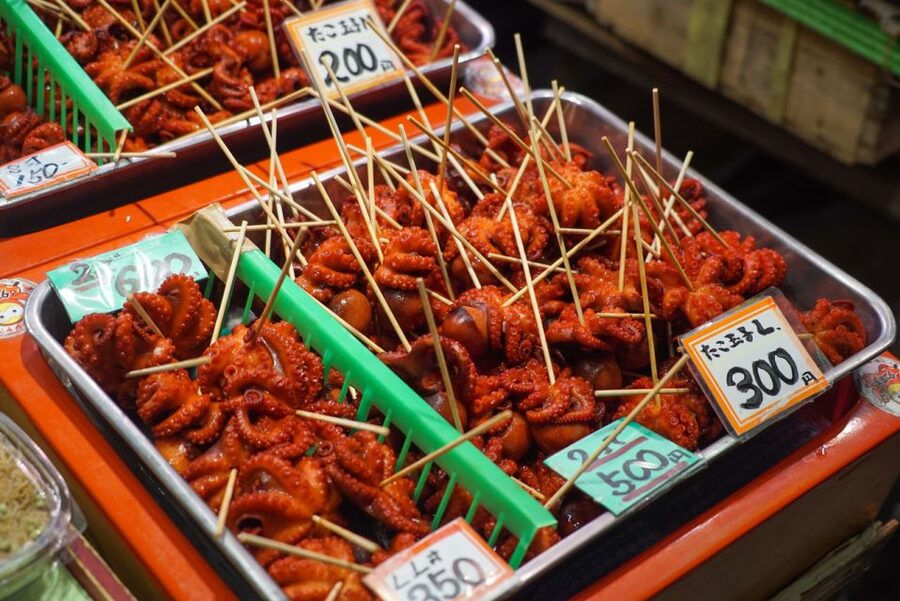
The tour ends its food portion with brunch at a restaurant. This is an important difference between a market sampling walk and a full morning food tour. Small samples can be fun, but they do not always make a meal. Here, you finish with a sit-down restaurant meal, and participants have praised the food as delicious and filling.
At some stops, the guide has offered a choice of several dishes. One tour included six brunch choices, while another ended with a yuba meal. The exact restaurant and menu may vary, so treat those examples as possibilities rather than promises.
Sharing a meal with the guide also gives you time to ask questions without trying to talk over market noise. Guides have discussed the history of the restaurant, suggested places to eat later, and offered ideas for continuing a food-focused day in Kyoto.
I especially like this part for first-time visitors. You are not left at the market entrance with a list of foods and no plan. You finish with a meal, some context, and recommendations you can use during the rest of your trip.
The guides make or break the morning
The food is important, but the guide is the feature that receives the strongest praise. Names that appear repeatedly in the tour feedback include Yutaka, Chie, Hikaru, Yuki, Yuma, Nori, Peco, Aki, Takaya, and Reiko.
That does not mean you can select a specific guide when booking. It does show the sort of service the company aims for. Guides have been described as friendly, patient, humorous, clear in English, and willing to answer questions about history, food, festivals, shrines, and local customs.
Chie has been especially good at making history lively, taking photographs, and allowing participants to try foods that catch their eye. Takaya used visual diagrams, fun facts, and stories to explain Kyoto culture, while also tailoring the tour to the group’s interests. Yuki has provided context that made a familiar market feel different on a second visit.
Photos are included during the tour. This is handy for couples and families who want group shots without asking strangers every few minutes. Do not expect a professional photo session, but you can expect the guide to help capture the morning at useful points.
How the $66 price measures up
At $66 per person, this is not the cheapest way to enter Nishiki Market. You can walk through the market for free and buy a few snacks on your own.
The price begins to make sense if you value seven included tastings, a restaurant brunch, and three hours of local guidance. You are also paying for help choosing food, explanations in English, group photos, and a route that combines several nearby areas rather than stopping at Nishiki alone.
It is especially good value for a first visit. If you already know Nishiki Market well, speak Japanese, and prefer choosing every dish independently, you may find the structure less useful. For most visitors, though, the included meal and tastings reduce the guesswork and make the morning easier.
Free cancellation up to 24 hours before the tour and a reserve-now, pay-later option add flexibility. Starting times vary, so check availability before planning other activities around it.
Who should book this food walk
I would recommend the tour to first-time Kyoto visitors who want an introduction to local food and central neighborhoods without committing to a full-day excursion. It also suits families with older children and teenagers. One guide was praised for connecting well with children, and the small group makes it easier to keep everyone involved.
Food-focused visitors will get the most from it, especially if you enjoy trying unfamiliar dishes. The guide can point out items you might overlook and explain what makes them part of Kyoto’s food traditions.
It is also a useful first or second morning in the city. You get practical food suggestions for later, learn basic shrine etiquette, and finish near Nishiki Market, where you can continue shopping or eating on your own.
This is not the right choice for wheelchair users or people using strollers because parts of the route are not accessible. It is also unsuitable for people with gluten intolerance. Vegan requests cannot be accepted, and the operator cannot guarantee allergy-free food because the dishes are prepared in kitchens it does not control.
If you have an allergy or dietary request, tell the operator at least one day before the tour. Substitutions may not be possible at every stop, though the guide will try to make adjustments elsewhere. That policy is worth taking seriously rather than hoping the market will provide an easy solution.
Weather, clothing, and the walking pace
Kyoto’s climate can be demanding. Summer temperatures may reach 40°C, while winter temperatures can fall to -5°C. Dress for the forecast, bring water when needed, and wear shoes that can handle three hours of walking and standing.
The route includes outdoor streets, a bridge, a shrine, and the market. Rain or heat can affect how comfortable the morning feels, even though the market portion provides some shelter in places. A hat in summer and warm layers in winter are sensible choices.
The walk itself is generally easy, but easy does not mean entirely seated. You will stroll through several districts before spending most of the time at the market. If you have mobility concerns, read the accessibility limits carefully before paying.
Should you book the Nishiki Market brunch tour?
Book it if you want Nishiki Market to make sense, not just look interesting. The combination of quiet morning streets, Pontocho, Nishiki-Tenmangu Shrine, seven tastings, and a full brunch gives you a well-shaped introduction to Kyoto food and culture.
The strongest reasons to go are the small group, the helpful guides, and the fact that the meal is included. Guides such as Chie, Yutaka, Hikaru, and Takaya have made the tour personal through photos, clear explanations, and useful food suggestions.
Skip it if you need strict dietary control, wheelchair access, or complete freedom to choose every stop. Otherwise, $66 is a fair price for a three-hour introduction that leaves you full, better oriented, and ready to explore Nishiki Market again on your own.
FAQ
Where does the Nishiki Market brunch tour meet?
Meet outside Exit 5 of Gion Shijo Station, beside the Statue of Izumo-no-Okuni. The guide will hold a sign saying MagicalTrip.
How long does the tour last?
The tour lasts three hours. Starting times vary, so check availability when booking.
What food is included?
The tour includes brunch at a restaurant and seven kinds of tastings. Four or five of the tastings are selected by the guide at Nishiki Market. Additional food and drinks are not included.
Is the tour conducted in English?
Yes. The tour includes a live English-speaking guide.
Can the tour accommodate vegan, gluten-free, or allergy-related diets?
Vegan and gluten-free requests cannot be accommodated. Allergy-free food is not guaranteed because the food is prepared in kitchens that do not belong to MagicalTrip. Inform the operator at least one day before the tour about any dietary requests or allergies.
Is the route accessible for wheelchairs and strollers?
No. Some locations on the route are not accessible by wheelchair or stroller, and the tour is not suitable for wheelchair users.
More Shopping Tours in Kyoto
- Kyoto: Local Food Tasting Tour at the Nishiki Market
★ 4.7 · 135 reviews - Kyoto: Nishiki Market and Depachika Food Tour with a Local
★ 4.7 · 76 reviews - Kyoto: Nishiki Market Tour with a Local Foodie & Tastings
★ 4.5 · 67 reviews - Nishiki Market Lunch Tour
★ 5.0 · 47 reviews
Just added around Kyoto
- Kyoto: Gion Night Walking Tour with Geisha Insight★ 5.0 · 39 reviews
- Kyoto: Private Customizable Day Trip by Car★ 5.0 · 38 reviews
- Kyoto: Full Day Bike Tour★ 4.9 · 39 reviews
- Private Japanese Calligraphy in Kyoto – Learn Shodō with a Master★ 5.0 · 39 reviews
- Experience a tea ceremony in an authentic tearoom, in Kyoto!★ 4.5 · 41 reviews
- Kyoto: Gion Evening Walk with Hidden Gems, Geisha & Sake★ 5.0 · 41 reviews
- Kyoto Private Photo Shoot & Tour by SnapKyoto★ 5.0 · 41 reviews
- The Way of Tea: Kyoto Crafts, Hidden Temples & Wabi-Sabi Walk★ 5.0 · 41 reviews
Markets, compared.
Tokyo Tsukiji Fish Market Food and Culture Walking Tour
Read our review →
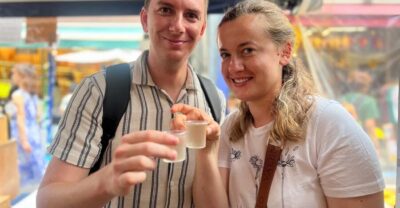
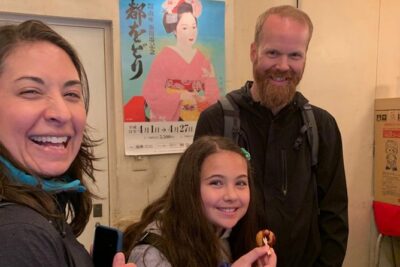
Nishiki Market Brunch Walking Tour (7 Tastings + Brunch)
Read our review →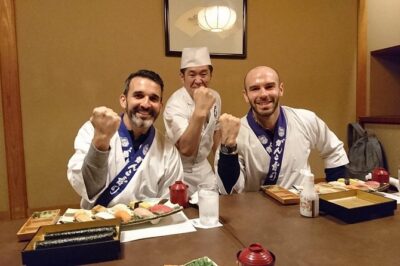
Tsukiji Fish Market Guided Tour and Sushi Making with Pro Chef
Read our review →Tsukiji Fish Market Food and Culture Walking Tour
Read our review →
Tsukiji Fish Market: Street Food & Culture Walking Tour
Read our review →
Tsukiji Fish Market Small-Group Food Walking Tour
Read our review →Browse the lists this tour appears in