
Reviewed · SAMURAI & NINJA EXPERIENCES
Ninja 2-hour Hands-on Lesson by Japanese master in Kyoto -Medium
Ninjas come to life in Kyoto. This small-group lesson gives you two hours of hands-on training with an English-speaking Japanese sensei, covering meditation, breathing, stealthy movement, and traditional weapons. I like the group limit of six, which leaves room for personal help, and the included ninja clothing, which makes the session more fun and gives you memorable photos. The main consideration is that this is an introductory class, not serious martial-arts training.
You meet at the NINJA Dojo and Store Kyoto at 10 a.m. and return to the same spot. The $95.51 price is fair if you want an active cultural experience rather than another temple visit, especially since clothing rental and admission are included. Families and first-timers seem to fit the class well, but anyone expecting a long historical lecture or advanced combat practice may find the lesson lighter than expected.
In This Review
- Key points to know before booking
- Starting at the Kyoto Ninja Dojo
- Changing into ninja clothing
- Beginning with Kuji-In meditation and ninja breathing
- The ninja trick house and its hidden mechanisms
- Practicing the ninja sword and other weapons
- How the two-hour lesson feels in practice
- Why families and mixed-age groups fit so well
- Is $95.51 a good value?
- Practical details that affect your day
- Who should book this Kyoto ninja lesson?
- Should you book the Ninja lesson?
- FAQ
- Where does the ninja lesson meet?
- What time does the experience start?
- How long does the ninja class last?
- How many people can join the class?
- Is ninja clothing included?
- Is the lesson taught in English?
- What techniques are included?
- Is transportation included?
- Can I cancel for a full refund?
Key points to know before booking
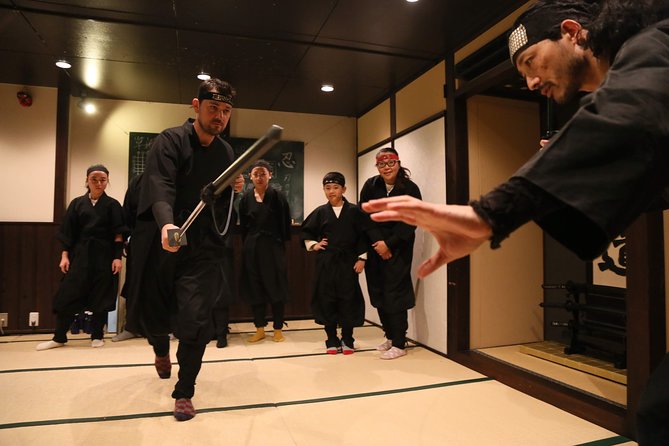
- Six-person maximum: A small class gives you more chances to practice and ask questions.
- Full ninja clothing included: You change into the dojo’s ninja outfit before training begins.
- Many techniques in two hours: The lesson covers breathing, meditation, walking, sword work, rope methods, shuriken, kunai, and blow darts.
- English instruction: A Japanese sensei trained in ninja arts teaches the class in English.
- Family-friendly format: Children as young as five have taken part, while adults and older children also found it enjoyable.
- Same-day photos may be provided: Staff take photos and videos during the session and may send them by email afterward.
Starting at the Kyoto Ninja Dojo
The experience begins at NINJA Dojo and Store Kyoto, at 528 Hakurakutencho, second floor, in Kyoto’s Shimogyo Ward. The listed postal code is 600-8422. You should arrive early, since the entrance routine includes removing your shoes and changing into indoor footwear before heading upstairs.
The class starts at 10 a.m. and ends back at the meeting point. There is no hotel pickup, so you need to make your own way to the dojo. The location is near public transportation, which makes it practical to fit into a day of sightseeing around central Kyoto.
One useful detail is the small size. The class accepts no more than six people, rather than placing you in a large room full of participants. That matters when you are learning physical movements. The instructor can watch your stance, explain a technique again, or help a child who needs a slower demonstration.
The atmosphere is designed to be friendly and playful. Sho is one staff member mentioned in the experience, welcoming people at the door and helping with the change into ninja clothing. The clothing is part of the event, not an optional extra, so you do not need to bring a costume.
More Samurai & Ninja Experiences in Kyoto
- Kyoto Samurai Experience
★ 5.0 · 1,294 reviews - Kyoto: Kendo and Samurai Experience with Uniform and Gear
★ 4.9 · 815 reviews - Kyoto: Samurai Sword Class by Experts in Traditional Arts
★ 4.9 · 657 reviews
Changing into ninja clothing
The costume helps turn a short lesson into a complete activity. You dress in the dojo’s own ninja clothing before the instruction begins, and staff help if you need it. For children, this is often the moment the class shifts from ordinary sightseeing to make-believe with a practical edge.
The outfit also works well for photographs. Staff take pictures and videos during the session, and some participants received the files by email through Google Photos on the same day. That service is a welcome touch, since it lets you concentrate on the activity instead of trying to photograph every movement yourself.
Still, you should treat the costume as part of the fun rather than historical proof that you are dressed exactly like a medieval ninja. The class uses familiar ninja imagery and training methods in an accessible modern setting. That makes it easy to enjoy, but it also means the experience is entertainment and instruction combined, not a museum demonstration.
Beginning with Kuji-In meditation and ninja breathing
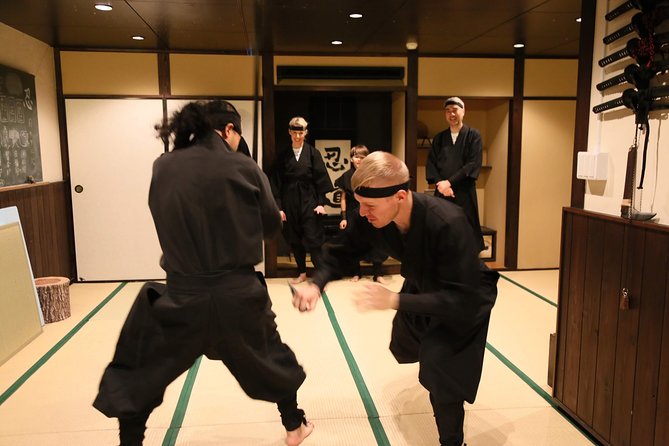
The class starts with quieter exercises, including Kuji-In ninja meditation and breathing. This is a smart way to begin. Instead of rushing straight to weapons, the sensei introduces the mental side of ninja practice and gives you a chance to settle into the lesson.
You also learn about ninja walking. The movement is presented as a technique, not just a costume pose. You can expect demonstrations followed by your own attempts, with the instructor correcting or encouraging you as needed.
These early activities may appeal most to adults who want more than staged sword swings. They provide a glimpse of the discipline and concentration linked with ninja training. Children may find the meditation section less exciting than throwing stars or firing blow darts, but the short format keeps the pace moving.
One point to keep in mind: the available information gives only a brief outline of the historical background. If you want a detailed account of ninja origins, regional traditions, or the difference between popular images and historical evidence, you may need to ask questions during the session or study that subject elsewhere.
The ninja trick house and its hidden mechanisms
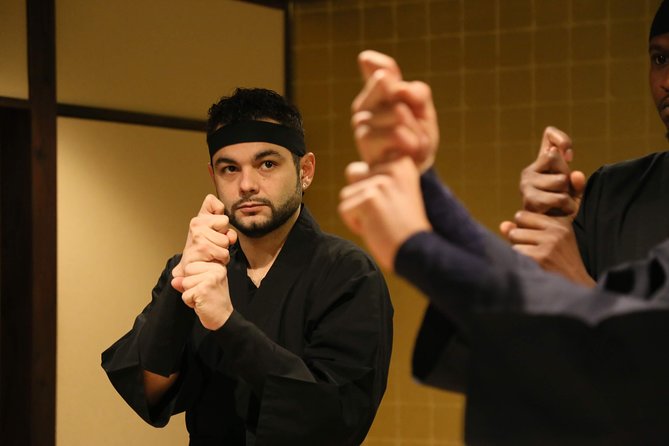
The lesson includes an introduction to gimmicks and traps in a ninja trick house. This section adds a physical setting to the ideas introduced during meditation and walking. Rather than simply hearing about stealth, you get to see how concealment and surprise can be built into a space.
The trick-house portion is especially useful for families. It gives younger participants something to inspect and react to, while adults can appreciate the practical side of the demonstration. It also breaks up the lesson before the weapons practice begins.
The details of the trick house are not specified, so you should not expect a full-scale historical residence or a large attraction. Think of it as one segment of a compact dojo lesson. Its value comes from showing ninja-style devices in context, not from occupying most of the two hours.
A completely different kind of day out in Kyoto:
- PERFECT KYOTO 1-Day Bus Tour
★ 5.0 · 13,518 reviews - Kyoto: Fushimi Inari, Kinkakuji, Bamboo Grove 1 Day Bus Tour
★ 4.8 · 4,316 reviews - Kyoto: Tea Ceremony in a Traditional Tea House in Kiyomizu
★ 4.9 · 3,519 reviews - Kyoto Geisha Walking Tour: Gion District & Hidden Gems
★ 4.7 · 3,273 reviews
Practicing the ninja sword and other weapons
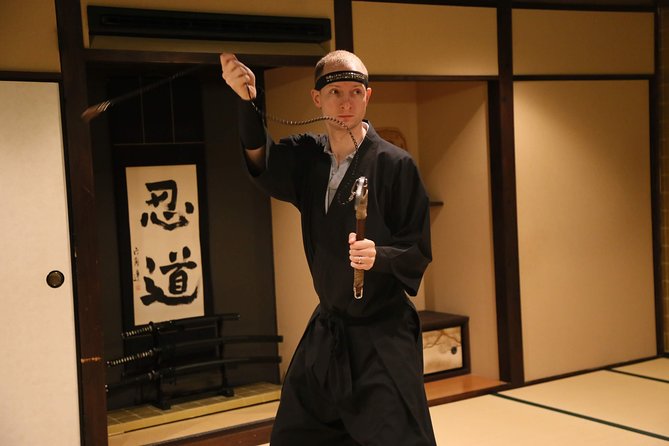
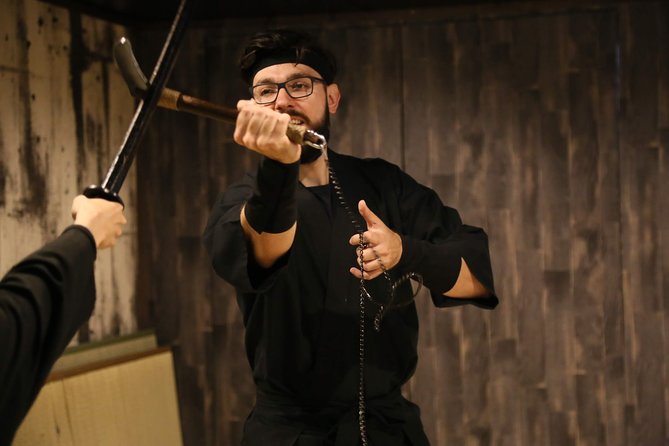
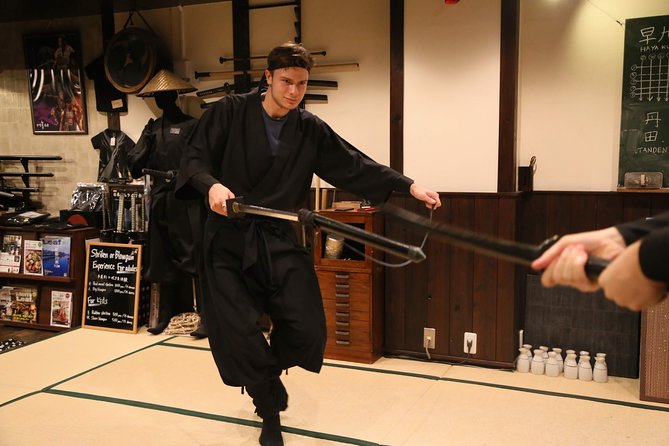
The weapons portion is the main attraction for many people. Training includes the ninja sword, kunai dagger, kusarigama sickle with chain, rope techniques, kunai with rope, shuriken ninja stars, stick-type shuriken, and a ninja blowgun with blow darts.
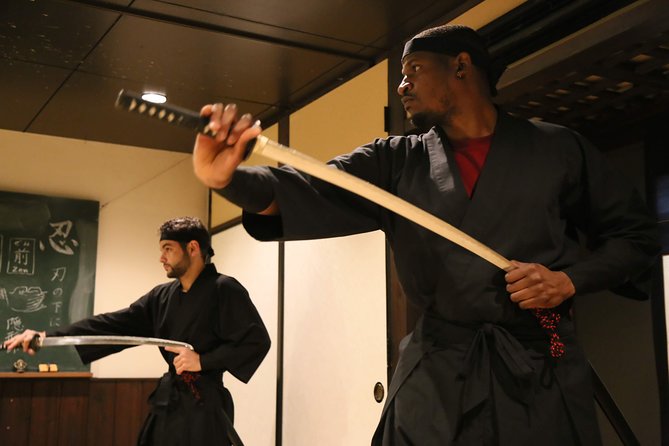
You also practice combinations such as ninja sword with shuriken. The sensei demonstrates each movement before you try it, and the class is built for beginners. That matters because the list sounds ambitious for a two-hour session. You will sample many skills rather than master them.
Several people particularly enjoyed being allowed to handle the weapons and aim at targets. The experience is described as using authentic training weapons rather than toy props, which gives the practice more weight. At the same time, the lesson is structured for general visitors, not specialists. Follow the instructor closely and treat every object with care.
The shuriken and blowgun exercises bring a clear sense of achievement. You can see the result of your attempt right away, which helps keep the session lively. The sword practice offers a different challenge, focusing more on posture, grip, and controlled movement than on speed.
The kusarigama and rope work are likely to feel less familiar. They show that ninja tools were not limited to the sword and throwing star image common in films and games. You may not leave with polished technique, but you will have tried a broad set of skills in a short time.
How the two-hour lesson feels in practice
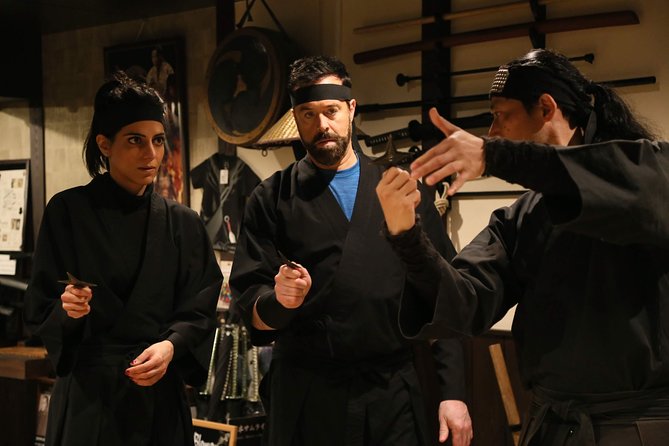
The class has a useful rhythm: quiet concentration, movement, demonstrations, and target practice. That variety is one reason it works for mixed groups. A family can participate together, and adults do not need to be highly flexible or athletic to take part.
The pace can also feel full. The elementary-level lesson includes the entry-level material plus five additional techniques, while the complete outline lists more than a dozen activities. You should expect a sampler class with clear demonstrations and repeated attempts, not long periods devoted to one weapon.
The instructors are described as patient, funny, and clear in English. That combination matters more here than formal credentials. Beginners need simple explanations, especially when several children and adults of different ages share one class.
Photos and videos are taken during the session, sometimes by a staff member using a professional camera. If this service is important to you, confirm the current arrangement when you arrive, since the supplied details describe it as something participants received rather than a separately listed inclusion.
Why families and mixed-age groups fit so well
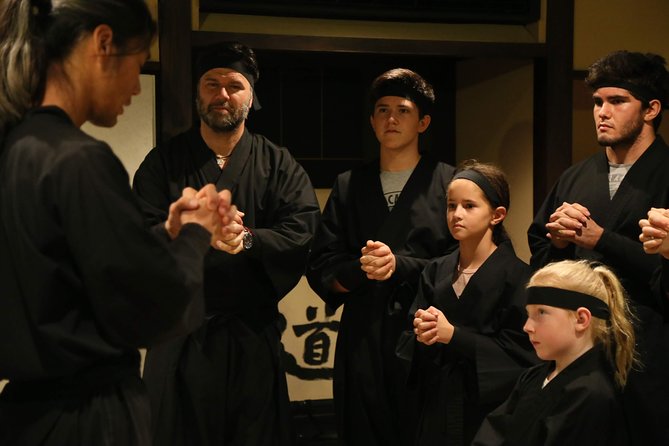
The strongest case for this experience is a family looking for something active. Children aged five to twelve have taken part, and older children and teenagers have also enjoyed it. The activity is hands-on without requiring prior martial-arts experience.
Adults are not left behind. Couples, parents, solo participants, and groups with young people have all found the lesson accessible. One useful detail for older visitors is that the movements are not presented as demanding athletic drills. A middle-aged couple who were not especially limber still found the class manageable.
The session also gives families a shared activity rather than another attraction where everyone walks quietly from room to room. You dress alike, learn the same techniques, and have photos to remember the afternoon or morning. That shared silliness is part of the appeal.
Very young children may need help following instructions, especially during weapon exercises. The small group makes that easier, but you should still stay attentive and make sure children listen to the sensei before touching or using any equipment.
Is $95.51 a good value?
At $95.51 per person, this is not a cheap add-on. Kyoto offers plenty of low-cost sightseeing, and you can visit many temples for far less. The question is what you want your money to buy.
The fee includes admission and ninja clothing rental, so there are no listed extra charges for entering the dojo or borrowing the outfit. You also receive a two-hour lesson with an English-speaking Japanese sensei in a group capped at six people. Those details make the price easier to justify than a brief photo opportunity.
I would consider it good value for a family or anyone who wants a memorable activity between cultural visits. The lesson gives you instruction, participation, costume photos, and contact with a specialized part of Japanese culture. It is less attractive for someone mainly seeking detailed historical education or formal martial-arts certification.
The class has received a five-star rating from 218 reviews, with 100 percent recommending it. That strong response matches the parts of the experience that are easiest to judge: the friendly instructors, the personal attention, the number of activities, and the fun of dressing up.
Practical details that affect your day
The tour starts at 10 a.m. and lasts about two hours. Since it ends where it begins, you can plan another Kyoto activity afterward without arranging a second pickup point.
Food and drinks are not included. You may want to eat before the morning session or plan lunch afterward. The dojo has a store, which can be convenient if you want to browse or buy a ninja-themed souvenir after class.
Confirmation is provided when you book. Most people can participate, and service animals are allowed. The class is near public transportation, but you are responsible for getting to the meeting point.
Cancellation is free up to 24 hours before the start time for a full refund. Changes or cancellations inside that 24-hour window are not accepted and are not refunded. The activity can also be canceled if poor weather affects the session or if the minimum number of participants is not reached. In those cases, you are offered another date or experience, or a full refund.
Who should book this Kyoto ninja lesson?
I would recommend it most strongly to:
- Families with children who need a break from temples and museums
- First-time visitors curious about ninja culture
- Couples looking for a playful shared activity
- Solo participants who want a structured experience in Kyoto
- Teenagers who enjoy action-based activities
- Adults who like learning by doing rather than watching
I would be more cautious if your main goal is historical study. The lesson includes information and ninja philosophy, but the available details suggest a broad introduction rather than a specialist seminar. I would also avoid booking it if you dislike costumes, staged demonstrations, or handling training weapons.
The class is not presented as a path to real ninja certification. The joking idea of becoming ninja certified captures the mood, but your reward is a fun set of skills and memories, not a professional qualification.
Should you book the Ninja lesson?
Yes, if you want an unusual Kyoto activity with plenty of participation. The small group, English-speaking Japanese sensei, broad selection of techniques, and included clothing give the experience more substance than a quick dress-up photo stop.
Book it especially if your family includes children or teenagers, or if you want a lighter morning after several serious cultural sights. The only real warning is to keep your expectations in line: you will sample many ninja skills in two hours, not receive advanced training or a long history course.
For $95.51, I think the class earns its place in a Kyoto itinerary when you value interaction, humor, and a story to take home. Arrive early, wear comfortable clothing beneath the costume, listen carefully during the weapon demonstrations, and leave room in your day for lunch after the dojo.
FAQ
Where does the ninja lesson meet?
The lesson meets at NINJA Dojo and Store Kyoto, 528 Hakurakutenchō, second floor, in Kyoto’s Shimogyo Ward. The postal code is 600-8422.
What time does the experience start?
The listed start time is 10:00 a.m.
How long does the ninja class last?
The lesson lasts approximately two hours.
How many people can join the class?
The activity has a maximum of six participants.
Is ninja clothing included?
Yes. Ninja clothing rental during the training is included in the price.
Is the lesson taught in English?
Yes. A Japanese sensei trained in ninja arts teaches the class in English.
What techniques are included?
The lesson includes Kuji-In meditation, ninja breathing, ninja walking, trick-house mechanisms, ninja sword practice, kunai, kusarigama, rope techniques, shuriken, stick-type shuriken, sword and shuriken practice, and a ninja blowgun with blow darts.
Is transportation included?
No. Hotel pickup and drop-off are not included. The dojo is near public transportation, and the activity ends back at the meeting point.
Can I cancel for a full refund?
Yes, if you cancel at least 24 hours before the experience start time. Cancellations within 24 hours are not refunded, and changes inside that window are not accepted.
More 2-Hour Experiences
- Kyoto Gion: 2-Hour Geisha Culture & History Walking Tour
★ 5.0 · 1,186 reviews - Kyoto: 2-Hour Maiko Makeover and Photo Studio Shoot
★ 4.7 · 122 reviews - Kyoto 2 Hours Genuine Kendo / Samurai Experience In Japan
★ 5.0 · 57 reviews - Osaka: 2-Hour Nightlife District Walking & Local Food Culture
★ 5.0 · 199 reviews
Just added around Kyoto
- Kyoto: Gion Night Walking Tour with Geisha Insight★ 5.0 · 39 reviews
- Kyoto: Private Customizable Day Trip by Car★ 5.0 · 38 reviews
- Kyoto: Full Day Bike Tour★ 4.9 · 39 reviews
- Private Japanese Calligraphy in Kyoto – Learn Shodō with a Master★ 5.0 · 39 reviews
- Kyoto: Gion Evening Walk with Hidden Gems, Geisha & Sake★ 5.0 · 41 reviews
- Experience a tea ceremony in an authentic tearoom, in Kyoto!★ 4.5 · 41 reviews
- Kyoto Private Photo Shoot & Tour by SnapKyoto★ 5.0 · 41 reviews
- The Way of Tea: Kyoto Crafts, Hidden Temples & Wabi-Sabi Walk★ 5.0 · 41 reviews
Samurai & Ninja Experiences, compared.
Samurai Ninja Museum Guided tour and Experience
Read our review →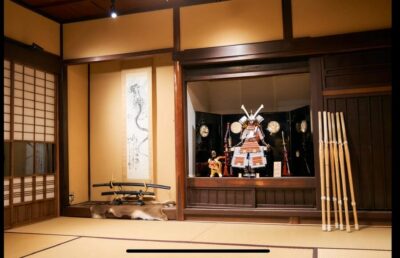
Kendo and Samurai Experience with Uniform and Gear
Read our review →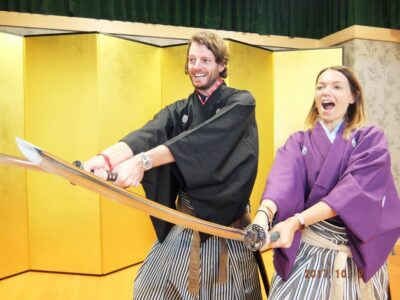
Samurai Sword Class by Experts in Traditional Arts
Read our review →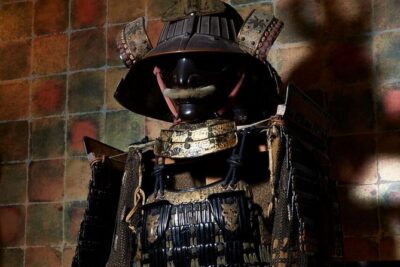
Skip the lines Basic Ticket at SAMURAI NINJA MUSEUM KYOTO
Read our review →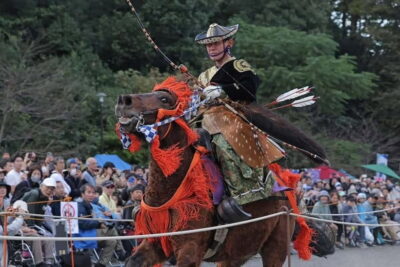
Samurai Sword & Archery Class from Samurai Descendant
Read our review →
Browse the lists this tour appears in