
Reviewed · GEISHA & GION DISTRICT TOURS
One Hour Geisha Show in Kyoto
Kyoto keeps a few doors delightfully closed. This small-group show gives you a rare look at a real Maiko, an apprentice Geisha, through graceful dance, conversation, tea, and a traditional game. I especially like the chance to ask direct questions and the friendly help from English-speaking guides such as Genki, Rin, Akari, and Taira Yoshino.
I also like that you can take photos and videos, then have a personal photo opportunity with the Maiko. The main thing to understand is that this is not one continuous hour of dancing. The dances are short by design, and the rest of the time includes explanations, questions, a game, tea, and, with the Tea House option, a shrine visit.
In This Review
- What Makes This Kyoto Show Special
- Meeting a Maiko in Kyoto
- The Two Dance Performances
- Tea, Snacks, and the Kyo-Machi-ya Setting
- The Gion Theater Option
- Questions, Explanations, and the Human Side
- The Game and Photo Opportunity
- Kitano Tenmangu Shrine With the Maiko
- Is $50 a Fair Price?
- Who Will Enjoy This Most?
- Practical Booking Advice
- Should You Book This Maiko Show?
- FAQ
- How long does the Maiko show last?
- Will the Maiko dance continuously for one hour?
- Can I take photos and videos?
- What is the difference between the Tea House and Gion Theater options?
- Is the experience wheelchair accessible?
- Which languages are available?
- What should I bring and what is not allowed?
What Makes This Kyoto Show Special
- A real Maiko appears in person: Kyoto has only about 40 Maikos left, making this a rare chance to see one up close.
- Two graceful dances: The performance includes two dances of roughly five minutes each, rather than a nonstop stage show.
- Questions are welcome: Your guide translates between the Maiko and the audience, helping you learn about her work, clothing, makeup, and life.
- A traditional game adds fun: You may play Konpira Fune Fune, a quick Japanese hand game. Be warned, it is harder than it looks.
- Two very different settings: The Tea House option takes place in a Kyoto-style Kyo-Machi-ya house and includes a shrine visit. The Gion Theater option takes place in a showhouse and is wheelchair accessible.
- Tea and snacks are included: Matcha or water and traditional Japanese snacks provide a calm introduction before the performance.
Meeting a Maiko in Kyoto
A Maiko is an apprentice Geisha, still learning the arts of dance, music, conversation, and formal hospitality. Her appearance is carefully arranged, from the kimono and hair ornaments to the makeup and accessories. That visual detail is not just decoration. It helps explain the role and traditions of the Maiko.
The show gives you time to look closely, but it is not a costume photo session. The Maiko is a working artist, and the performance is built around restraint and formality. You get a glimpse of a private cultural world without pretending that it is an everyday public attraction.
That distinction matters. The short dances may surprise you if you expect a full hour of continuous entertainment. In this tradition, performances are intentionally brief to protect their grace and exclusivity. I would treat the quiet pauses and conversation as part of the show, not as filler.
The Maiko is joined by a guide who explains the proceedings in English or Korean. Genki, Rin, Akari, Chihiro, and Taira Yoshino have all been praised for making the communication easy and helping the audience understand what is happening. The guide is especially important because your questions are translated before the Maiko answers.
More geisha district walks in Kyoto:
- Kyoto Geisha Walking Tour: Gion District & Hidden Gems
★ 4.7 · 3,273 reviews - Kyoto: Gion Magical Night Walking Tour with Geisha Trivia
★ 4.9 · 2,393 reviews - Kyoto: Gion Geisha District Walking Tour – Stories of Geisha
★ 4.7 · 2,187 reviews
The Two Dance Performances
The dance is the heart of the event. One performance usually lasts about five minutes, and the program includes two dances. The short length allows the Maiko to maintain the careful posture, controlled movement, and concentration expected of this art.
You may find the dance more subtle than dramatic. There are no big stage effects or rapid choreography. The appeal comes from small movements, elegant turns, the motion of the sleeves, and the way the Maiko holds herself. If you enjoy watching traditional arts closely, this is the part to savor.
The dances may be performed from different sides of the room so people can see properly. One account describes the Maiko performing once on each side of the table, giving the group a better view. That is useful in a small room, where a single angle could otherwise leave some people watching the back of a kimono.
Photos and videos are allowed, which is a major benefit for many visitors. Still, I would keep your camera under control during the dance. Watch first, photograph second. The movements are easy to miss if you spend the whole performance looking at a screen.
Tea, Snacks, and the Kyo-Machi-ya Setting
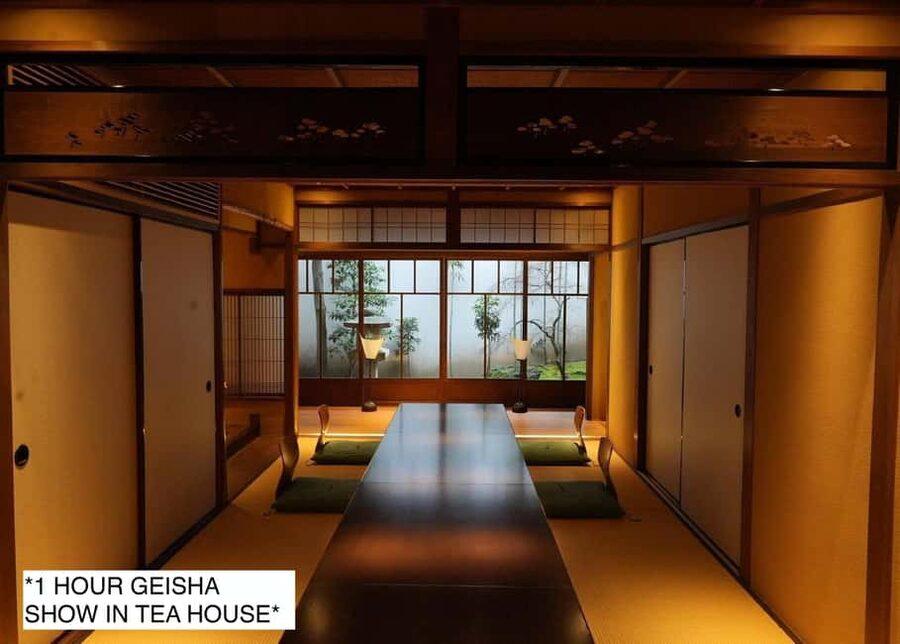
The Tea House option is held in a Japanese Kyo-Machi-ya, a traditional Kyoto-style house. This setting gives the event a more intimate and local feel than a theater. You will have tea and traditional Japanese snacks, with matcha or water available depending on your choice.
This option also includes a 30-minute guided session at Kitano Tenmangu Shrine with the Maiko. That makes it the better choice if you want the show connected to Kyoto’s streets and religious culture rather than a performance alone.
A Tea House visit also involves sitting in a traditional setting, so wear socks. Bare feet are not allowed, and socks are listed as an important item to bring. This is a small detail, but forgetting it could make the visit uncomfortable or prevent you from entering.
The Tea House group can have up to 23 people. That is not a private appointment, but it is still a fairly contained group for a cultural presentation. A smaller audience makes it easier to hear the guide, see the Maiko, and take part in the questions.
The Gion Theater Option
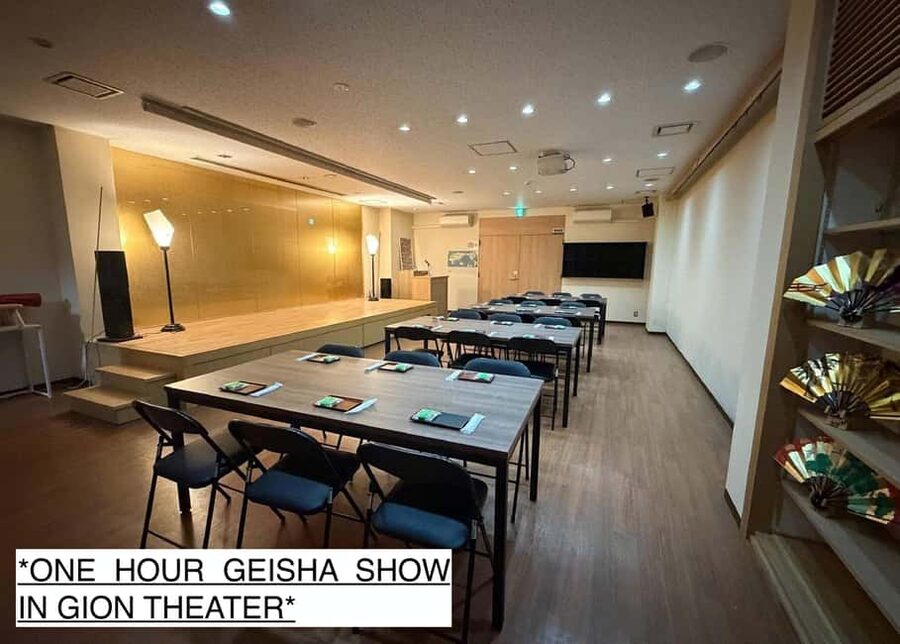
The Gion Theater option is a different tour, not simply another entrance for the same event. It takes place in a showhouse rather than a Kyo-Machi-ya and does not include the walking session at Kitano Tenmangu Shrine.
This option allows groups of up to 30 people. It may suit you if you mainly want the stage presentation, photos, questions, and game in a dedicated performance space. It is also the wheelchair-accessible choice, while the Tea House option is not wheelchair accessible.
Read the booking choice carefully before paying. The meeting point can vary, and the two options do not offer the same setting or itinerary. Confusing them could leave you expecting a shrine visit that is not included, or a traditional house that is not where your show takes place.
A few more Kyoto experiences worth weighing up
- Kyoto Gion Cultural Walk & Geisha Show with Dining Options
★ 5.0 · 518 reviews - Kyoto Gion Cultural Walk & Geisha Show with Dining Options
★ 5.0 · 483 reviews - 1 Hour Geisha Show in Kyoto
★ 5.0 · 452 reviews - Kyoto: Samurai Kenbu Traditional Sword Dancing Show
★ 4.5 · 426 reviews
Questions, Explanations, and the Human Side
The question-and-answer period is one of the strongest parts of this event. You can learn what the Maiko’s clothing, hair, makeup, and accessories mean, as well as ask about her art and daily life. The guide helps translate, so the conversation becomes more than a rehearsed introduction.
This is where the experience feels personal. You are not only watching a dancer from a distance. You can hear explanations from the Maiko herself, with the guide making sure the exchange works for an international audience.
The quality of translation matters. English and Korean are offered, and the guides are generally described as clear and welcoming. One piece of practical feedback noted that several languages being spoken at once made the explanations harder to follow. If your group includes many language communities, wait for the guide to finish each translation before asking a follow-up question.
The atmosphere is friendly rather than stiff. The Maiko answers questions openly, and guides help the audience take part without turning the session into a loud variety show. I like that balance. You get cultural information, but there is still room for warmth and humor.
The Game and Photo Opportunity
After the dances and questions, you can play a traditional Japanese game with the Maiko. The game often mentioned is Konpira Fune Fune, in which players match quick hand movements around a small object or surface.
It sounds simple. It is not. Several people have enjoyed playing but failed to win, which may be the safest expectation. Losing is part of the fun, and the game gives you a relaxed way to interact after the formal performance.
You can then take a photo with the Maiko. Since pictures and videos are welcome, you have more freedom than at many traditional performances. Be respectful with your camera, follow the guide’s directions, and remember that this is still a cultural meeting rather than a staged character encounter.
Some sessions may include a small name sticker or good-luck token from the Maiko. That detail is not guaranteed as a formal inclusion, so I would regard it as a pleasant possibility rather than something to book for.
Kitano Tenmangu Shrine With the Maiko
The Tea House option includes a 30-minute session at Kitano Tenmangu Shrine. This gives the program a second setting and adds a short guided walk to the indoor performance.
Kitano Tenmangu is one of the listed meeting or drop-off points, and the visit can help you connect the Maiko’s art with Kyoto itself. You are not only sitting in a room and watching a dance. You are also seeing the Maiko at a well-known shrine site, with a guide providing context.
The shrine visit is exclusive to the Tea House option. If this part is important to you, check the option name before booking. The Gion Theater choice does not include it.
The overall timing can range from one hour to 105 minutes. The longer version reflects the shrine session and the extra movement around the program. Allow enough time afterward so you are not rushing to another reservation.
Is $50 a Fair Price?
At $50 per person, this is not the cheapest cultural activity in Kyoto. It is also not simply a one-hour dance recital. The price includes a real Maiko performance, an English or Korean-speaking guide, tea, traditional snacks, questions, the game, and, with the Tea House option, a 30-minute shrine session.
I consider the value strongest if you want personal contact and explanation. A short dance alone might not justify the cost for every budget-conscious visitor. Add the chance to ask questions, take photos, play a game, and visit the shrine, and the price becomes easier to defend.
The group size also affects the value. With up to 23 people in the Tea House option and 30 in the theater, you are not buying private access. Still, these are limited groups compared with a large public performance, and the guide-led format gives you a better chance to understand what you are seeing.
You can reserve now and pay later, which helps if you are still arranging a Kyoto schedule. Cancellation is free up to 24 hours in advance for a full refund. The booking requires a phone number reachable in Japan and on WhatsApp, so the organizers can send clear information and coordinate with you before the event.
Who Will Enjoy This Most?
I would recommend this show to you if you want a close look at Kyoto’s traditional arts and prefer conversation over a silent performance. It suits first-time visitors who need cultural context, photographers who appreciate permission to take pictures, and couples or families looking for a memorable evening activity.
It also works well after time in Gion. One participant came from the Gion Kagai Art Museum and found the live Maiko performance a natural follow-up. The combination gives you both background and a live example of the art.
You may not enjoy it as much if you expect constant dancing, a large theatrical production, or a private meeting. The performance is deliberately short, and the show relies on patience, listening, and respect.
The activity is not suitable for people over 95. The Tea House option is not wheelchair accessible, while the Gion Theater option is wheelchair accessible. Baby strollers, alcohol, and drugs are not allowed, and everyone must wear socks.
Practical Booking Advice
Start by choosing the setting, not just the time. Select the Tea House option for the Kyo-Machi-ya atmosphere, tea, snacks, and Kitano Tenmangu Shrine session. Choose the Gion Theater option if wheelchair access is essential or if you prefer a showhouse presentation.
The listed starting locations include 梅乃 UMENO at 302-2 Daikokuchō near KOHYO Kamishichikenten, but the exact meeting point may depend on your selected option. Your drop-off may be at 梅乃 UMENO, Kitano Tenmangu Shrine, or 302-2 Daikokuchō.
Bring socks, keep your phone number active during your stay, and provide a WhatsApp number that the organizers can actually reach. If you are booking for someone else, enter the participant’s number rather than a travel agency contact.
Guides may speak English or Korean. If you need one of those languages, confirm the option and time carefully. The experience works best when you arrive ready to listen, ask questions, and let the guide manage the translations.
Should You Book This Maiko Show?
I would book it if you want an accessible, respectful introduction to Kyoto’s Geisha culture rather than a long dance recital. The Maiko’s elegance, the direct questions, the game, and the photo opportunity create a personal memory that is difficult to reproduce elsewhere.
Choose the Tea House option for the fullest program, especially if the shrine visit matters to you. Choose the theater option for wheelchair access or a simpler showhouse setting. Just keep your expectations clear: the dances are brief, and the real value comes from the complete hour or 105-minute program, not nonstop movement.
For $50, it is a fair choice for a special Kyoto evening, particularly if you take part rather than simply point a camera at the stage.
FAQ
How long does the Maiko show last?
The activity lasts between one hour and 105 minutes, depending on the option and schedule. The performance itself includes two short dances, followed by questions, a game, photos, and other parts of the program.
Will the Maiko dance continuously for one hour?
No. Maiko performances are intentionally short. The program includes two dances of about five minutes each, with the remaining time used for explanations, questions, a traditional game, photos, tea, snacks, and, for the Tea House option, a shrine session.
Can I take photos and videos?
Yes. Photos and videos are welcome during the experience. You will also have an opportunity to take a photo with the Maiko.
What is the difference between the Tea House and Gion Theater options?
The Tea House option takes place in a Kyoto-style Kyo-Machi-ya and includes tea, traditional snacks, and a 30-minute Kitano Tenmangu Shrine session with the Maiko. The Gion Theater option takes place in a showhouse and does not include the shrine walking session.
Is the experience wheelchair accessible?
The Gion Theater option is wheelchair accessible. The Tea House option is not wheelchair accessible.
Which languages are available?
The live tour guide is available in English or Korean. Guides help translate questions and explanations between the Maiko and the audience.
What should I bring and what is not allowed?
You should bring socks, and bare feet are not allowed. Baby strollers, alcohol, and drugs are also not allowed.
More 1-Hour Experiences
- Ninja 1-hour Hands-on Lesson by Japanese master in Kyoto -Entry
★ 5.0 · 489 reviews - One Hour Geisha Show in Gion Kyoto
★ 5.0 · 59 reviews - Ring making experience Completed in about 1 hour!
★ 5.0 · 141 reviews - Ninja Lesson in Tokyo – 1 Hour Hands-On with Japanese Master
★ 5.0 · 52 reviews
Just added around Kyoto
- Kyoto: Gion Night Walking Tour with Geisha Insight★ 5.0 · 39 reviews
- Kyoto: Private Customizable Day Trip by Car★ 5.0 · 38 reviews
- Kyoto: Full Day Bike Tour★ 4.9 · 39 reviews
- Private Japanese Calligraphy in Kyoto – Learn Shodō with a Master★ 5.0 · 39 reviews
- Kyoto: Gion Evening Walk with Hidden Gems, Geisha & Sake★ 5.0 · 41 reviews
- Experience a tea ceremony in an authentic tearoom, in Kyoto!★ 4.5 · 41 reviews
- Kyoto Private Photo Shoot & Tour by SnapKyoto★ 5.0 · 41 reviews
- The Way of Tea: Kyoto Crafts, Hidden Temples & Wabi-Sabi Walk★ 5.0 · 41 reviews
Geisha & Gion District Tours, compared.

Kyoto Geisha Walking Tour: Gion District & Hidden Gems
Read our review →
Gion Magical Night Walking Tour with Geisha Trivia
Read our review →
Gion Geisha District Walking Tour – Stories of Geisha
Read our review →
Best of Kyoto: Gion, Geisha, Pagodas & Cobblestones
Read our review →

Kyoto Night Foodie Tour in Gion (9+ dishes + 6 Sake tastings)
Read our review →
Kyoto Gion Geisha District Walking Tour – The Stories of Geisha
Read our review →
Kyoto Gion: 2-Hour Geisha Culture & History Walking Tour
Read our review →Browse the lists this tour appears in