
Reviewed · WALKING TOURS
Osaka Local Foodie Walking Tour in Dotonbori and Shinsekai
Osaka’s best stories often come with sauce. This three-hour walk links Shinsekai and Dotonbori, two of the city’s most entertaining food districts, with tastings of kushikatsu, okonomiyaki, and takoyaki. I like the small maximum group of seven, and I like that local guides such as Aika, Yuma, Michiko, Kent, and Emi add personal tips about food, shrines, shopping, and daily life.
The main caution is value. At $111.42 per person, this is not a bargain food crawl, especially if you expect many small samples from many stalls. The menu is substantial on paper, but the experience can feel more like a neighborhood walk with several meals than a rapid tour of Osaka’s food scene.
I also like the route’s contrast. You move from Tsutenkaku and old-style Shinsekai to the neon signs, lanes, and crowds of Dotonbori. Just arrive ready to walk, keep up with the group, and tell the company about dietary needs at least one day ahead.
In This Review
- Key points at a glance
- Shinsekai starts under Tsutenkaku Tower
- Jan-Jan Yokocho and the old Osaka feel
- From Shinsekai toward Dotonbori
- Hozen-ji Temple and Ukiyo Alley
- Takoyaki, okonomiyaki, and the Glico photo
- How much food do you really get?
- The guide can make or break the evening
- Food restrictions and comfort concerns
- Who should book this Osaka food walk?
- Should you book it?
- FAQ
- How long does the tour last?
- What food is included?
- Are alcoholic drinks included?
- Is transportation included?
- Where does the tour start?
- Where does the tour end?
- How many people can join?
- Can vegetarians join?
- Can the tour accommodate gluten-free or vegan diets?
Key points at a glance
- Six kushikatsu skewers: Try Osaka’s famous deep-fried skewers with meat and vegetables in the Shinsekai area.
- Three classic Osaka foods: The menu includes kushikatsu, one serving of okonomiyaki, and a box of takoyaki.
- Small groups of up to seven: A compact group makes it easier to ask questions and stay together in crowded streets.
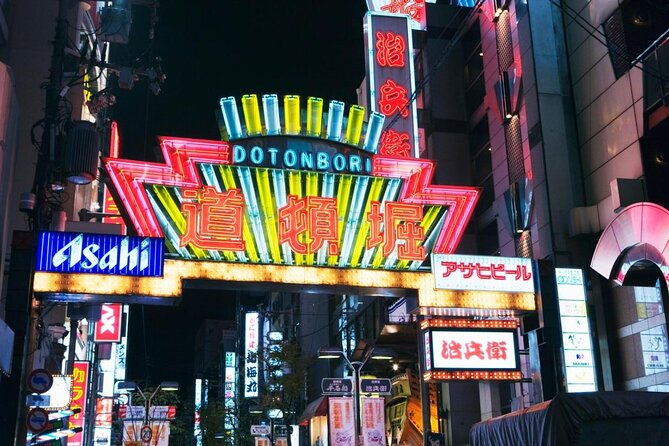
- Two very different neighborhoods: Shinsekai feels older and more local, while Dotonbori delivers Osaka’s famous signs, shopping, and nightlife.
- Three drinks included: Alcoholic and non-alcoholic choices are available, adding value for guests who want a drink with the food.
- Advance dietary planning matters: Gluten-free and vegan diets cannot be accommodated, and vegetarian requests must be made by the day before.
Shinsekai starts under Tsutenkaku Tower
The tour begins near FamilyMart at 1-17 Sanno in Nishinari Ward. The meeting point is close to public transportation, but one past experience found it difficult to locate, so I would allow extra time rather than trying to arrive at the last second.
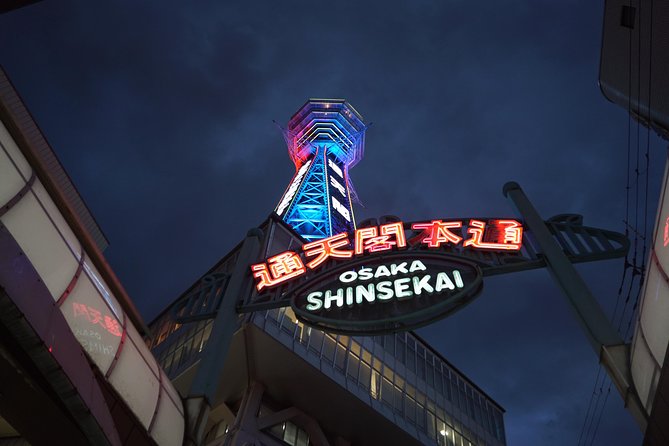
From there, you enter Jan-Jan Yokocho, a narrow alley near Tsutenkaku Tower. This is a good place to begin an Osaka food tour because Shinsekai has a strong connection to the city’s casual eating culture. The district is not polished in the same way as a modern shopping quarter. Its appeal comes from old signs, compact lanes, local restaurants, and the slightly rough-around-the-edges atmosphere.
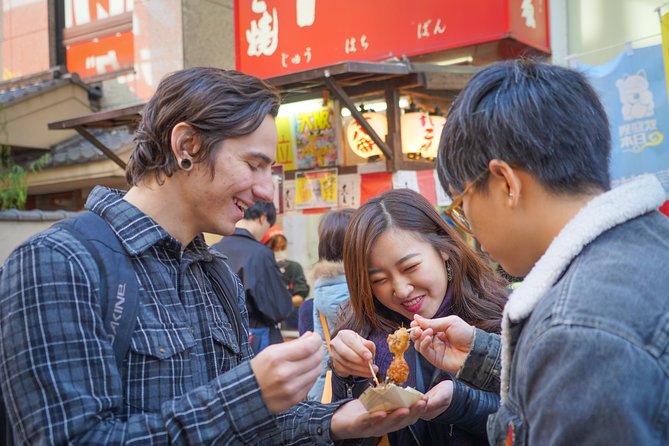
The first tasting is six pieces of kushikatsu, deep-fried skewers of meat and vegetables. The food is commonly associated with Shinsekai, and the format is easy to enjoy: pick up a skewer, take a bite, and compare the crisp coating with the ingredient inside. Expect fried food, so this is not a light opening course.
The tour description allows about 30 minutes here, with admission included. Two drinks are listed at the kushikatsu stop, although the total package includes three drinks and both alcoholic and non-alcoholic options. If you do not drink alcohol, ask what alternatives are available before ordering.
More Walking Tours in Osaka
- Osaka: Hotspots & Hidden Gems Walking Tour Private or Group
★ 4.9 · 1,300 reviews - Osaka Bar Hopping Night Walking Tour in Namba (3 bars, 6 tastes)
★ 5.0 · 958 reviews - Osaka: Deep Backstreets Walking Tour with Dinner Option
★ 4.9 · 902 reviews
Jan-Jan Yokocho and the old Osaka feel
The walk through Shinsekai includes the market area, Tsutenkaku Tower, and a Billiken statue. Billiken is a familiar figure in Osaka, often linked with good luck and the city’s playful character. The tour uses the alley as a kind of living museum, showing how parts of central Osaka looked more than 80 years ago.
This section is valuable if you want context, not just food. A good guide can connect the neighborhood’s lanes and signs with everyday Osaka culture. Aika has been praised for offering lively explanations, useful restaurant tips, and suggestions for snacks to take home. Yuma has also been praised for explaining how dishes are made and for stopping at shrines and temples along the way.
The quality of the experience depends heavily on the guide’s energy. Some guides provide a running explanation as the group walks. Others may answer questions well but offer less narration between stops. If you want a history-heavy tour, ask questions directly and stay engaged. That small effort can make the walk feel much more personal.
One practical issue is pace. At least one account described the guide walking quickly, while another found the tour slower than expected. With a group of up to seven, the pace may depend on the guide and the day. Comfortable walking shoes are sensible, and you should tell the guide if you need a slower pace.
From Shinsekai toward Dotonbori
The route then shifts toward Dotonbori, with stops connected to Shinsaibashi-suji Shopping Street and Sennichimae Doguyasuji Shopping Street. The itinerary shows some variation between daytime and nighttime departures. During the day, you may visit Dōgu-ya-suji for souvenir shopping and see Hōchō-ya, a knife shop. At night, the guide may explain the area around Namba Grand Kagetsu before taking you shopping nearby.
That variation matters. This is not a rigid museum tour where every group sees the same doorway at the same minute. Shops, light levels, restaurant schedules, and the time of day shape the route. If you care about buying a Japanese kitchen knife, the daytime option appears more useful because the knife shop is specifically included in that version.
Sennichimae Doguyasuji is a practical stop rather than a food tasting alone. The street is associated with cooking equipment, restaurant supplies, utensils, and food-related souvenirs. It gives you a look at the working side of Osaka’s restaurant culture. You might find it more interesting than another brightly lit shopping arcade, especially if you cook at home.
The walk between areas is part of the tour, but the itinerary only assigns short periods to some shopping and sightseeing stops. Do not book this expecting three hours of nonstop guided commentary. You are combining food, walking, photos, shopping, and cultural stops.
Hozen-ji Temple and Ukiyo Alley
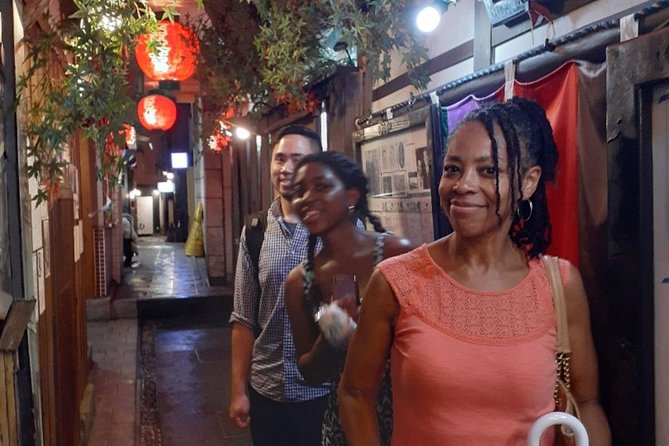
Hozen-ji Temple provides a quieter pause inside the Dotonbori area. The temple is followed by a walk through Ukiyo-koji, also called Ukiyo Alley, where the narrow passage offers a sharp contrast to the broad signs and crowds nearby.
This is one of the route’s better changes of mood. Osaka can feel loud and commercial around Dotonbori, but small temple lanes can make the city feel more intimate. Guides have used this part of the walk to explain local customs and point out places that are easy to miss when you are focused on the main streets.
The timing can affect the visit. A temple stop after dark may feel atmospheric, but it can also be hard to see details. One past account found the temple visit disappointing because of the low light. If photography matters to you, daytime is likely the safer choice.
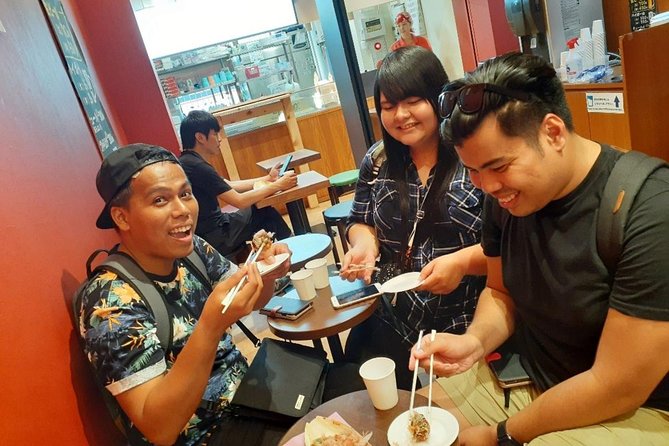
The tour also allows about ¥500 for extra snacks such as takoyaki and sweets. This amount is separate from the main included menu, so carry some yen. You may want to buy something that catches your eye rather than treating every snack as part of the fixed tasting.
More food tours in Osaka:
- Osaka: Shinsekai Food Tour with 13-15 Dishes at 5 Eateries
★ 4.8 · 2,204 reviews - Osaka Food Tour: 13 Dishes at 5 Local Eateries
★ 5.0 · 2,149 reviews - Hungry Osaka Street Food Tour:15 Tastings & 3 Drinks with a Local
★ 5.0 · 1,727 reviews - Hungry Osaka Street Food Tour: 15 Dishes & 3 Drinks
★ 4.9 · 694 reviews
Takoyaki, okonomiyaki, and the Glico photo
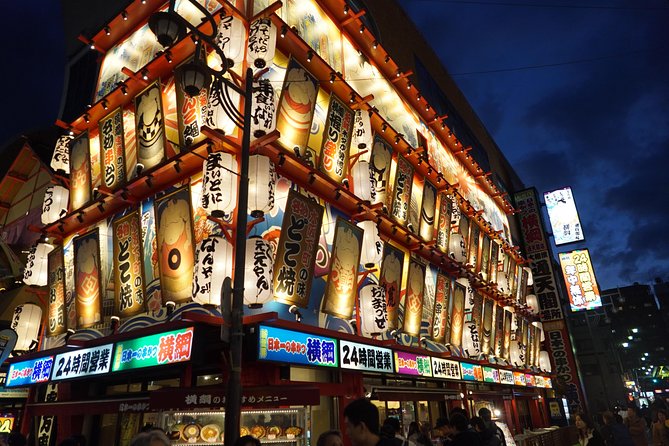
Dotonbori is where the food portion becomes especially familiar to first-time visitors. The tour includes one box of takoyaki, the round batter snacks filled with tender octopus and topped with sauces and other additions. They are hot, soft inside, and easy to burn your mouth on, so give them a moment before eating.
The itinerary also includes a photo stop at the Glico sign. This is a classic Osaka picture, and the guide can help with photos. Aika has been praised for taking photographs and sending them after the tour, while Justin helped his group find photo spots in the crowded night streets. That kind of assistance is small but useful when you are trying to fit a whole group into one frame.
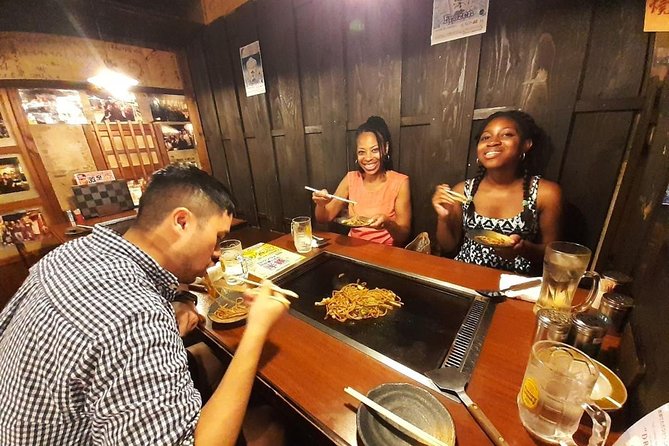
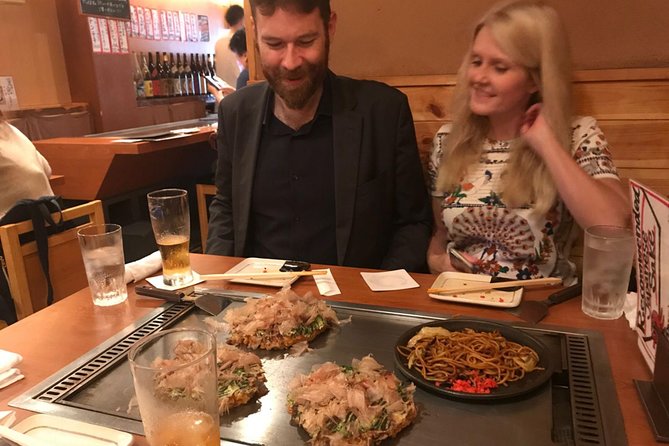
The final major tasting is okonomiyaki, Osaka’s savory pancake. The name comes from okonomi, meaning as you like, and yaki, meaning grilled. Toppings and ingredients vary, and some groups have been able to grill their own pancake, turning dinner into a hands-on activity.
The menu lists one piece of okonomiyaki. Depending on the venue, this may feel like a proper shared meal rather than a tiny bite. That is good news if you want enough food to feel satisfied, but less ideal if your goal is to visit many different restaurants and sample tiny portions at each.
How much food do you really get?
The included food is:
- Six kushikatsu skewers
- One piece of okonomiyaki
- One box of takoyaki
- Three drinks
- Extra snacks costing about ¥500, if you choose to buy them
That is a fair amount of food for a three-hour neighborhood walk, but the word foodie can set the wrong expectation. I would describe this as a guided Osaka food-and-culture outing rather than a serious tasting tour for culinary specialists.
The strongest part is the chance to try three foods closely tied to Osaka. The weaker point is variety within the meals. You may visit only two main food venues, with an optional third stop in some cases. If you prefer five or six small tastings from separate stalls, this tour may leave you wanting more.
The drinks improve the value for some people. If you enjoy beer, sake, plum wine, or another alcoholic option, three included drinks can help justify the cost. If you do not drink, the package may feel less generous unless non-alcoholic choices appeal to you.
The price is $111.42 per person, and a 190-yen transportation fee is not included. Group discounts may be available. For a small group with a strong guide, the price pays for direction, translation, restaurant access, cultural explanation, and the convenience of not planning the evening yourself. It is harder to justify if your main goal is simply to eat the same dishes at inexpensive local prices.
The guide can make or break the evening
The company uses MagicalTrip Certified Guides, and the maximum group is seven. That is a useful size in narrow alleys and crowded shopping areas. You can usually ask a question without holding up a large coach group, and the guide can keep an eye on everyone while crossing busy streets.
Guide quality is not identical from one departure to another. Aika has been praised for her warmth, food suggestions, local insight, and photography. Yuma has received strong praise for his English, friendliness, and ability to explain both food and culture. Michiko has been appreciated for linking restaurants and local customs to everyday life. Emi has been praised for connecting food choices with ordinary Osaka routines.
There have also been weaker experiences, including guides who offered little information unless asked or who seemed early in their guiding career. That does not mean the tour will be poor, but it does mean you should not assume a lecture at every stop. Ask about the origin of a dish, how locals eat it, or what the guide recommends for the rest of your stay.
Some guides have also helped with subway directions after the tour. Since the walk ends at the Glico sign, that extra help can be welcome if this is your first night in Osaka. It is a pleasant bonus, not a guaranteed part of the formal program.
Food restrictions and comfort concerns
This tour cannot accommodate gluten-free or vegan diets. Vegetarian food may be available if you choose the vegetarian option while booking or request it by the day before.
There is an important detail at the kushikatsu restaurant: the vegetarian skewers still use dashi made with pork broth. If you cannot eat pork-based dashi, tell the operator in advance so another vegetarian dish can be prepared.
Allergy-free meals and substitutions cannot be guaranteed because the food is prepared in kitchens operated by other businesses. Do not wait until the tour begins. Requests made on the day cannot be accommodated.
The tour may also visit places where smoking is allowed, and the company may not be able to change the venue. Summer temperatures in Osaka can reach 40°C, while winter temperatures may drop to -5°C. Dress for the season, carry water in hot weather, and remember that standing outside while waiting for food can make the heat feel stronger.
The tour starts on time. If you arrive late and miss the group, you cannot join later, reschedule, or receive a refund. The free cancellation policy allows a full refund when you cancel at least 24 hours before the start time. Changes made inside that window are not accepted.
Who should book this Osaka food walk?
I would recommend it most strongly to a first-time Osaka visitor who wants a guided orientation with food built in. You will see two famous districts, learn basic context, try three signature dishes, and finish in a central area where you can continue exploring.
It also suits families and small groups. One family of six effectively received a private tour because the group filled the available places. Children and older adults can participate, but the walking pace and crowded streets are worth considering.
Repeat visitors may enjoy it if they want a relaxed look at Shinsekai and Dotonbori with a local guide. Dedicated food fans should study the menu carefully. You are paying for companionship and explanation as much as for the food, and the number of restaurant stops may feel limited.
Should you book it?
Book this tour if you want a friendly introduction to Osaka, three well-known local foods, useful neighborhood orientation, and a small group rather than a large organized outing. It is especially practical at the start of a Japan trip, when a guide can explain dishes, point out shopping streets, and help you navigate afterward.
Skip it if you want an intense food crawl with many independent stalls, unusual dishes, and small portions at a low price. You may also want another option if you are gluten-free, vegan, highly sensitive to smoking, or unable to tolerate pork-based dashi.
For the best chance of enjoying it, choose a time that suits your interest in photography and temples, arrive early at the FamilyMart meeting point, bring about ¥500 for optional snacks, and send dietary requests by the previous day. Think of it as Osaka sightseeing you can eat, not a restaurant marathon.
FAQ
How long does the tour last?
The tour lasts approximately three hours.
What food is included?
The included menu has six kushikatsu skewers, one piece of okonomiyaki, one box of takoyaki, and three drinks.
Are alcoholic drinks included?
Yes. The three included drinks can be alcoholic or non-alcoholic.
Is transportation included?
Transportation is not included. An additional transportation fee of 190 yen is listed.
Where does the tour start?
The tour starts near FamilyMart at 1-17 Sanno, Nishinari Ward, Osaka, 557-0001.
Where does the tour end?
The tour ends at the Glico sign in Dotonbori, at 1-chōme-10-3 Dōtonbori, Chuo Ward, Osaka, 542-0071.
How many people can join?
The tour has a maximum of seven participants.
Can vegetarians join?
Vegetarian food can be requested when booking or by the day before. The kushikatsu venue uses pork-based dashi even for vegetarian kushikatsu, so mention this restriction in advance.
Can the tour accommodate gluten-free or vegan diets?
No. Gluten-free and vegan diets cannot be accommodated on this tour. Allergies and substitutions also cannot be guaranteed, so you should provide any dietary information at least one day before the tour.
Just added around Osaka
- Osaka Food Tour with 10 Classic Japanese Tastings & Drinks★ 5.0 · 38 reviews
- Osaka: Highlights & Hidden Gems Private Walking Tour★ 4.7 · 38 reviews
- Kyoto private tour (Shore excursion available from Osaka or Kobe port)★ 5.0 · 39 reviews
- Osaka Private Day Trip – Enjoy Your First-Time Visit to Osaka!★ 5.0 · 39 reviews
- Kyoto & Nara & Uji: Full Day Sightseeing Tour from Osaka or Kyoto★ 4.5 · 39 reviews
- Authentic SUSHI Course Cooking Class★ 5.0 · 39 reviews
- Osaka: Mind & Spirit Balance Temple Reiki Healing★ 5.0 · 41 reviews
- Osaka Afternoon Walking Tour with Osaka River Cruise★ 3.5 · 42 reviews
Walking Tours, compared.
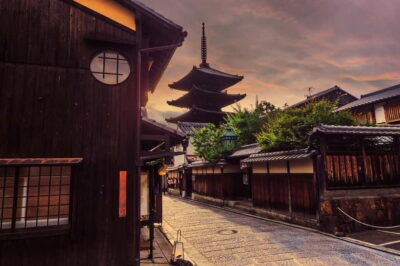
Kyoto Geisha Walking Tour: Gion District & Hidden Gems
Read our review →
Tokyo Tsukiji Fish Market Food and Culture Walking Tour
Read our review →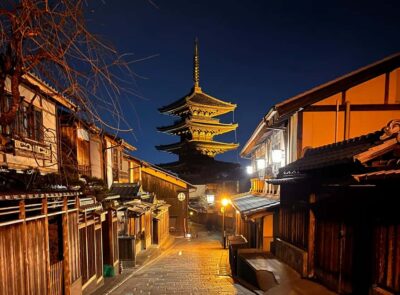
Gion Magical Night Walking Tour with Geisha Trivia
Read our review →
Imperial Palace and Shogun Historical Walking Tour
Read our review →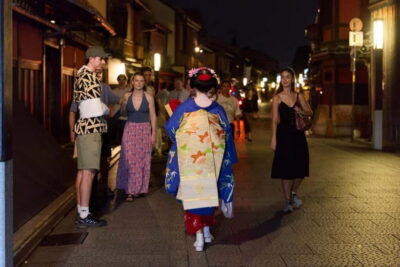
Gion Geisha District Walking Tour – Stories of Geisha
Read our review →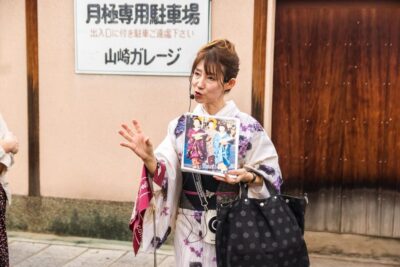

Shinjuku Local Bar and Izakaya Guided Walking Tour
Read our review →
Browse the lists this tour appears in