
Reviewed · SUMO EXPERIENCES
Osaka Sumo Experience with Live Show and Audience Challenge
Sumo is theater with rules. This 90-minute Osaka experience makes the sport easy to enjoy, even if you cannot tell a tachiai from a tachioutoshi yet. You get a clear introduction to sumo’s rituals, training methods, and famous techniques, followed by live demonstrations and a dramatic match between retired wrestlers. I especially like the English-speaking guidance and the chance to see the sport explained rather than simply performed.
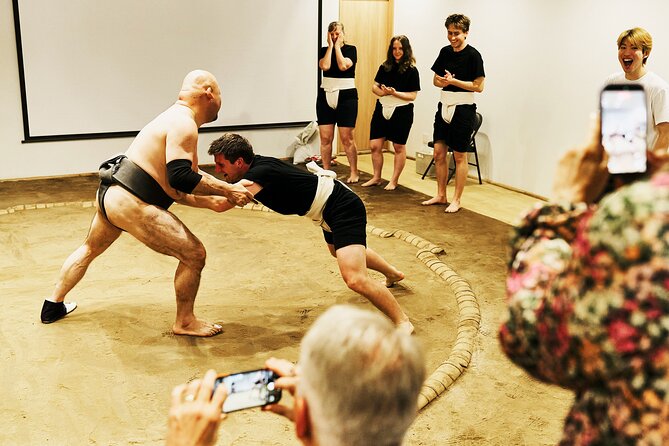
I also like that the audience is not kept behind a polite wall. A limited number of volunteers can step into the ring and test themselves against a sumo wrestler, which adds plenty of laughs and gives you a better sense of how demanding the sport is. The main consideration is that the experience is short, and the audience challenge has limited places, so you should not assume you will wrestle.
In This Review
- Key points to know before you book
- Why this Osaka sumo show works for first-time fans
- From ceremony to training and technique
- The tachiai match brings the energy
- The audience challenge is the most memorable extra
- A welcoming format with useful English support
- What the 50-person maximum means
- Location and timing in Osaka
- Is $55.50 a fair price?
- Who should book, and who may want something else
- Cancellation and booking details worth noting
- Final call: book it for the culture and the fun
- FAQ
- Where does the Osaka Sumo Experience meet?
- How long does the experience last?
- Where does the experience end?
- Is transportation included?
- Is a meal included?
- Is an English-speaking guide included?
- Can I wrestle a sumo wrestler?
- How many people can join the activity?
- What is the cancellation policy?
Key points to know before you book
- A 90-minute introduction to sumo: The program covers history, rules, sacred customs, training, and technique without requiring prior knowledge.
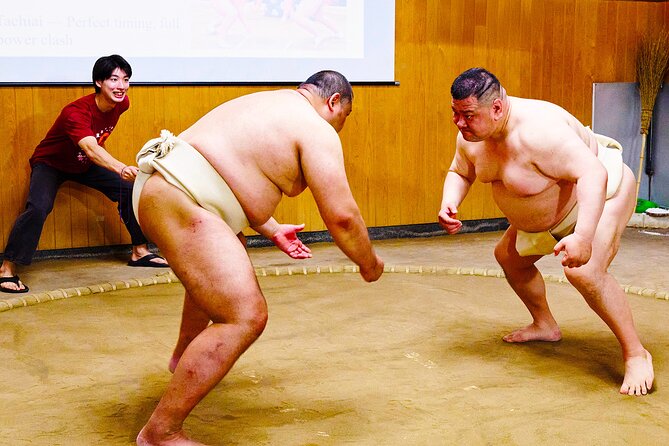
- Retired wrestlers perform the live match: The featured tachiai demonstration brings real force and ceremony to the show.
- Audience participation is limited: You may be invited to enter the ring and face a wrestler, but places are not guaranteed.
- English is part of the experience: The guide explains the action and cultural details in English, which makes the show accessible to first-time visitors.
- The group can reach 50 people: That is large enough for a lively room but still more manageable than a major stadium event.
- The meeting point is in Nishinari Ward: You meet at AI Building, 1-chōme 5-1 Asahi, Osaka 557-0032, and return there when the show ends.
Why this Osaka sumo show works for first-time fans
A formal sumo tournament can be hard to fit into an Osaka schedule. Tournament dates are fixed, tickets can be difficult to arrange, and much of the action can feel mysterious if you do not know the customs. This show offers a shorter, more direct way to understand the sport.
I like the balance between explanation and action. You are not simply watching a lecture about sumo, and you are not dropped into a noisy performance with no context. The guide explains what you are seeing, then the wrestlers demonstrate it in front of you.
That matters because sumo is packed with gestures that can look odd at first. The stamping, crouching, clapping, and ritual movements have purpose. With an English-speaking guide, you can connect those actions to the sport’s rules and traditions instead of treating them as colorful stage decoration.
The show also welcomes people who have never watched a bout. You do not need to know the names of famous champions or understand every rule before arriving. The structure gives you enough background to follow the later demonstrations, while experienced fans still get the pleasure of seeing sumo techniques performed close up.
More sumo experiences:
- Osaka: Sumo Show & Experience w/ Optional Kimono & Hot Pot
★ 4.5 · 609 reviews - Osaka: Sumo Stage Show with Bento or Snack + Fight & Photo
★ 4.3 · 364 reviews - Tokyo: Sumo Show Experience with Chicken Hot Pot and a Photo
★ 4.8 · 6,678 reviews
From ceremony to training and technique
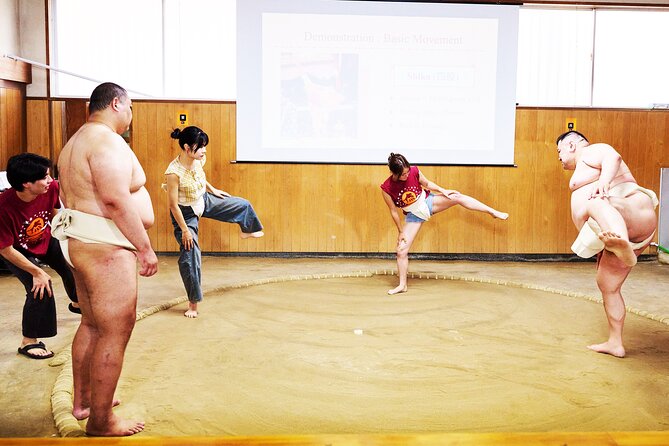
The first part of the program introduces sumo as more than a contest of size and strength. You learn about its origins, customs, and the disciplined training that supports a wrestler’s short, explosive attacks.
The exact presentation can vary, but the advertised program includes demonstrations of authentic training and legendary techniques. This is useful because sumo action is often over in seconds. A bout may look simple from a distance: two wrestlers charge, one goes out, and it is finished. The explanation helps you notice balance, foot placement, timing, and the way a wrestler uses an opponent’s movement.
I find this kind of demonstration more valuable than a long list of facts. You get to see how the body is prepared for the ring and how a technique works in practice. It also puts the wrestlers’ physical skill in better perspective. Sumo is not just about being heavy. It requires control, positioning, timing, and a great deal of practice.
The show covers sacred rituals as well. These customs are an important part of sumo’s identity, and they help explain why the sport feels different from ordinary entertainment wrestling. The mood can shift from playful to solemn, giving the program some cultural weight without making it overly formal.
The tachiai match brings the energy
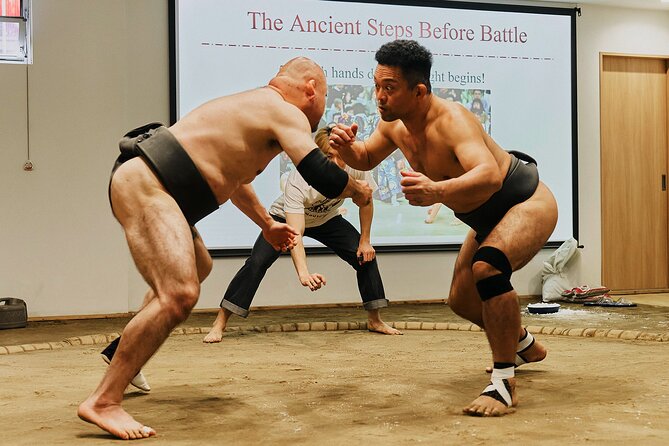
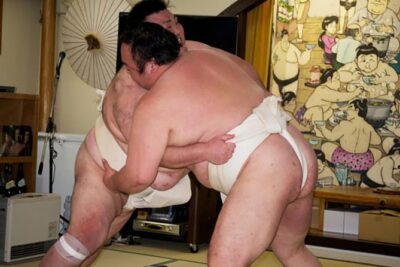
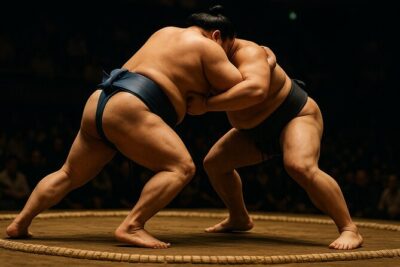
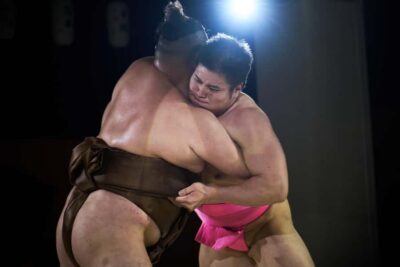
The featured live match is a tachiai between retired sumo wrestlers. The tachiai is the opening collision, the instant when both competitors launch from their crouch and meet in the center of the ring.
It is a small word for a very large moment. You can expect the match to make the earlier explanations click. The speed, force, and close positioning are much easier to understand when you see two experienced wrestlers use them against each other.
Because the performers are retired, this is not the same as attending an official professional tournament bout. That is worth keeping clear. You are seeing a cultural demonstration and live show, not a sanctioned competition with tournament rankings or championship stakes.
Still, the match gives the experience its central burst of excitement. The wrestlers know how to present the sport clearly, and their experience lets them demonstrate techniques in a way that beginners can follow. You get spectacle, but the spectacle is tied to real sumo movements and customs.
The atmosphere also appears to be friendly and humorous. That helps if you are bringing children, friends, or family members who might not normally choose a martial arts presentation. The program aims to teach, but it does not take itself so seriously that you need to sit quietly for an hour and a half.
The audience challenge is the most memorable extra
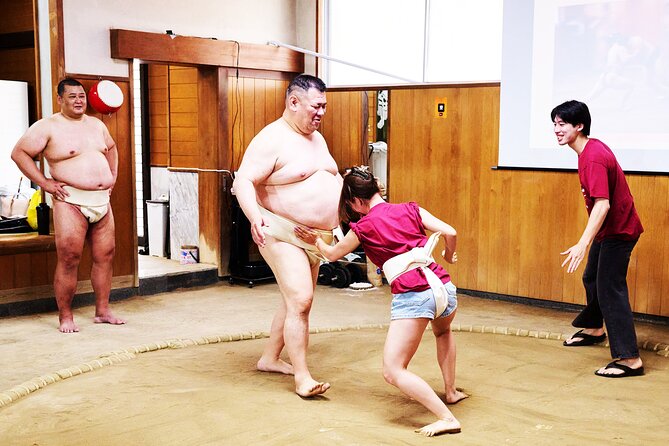
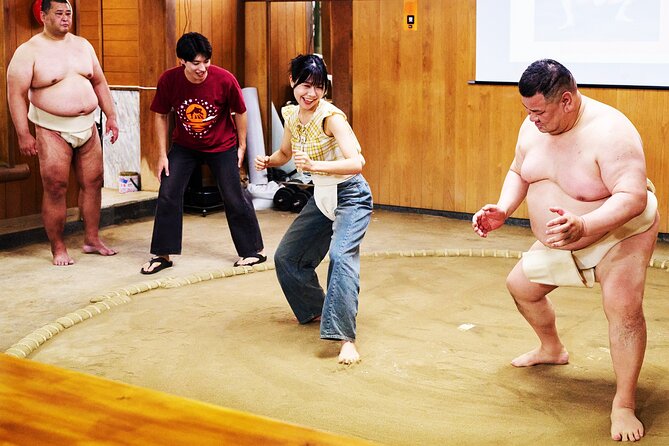
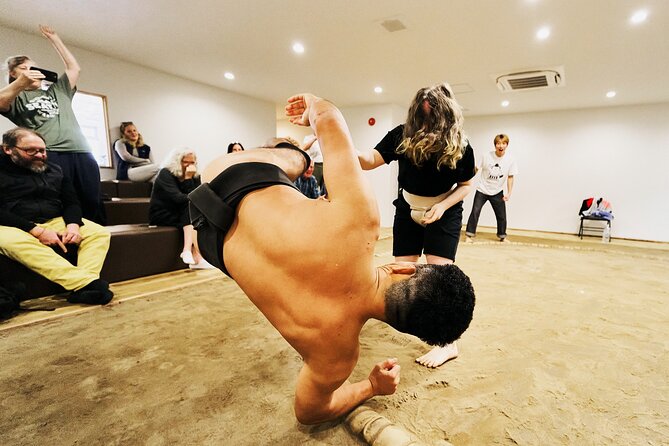
The most unusual part is the chance for audience members to enter the ring and face a sumo wrestler. The wording is important: places are limited. You can volunteer, but you should treat participation as a possibility rather than a promise.
This activity gives you an immediate lesson in sumo’s physical demands. One participant described it as much harder than expected, which is hardly surprising. Even a short push against a trained wrestler can show how much balance and leverage matter.
I like this feature because it turns a show into a shared event. You are not only watching a demonstration. You are seeing people from the audience try the movements, laugh at the challenge, and learn through direct experience.
If you are hoping to participate, arrive ready to be flexible. The program includes an audience challenge, but it does not promise that every person will have a turn. If you are traveling with a group, decide in advance who wants to volunteer, and understand that selection may depend on the limited number of places.
One practical caution concerns the clothing and sandals used for the wrestling activity. A participant felt that larger sizes would be helpful. If you need generous sizing, or if the available clothing may not fit comfortably, keep that in mind before volunteering. The supplied information does not give a size range.
A few more Osaka experiences worth weighing up
- Osaka: English Stand Up Comedy Show at Osaka Comedy Club
★ 4.7 · 203 reviews - Osaka: UTAGE Japanese Taiko Live Show
★ 4.9 · 167 reviews - OSAKA NIGHT FUSION Japanese Taiko Kabuki Samurai Dance Show
★ 4.8 · 155 reviews - Osaka: UTAGE Modern Japanese Taiko Live Show
★ 5.0 · 81 reviews
A welcoming format with useful English support
The quality of the explanations matters as much as the wrestling. The English-speaking staff receive especially strong praise for making the history, rules, and interactive sections easy to follow.
That is a real advantage in Osaka. Sumo has many specialized terms and customs, and a translation that only covers the basic action would leave out much of what makes the sport distinctive. Here, the guide helps connect the ritual and the wrestling.
The tone also seems welcoming. The wrestlers are described as respectful and kind, while the staff create a friendly setting for people who may feel nervous about joining the action. That combination is important. A participant challenge can become awkward if the audience feels pressured, but this program appears to frame it as an invitation.
I would recommend it to families, couples, solo visitors, and small groups of friends. The format has enough history for a culture-minded visitor, enough action for someone who wants entertainment, and enough audience involvement to keep the hour and a half moving.
What the 50-person maximum means
The maximum group size is 50 people. That is not an intimate private lesson, and you should not expect a one-on-one conversation with a wrestler. At the same time, it is far smaller than a stadium crowd, so the event can still feel personal and lively.
A group of this size also makes the audience challenge more fun. You have other people reacting to the demonstrations, cheering volunteers, and laughing at the physical mismatch between an ordinary participant and a trained sumo wrestler.
The trade-off is visibility and access. Depending on the room arrangement, some seats may feel closer to the action than others. The provided information does not specify seating, so I would avoid booking this if you require a guaranteed front-row position or a private experience.
The 90-minute length is well judged for most schedules. It is long enough to explain the sport and include several demonstrations, but short enough to fit around sightseeing in Osaka. There are no meals included, so plan to eat before or after the show rather than expecting food during the activity.
Location and timing in Osaka
The meeting point is AI Building at 1-chōme 5-1 Asahi, in Nishinari Ward, Osaka, postal code 557-0032. The activity ends back at the same meeting point.
The venue is near public transportation, which makes it easier to reach without arranging a private car. Private transportation is not included, so you need to make your own way there and back. A mobile ticket is provided, which is convenient for a day when you are already using your phone for maps and transit information.
I would allow extra time to find the building, especially if you are unfamiliar with the neighborhood or reading Japanese addresses. The meeting information includes Japanese characters, AI Building, and the full postal address, so keep those details available on your phone.
Because the entire program lasts about an hour and a half, it pairs well with other Osaka plans. You can build it into a day of sightseeing instead of giving up a full day for sumo. Just leave room for getting to the meeting point and returning to your next stop.
Is $55.50 a fair price?
At $55.50 per person, this is not the cheapest short activity in Osaka. The value depends on what you want from the experience.
If you are searching for an official tournament, this is not a substitute. You are paying for a guided cultural show with demonstrations, a live tachiai match, and the possibility of audience participation. For a first introduction to sumo, that package is reasonably priced because it combines instruction and entertainment in one compact visit.
I especially see value for people who would otherwise struggle to understand sumo at a tournament. You get the rules and rituals explained in English, then see the physical action up close. That saves you from spending the first part of a tournament wondering what is happening.
The price also covers the chance to participate, though it does not guarantee your place in the ring. I would book it for the atmosphere, instruction, and live demonstrations first. Consider the audience challenge a worthwhile bonus, not the sole reason to pay.
Meals and private transport are extra. Those omissions are normal for a short show, but they affect your budget. Add local transit and food when comparing this with other Osaka activities.
Who should book, and who may want something else
This experience suits you best if:
- You want a clear introduction to sumo without attending a full tournament.
- You enjoy cultural activities that include live action.
- You appreciate English explanations of customs and rules.
- You are willing to volunteer for a physical challenge, or enjoy watching others try.
- You have about 90 minutes to spare in Osaka.
- You are traveling with family or friends who want something more active than a museum visit.
You may want to skip it if you are looking for a serious tournament atmosphere, official competition, or a private lesson. You may also be disappointed if your main goal is to wrestle and you are not selected for the limited audience places.
The show is accessible to most people, according to the activity information, but sumo participation is physical. Watching from the audience is the safer choice if you have concerns about exertion. The available details do not provide a specific fitness requirement, so use your judgment before volunteering.
Cancellation and booking details worth noting
You receive confirmation when you book. Cancellation is free if you cancel at least 24 hours before the local start time, and you receive a full refund.
If you cancel less than 24 hours before the start, you should expect no refund. Changes made inside that same 24-hour window are not accepted. This is a useful policy for a fixed Osaka schedule, but mark the local cut-off time carefully.
The activity is operated by Local Guide Stars. The mobile ticket makes entry simple, and the English-speaking guide is included with the sumo show. Meals and private transportation are not included.
Final call: book it for the culture and the fun
I would book this Osaka sumo experience if you want a friendly, compact way to understand Japan’s national sport. The combination of history, sacred customs, training demonstrations, a live tachiai match, and English support gives you more than a staged photo opportunity.
The audience challenge makes it memorable, but do not count on being selected. Go expecting to watch, learn, and laugh, then treat the chance to wrestle as an extra.
At $55.50, the experience offers good value for first-time sumo fans and families who want an activity with real cultural content. It is less suitable for anyone seeking an official tournament or a private encounter. For most Osaka visitors, though, 90 minutes is a practical investment, and the return is a much clearer understanding of why sumo is both sport and ceremony.
FAQ
Where does the Osaka Sumo Experience meet?
The meeting point is AI Building, 1-chōme 5-1 Asahi, Nishinari Ward, Osaka 557-0032, Japan.
How long does the experience last?
The activity lasts approximately 1 hour and 30 minutes.
Where does the experience end?
The activity ends back at the same meeting point.
Is transportation included?
Private transportation is not included. The meeting point is near public transportation, so you arrange your own way there and back.
Is a meal included?
No. Meals are not included in the price.
Is an English-speaking guide included?
Yes. An English-speaking guide is included with the sumo show.
Can I wrestle a sumo wrestler?
There is a chance to step into the ring and face a sumo wrestler, but places are limited, so participation is not guaranteed for everyone.
How many people can join the activity?
The maximum group size is 50 people.
What is the cancellation policy?
You can cancel for a full refund up to 24 hours before the experience’s local start time. Cancellations or changes made less than 24 hours before the start are not accepted and are not refunded.
Just added around Osaka
- Osaka Food Tour with 10 Classic Japanese Tastings & Drinks★ 5.0 · 38 reviews
- Osaka: Highlights & Hidden Gems Private Walking Tour★ 4.7 · 38 reviews
- Kyoto private tour (Shore excursion available from Osaka or Kobe port)★ 5.0 · 39 reviews
- Osaka Private Day Trip – Enjoy Your First-Time Visit to Osaka!★ 5.0 · 39 reviews
- Kyoto & Nara & Uji: Full Day Sightseeing Tour from Osaka or Kyoto★ 4.5 · 39 reviews
- Authentic SUSHI Course Cooking Class★ 5.0 · 39 reviews
- Osaka: Mind & Spirit Balance Temple Reiki Healing★ 5.0 · 41 reviews
- Osaka Afternoon Walking Tour with Osaka River Cruise★ 3.5 · 42 reviews
Sumo Experiences, compared.
Tokyo Shinjuku Sumo Show & Experience with Photo
Read our review →
Sumo Show & Experience w/ Optional Kimono & Hot Pot
Read our review →
Authentic Sumo Experience in Tokyo: Enter the Sanctuary
Read our review →
Luxury Sumo Show Experience & Japanese cuisine & Drink
Read our review →Browse the lists this tour appears in