
Reviewed · WALKING TOURS
Osaka: Walking Tour and Top Highlights
Osaka rewards curious walkers. This four-hour tour links the city’s major sights with useful local context, from Osaka Castle and Shitennoji Temple to the food stalls of Kuromon Market and the neon streets of Dotonbori. I especially like the chance to use Osaka’s subway with a guide, and the helpful food and restaurant advice offered by guides such as Nagi, Kenji, Minori, and Buchi. The main catch is the pace: six major areas in four hours means short visits and plenty of walking.
I also like that the tour can be private or run in a small group, with time for photos and some flexibility when the group is small. Guides have helped visitors manage hot weather, rain, subway transfers, and family needs. Still, you pay extra for subway fares, food, and Osaka Castle entry, so the $64 price is not the full cost.
In This Review
- Five useful things to know before booking
- Why this Osaka tour works as a first-day introduction
- Meeting at Namba Walk and getting started
- Osaka Castle and Hokoku Shrine: a strong opening stop
- Shinsekai, Shinsekai Market, and Tsutenkaku
- Shitennoji Temple and the older side of Osaka
- Kuromon Ichiba Market, Osaka’s kitchen
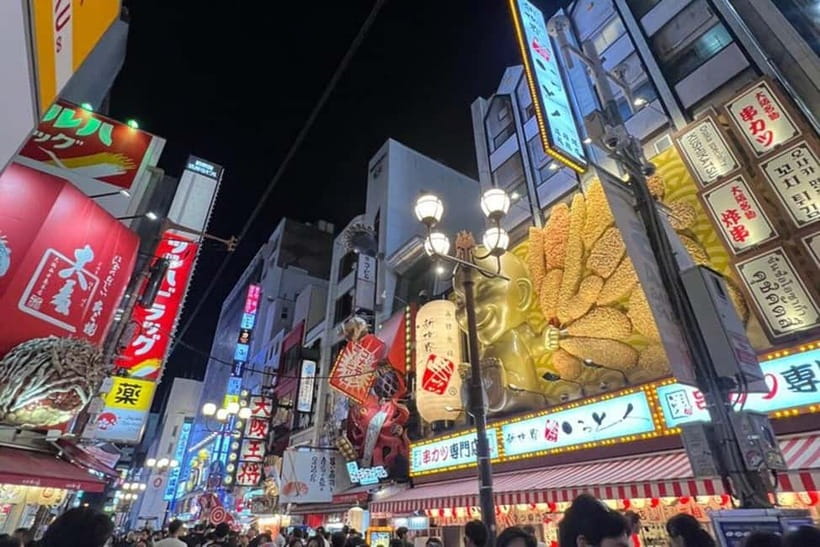
- Dotonbori: ending beneath Osaka’s neon
- The pace, walking, and public transport
- Small groups, private guiding, and guide quality
- What the $64 price really buys
- Who should book this Osaka walking tour?
- My booking advice
- FAQ
- How long does the Osaka walking tour last?
- What sights are included?
- Are subway fares included in the price?
- Is Osaka Castle admission included?
- Is food included at Kuromon Market?
- What should I bring?
Five useful things to know before booking
- Six major Osaka stops in four hours: You see Osaka Castle, Shinsekai, Shitennoji Temple, Kuromon Market, Dotonbori, and nearby sights without spending a full day on one area.
- Subway travel saves time: Around 800 yen in subway fares is extra, but public transport makes this route possible.
- Food is not included: Kuromon Market is a chance to buy seafood, snacks, tea, and street food at your own expense.
- The guide can shape the day: Private and small-group options allow more questions, photo stops, and occasional changes.
- It is a true walking day: Comfortable shoes, cash, and rain protection matter, especially in Osaka’s hot or wet seasons.
Why this Osaka tour works as a first-day introduction
Osaka can feel scattered at first. The castle sits away from the southern food districts, Shitennoji lies near Tennoji, and Shinsekai has a completely different mood from Dotonbori. This tour connects those parts in one outing, using the subway between the longer stretches.
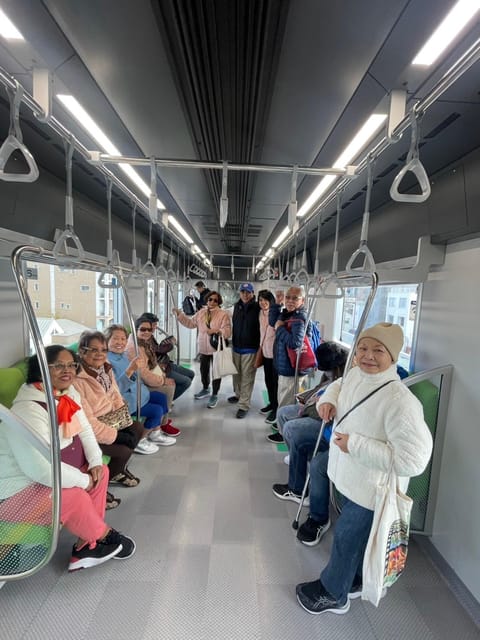
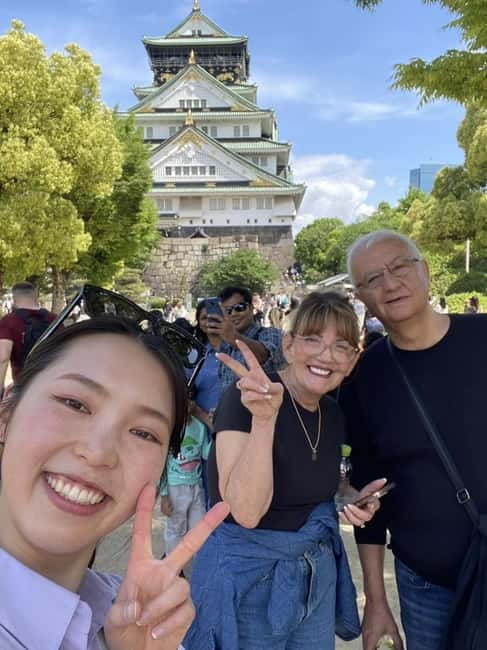
I see the main value in the guide’s role. You are not just being moved from one photo stop to the next. The guide explains what you are seeing, helps with subway travel, takes photos, and points out places to eat afterward. Several guides have been praised for clear English, patience, and practical help. Minori, for example, kept a group together through the train system and allowed free time at several stops. Haru helped one visitor learn to use the subway, which can make the rest of an Osaka stay cheaper and less stressful.
The route is also useful for someone with only a day or two in Osaka. You get a first look at the city’s old temples, castle symbolism, shopping streets, food culture, and modern nightlife in a single block of time. I would not treat it as a slow historical tour. It is better understood as a fast, well-guided orientation.
At $64 per person, the price is fair if you value a guide and want to cover a lot without planning the transport yourself. It becomes less of a bargain if you already know Osaka, prefer long visits inside museums and temples, or want to eat freely at every market stop. The tour includes the guide and walking service, but you should budget roughly 800 yen for subway fares, up to 1,200 yen for Osaka Castle entry, and extra for food and drinks.
More Walking Tours in Osaka
- Osaka: Hotspots & Hidden Gems Walking Tour Private or Group
★ 4.9 · 1,300 reviews - Osaka Local Foodie Walking Tour in Dotonbori and Shinsekai
★ 5.0 · 985 reviews - Osaka Bar Hopping Night Walking Tour in Namba (3 bars, 6 tastes)
★ 5.0 · 958 reviews
Meeting at Namba Walk and getting started
The regular meeting point is the guide’s base in Namba Walk, an underground shopping area. Look between exits B21 and B23, near the DOCOMO and MIZUNO shops. Namba Walk has two parallel walkways, so if you cannot find the store between those shops, check the opposite side.
This detail matters. Namba Walk can be confusing if you are rushing, and an underground meeting point is not always obvious on a first visit. I would arrive early and keep the meeting instructions available on your phone.
Hotel pickup may be available as an optional service near the cruise terminal or from your hotel, depending on the selected option. Cruise passengers can request pickup near the terminal for an additional ¥5,000, tax included, by messaging at least one day in advance. For hotel pickup, you should be in the lobby about 10 minutes before the start. The guide may hold a sign reading Osaka JOINER, though this is not guaranteed.
The guide payment must be made in cash. Bring cash for that, the subway, castle admission, and any food you want at Kuromon Market. A credit card may not solve every small payment on this route.
Osaka Castle and Hokoku Shrine: a strong opening stop
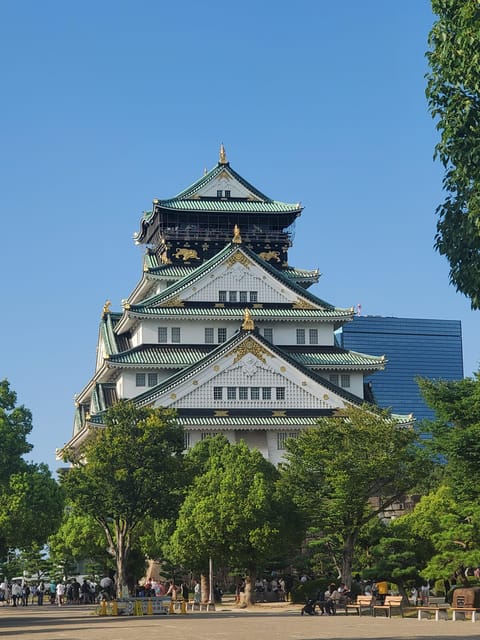
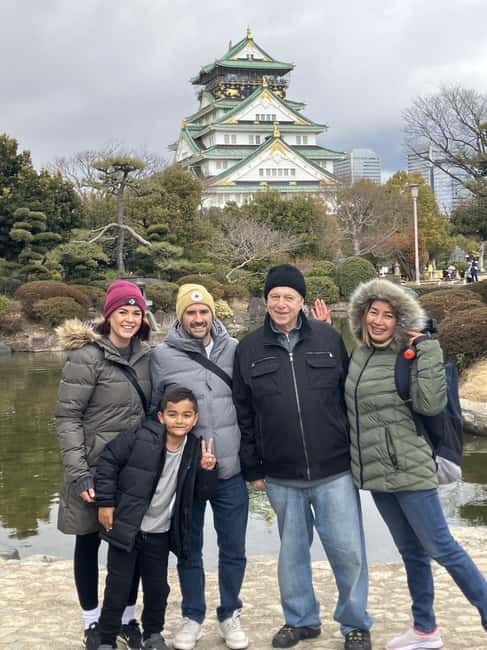
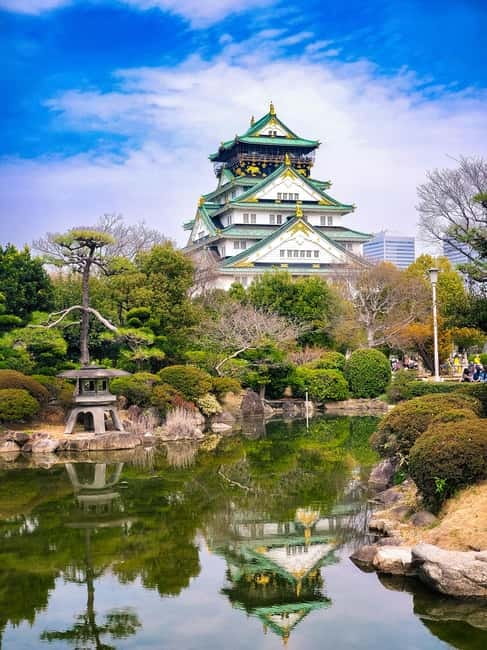
The first major sight is Osaka Castle, with about 50 minutes for a photo stop, a visit, and sightseeing. This is one of Osaka’s essential landmarks, and the park gives you room to see the castle from different angles rather than simply snapping one picture at the entrance.
The tour focuses on the castle grounds and surrounding park. Castle entry is not included, and the stated admission cost is 1,200 yen. With only 50 minutes in the schedule, you should ask your guide how much time is practical inside before paying. If you want a long museum visit, the schedule may feel tight. If you mainly want the exterior, views, and basic historical setting, the stop fits well.
The nearby Hokoku Shrine receives about 15 minutes. This shorter visit adds another layer to the castle area and gives the guide a chance to explain local history and religious traditions. It is not a long temple visit, but it breaks up the castle stop and keeps the morning moving.
I like this pairing because it gives you both the grand landmark and a smaller sacred site. The tradeoff is that you do not have much unstructured time. Visitors who enjoy lingering over gardens or reading every display should plan a separate return visit.
Shinsekai, Shinsekai Market, and Tsutenkaku
After another subway ride, the tour reaches Shinsekai, Osaka’s old-style entertainment district. You get around 20 minutes for walking, photos, free time, and possibly shopping. Shinsekai feels distinct from the polished shopping areas elsewhere in the city, with a retro character and strong links to Osaka’s everyday food culture.
The stop is short, but that can be an advantage. You get a taste of the area without using half the tour here. Your guide can point out Tsutenkaku Tower and local specialties, then help you decide if Shinsekai deserves a longer return visit.
The next stop, Shinsekai Market, lasts about 15 minutes and may include tea or a tea ceremony if that option is selected. The information for the experience lists a matcha tea experience as included only with the appropriate option, so check the booking choice rather than assuming it comes with every ticket.
Tsutenkaku receives about 10 minutes for a visit, sightseeing, and photos. This is enough for a quick look and a picture, but not a leisurely tower experience. I would treat it as a visual symbol of Shinsekai, not the main attraction of the tour.
Together, these three stops show a side of Osaka that a castle-and-shopping plan could miss. You see a more local, old-fashioned district and get a little time to explore on your own. The drawback is obvious: 45 minutes in total is not enough to sample every food stall or fully explore the neighborhood.
A completely different kind of day out in Osaka:
- Osaka Go Karting Tour with Funny Costume
★ 5.0 · 2,658 reviews - Osaka Castle: Museum and Tower Entry Ticket
★ 4.5 · 2,380 reviews - Osaka: Shinsekai Food Tour with 13-15 Dishes at 5 Eateries
★ 4.8 · 2,204 reviews - Osaka Food Tour: 13 Dishes at 5 Local Eateries
★ 5.0 · 2,149 reviews
Shitennoji Temple and the older side of Osaka
The subway then takes you to Shitennoji Temple, with about 30 minutes for sightseeing and photos. The temple is described as one of Japan’s oldest Buddhist temples, making it an important stop for anyone who wants more than modern Osaka streets and food signs.
I would use this part of the tour to ask questions. A guide can explain what you are looking at, how the temple fits into Osaka’s past, and what details deserve your attention. The tour does not promise a long religious or architectural lecture, so the quality of your visit will depend partly on how actively you engage with the guide.
Thirty minutes gives you a useful introduction, but it is not enough to study every building or garden at a slow pace. If Shitennoji is a top priority, note what you want to see and return later. The advantage of visiting with a guide is that you get context right away. The limitation is the clock.
This is also one of the stops that helps balance the food and neon districts. Osaka is famous for eating and nightlife, but Shitennoji shows why the city also matters as a historic center.
Kuromon Ichiba Market, Osaka’s kitchen
Kuromon Ichiba Market is the tour’s best chance to stop eating and start tasting. The schedule allows about 20 minutes for a market visit, free time, shopping, walking, food tasting, and street food. Food and drinks are not included, so bring cash and decide in advance how much you want to spend.
The market is widely known as Osaka’s kitchen, and the appeal is direct: fresh seafood, local snacks, drinks, and small portions that can be sampled as you walk. You may find yourself wanting more than 20 minutes here, especially if you enjoy choosing food stall by stall. The short stop is enough for a first look and one or two purchases, but not a full market meal.
This is where guide advice can save time. A guide can explain what you are seeing, help with basic ordering questions, and suggest which parts of the market deserve attention. Several guide experiences have included food suggestions, and Nagi was praised for recommending a sushi restaurant after the tour. Kenji and Victor also gave useful restaurant and shopping tips for later in the stay.
I would avoid arriving at Kuromon with a full stomach. Even though the scheduled visit is brief, the market works best when you have room to try something. Keep your budget flexible because food prices will vary by purchase, and the tour does not cover them.
Dotonbori: ending beneath Osaka’s neon
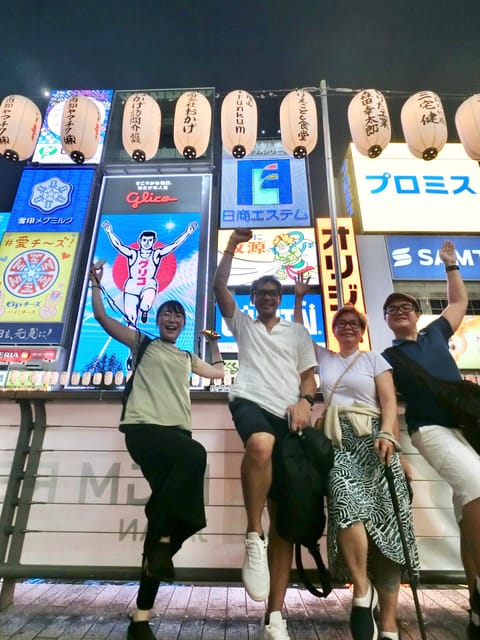
From Kuromon Market, you walk about 10 minutes to Dotonbori, where the tour ends after roughly 15 minutes of sightseeing and photos. This is Osaka’s famous neon-lit food and shopping district, and it gives the tour a lively finish.
The brief Dotonbori stop is mainly an introduction. You can see the canal-side signs, absorb the crowded visual energy, and take photos, but you will need more time if you want to shop, eat, or explore the side streets. The good news is that ending here gives you a simple choice: stay in Dotonbori and continue on your own, or use the stated drop-off locations.
Dotonbori is also a practical ending point because you have just received food suggestions and local orientation. You can immediately put those tips to use, though the exact restaurant recommendations will depend on your guide. The tour’s final location is more useful than ending back at the starting point for many people, since you are already in one of Osaka’s main evening areas.
I would save an appetite for this neighborhood if you want to eat after the tour. Kuromon offers market snacks, while Dotonbori gives you a wider choice of Osaka food and shopping.
The pace, walking, and public transport
The tour lasts four hours, but the route includes several subway rides of about 15 minutes, plus a 10-minute ride later in the day and a 10-minute walk from Kuromon to Dotonbori. This is not four hours of uninterrupted walking, yet you will spend much of the outing on your feet, changing trains, crossing streets, and moving through busy public areas.
Comfortable shoes are essential. The tour information says brief stops are built into the day, and guides have made room for water breaks, drinks, photos, and small food stops. Minori was praised for checking on water breaks during a hot day, while Lily continued the planned route during steady rain and made sure the group reached each location.
The tour runs in rainy weather. Bring an umbrella or raincoat, and expect the route to continue rather than switch to an indoor plan. Osaka’s summer heat can also affect your enjoyment, so light clothing and water make sense, though the experience specifically requires comfortable shoes and cash.
This tour is not suitable for people with mobility impairments, people over 75, or people recovering from recent surgery. The combination of walking, subway transfers, stairs, and short stops makes that restriction important. If you tire easily, a private option may allow more flexibility, but the stated route still involves substantial movement.
Small groups, private guiding, and guide quality
The tour is available as a private or small-group experience. That choice affects the value. A private tour costs more in many cases, but it can make the fast route feel less rushed because you can ask more questions and request small adjustments. In a small group, you gain a social setting but need to keep up with the agreed schedule.
The strongest pattern in the guide feedback is personal care. Buchi was praised for waiting, taking photos, answering questions, and suggesting places to eat. Tony made the tour easy for a solo visitor by explaining Osaka clearly and taking good photos. Risa was noted for giving a great deal of information in a friendly way, while Haruka and Kota were praised for being considerate and flexible.
English ability is another practical strength. The guides named in the feedback, including Kenji, Minori, Nagi, Halu, Kito, Satsuki, and others, were described as clear, friendly, and able to explain both historical subjects and daily life in Osaka. Individual style will vary, but the overall rating of 4.8 from 104 ratings points to a consistently positive experience.
Do not expect one fixed personality or one identical tour every day. The guide assigned to you can shape the experience. I would tell the guide at the start if you care most about food, temples, photography, shopping, or learning the subway.
What the $64 price really buys
At $64 per person, I see the main purchase as time and local help. You could visit these districts yourself for less, especially if you already understand Osaka’s subway system and can read the signs. But planning the order, finding the correct stations, keeping track of time, and deciding what deserves attention all take effort.
The tour includes an English-speaking guide, the walking service, and help with photography. It does not include subway fees, food and drinks, or the 1,200 yen castle entry. The subway cost is estimated at around 800 yen, so the added expenses are clear rather than hidden.
For a first visit, the value is strongest if you have limited time or feel uneasy using public transport. It is also useful for solo visitors who want company and photos, families who want a simple route, and people who prefer explanations over self-guided sightseeing.
The value is weaker for repeat visitors or slow sightseers. You may prefer to spend four hours at Osaka Castle, Shitennoji, or Kuromon Market alone. The route covers a lot, but it cannot give every stop the same attention.
Who should book this Osaka walking tour?
I would book it for a first visit, a short stay, or the first full day in Osaka. It gives you a clear sense of the city’s main zones and leaves you with ideas for what to revisit. It is also a smart choice if you want practical help with the subway and food decisions.
Families can benefit from the guide’s ability to keep a group together, explain local culture, and adjust the pace when possible. Solo visitors may value the company and photography help. Food-focused visitors should see Kuromon and Dotonbori as starting points, not a replacement for a longer food tour.
I would skip it if you dislike fixed schedules, have mobility limitations, or want deep time at each sight. The four-hour route is energetic and efficient, not leisurely. You will see many highlights, but you will need to return on your own for a slower look.
My booking advice
Book this tour if you want a guided first taste of Osaka and understand that the city is being sampled, not fully explored. Bring cash, wear shoes you can walk in, budget for the subway and castle, and leave room for food afterward.
If you can, choose a small group or private format when personal questions and flexibility matter to you. Tell the guide what you want from the day, and use the final Dotonbori stop as a launch point for your own evening. For most first-time visitors with limited time, that combination of orientation, local advice, and major sights makes the $64 fee reasonable.
FAQ
How long does the Osaka walking tour last?
The tour lasts four hours. It includes walking, several subway rides, sightseeing stops, photo opportunities, and short breaks.
What sights are included?
The route includes Osaka Castle, Hokoku Shrine, Shinsekai, Shinsekai Market, Tsutenkaku, Shitennoji Temple, Kuromon Ichiba Market, and Dotonbori.
Are subway fares included in the price?
No. Subway fees are extra and are estimated at around 800 yen.
Is Osaka Castle admission included?
No. Castle entry is extra and listed at 1,200 yen.
Is food included at Kuromon Market?
No. Food and drinks are not included. You can buy seafood, street food, snacks, and other local treats during the market stop.
What should I bring?
Bring comfortable shoes and cash. If rain is expected, bring a raincoat or umbrella because the tour continues in rainy weather.
Just added around Osaka
- Osaka Food Tour with 10 Classic Japanese Tastings & Drinks★ 5.0 · 38 reviews
- Osaka: Highlights & Hidden Gems Private Walking Tour★ 4.7 · 38 reviews
- Kyoto private tour (Shore excursion available from Osaka or Kobe port)★ 5.0 · 39 reviews
- Osaka Private Day Trip – Enjoy Your First-Time Visit to Osaka!★ 5.0 · 39 reviews
- Kyoto & Nara & Uji: Full Day Sightseeing Tour from Osaka or Kyoto★ 4.5 · 39 reviews
- Authentic SUSHI Course Cooking Class★ 5.0 · 39 reviews
- Osaka: Mind & Spirit Balance Temple Reiki Healing★ 5.0 · 41 reviews
- Osaka: Gluten-Free Ramen and Gyoza Cooking Class★ 5.0 · 42 reviews
Walking Tours, compared.
Kyoto Geisha Walking Tour: Gion District & Hidden Gems
Read our review →
Tokyo Tsukiji Fish Market Food and Culture Walking Tour
Read our review →
Gion Magical Night Walking Tour with Geisha Trivia
Read our review →
Imperial Palace and Shogun Historical Walking Tour
Read our review →
Gion Geisha District Walking Tour – Stories of Geisha
Read our review →

Shinjuku Local Bar and Izakaya Guided Walking Tour
Read our review →
Browse the lists this tour appears in