
Reviewed · HISTORICAL TOURS
Hiroshima History Tour : A-Bomb Dome, Peace Memorial & City
Hiroshima asks you to slow down. This private tour links the Peace Memorial Museum and Atomic Bomb Dome with local streets, Hiroshima Castle, and Shukkeien Garden, giving you both the hard facts and the city’s present-day character. I especially like the guides’ personal ties to Hiroshima, and the freedom to shape the route around your interests. The main caution is time: seeing every listed stop properly can stretch beyond three hours.
The skip-the-line museum entry is another strong point, particularly when your visit is short. Guides including Yuka, Masa, Yuta, and Ally have been praised for warmth, clear explanations, and flexible pacing. You should also expect plenty of walking, and public transportation costs an additional ¥240 per person.
In This Review
- What makes this Hiroshima tour worth considering
- Starting with Hiroshima’s difficult story
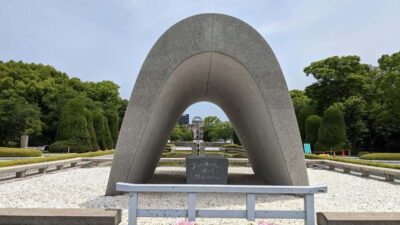
- Walking through Peace Memorial Park
- The Children’s Peace Monument and Sadako’s story
- Seeing the Atomic Bomb Dome from the river
- Standing at the hypocenter
- Adding Hiroshima Castle to the route
- Finding quiet at Shukkeien Garden
- How the private format changes the day
- What the $105.42 price includes
- Who will get the most from this experience
- Should you book the Hiroshima History Tour?
- FAQ
- How long is the Hiroshima History Tour?
- Is the Peace Memorial Museum admission included?
- Is transportation included?
- Can the itinerary be customized?
- Is Hiroshima Castle admission included?
- What is the cancellation policy?
What makes this Hiroshima tour worth considering
- Personal family connections: Some guides are second-generation atomic bomb survivors, while others grew up in Hiroshima or have relatives affected by the bombing.
- A thoughtful route through six major sites: The tour can include the Peace Museum, memorial park, Children’s Peace Monument, A-Bomb Dome, hypocenter, castle, and Shukkeien Garden.
- Private and customizable: Only your group participates, so you can adjust the pace and focus.
- A useful contrast of sorrow and renewal: The tour moves from war memorials to a samurai castle and a calm Japanese garden.
- Photo data included: You receive tour photographs, a pleasant extra after an emotionally serious day.
- Best for walkers with limited time: Three hours gives you a brisk overview, while four hours makes the full route more comfortable.
Starting with Hiroshima’s difficult story
Hiroshima is not a place where the past sits politely behind glass. It is part of the streets, the riverbanks, the monuments, and the families who still live here. A local guide can help you understand that the atomic bombing was not only a date in a textbook. It affected homes, schools, families, buildings, and the shape of the city itself.
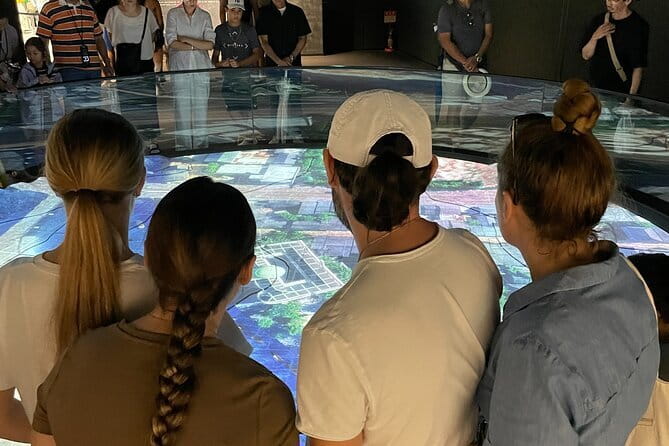
This tour begins at the Hiroshima Peace Memorial Museum, where your admission is included and skip-the-line access is provided. The museum uses objects, survivor paintings, records, and data to explain the bombing and its aftermath. You should allow the full hour listed for this stop. Rushing through it would undercut the reason for coming.
The museum is emotionally heavy. That is not a flaw, but it is worth knowing before you arrive. Some displays are direct and painful. A guide can give you context and help you connect the exhibits to the city outside, but you still need room to process what you see.
The private format helps here. You can ask questions without worrying about a large group, and your guide can slow down when a section needs more time. If you are visiting with children, older relatives, or anyone who finds war museums difficult, tell the guide in advance so the route and discussion can be adjusted.
More History Tours in Hiroshima
- Hiroshima Historical Walking Tour – Why A-Bomb was Dropped
★ 4.8 · 893 reviews - Hiroshima Peace (Heiwa) Walking Tour at World Heritage Sites
★ 5.0 · 872 reviews - Miyajima Half-day Trip Historical Walking Tour
★ 5.0 · 284 reviews
Walking through Peace Memorial Park
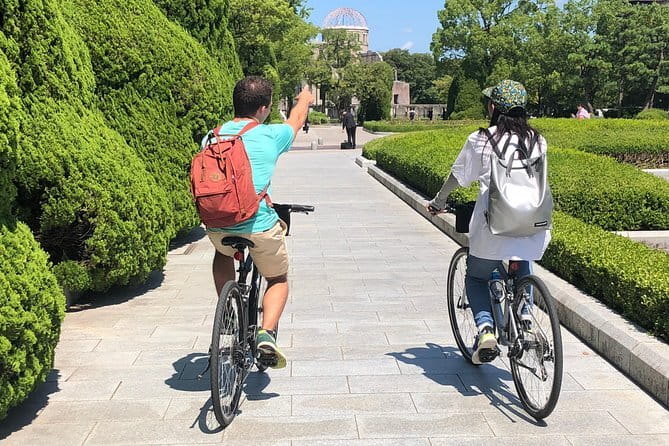
After the museum, you walk through Peace Memorial Park for about 20 minutes, visiting several monuments and hearing about Hiroshima’s recovery. The park is spacious and carefully maintained, with open views and quiet paths along the river.
The short scheduled time gives you a general introduction rather than a full monument-by-monument tour. That works well if you have only a few hours, but you may want to return later on your own. The park contains more than can be absorbed in one quick circuit.
The guide’s local perspective matters most here. You may hear how people in Hiroshima think about remembrance, rebuilding, and the city’s message for the future. Some guides have family connections to the bombing, and those personal stories can add a human layer that a museum label cannot provide.
This is also a useful point to pause. The tour is not only about destruction. Hiroshima rebuilt itself into a working modern city, and the park reflects both grief and the determination to keep peace at the center of public life.
The Children’s Peace Monument and Sadako’s story
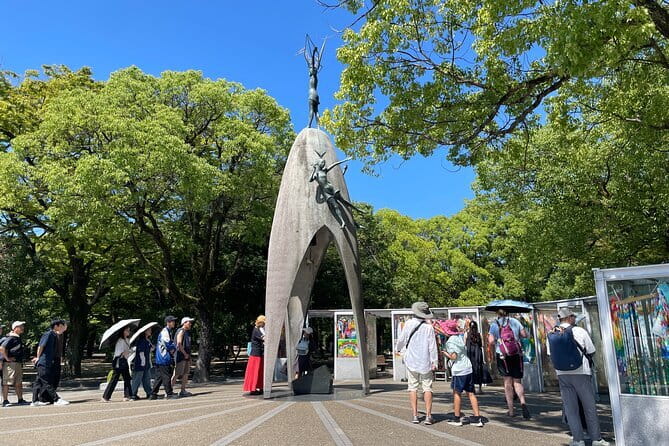
The Children’s Peace Monument is a brief stop, listed at around five minutes. It is linked to Sadako Sasaki, the young girl whose story became associated with folded paper cranes and the wish for peace.
You will see many origami cranes around the monument. The visit is short, but the emotional effect can be strong, especially for families. Children may connect with Sadako’s story more easily than with the museum’s technical explanations.
Do not expect a long presentation here. The value comes from the guide’s explanation and the chance to understand why cranes have become such a lasting symbol in Hiroshima. If this part interests you, ask for extra time. The private format makes that possible.
Seeing the Atomic Bomb Dome from the river
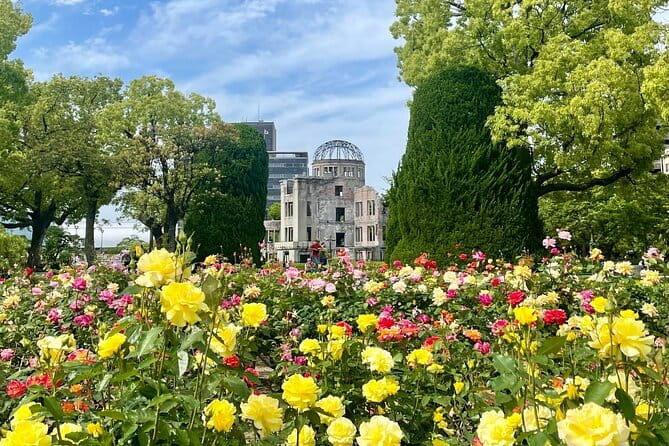
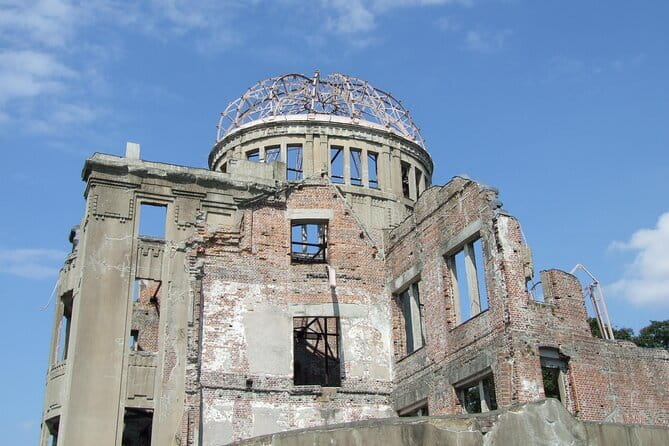
The Atomic Bomb Dome is the city’s most recognizable symbol. It was near the bomb’s hypocenter and retained much of its original form, while almost everything around it was destroyed. Today, it is protected as a UNESCO World Heritage Site.
The tour allows about 20 minutes at the dome. That is enough to view the structure, take photographs, and hear how it fits into the events of August 6, 1945. The building’s exposed frame and damaged walls make the bombing feel physically present.
You cannot treat the dome like an ordinary historic building. It is preserved as a memorial, not restored for use. Your guide can explain what you are seeing and why the structure remains important, but the site itself does much of the speaking.
I like the way this tour places the dome after the museum and park. By then, you have context. You are not simply taking a photograph of a famous ruin. You understand why the building survived and what it represents to Hiroshima.
A completely different kind of day out in Hiroshima:
- Peaceful Hiroshima & Miyajima UNESCO 1 Day Bus Tour
★ 5.0 · 5,309 reviews - Hiroshima: Hiroshima and Miyajima UNESCO Sites 1-Day Tour
★ 4.9 · 2,330 reviews - Hiroshima / Miyajima Full-day Private Tour with Government Licensed Guide
★ 5.0 · 1,298 reviews - Hiroshima in a Nutshell: Morning Bike Adventure
★ 5.0 · 524 reviews
Standing at the hypocenter
The hypocenter monument marks the location directly above the point where the atomic bomb exploded. The tour allows about 10 minutes here, and that compact stop can be one of the most powerful.
The site is connected with Shima Hospital, which was almost directly below the explosion. Your guide may ask you to picture the location before and after the bombing. This is not a grand memorial with a large plaza. Its simplicity makes the physical fact feel stark.
Many people visit the dome and miss the hypocenter. Including both gives you two different ways to understand the event. The dome shows the visible damage that remains. The hypocenter marks the precise center of the blast.
Because the stop is brief, keep your attention on the guide. Traffic and ordinary city life continue nearby, which can feel jarring. That contrast is part of modern Hiroshima: the city has moved forward, but the location has not been forgotten.
Adding Hiroshima Castle to the route
Hiroshima Castle changes the mood. The original castle was built in the 16th century and destroyed by the atomic bombing. The current structure is a replica, so you are seeing a reconstruction rather than an untouched historical building.
The usual plan is an outside photo stop of about 15 minutes. You can request entry to the interior museum, but that admission is not included. This is an important detail if castles are a major interest for you, since going inside requires extra time and an additional ticket.
The castle adds useful context before the bombing. Hiroshima was not created only as a memorial city. It had centuries of samurai-era history, local government, and cultural life. Seeing the castle helps you understand what was lost and what the city has rebuilt.
If your priority is the Peace Museum, you may prefer to keep the castle short. If you enjoy Japanese castles and want a broader view of Hiroshima, ask your guide to spend more time here. Since the activity is private, the choice is yours.
Finding quiet at Shukkeien Garden
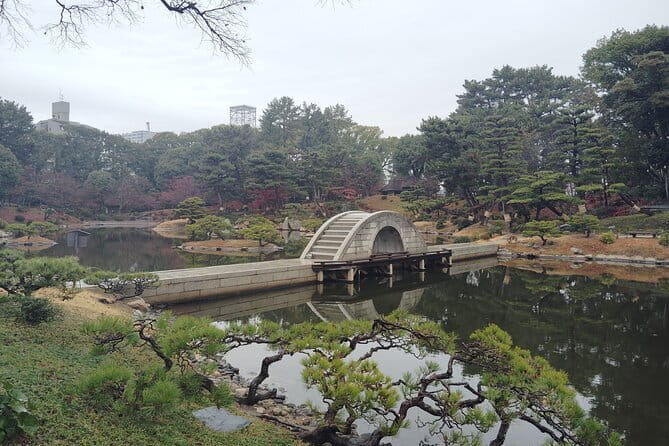
Shukkeien is one of the oldest Japanese gardens in Hiroshima. Created in 1620, it was associated with a samurai who settled in the area. The garden uses a pond, trees, paths, and gentle changes in height to create a calm, natural setting.
The planned visit lasts about 45 minutes, and admission is included. This is the longest stop after the museum, which makes sense. You need time to walk, look across the pond, and enjoy the change from memorial sites to traditional garden design.
I consider Shukkeien one of the tour’s best balancing elements. Hiroshima’s wartime story is essential, but three hours of difficult material can be exhausting. The garden gives you a quiet place to think about what you have seen without turning the day into a series of grim stops.
Season can affect the experience. One guide took visitors to the Momiji Festival, where autumn colors made the garden especially striking. Do not assume a festival will be taking place during your visit, but ask about seasonal events when you arrange the tour.
How the private format changes the day
This is a private activity, so only your group participates. That makes a real difference in Hiroshima. You can ask direct questions, discuss family history, or stop for a longer look without waiting for strangers.
The tour can be arranged in English or Japanese. Guides have been praised for being friendly, accommodating, and easy to understand. Masa, in particular, has been appreciated for combining local knowledge with a personal family connection to Hiroshima’s wartime history.
The guide may meet you at your hotel if pickup is arranged. Pickup is offered, but private transportation is not included. You should expect to walk and use public transportation, with the stated transit cost of ¥240 per person.
One family described walking a great deal and also stopping at a restaurant for lunch. Lunch is not part of the tour, and food and drinks are not included, so plan separately. Your guide may be able to offer local suggestions, but you should not treat a restaurant visit as a guaranteed part of the package.
The itinerary is flexible, yet the listed stops total roughly 175 minutes before travel time. That is more than a relaxed three-hour outing. If you want the museum, all memorial sites, Hiroshima Castle, and the garden, choose the four-hour option if available or agree in advance on priorities.
What the $105.42 price includes
At $105.42 per person, this is not a bargain-priced group walk. You are paying for a private guide, a personalized route, museum admission with skip-the-line access, Shukkeien entry, English or Japanese guidance, and photo data from the tour.
The value is strongest for couples, families, or small groups who want conversation and control over the schedule. A large group tour may cost less, but it will not offer the same freedom to adjust the route or ask personal questions.
Group discounts may be available, which can improve the price for families or friends traveling together. Be clear about the number of people and your must-see sites before booking. That helps you judge if the tour will feel like a focused introduction or an overpacked checklist.
The museum and garden admissions alone do not account for the full price. The main benefit is the human explanation and the ability to connect several parts of Hiroshima in one walk. If you prefer to read signs independently and move at your own speed, you may not gain as much from the cost.
Who will get the most from this experience
I would choose this tour if Hiroshima is your first visit and you want help making sense of the memorial sites. It is also a good fit if you value local family stories and prefer a private conversation to a scripted group lecture.
Families can benefit from the flexible pace, especially at the Children’s Peace Monument and Peace Memorial Museum. Couples and solo visitors may appreciate the chance to ask sensitive questions in a quieter setting.
It suits people who want more than the A-Bomb Dome. The castle and garden add prewar culture and present-day calm, giving you a fuller picture of the city.
You should think twice if you dislike walking, want a slow museum visit, or have only three hours but expect to see every stop in detail. The tour requires good weather, and a cancellation caused by poor weather results in a different date or a full refund.
For comfort, wear practical walking shoes and keep your schedule flexible. Cold symptoms are a reason not to participate. Service animals are allowed, and the tour is near public transportation. Most people can take part, but the walking and emotional weight still deserve consideration.
Should you book the Hiroshima History Tour?
Book it if you want Hiroshima explained by someone who knows the city as home, not only as a memorial destination. The strongest part is the combination of the museum’s evidence, the city’s physical memorials, and guides such as Yuka, Masa, Yuta, and Ally, who have been praised for warmth, clear teaching, and thoughtful personal perspectives.
Before booking, decide what matters most. For the museum, Peace Memorial Park, dome, hypocenter, castle, and Shukkeien Garden, allow four hours if possible. For a shorter visit, prioritize the museum, park, dome, and hypocenter, then use the remaining time for either the castle or garden.
The free cancellation policy allows a full refund when you cancel at least 24 hours before the start time. Last-minute changes are not accepted, and poor weather may lead to a new date or refund.
At $105.42, this is best viewed as a private orientation to Hiroshima, not simply a walk between attractions. If personal context, flexible pacing, and a careful introduction to the city matter to you, it is a strong choice.
FAQ
How long is the Hiroshima History Tour?
The tour lasts approximately three or four hours, depending on the option selected and how the itinerary is customized.
Is the Peace Memorial Museum admission included?
Yes. Museum admission is included, with skip-the-line entry provided.
Is transportation included?
Private transportation is not included. Public transportation costs ¥240 per person, and the tour is near public transportation.
Can the itinerary be customized?
Yes. You can customize the tour in advance and adjust the route to suit your pace and interests.
Is Hiroshima Castle admission included?
No. The usual visit is an outside photo stop. Entry to the castle museum is optional and requires an additional admission fee.
What is the cancellation policy?
You can cancel at least 24 hours before the experience start time for a full refund. Cancellations or changes made less than 24 hours before the start time are not refunded or accepted.
Just added around Hiroshima
- Hiroshima Country Cycling: Explore Rural Life 1 HR from City★ 5.0 · 22 reviews
- History of Hiroshima Group Walking Tour★ 5.0 · 23 reviews
- Hiroshima and Miyajima 1 Day Cruise Tour★ 5.0 · 24 reviews
- Hiroshima Peace Park & Atomic Bomb Dome Guided Walk★ 4.9 · 24 reviews
- Hiroshima Private Tour with a Local – Highlights & Hidden Gems★ 4.5 · 24 reviews
- Hiroshima & Miyajima: UNESCO A-Bomb Dome & Itsukushima with Local★ 5.0 · 25 reviews
- Calligraphy Workshop at Traditional Folk Craft Shop in Hiroshima★ 5.0 · 26 reviews
- Hiroshima Peace Park & A-Bomb Dome Private Walking Tour (4 Hours)★ 5.0 · 26 reviews
Historical Tours, compared.
World Heritage Shirakawa-go and Experience Tours from Kanazawa
Read our review →
Imperial Palace and Shogun Historical Walking Tour
Read our review →
World Heritage Kyoto & Nara Uji Authentic Matcha Experience
Read our review →
Kyoto Gion: 2-Hour Geisha Culture & History Walking Tour
Read our review →
World Heritage Shirakawa-go Morning Guided Tour
Read our review →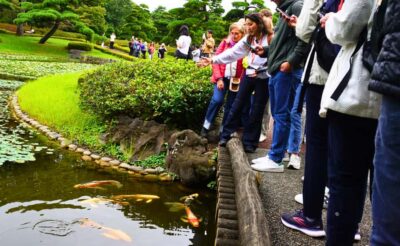
Hiroshima Historical Walking Tour – Why A-Bomb was Dropped
Read our review →
Hiroshima Peace (Heiwa) Walking Tour at World Heritage Sites
Read our review →Browse the lists this tour appears in