
Reviewed · WALKING TOURS
Hiroshima Peace Park & Atomic Bomb Dome Guided Walk
History asks for your attention here. This two-hour Hiroshima Peace Park walk brings together the Atomic Bomb Dome, memorials, and the story of August 6, 1945 in a way that is easy to follow. I like the route’s range, from the Fountain of Prayer and Children’s Peace Monument to the Korean Victims Memorial and Peace Bell. I also like that the tour includes the Peace Memorial Museum, though the museum portion is brief and the subject matter is understandably heavy.
The $21 price is fair for a guided introduction, especially if you want context rather than a quick photo stop. Guide Adina has earned praise for patient explanations, enthusiasm, and detailed discussion of nuclear reactions. The main consideration is walking: the tour covers many stops in two hours, and the information about accessibility is inconsistent, so you should confirm your needs before booking.
In This Review
- Key things to know before you go
- Why this Hiroshima walk is worth your time
- Starting at the Gates of Peace
- The Fountain of Prayer and the human cost
- A short but useful visit to the Peace Memorial Museum
- The Cenotaph and Flame of Peace
- The National Peace Memorial and Rest House
- Children’s Peace Monument and Sadako’s legacy
- Remembering Korean victims
- Ringing the Peace Bell
- Seeing the Atomic Bomb Dome
- The Hypocenter Monument and the moment of impact
- What Adina adds to the experience
- Price, pace, and practical value
- Who should book this Hiroshima tour?
- Should you book the Peace Park and Atomic Bomb Dome walk?
- FAQ
- How long does the Hiroshima Peace Park tour last?
- Where does the tour meet?
- Is entry to the Hiroshima Peace Memorial Museum included?
- Which languages are available?
- What should I bring?
- Can I cancel for a full refund?
Key things to know before you go
- The route covers the main memorial sites: You visit the Gates of Peace, Fountain of Prayer, Flame of Peace, Cenotaph, Children’s Peace Monument, Korean Victims Memorial, Peace Bell, Peace Tower, Atomic Bomb Dome, and Hypocenter Monument.
- Adina brings a science background: He is described as a PhD student who can explain nuclear reactions as well as the human story behind the bombing.
- The museum visit is short: Ten minutes is listed for the Hiroshima Peace Memorial Museum, so this tour works best as an introduction, not a full museum study visit.
- The meeting point is easy to identify: Look for the Gates of Peace, in front of an Italian restaurant, at coordinates 34.3906308, 132.4516662.
- You need comfortable shoes and water: The walk includes many stops across the park, with sunscreen useful in bright weather.
- Check mobility arrangements carefully: The activity is marked wheelchair accessible in one place but also says it is not suitable for wheelchair users or people with mobility impairments.
Why this Hiroshima walk is worth your time
Hiroshima Peace Memorial Park is not simply a collection of monuments. It is a carefully arranged place where each memorial adds another part of the story. A guide helps you connect those pieces, especially if this is your first visit and you are unsure what each site represents.
I like that this walk does not focus only on the Atomic Bomb Dome. The Dome is the image most people recognize, but it is only one part of Hiroshima’s memorial story. The tour also brings attention to children, Korean victims, medical aid workers, and the city’s continuing appeal for peace.
That broader approach matters. It keeps Hiroshima from becoming only a dramatic photograph or a single historic date. You are encouraged to think about the people affected, the medical response, the children who died, and the international message built into the park.
The guide is an important part of the experience. Adina has been praised for being approachable, patient, and clear. One particularly useful detail is his reported ability to explain nuclear reactions in plain terms, thanks to his academic background. That can help you understand what happened without turning the visit into a dry science lecture.
Still, this is a serious experience. It is not designed as light sightseeing. You will encounter memorials, personal loss, and museum material connected to the bombing. I would plan this walk for a time when you can give it your full attention.
More Walking Tours in Hiroshima
- Hiroshima Historical Walking Tour – Why A-Bomb was Dropped
★ 4.8 · 893 reviews - Hiroshima Peace (Heiwa) Walking Tour at World Heritage Sites
★ 5.0 · 872 reviews - Hiroshima City 4hr Private Walking Tour with Licensed Guide
★ 5.0 · 437 reviews
Starting at the Gates of Peace
The meeting point is the Gates of Peace, in front of an Italian restaurant. This is a practical place to begin because the gates immediately establish the theme of the tour: a public call for cooperation and global unity.
The opening guided section lasts about 10 minutes. That is enough time to get oriented and hear why the gates matter before moving into the park. I like beginning here instead of at the Atomic Bomb Dome because the route starts with Hiroshima’s message for the future, not only its destruction.
Make sure you arrive with the exact meeting point saved on your phone. The supplied coordinates are 34.3906308, 132.4516662. Hotel pickup is not included, so you will need to make your own way to the gates.
The Fountain of Prayer and the human cost
The Fountain of Prayer is one of the more reflective early stops. Here, you pause for the victims of the atomic bomb rather than simply receiving a fast historical explanation.
The scheduled visit lasts about 10 minutes. That may sound short, but a good guide can use it well by explaining the symbolism and giving you time to look around. I appreciate this kind of stop because it slows the pace before the tour moves through more sites.
You should not expect every memorial to provide a long speech or a large display. Several stops are brief by design. The value comes from the sequence: one memorial introduces a theme, another adds a different group or perspective, and together they create a fuller picture.
A short but useful visit to the Peace Memorial Museum
The Hiroshima Peace Memorial Museum is the emotional center of most visits to the park. This tour includes entry, but the listed guided time is about 10 minutes.
That is the first major limitation to understand. Ten minutes is not enough to study the museum’s exhibits carefully. Instead, I would treat the tour stop as an introduction that points you toward the museum’s importance and gives you basic context about August 6, 1945.
If you want to examine the displays at length, you may need separate time beyond the two-hour walk. The activity does not include meals, and food and drinks are not allowed inside the museum, so finish your snack or carry water for later before entering.
The short museum stop can still be valuable for first-time visitors. It gives the guide a place to explain the event in historical and human terms, while the rest of the tour lets you see how Hiroshima remembers it in public spaces.
A completely different kind of day out in Hiroshima:
- Peaceful Hiroshima & Miyajima UNESCO 1 Day Bus Tour
★ 5.0 · 5,309 reviews - Hiroshima: Hiroshima and Miyajima UNESCO Sites 1-Day Tour
★ 4.9 · 2,330 reviews - Hiroshima / Miyajima Full-day Private Tour with Government Licensed Guide
★ 5.0 · 1,298 reviews - Hiroshima in a Nutshell: Morning Bike Adventure
★ 5.0 · 524 reviews
The Cenotaph and Flame of Peace
The Hiroshima Victims Memorial Cenotaph is another central place of tribute. The cenotaph honors those who died, and the guide helps explain its role within the park’s wider message.
The Flame of Peace adds a forward-looking note. It represents a commitment to a world without nuclear weapons. I like the contrast between the cenotaph and the flame: one asks you to remember the dead, while the other asks you to think about what should happen next.
Both stops are scheduled for roughly 10 minutes. That makes this part of the tour easy to follow, though the pace may feel quick if you prefer to linger silently at memorials. You can always return to the park later if one particular place deserves more time.
The National Peace Memorial and Rest House
The Hiroshima National Peace Memorial is included in the route, along with a visit to the Rest House. These sites add another layer to the park’s story and help show how remembrance is organized beyond the best-known monuments.
The Rest House is especially useful as a witness to the past. Its presence connects the memorial grounds to the buildings and daily life that existed before the bombing. I like that the tour includes it because it gives you something more concrete than monuments alone.
The supplied schedule has a 10-minute guided visit for this part of the route. You should expect a concise explanation rather than an extended indoor stop. The exact sequence may vary slightly, since the itinerary includes two unnamed 10-minute guided sections in addition to the listed locations.
Children’s Peace Monument and Sadako’s legacy
The Children’s Peace Monument honors young lives lost in the bombing. It is one of the park’s most recognizable memorials and a place where the human effects on children come into sharp focus.
This stop can be especially meaningful for families and younger visitors, though the subject remains difficult. The monument gives the guide a chance to explain how Hiroshima remembers children separately and why their stories remain central to the city’s peace message.
I would listen closely here rather than rush toward the next photograph. The tour provides around 10 minutes, and that is enough to understand the memorial’s purpose if the guide keeps the explanation focused.
Remembering Korean victims
The Korean Atomic Bomb Victims Cenotaph is a valuable inclusion. It recognizes Koreans who died in the atomic bombing, a group that can be overlooked in a simplified account of Hiroshima.
This stop makes the tour more historically careful. The bombing affected people from more than one national background, and the memorial reflects that wider reality. I appreciate that the route does not present Hiroshima’s story as belonging only to Japanese citizens.
The scheduled stop is about 10 minutes. If you are interested in the international dimensions of the bombing, this may be one of the most important points on the walk. It also shows why a guided route can add value: a name and location alone may not tell you why a memorial belongs in the park.
Ringing the Peace Bell
The Peace Bell offers a more active moment in an otherwise contemplative walk. You are invited to ring it as a gesture for global harmony.
This experience gives you something to do, but it should not be treated as a novelty. The bell fits the park’s larger message of peace and personal responsibility. After hearing about victims and destruction, taking part in a quiet symbolic action can make the theme feel less distant.
The tour also includes the Peace Tower. Since the provided schedule lists an additional unnamed guided stop, the precise order of the bell and tower may vary. The guide can explain how each fits the park’s call for peace.
Seeing the Atomic Bomb Dome
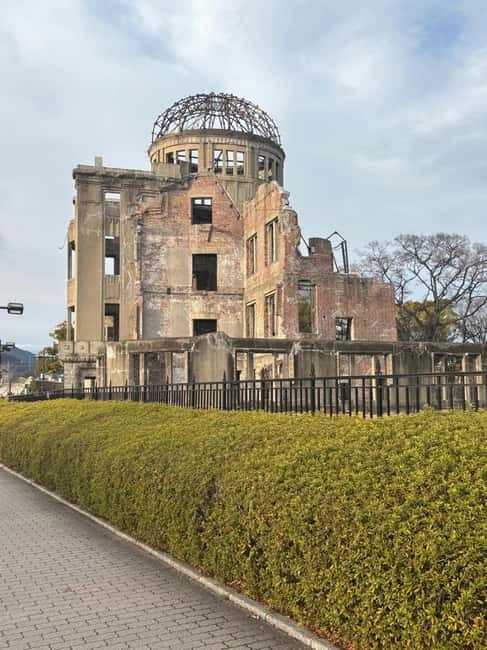
The Atomic Bomb Dome is the stop many people picture first, and it is a powerful one. The preserved remains are a direct reminder of the force that destroyed much of Hiroshima while leaving this structure partially standing.
The tour saves this major sight for later in the route. That is a sensible choice. By the time you reach the Dome, you have heard about victims, medical aid, children, Korean victims, and the city’s anti-nuclear message. You see the building with more context than you would at the beginning.
The guide can help you read the Dome as more than an old building. It is a physical reminder of August 6, 1945 and of the lives changed around it. You will have time for photos, but this is not a casual photo stop. Keep your camera respectful and give yourself a quiet moment before moving on.
The Hypocenter Monument and the moment of impact
The Hypocenter Monument marks the point directly below the atomic bomb’s explosion. It is one of the simplest locations on the route, yet its meaning is enormous.
At the Atomic Bomb Dome, you see the remains of a structure. At the Hypocenter Monument, you are asked to consider the exact point where the blast began. That change in scale can make the history feel more immediate.
The itinerary includes this monument near the end, with another 10-minute guided section listed. I think the placement works well because the walk has already given you background before asking you to pause at the central point of the event.
What Adina adds to the experience
The strongest praise connected to this activity focuses on Adina’s manner and explanations. He is described as kind, patient, passionate, and willing to take time with questions. Those qualities matter in Hiroshima, where a rushed or overly dramatic delivery would weaken the experience.
One useful feature is the mix of history and science. Adina is described as a PhD student who explains nuclear reactions in detail. If you want to understand not only what happened but also the basic science behind the bombing, this could be a strong match.
At the same time, a science-focused explanation may not suit everyone. If you mainly want silent reflection and personal time, a guided walk may feel more structured than necessary. The value depends on how much context you want while moving between memorials.
The tour is offered in English, Urdu, and Hindi. That language range may make the experience more comfortable for visitors who prefer one of those options. Confirm your selected language and starting time when booking.
Price, pace, and practical value
At $21 per person, the tour offers good value if you want a clear introduction to the park and a guide who can explain details you might otherwise miss. The price includes entry to the Peace Memorial Museum and visits to the major memorials listed above.
The two-hour duration keeps the experience manageable. You cover many stops without giving up an entire day, which is useful if you also plan to visit other parts of Hiroshima. The tradeoff is pace. Ten minutes at each location leaves limited time for long reflection or detailed museum viewing.
Wear comfortable walking shoes. Bring water, sunscreen, and a camera, but remember that food and drinks are not allowed inside the museum. Since hotel pickup and drop-off are not included, plan your route to the Gates of Peace before the start time.
Free cancellation is available up to 24 hours in advance for a full refund, and you can reserve now and pay later. Those options are useful if your Japan schedule is still changing.
The accessibility information needs careful attention. The activity is described as wheelchair accessible in one section, but another section says it is not suitable for wheelchair users or people with mobility impairments. Contact the provider before booking if this affects you, rather than relying on the general accessibility label.
Who should book this Hiroshima tour?
I would recommend it to first-time visitors who want the main sites explained in a logical order. It is also a good fit if you want a compact two-hour introduction before returning to the museum or park on your own.
History students, families with older children, and anyone interested in the science of nuclear weapons may value Adina’s detailed explanations. The inclusion of the Korean Victims Memorial and Dr. Marcel Junod Monument also suits visitors who want more than the standard Atomic Bomb Dome photo.
I would be more cautious if you dislike guided pacing or want several hours inside the museum. The museum visit is too short for that purpose. The walk also asks you to move from site to site, so people who need frequent rests should clarify the route and mobility arrangements first.
Should you book the Peace Park and Atomic Bomb Dome walk?
Book this tour if you want context, structure, and a human focus for your first visit to Hiroshima Peace Memorial Park. At $21, the combination of a live guide, museum entry, and major memorials is a sensible deal.
Do not book it expecting a full museum tour or a slow, private meditation at every stop. The route is compact and purposeful. For many people, that is exactly its strength: in two hours, you learn how Hiroshima remembers the bombing and why its message reaches beyond Japan.
FAQ
How long does the Hiroshima Peace Park tour last?
The guided walk lasts two hours.
Where does the tour meet?
The meeting point is at the Gates of Peace, in front of an Italian restaurant. The coordinates are 34.3906308, 132.4516662.
Is entry to the Hiroshima Peace Memorial Museum included?
Yes. Peace Memorial Museum entry is included, though the scheduled guided portion is about 10 minutes.
Which languages are available?
The live guide is available in English, Urdu, and Hindi.
What should I bring?
Bring comfortable walking shoes, water, sunscreen, and a camera. Food and drinks are not allowed inside the museum.
Can I cancel for a full refund?
Yes. You can cancel up to 24 hours in advance for a full refund.
Just added around Hiroshima
- Hiroshima Country Cycling: Explore Rural Life 1 HR from City★ 5.0 · 22 reviews
- History of Hiroshima Group Walking Tour★ 5.0 · 23 reviews
- Hiroshima and Miyajima 1 Day Cruise Tour★ 5.0 · 24 reviews
- Hiroshima Private Tour with a Local – Highlights & Hidden Gems★ 4.5 · 24 reviews
- Hiroshima & Miyajima: UNESCO A-Bomb Dome & Itsukushima with Local★ 5.0 · 25 reviews
- Calligraphy Workshop at Traditional Folk Craft Shop in Hiroshima★ 5.0 · 26 reviews
- Hiroshima Peace Park & A-Bomb Dome Private Walking Tour (4 Hours)★ 5.0 · 26 reviews
- Hiroshima History Tour : A-Bomb Dome, Peace Memorial & City★ 5.0 · 26 reviews
Walking Tours, compared.
Kyoto Geisha Walking Tour: Gion District & Hidden Gems
Read our review →
Tokyo Tsukiji Fish Market Food and Culture Walking Tour
Read our review →
Gion Magical Night Walking Tour with Geisha Trivia
Read our review →
Imperial Palace and Shogun Historical Walking Tour
Read our review →
Gion Geisha District Walking Tour – Stories of Geisha
Read our review →
Shinjuku Local Bar and Izakaya Guided Walking Tour
Read our review →
Browse the lists this tour appears in