
Reviewed · TEA CEREMONY EXPERIENCES
Kyoto: Tea Ceremony with Maiko Premium
Kyoto’s living traditions come close. This 90-minute experience combines a matcha lesson, two elegant Maiko dances, a question-and-answer session, games, and a photo opportunity for about $50 per person. I especially like the direct conversation with the Maiko and the generous mix of activities, which gives you more than a quick performance.
I also like the welcoming tone. Children can enjoy the simple games, and the Maiko usually answers questions about training, daily life, clothing, and traditions. The main thing to consider is the setting: this takes place in a modern building with tables, chairs, and promotional posters, not in a traditional tatami room or ochaya.
In This Review
- Key Points at a Glance
- Meeting a Maiko in Central Kyoto
- Why the Maiko Encounter Matters
- Making Matcha and Eating Japanese Sweets
- The Q&A: Ask About Life as a Maiko
- Two Dances Show the Maiko’s Formal Side
- Photos, Senjafuda, and a Personal Keepsake
- Games Turn the Program Into a Shared Event
- How the 90 Minutes Usually Unfold
- Is Premium Worth the Extra Cost?
- Who Should Book This Experience?
- Booking and Practical Advice
- Final Verdict: A Good Choice for Direct Cultural Contact
- FAQ
- Where is the Maiko tea ceremony held?
- How long does the experience last?
- Is matcha included?
- Can I make my own matcha?
- Is the performance always by a Maiko?
- Is English available?
- Are children allowed to join?
- Is the building accessible by elevator?
Key Points at a Glance
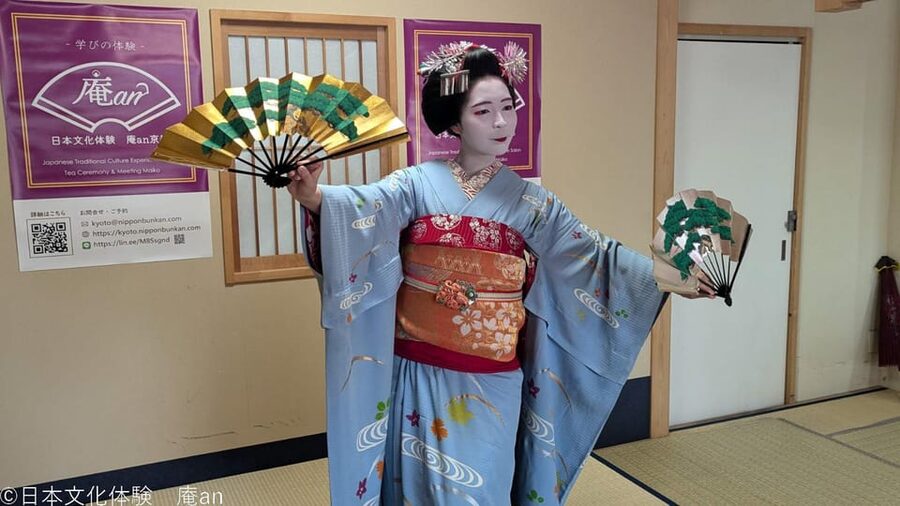
- Two dances are included: The Premium option adds traditional Maiko performances that express seasonal scenes, love stories, or everyday life.
- You make your own matcha: The Maiko demonstrates the process, then guides you as you whisk your tea with two Japanese sweets.
- The Q&A is a major highlight: You can ask about Maiko training, routines, kimono, hairstyles, and the path toward becoming a Geiko.
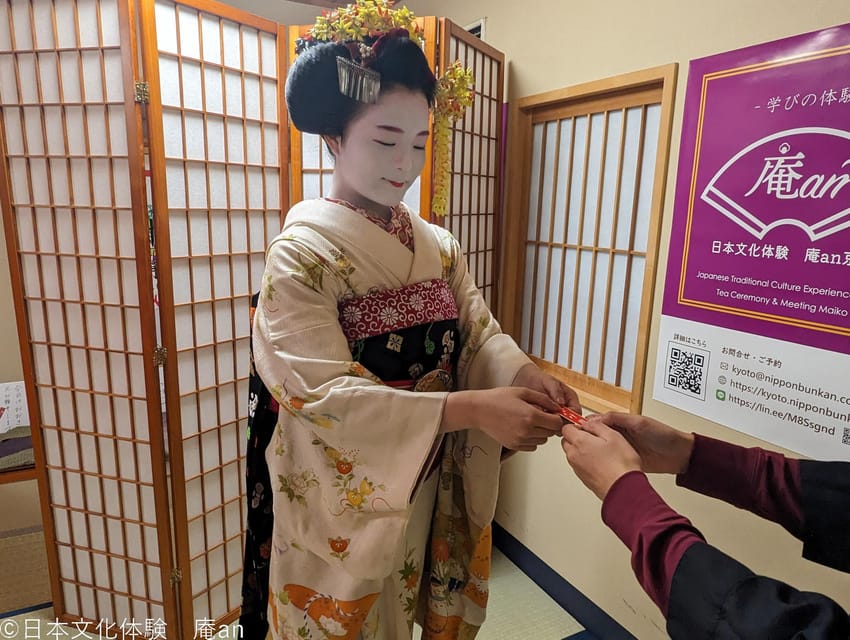
- Photos are taken up close: You receive a commemorative photo opportunity beside the Maiko, along with a Senjafuda lucky charm.
- The games make it social: Simple traditional games let volunteers interact with the Maiko while the rest of the room claps and cheers.
- The venue is practical but plain: It is one minute from Gojo Station, though you must use stairs and may see advertisements in the background of your photos.
Meeting a Maiko in Central Kyoto
The activity is held just one minute from Exit 1 of Gojo Station on the Subway Karasuma Line. The entrance faces Gojo-dori, so it is easy to find once you reach the main street.
That convenient location matters. You can fit the program between sightseeing in central Kyoto, and you do not need to make your way into the more confusing lanes of Gion. Arrive early, since the event cannot be held for people delayed by transport or late departures from another attraction.
The venue is inside a building rather than a traditional Japanese house. You will use stairs because there is no elevator. If you have limited mobility, contact the provider before booking and ask about the specific arrangements.
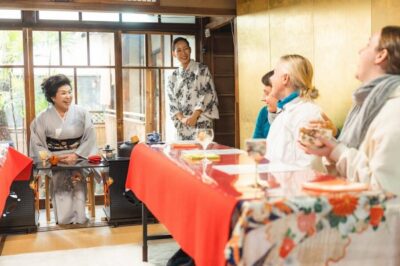
Inside, expect a relaxed room with tables and chairs. The Maiko sits at the front during the demonstrations and performances. It is a comfortable arrangement for a group activity, but it does not recreate the quiet formality of a tea room.
That difference is worth understanding before you pay. You are coming here to meet a Maiko and take part in several activities, not to experience a fully traditional tea ceremony in a historic house.
More Tea Ceremonies in Kyoto
- Kyoto: Tea Ceremony in a Traditional Tea House in Kiyomizu
★ 4.9 · 3,519 reviews - Kyoto: Tea Ceremony Ju-An at Jotokuji Temple
★ 4.9 · 3,207 reviews - Kyoto: 45-Minute Tea Ceremony Lesson Experience
★ 4.3 · 2,378 reviews
Why the Maiko Encounter Matters
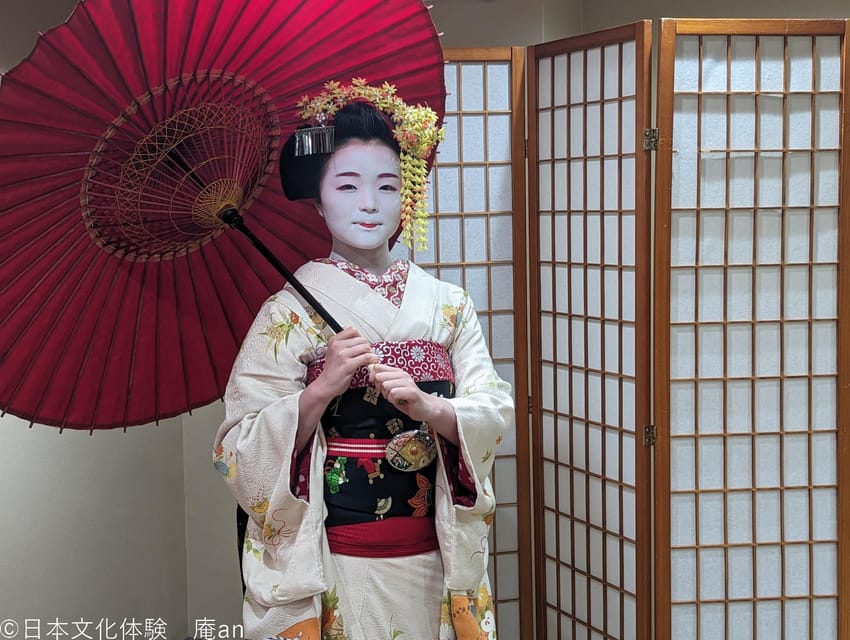
A Maiko is an apprentice entertainer in Kyoto’s traditional arts world. Her clothing, hairstyle, makeup, dance, music, and manners are part of a demanding way of life that continues today.
The experience gives you a personal point of contact with that tradition. Instead of simply seeing a costumed performer on a stage, you can ask questions and hear about her life directly. That conversation helps explain why the outfit, hair ornaments, and formal behavior matter.
The session can also include a Geiko instead of a Maiko. Several people have found this a pleasant surprise, but you should not book expecting one specific performer. Both are part of Kyoto’s traditional entertainment culture, yet the program may vary depending on the day.
The English support also varies. The instructor is Japanese, and English translation is provided as much as possible if requested. Some sessions have had a host who spoke both Japanese and English, while other groups relied more on translation. If detailed English explanations are important to you, contact the provider in advance.
Making Matcha and Eating Japanese Sweets
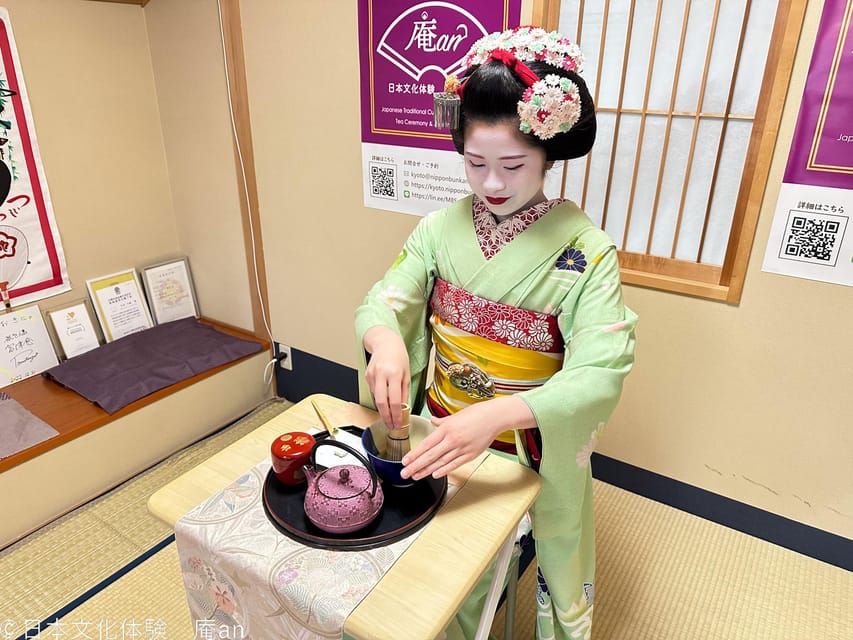
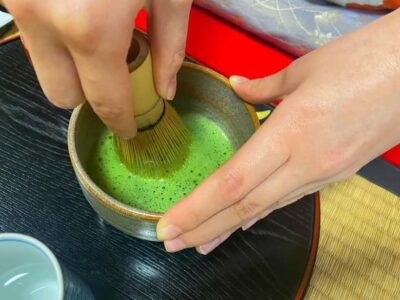
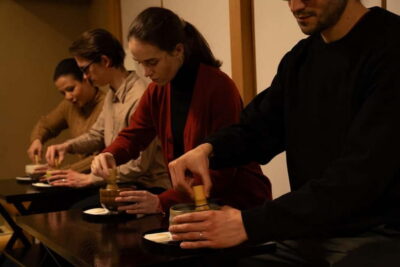
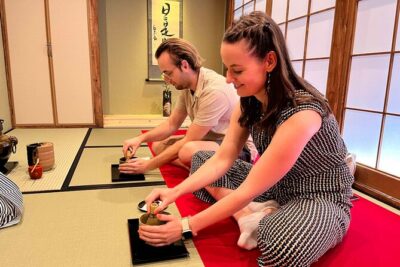
The tea portion begins with a demonstration. The Maiko shows you how to prepare matcha, explains what to do, and then gives you a chance to make your own bowl.
This is not a long, formal tea ceremony with every movement treated as a ritual. It is a basic, hands-on introduction designed for visitors. That makes it approachable, especially if you have never used a bamboo whisk or followed the standard order of preparing matcha.
You receive two dried Japanese sweets with the tea. Their sweetness helps balance matcha’s slightly bitter taste, and they give you a small taste of the customs surrounding Japanese tea.
I would set your expectations at an introductory level. The tea itself is ordinary matcha, and the focus is on participation rather than a connoisseur lesson. Still, making the tea yourself gives this part more value than simply watching someone prepare it.
You do not need special preparation. There is no requirement to know Japanese manners or tea ceremony rules before arriving. Follow the Maiko’s instructions, take your time, and do not worry about making a perfect bowl.
The Q&A: Ask About Life as a Maiko
The question session is one of the strongest parts of the Premium program. You can ask about training, daily routines, kimono, hairstyles, performances, and the transition from Maiko to Geiko.
One detail that has come up in the conversation is the length of the training process, with a five-year period mentioned. The Q&A helps you see that this is not simply a job involving beautiful clothing and dancing. It requires long-term dedication to traditional skills and behavior.
The quality of this section depends partly on your questions. Instead of asking only general questions about Kyoto, ask about the performer’s own routine and experiences. You might ask how she prepares for a performance, how long dressing takes, what she studies, or what part of Maiko life she finds most difficult.
The session is friendly rather than stiff. The Maiko may be accompanied by a host or translator who keeps the conversation moving. You are not limited to watching from a distance, which is a big reason this program feels more personal than a short stage show.
Keep in mind that it is still a group activity. You will share the Q&A with other people, so you may not get a long private conversation. Large groups can also affect the atmosphere, and one person found that noise from other participants distracted from the ceremony.
More geisha district walks in Kyoto:
- Kyoto Geisha Walking Tour: Gion District & Hidden Gems
★ 4.7 · 3,273 reviews - Kyoto: Gion Magical Night Walking Tour with Geisha Trivia
★ 4.9 · 2,393 reviews - Kyoto: Gion Geisha District Walking Tour – Stories of Geisha
★ 4.7 · 2,187 reviews - Best of Kyoto: Gion, Geisha, Pagodas & Cobblestones
★ 4.9 · 2,058 reviews
Two Dances Show the Maiko’s Formal Side
The Maiko performs two traditional dances. These dances can express the seasons, a love story, or scenes from ordinary life. The movements are controlled and graceful, with the kimono and hairstyle adding to the visual effect.
This is the moment when the room becomes quiet and focused. The dance gives context to the training you hear about during the Q&A. You are not only looking at the costume. You are watching a performer use precise movement, posture, and timing.
Many people consider the dancing the best reason to choose Premium. The Standard experience may not include the full combination of dances and games, while Premium brings the evening together as a fuller program.
The plain backdrop is the main weakness. The performance area is not arranged like a traditional stage, and several photos have included company advertisements, a name, or a QR code behind the Maiko. If you care about photography, ask where the cleanest angle is before the performance begins.
Even with that limitation, the dances remain the artistic heart of the experience. You may find the contrast interesting: a centuries-old style presented in a modern room near a subway station.
Photos, Senjafuda, and a Personal Keepsake
After the conversation, you have the chance to take a commemorative photo beside the Maiko. This is an up-close photo opportunity, not just a distant picture from your seat.
The provider also gives you a Senjafuda. This is a small traditional name card or charm associated with Japanese religious and entertainment customs. It makes a more distinctive souvenir than a standard printed ticket or generic gift.
Photography is allowed during much of the program, including the dance and presentation, but be considerate. Avoid blocking other people, and follow any instructions from the host about flash, video, or where to stand.
The background deserves attention. Promotional material may appear in photos, so frame your picture carefully. One useful approach is to take the official photo when invited, then take additional images during a moment when the Maiko is positioned away from the most noticeable signage.
Games Turn the Program Into a Shared Event
The interactive game is simple, lively, and often the most enjoyable part for families. Volunteers can play directly with the Maiko, while everyone else claps, watches, and encourages the participants.
You do not need to volunteer to enjoy this section. The game breaks up the quiet concentration of the tea demonstration and dance. It also gives the Maiko a chance to show the playful side of her hospitality.
Children can take part in the fun. The experience has worked well for families with young children, including children aged four and ten. Under-two children sitting on a parent’s lap are free, though a child needing a separate seat or meal is charged the same fee as one person.
The activity is not designed as a serious contest. The point is the shared laughter and interaction, although the Maiko’s professional skill may make her difficult to beat.
How the 90 Minutes Usually Unfold
The published schedule allows about 90 minutes from beginning to room departure. The main program runs for roughly 75 minutes, followed by about 15 minutes of chatting time after the Maiko leaves.
The order is generally:
- Greeting from the Maiko
- Matcha demonstration and hands-on tea preparation
- Two dried Japanese sweets and matcha
- Q&A session
- Photo opportunity
- Senjafuda presentation
- Two Maiko dances
- Interactive game
- Departure and informal chatting time
Some people have felt the active portion passed quickly, with the whole experience closer to 70 minutes. I would therefore avoid scheduling a train, restaurant reservation, or second tour immediately afterward.
The Maiko may leave after the formal program while you remain for a little extra conversation. If you arrive early, you might also see the Maiko arrive by taxi, and you can stay afterward to wave goodbye. That small moment adds a human touch, though it is not a guaranteed part of the program.
The event may take place alongside people having lunch or dinner. This means the room may not feel like a private cultural appointment. It can also create background noise, depending on the group and the day.
Is Premium Worth the Extra Cost?
The listed price is about $50 per person. For 90 minutes, that is reasonable if you want several activities in one compact Kyoto experience.
The value comes from the combination. You receive matcha, sweets, direct conversation, two dances, a game, a photo opportunity, and a Senjafuda. Paying for each element separately would be difficult, and the program saves you from arranging several cultural activities across different locations.
The Premium seat upgrades cost extra:
- SS seat, first row: 3,300 yen
- S2 seat, second row: 2,200 yen
- S3 seat, third row: 1,100 yen
The standard Premium price may be enough for many people. The Maiko is close enough for the Q&A and photo opportunity, and the room is not a huge theater. A front-row upgrade makes more sense if you care strongly about dance photography or want the clearest view.
The value is weaker if your main goal is an old-fashioned tea ceremony in a traditional room. In that case, the modern venue and basic tea preparation may disappoint. You are paying primarily for access to the Maiko, the performances, and the interaction.
Drinks beyond the included tea may be available for an additional charge. The included refreshments are limited to matcha, sweets, snacks, and the listed drink service, so do not arrive expecting a full meal.
Who Should Book This Experience?
I would recommend it to first-time visitors who want a clear introduction to Maiko culture without committing to a long or expensive evening.
It is especially suitable for:
- Families with children
- Visitors who want a cultural activity near a subway station
- People curious about Maiko training and daily life
- Anyone who wants a photo with a Maiko
- Visitors who prefer participation to a lecture
- Those with only 90 minutes available
It may not suit you if you want complete silence, a historic setting, or a private meeting. The room can be busy, the group may be large, and the backdrop is functional rather than beautiful.
You should also think about the cultural tone. The Maiko is a professional entertainer, and the experience is designed for an international audience. It offers a respectful introduction, but it is still a public program rather than an invitation into a private ochaya.
Booking and Practical Advice
You can cancel for a full refund up to eight days before the experience. After the cancellation period, fees apply, and changing the date or time may also cost extra. The provider does not cover your travel costs if you cancel or miss the event.
Reservations received after 5:00 p.m. are processed the following day. Operation hours for reservations are 10:00 a.m. to 5:00 p.m.
Plan to arrive about 15 minutes early. This gives you time to locate the entrance, climb the stairs, settle into your seat, and avoid losing part of the program. Late arrivals cannot expect the event to wait.
Only participants with reservations may enter. If you are booking for a child, remember that only children under two sitting on a parent’s lap are free. A separate seat requires the adult fee.
Ask for English translation when you book if you need it. The activity is conducted in Japanese, and English assistance is provided as much as possible rather than promised as a fully bilingual presentation.
Final Verdict: A Good Choice for Direct Cultural Contact
I would book the Kyoto Tea Ceremony with Maiko Premium if I wanted an easy, affordable way to meet a Maiko, ask questions, watch traditional dance, and take part in a few simple activities.
The strongest parts are the Q&A, the two dances, and the relaxed interaction during the game. Those elements turn a short tea demonstration into a fuller cultural program. The experience also works well for families and for anyone who wants a memorable photo without spending an entire evening.
I would skip it only if the setting matters as much as the performer. This is not a traditional tea house, and the advertising backdrop can spoil an otherwise beautiful photograph. Go in expecting a modern, organized cultural presentation rather than an intimate ceremony, and the $50 price feels fair.
FAQ
Where is the Maiko tea ceremony held?
It is one minute from Exit 1 of Gojo Station on the Subway Karasuma Line. The entrance faces Gojo-dori.
How long does the experience last?
The scheduled duration is 90 minutes. The main program lasts about 75 minutes, followed by chatting time after the Maiko leaves.
Is matcha included?
Yes. You receive matcha, instruction from the Maiko, and two dried Japanese sweets.
Can I make my own matcha?
Yes. The Maiko demonstrates how to prepare the tea, then you make your own bowl.
Is the performance always by a Maiko?
No. Depending on the situation, a Geiko may be invited instead of a Maiko.
Is English available?
The activity is conducted in Japanese. English translation is provided as much as possible if requested, so contact the provider in advance if you need translation.
Are children allowed to join?
Yes. Children under two sitting on a parent’s lap are free. If a child needs a separate seat or meal, the same fee as one person applies.
Is the building accessible by elevator?
No. There is no elevator, and you must use stairs to reach the venue.
Just added around Kyoto
- Kyoto: Gion Night Walking Tour with Geisha Insight★ 5.0 · 39 reviews
- Kyoto: Private Customizable Day Trip by Car★ 5.0 · 38 reviews
- Kyoto: Full Day Bike Tour★ 4.9 · 39 reviews
- Private Japanese Calligraphy in Kyoto – Learn Shodō with a Master★ 5.0 · 39 reviews
- Kyoto: Gion Evening Walk with Hidden Gems, Geisha & Sake★ 5.0 · 41 reviews
- Experience a tea ceremony in an authentic tearoom, in Kyoto!★ 4.5 · 41 reviews
- Kyoto Private Photo Shoot & Tour by SnapKyoto★ 5.0 · 41 reviews
- The Way of Tea: Kyoto Crafts, Hidden Temples & Wabi-Sabi Walk★ 5.0 · 41 reviews
Tea Ceremony Experiences, compared.
Tea Ceremony in a Traditional Tea House in Kiyomizu
Read our review →
Browse the lists this tour appears in