
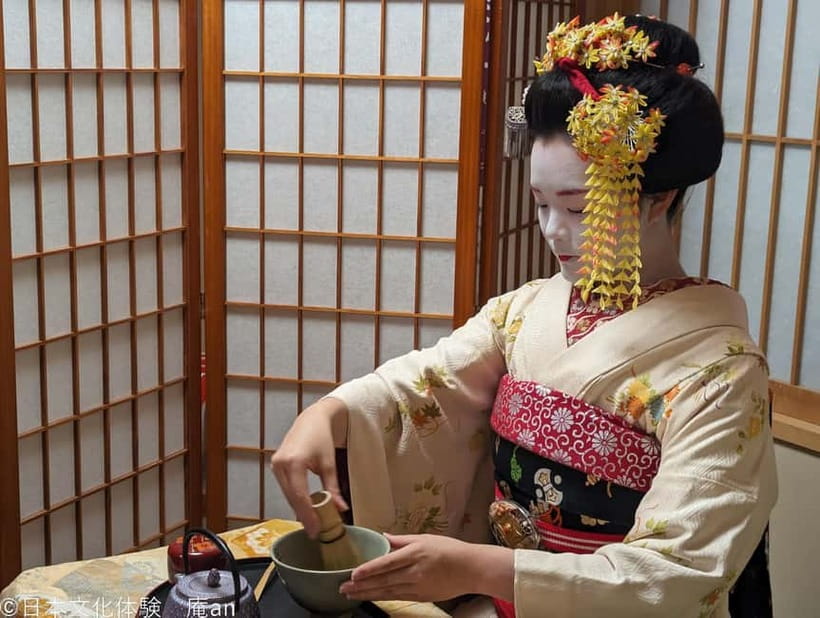
Reviewed · TEA CEREMONY EXPERIENCES
Kyoto: Tea Ceremony with Maiko
Kyoto can serve tradition in 45 minutes. This compact tea experience brings you close to a maiko, lets you prepare your own matcha, and includes a photo beside her. I especially like the direct question session and the easy location near Gojo Station. The main drawback is that the event takes place in a building rather than a traditional tea house, and English support may be limited.
You also receive two small dried sweets and a Senjafuda lucky charm to take home. The short schedule suits a busy Kyoto day, but you need to arrive on time because late arrivals cannot be accommodated or refunded.
In This Review
- Key points to know before booking
- Why this short Kyoto encounter works
- Finding the venue near Gojo Station
- The opening greeting and tea demonstration
- The Q&A is the most personal part
- A close photo and the Senjafuda gift
- What makes the value reasonable at $28
- The maiko or geiko may change
- Timing, language, and group comfort
- Cancellation and booking details that matter
- Who should book this Kyoto tea experience
- My call: book it for access, not ceremony
- FAQ
- How long does the tea ceremony experience last?
- How much does the experience cost?
- What is included in the price?
- Where is the meeting point?
- Is the venue a traditional tea house?
- Is there an elevator?
- Is the experience conducted in English?
- Will the host always be a maiko?
- Can children attend for free?
- What happens if I arrive late?
Key points to know before booking
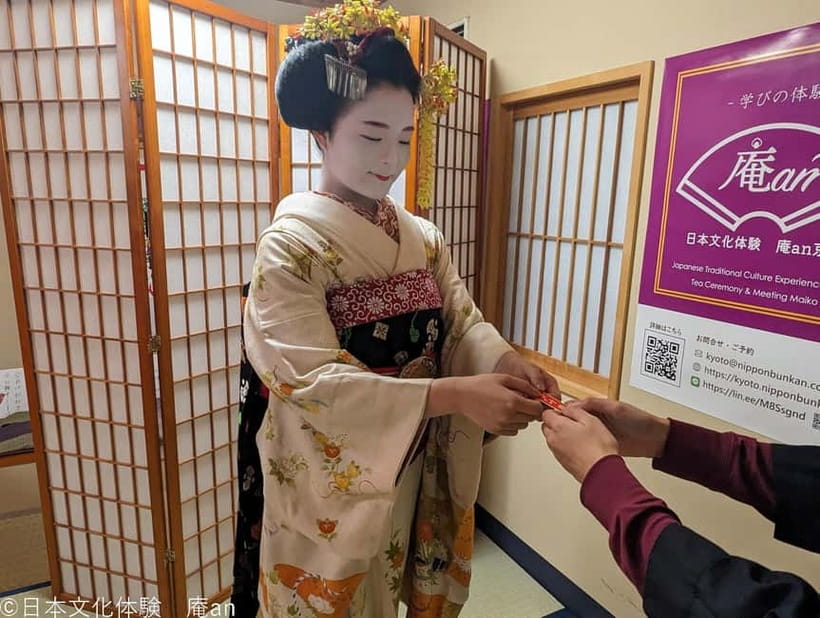
- Meet a maiko or possibly a geiko: The host may be a maiko or geiko, depending on the date.
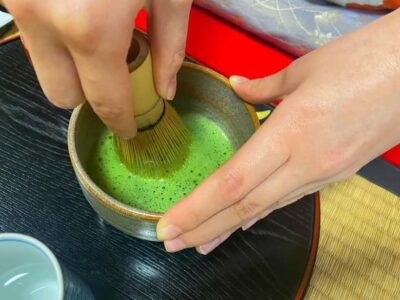
- Make your own matcha: You watch a demonstration, then whisk your tea yourself.
- Ask personal questions: The Q&A offers a more direct look at a performer’s daily life and training.
- Reach it quickly from Kyoto Station: Gojo Station is one subway stop area away, with the venue a one-minute walk from Exit 1.
- Leave with a keepsake: A Senjafuda charm is presented after the photo session.
- Expect stairs and possible translation help: There is no elevator, and English interpretation is offered as much as possible if requested in advance.
Why this short Kyoto encounter works
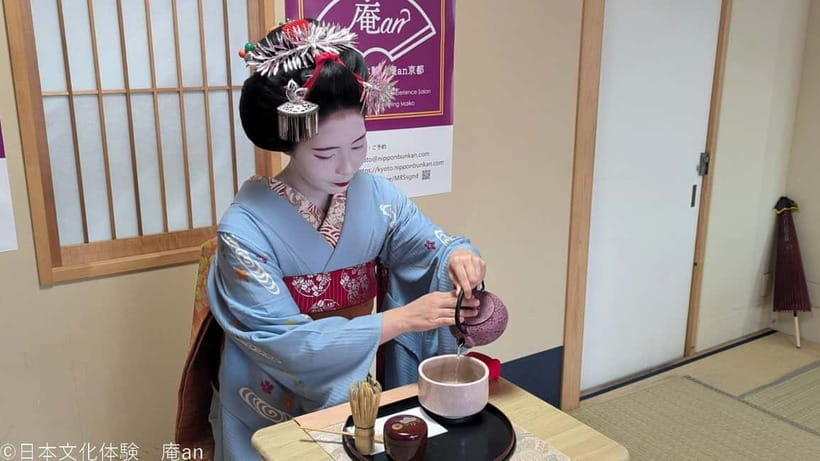
A maiko is a traditional Kyoto entertainer in training, recognized by formal clothing, elaborate hair ornaments, makeup, music, dance, and polite conversation. Meeting one in a planned setting gives you a chance to appreciate the person behind the costume without trying to approach someone on the street.
That matters in Kyoto. The city’s maiko culture is not a public performance available on every corner, and it is important to experience it respectfully. Here, you have a clear invitation to meet the performer, ask questions, and take a photograph together.
The program costs $28 per person and lasts about 45 minutes. I consider that a reasonable price if your main goal is a brief introduction to Kyoto’s tea customs and maiko culture. It is not a full afternoon in a traditional entertainment district, and you should not expect an elaborate private tea ceremony in an old wooden house.
The current rating is 3.5 out of 5 from 174 ratings, which suggests a mixed overall response despite many very positive individual experiences. The strongest praise centers on the maiko’s warmth, the chance to ask questions, the matcha preparation, and the smooth help from staff.
More Tea Ceremonies in Kyoto
- Kyoto: Tea Ceremony in a Traditional Tea House in Kiyomizu
★ 4.9 · 3,519 reviews - Kyoto: Tea Ceremony Ju-An at Jotokuji Temple
★ 4.9 · 3,207 reviews - Kyoto: 45-Minute Tea Ceremony Lesson Experience
★ 4.3 · 2,378 reviews
Finding the venue near Gojo Station
The meeting point is one minute from Exit 1 of Gojo Station on the Subway Karasuma Line. The entrance faces Gojo-dori, the main street, and this central location is one of the activity’s most useful features.
If you are coming from Kyoto Station, this is much easier than setting aside half a day for a distant cultural attraction. You can fit the session between a temple visit, lunch, and an evening reservation. The venue is also practical for anyone who wants a first taste of Kyoto culture soon after arriving.
Give yourself extra time to locate the entrance. The address can be easy to miss, especially if you are looking for a traditional tea house. One useful route is to leave through Exit 1, walk straight, cross a small street, and continue until you reach the location above the Carnival supermarket. You then go upstairs.
There is no elevator in the building. You need to use stairs to reach the venue, so this is an important consideration for anyone with mobility limitations or heavy luggage. The entrance is in a building, not an ochaya, or traditional Kyoto tea house. The room is described as relaxed and large enough for the activities, but the setting is functional rather than historic.
The opening greeting and tea demonstration
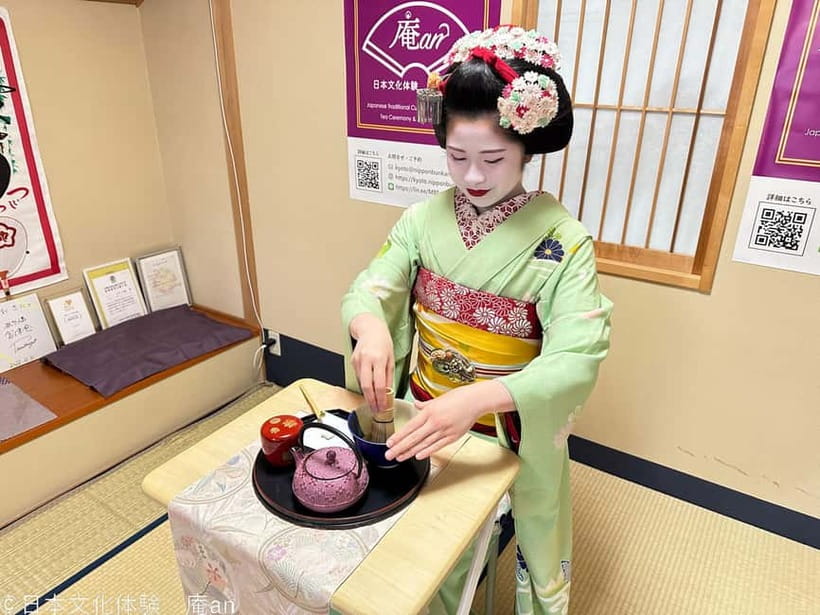
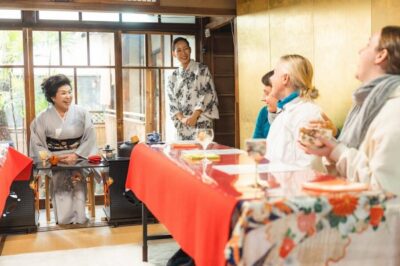
The program begins with a greeting from the maiko. This gives you a moment to settle in and see the details of her formal appearance at close range. You are not simply watching a distant stage performance. The central appeal is the personal setting.
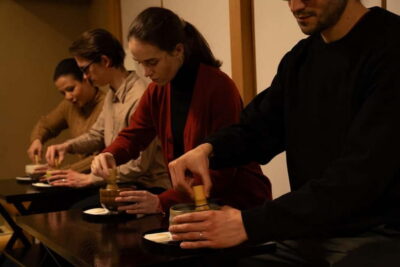
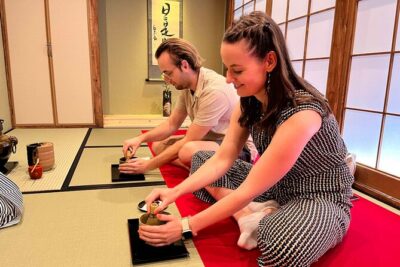
Next comes the tea ceremony. The maiko demonstrates how to prepare matcha and explains the basic procedure. You then make your own cup.
The hands-on part is simple enough for beginners. You do not need previous tea ceremony experience, special clothing, or advance preparation. The point is not to master every rule of formal Japanese tea practice in a few minutes. Instead, you get a practical sense of the gestures, tools, and care involved in making matcha.
The tea is served with two dried Japanese sweets called ohigashi. These are small, firm sweets designed to be eaten with matcha. They add sweetness before the slightly bitter tea and make the demonstration feel like a complete Japanese tea service rather than a standalone drink.
I like this part because it gives you something to do. A cultural presentation can become passive if you only sit and watch. Preparing the tea yourself makes the procedure easier to remember, even if your whisking technique is not perfect.
The Q&A is the most personal part
After the tea, you have a question and answer session with the maiko. This is where the program becomes more than a photo opportunity.
You can ask about her daily life and her path toward becoming a geiko. The exact questions will depend on the group, and the language of the experience is Japanese. English translation is provided as much as possible if requested, but you should contact the organizer ahead of time rather than assume full interpretation.
This language point deserves attention. Several particularly positive accounts describe an interpreter helping everyone understand the maiko’s answers. One experience with Maiko Masaya San was praised for making the tea lesson easy to follow, even though she answered in Japanese. The quality of translation can shape how much you gain from the Q&A, so make your language needs clear when booking.
The questions can also help you understand the difference between seeing a maiko in costume and learning about her work. You get a better sense of the discipline, public role, and transition toward becoming a geiko. The value is not just visual. It is the chance to hear directly from someone involved in this traditional profession.
Keep your questions respectful and focused. Ask about training, daily routines, performances, clothing, or the path from maiko to geiko. You should not treat the session as a chance to demand private information or turn the performer into a novelty.
More geisha district walks in Kyoto:
- Kyoto Geisha Walking Tour: Gion District & Hidden Gems
★ 4.7 · 3,273 reviews - Kyoto: Gion Magical Night Walking Tour with Geisha Trivia
★ 4.9 · 2,393 reviews - Kyoto: Gion Geisha District Walking Tour – Stories of Geisha
★ 4.7 · 2,187 reviews - Best of Kyoto: Gion, Geisha, Pagodas & Cobblestones
★ 4.9 · 2,058 reviews
A close photo and the Senjafuda gift
Around the 30-minute mark, the formal program ends and the photo portion begins. You can take a commemorative picture beside the maiko, close enough for a proper portrait rather than a distant snapshot.
This is a useful feature for families and first-time visitors who want a clear memory of the encounter. The chance to stand beside the performer also gives you a better look at the costume and styling than you would get during a public street sighting.
The organizer presents a Senjafuda after the photograph. A Senjafuda is a small paper name card or charm associated with Japanese religious and entertainment traditions. Here it functions as a lucky keepsake from the meeting.
The maiko then leaves the room, and you depart at about 45 minutes. The schedule is tidy, so you should not expect a long lingering session after the official activities finish.
What makes the value reasonable at $28
At $28, this is priced as a short introduction rather than a luxury cultural event. Your fee includes the tea ceremony with the maiko, two dried sweets, matcha, the photo opportunity, and the Senjafuda gift.
I think the price works best for three kinds of visitors. First, it suits anyone with limited time in Kyoto. Second, it works well for people who want a structured cultural activity without paying for a lengthy private ceremony. Third, it is a good choice if meeting a maiko directly matters more to you than visiting a formal tea school.
The value is less clear if you are seeking a traditional setting. The venue is in a building and not an old tea house, so the atmosphere will not provide the architecture, garden, or quiet formality that some visitors associate with Kyoto tea culture.
You should also keep your expectations in check about the word ceremony. You will learn the basic process and prepare matcha, but this is a short demonstration with a group. It is not presented as a full-length, highly formal tea ceremony with every traditional element.
The maiko or geiko may change
The host depends on the date. The event may be led by a maiko or a geiko, and the organizer does not guarantee the same type of performer for every session.
That difference may matter to you if you specifically want to meet a maiko. A maiko is still in training, while a geiko is an established professional. Both represent Kyoto’s traditional entertainment culture, but they are at different stages of the profession.
The safest approach is to book this for the cultural meeting itself, not for a guaranteed individual performer. If meeting a maiko rather than a geiko is essential, confirm the date details before paying.
The use of a named maiko can make the encounter feel more memorable. Maiko Masaya San received particular praise for her calm tea instruction and thoughtful responses. Still, performers can change, so treat any name connected with a particular date as information about that session, not a promise for yours.
Timing, language, and group comfort
The listed duration is 45 minutes, while the active program takes roughly 30 to 40 minutes. The final few minutes cover the photo, the Senjafuda presentation, and room departure.
That short length is a major advantage. You can plan around it without sacrificing a full temple visit or meal reservation. It also means the event stays focused, which helps if you are traveling with children or companions who are not committed tea ceremony enthusiasts.
Children who sit on a parent’s lap are free if they are under two years old. Children who need their own seat pay the same fee as one participant. That rule is worth checking before booking for a family.
The activity is conducted in Japanese. English translation can be added as much as possible if requested, but the supplied information does not promise full English interpretation at every session. If you want to understand the Q&A in detail, contact the organizer before the date.
You also need to arrive promptly. The event will not wait for delayed arrivals, and latecomers are not entitled to a refund. Avoid scheduling this immediately after a distant attraction or a train connection with no spare time.
Cancellation and booking details that matter
You can cancel up to eight days in advance for a full refund. Within seven days, changing the date or time brings a fee, and cancellation charges apply according to the stated policy.
Do not count on recovering your transportation costs if the activity is canceled. Also, people who are not participating cannot enter the experience area, so accompanying friends or family members need to be included in the reservation if they want to come inside.
Operating hours run from 10:00 AM to 5:00 PM. Reservations received after 5:00 PM are processed the following day. Starting times vary, so check availability before arranging the rest of your Kyoto schedule.
Who should book this Kyoto tea experience
I would choose this activity if you want a direct introduction to a maiko, a simple chance to make matcha, and a keepsake, all close to central Kyoto.
It is especially suitable for:
- First-time visitors who want a clear introduction to Kyoto traditions
- People with only a short window between other activities
- Couples and families looking for a memorable photograph
- Visitors curious about the maiko profession and life behind the formal appearance
- Beginners who have never prepared matcha
I would hesitate if you want an old wooden tea house, a private session, extensive English explanation, or a long ceremonial performance. The building is practical, the event is brief, and the language support may vary.
The strongest part is the personal contact. You can ask questions, make the tea, and speak with the performer rather than simply watch a staged display. The weakest part is the setting and the possibility that the session will not match a highly specific expectation of a traditional Kyoto ceremony.
My call: book it for access, not ceremony
For $28, this is a sensible short cultural stop near Gojo Station. I like the hands-on matcha lesson, the honest chance to ask about maiko life, the close photo, and the Senjafuda charm. The experience gives you a respectful, organized way to meet a maiko or geiko without trying to approach one in public.
Book it if you value personal contact and have limited time. Skip it if the old-house setting is the main reason you want a tea ceremony. Before committing, request English translation if needed, confirm whether the date is expected to feature a maiko or geiko, and leave enough time to find the upstairs venue.
FAQ
How long does the tea ceremony experience last?
The full experience lasts about 45 minutes. The main program finishes at around 30 minutes, followed by photos, the Senjafuda presentation, and room departure.
How much does the experience cost?
The price is $28 per person.
What is included in the price?
The price includes the tea ceremony with a maiko or geiko, matcha, two dried Japanese sweets, a photo opportunity, and a Senjafuda gift.
Where is the meeting point?
The venue is a one-minute walk from Exit 1 of Gojo Station on the Subway Karasuma Line. The entrance faces Gojo-dori.
Is the venue a traditional tea house?
No. The experience takes place in a building rather than an ochaya or traditional Japanese house.
Is there an elevator?
No. The building has no elevator, and you need to use stairs to reach the venue.
Is the experience conducted in English?
The instructor’s language is Japanese. English translation is provided as much as possible if you request it by contacting the organizer.
Will the host always be a maiko?
No. Depending on the date, the experience may be hosted by either a maiko or a geiko.
Can children attend for free?
Children under two years old who sit on a parent’s lap are free. Children who require their own seat pay the same fee as one participant.
What happens if I arrive late?
The event cannot be held for delayed arrivals. Latecomers are not entitled to a refund, so you should allow extra time to find the entrance and climb the stairs.
Just added around Kyoto
- Kyoto: Private Customizable Day Trip by Car★ 5.0 · 38 reviews
- Kyoto: Gion Night Walking Tour with Geisha Insight★ 5.0 · 39 reviews
- Kyoto: Full Day Bike Tour★ 4.9 · 39 reviews
- Private Japanese Calligraphy in Kyoto – Learn Shodō with a Master★ 5.0 · 39 reviews
- Kyoto: Gion Evening Walk with Hidden Gems, Geisha & Sake★ 5.0 · 41 reviews
- Experience a tea ceremony in an authentic tearoom, in Kyoto!★ 4.5 · 41 reviews
- Kyoto Private Photo Shoot & Tour by SnapKyoto★ 5.0 · 41 reviews
- The Way of Tea: Kyoto Crafts, Hidden Temples & Wabi-Sabi Walk★ 5.0 · 41 reviews
Tea Ceremony Experiences, compared.
Tea Ceremony in a Traditional Tea House in Kiyomizu
Read our review →
Browse the lists this tour appears in